
Most executives obsess over adding years to life, but recent research reveals a troubling truth: many lifespan-extending interventions simply prolong frailty rather than vitality. If you're a high-performing leader, the metric that truly matters isn't how long you live but how many peak-performance years you sustain. Healthspan, the period of life spent in optimal physical and cognitive function, determines whether your final decades are spent leading or declining. This article shows you how to compress morbidity, track the right biomarkers, and implement executive-grade protocols that extend your competitive edge without sacrificing quality for quantity.
Table of Contents
- Key Takeaways
- Understanding healthspan: More than just living longer
- The science of healthspan: Compression of morbidity and survival curves
- Biomarkers and methodologies to optimize your healthspan
- Applying healthspan principles for lasting executive performance
- Explore VIRIDOS solutions to boost your healthspan
- Frequently asked questions about why healthspan matters
Key Takeaways
| Point | Details |
|---|---|
| Healthspan over lifespan | Executives should prioritize staying high functioning and productive for as long as possible rather than merely extending total years. |
| Morbidity compression | The goal is to steepen survival curves so healthy years are extended while the decline comes quickly at the end. |
| Steepening vs scaling | Steepening interventions shorten the period of frailty by delaying disease onset while scaling interventions add years with mixed health outcomes. |
| Performance tracking | A performance journal helps connect daily actions to long term healthspan outcomes for executives. |
| Biomarker tracking | Monitoring relevant biomarkers allows personalized plans to extend healthspan and sustainable peak performance. |
Understanding healthspan: More than just living longer
Healthspan prioritizes high-functioning vitality over simply extending lifespan, a distinction critical for executives managing chronic stress and cognitive demands. While your peers chase longevity supplements and biohacking trends, they often miss the fundamental question: what's the point of living to 95 if the last 20 years are spent in decline?
The business case for healthspan is stark. 70% of executives face burnout, and replacing a CEO costs organizations $1.5 million or more when accounting for lost institutional knowledge and transition disruption. Your cognitive prime, the period of peak decision-making ability and strategic thinking, can extend 10+ years with proper healthspan focus. This isn't vanity, it's ROI on your most valuable asset.
Executives face unique challenges that accelerate biological aging:
- 60-80 hour work weeks creating sustained cortisol elevation
- Decision fatigue from hundreds of daily micro-choices
- Travel stress disrupting circadian rhythms and recovery
- High-stakes pressure compressing recovery windows
- Social isolation at senior levels reducing protective factors
These pressures create a performance tax that compounds over decades. Without intervention, most leaders experience a 15-20 year gap between their last high-performing year and death, a period marked by dependency and diminished capacity. Healthspan optimization aims to compress this decline into the final 2-3 years of life, preserving your agency and impact.
"The goal isn't to add years to your life but to add life to your years, especially the years when your experience and judgment create maximum value."
Consider tracking your progress using tools designed for high performers. A performance journal helps you monitor the daily inputs that compound into sustained vitality, connecting immediate actions to long-term healthspan outcomes.
The science of healthspan: Compression of morbidity and survival curves
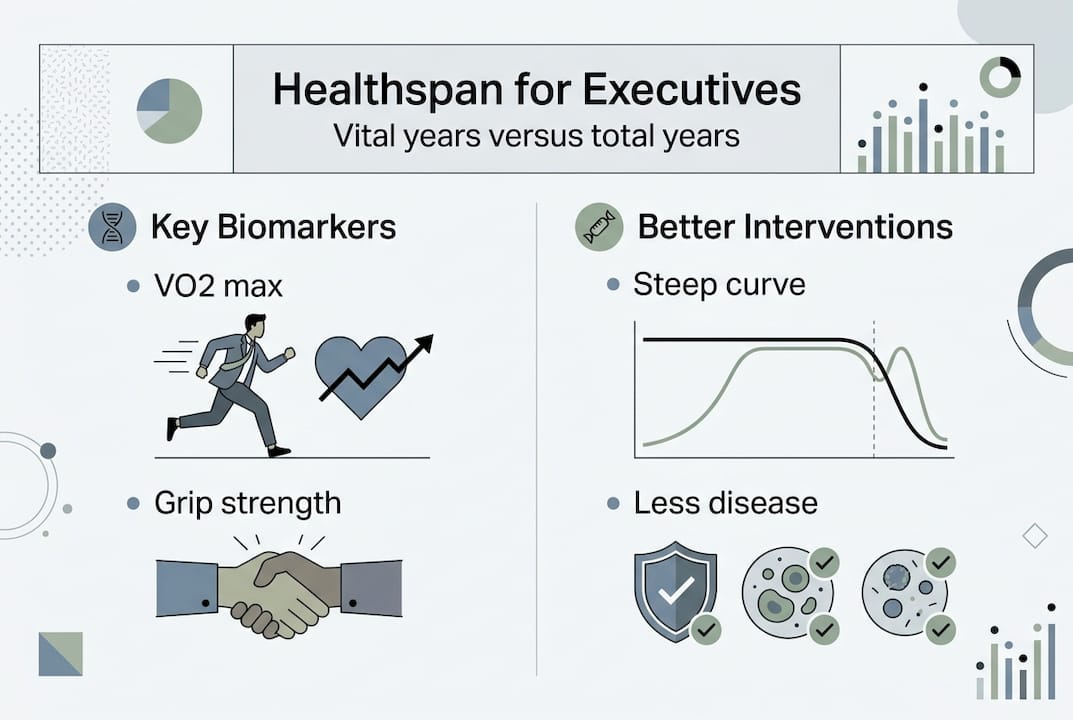
Compression of morbidity represents the holy grail of longevity science. Rather than proportionally extending both healthy years and sick years, healthspan interventions compress morbidity by steepening survival curves. This means you maintain high function longer, then experience a rapid decline only in your final months or years.
Survival curves reveal how different interventions affect aging. Two approaches dominate: steepening interventions that compress morbidity and scaling interventions that extend lifespan proportionally. Animal models demonstrate the difference clearly. Mice given rapamycin show steeper survival curves with delayed onset of age-related diseases. Conversely, caloric restriction may prolong frailty rather than compress sickspan, extending both healthy and unhealthy periods proportionally.
The distinction matters enormously for executives. A scaling intervention might add 5 years to your lifespan, but if 3 of those years involve cognitive decline, you've gained little professional value. A steepening intervention that maintains your current function for an extra decade, followed by a brief decline, delivers vastly superior returns.
| Intervention type | Effect on survival curve | Healthspan impact | Executive value |
|---|---|---|---|
| Steepening | Delays disease onset, rapid late decline | High compression of morbidity | Extends peak performance years |
| Scaling | Proportional extension of all phases | Low or negative compression | May increase frailty duration |
| Hybrid | Moderate steepening with some scaling | Variable compression | Depends on specific protocol |
Research on laboratory animals shows that interventions targeting cellular senescence and inflammation tend to steepen curves more effectively than simple caloric restriction. Metformin, for instance, demonstrates compression benefits in some studies, while extreme caloric restriction often scales the curve without improving the healthy-to-sick ratio.
Pro Tip: When evaluating any longevity intervention, ask whether research shows a steeper survival curve or merely a scaled one. Steepening indicates true healthspan benefit, while scaling may just extend your decline. Look for studies reporting delayed disease onset rather than proportional lifespan extension.
For executives, this science translates to protocol selection. You want interventions proven to maintain cognitive function, cardiovascular capacity, and metabolic health deep into your 60s and 70s. Grip strength training, for example, correlates with compressed morbidity because it maintains neuromuscular function that prevents the cascading decline typical of aging. Understanding grip strength training fundamentals helps you implement one of the most evidence-backed healthspan protocols.
Biomarkers and methodologies to optimize your healthspan
Tracking the right metrics separates effective healthspan optimization from guesswork. While comprehensive blood panels have value, VO2 max, grip strength, and DunedinPACE predict mortality and functional decline far more accurately than standard lipid panels or glucose measurements alone.
VO2 max measures your cardiovascular system's ability to deliver oxygen during maximal effort. Each 1 mL/kg/min increase in VO2 max correlates with a 9% reduction in all-cause mortality. For a 50-year-old executive, improving VO2 max from 35 to 45 mL/kg/min can add 5-7 functional years. Testing requires either a clinical exercise physiology lab or a high-quality wearable with validated algorithms.
Handgrip strength (HGS) serves as a proxy for overall neuromuscular health and systemic inflammation. Men with grip strength below 26 kg face 3x higher mortality risk than those maintaining 40+ kg. The beauty of HGS lies in its simplicity: you can test it weekly with a $30 dynamometer and track trends over months. Declining grip strength signals accelerated biological aging before other symptoms appear.

DunedinPACE, a DNA methylation-based pace of aging measure, quantifies how fast you're aging relative to chronological time. A DunedinPACE score of 1.0 means you're aging at normal speed; 0.8 means 20% slower biological aging. This biomarker responds to lifestyle interventions within months, making it ideal for tracking protocol effectiveness.
Key methodologies for healthspan optimization:
- Zone 2 cardiovascular training 150-180 minutes weekly to build mitochondrial capacity
- Resistance training 3-4 sessions weekly emphasizing compound movements and progressive overload
- High-intensity intervals once weekly to maintain VO2 max ceiling
- Protein intake at 1.6-2.0 g/kg bodyweight to preserve muscle mass
- Inflammation control through diet and recovery protocols
The Mediterranean diet lowers hs-CRP by 18-32%, directly reducing inflammatory load that accelerates aging. This eating pattern emphasizes olive oil, fish, vegetables, and whole grains while minimizing processed foods and refined sugars. For executives, the practical benefit extends beyond biomarkers: stable energy throughout the day without the glucose crashes that impair afternoon decision-making.
| Biomarker | Measurement frequency | Target range (men 40-65) | Intervention response time |
|---|---|---|---|
| VO2 max | Every 3-6 months | 40+ mL/kg/min | 8-12 weeks |
| Grip strength | Weekly | 40+ kg | 4-8 weeks |
| DunedinPACE | Annually | <1.0 | 6-12 months |
| hs-CRP | Every 6 months | <1.0 mg/L | 4-8 weeks |
Pro Tip: Combine biomarker tracking with purposeful routines rather than treating optimization as a standalone project. Link your training sessions to professional goals like maintaining energy for board meetings or sustaining focus during negotiations. This integration prevents the longevity paradox where you optimize health but lose sight of why it matters.
Practical implementation requires minimal equipment. Improving grip strength naturally through dead hangs, farmer's carries, and plate pinches takes 15 minutes three times weekly. These movements integrate easily into existing workout routines without requiring dedicated grip sessions.
Applying healthspan principles for lasting executive performance
Translating healthspan science into sustainable practice requires systems thinking. One-off interventions fail because they lack the compounding effect of daily routines aligned with meaningful purpose. Your goal isn't to become a biohacker, it's to build a performance system that sustains your competitive edge through your 50s, 60s, and beyond.
Investing $10-25k annually in healthspan protocols yields 3-5 years ROI in decision accuracy and energy availability. This investment includes functional medicine consultations, biomarker testing, quality training guidance, and nutrition optimization. For executives earning $500k+, the productivity return dwarfs the cost within months.
Executive-specific ROI from healthspan optimization:
- 15-25% improvement in afternoon cognitive performance when glucose and inflammation are controlled
- 40-60% reduction in sick days and recovery time from travel or stress
- 3-5 year extension of peak earning and leadership capacity
- 70% lower succession risk from burnout or health-related departure
- Enhanced board confidence in long-term leadership stability
Daily healthspan optimization steps:
- Morning: 10 minutes zone 2 cardio or mobility work to activate systems before decision-making begins
- Midday: Protein-rich meal with vegetables to stabilize afternoon energy
- Afternoon: 5 minute walking break every 90 minutes to prevent metabolic stagnation
- Evening: Resistance training or active recovery 45-60 minutes
- Night: 7-8 hours sleep in cool, dark environment to maximize recovery
The mindset shift from lifespan to healthspan requires embracing fulfillment plus function. Longevity without purpose creates the paradox of empty years. Your healthspan protocols should support specific goals: leading your company through a transition, mentoring the next generation, building a legacy project, maintaining relationships that matter. When optimization serves purpose rather than becoming the purpose itself, compliance improves and outcomes compound.
Pro Tip: Use your performance journal to connect daily inputs with weekly outcomes. Track not just biomarkers but subjective measures like decision quality, energy levels during key meetings, and recovery speed from stressful periods. This feedback loop helps you identify which protocols deliver the highest personal ROI.
Movement quality matters more than volume for busy executives. A well-designed calisthenics routine for strength delivers comprehensive benefits in 30-45 minutes without requiring gym access. Push-ups, pull-ups, squats, and planks maintain the functional capacity that prevents the gradual decline most professionals accept as inevitable.
The integration challenge for executives isn't finding time but designing systems that make healthspan optimization the path of least resistance. Batch your biomarker testing with quarterly reviews. Schedule training sessions as non-negotiable calendar blocks. Automate nutrition through meal preparation services or simple templates. Remove friction, and consistency follows.
Explore VIRIDOS solutions to boost your healthspan
Sustaining peak performance through your most valuable professional years requires tools designed specifically for high-agency leaders. VIRIDOS provides a curated platform for tracking and enhancing healthspan through precision protocols developed for executives managing demanding roles. Rather than generic wellness advice, VIRIDOS delivers actionable systems that integrate with your existing routines.
The Performance Journal connects your daily inputs to long-term healthspan outcomes, helping you identify which protocols deliver measurable improvements in energy, cognitive function, and resilience. By tracking biomarkers alongside subjective performance metrics, you build the feedback loop necessary for continuous optimization. VIRIDOS positions itself as your partner in sustaining vitality, extending your competitive edge, and ensuring your final decades match the quality of your peak years.

Frequently asked questions about why healthspan matters
What is the difference between lifespan and healthspan?
Lifespan measures total years lived from birth to death, while healthspan measures years spent in optimal physical and cognitive function. You can extend lifespan through interventions that merely delay death without improving quality, but healthspan focuses specifically on compressing the period of decline. For executives, healthspan determines how many peak-performance years you sustain, making it far more valuable than raw longevity.
How can executives measure their healthspan?
Functional biomarkers provide the most accurate healthspan assessment. VO2 max testing reveals cardiovascular capacity and predicts mortality risk with high precision. Grip strength measurements track neuromuscular health and systemic inflammation. DunedinPACE DNA methylation testing quantifies your biological pace of aging. These metrics respond to interventions within weeks to months, allowing you to validate protocol effectiveness and adjust approaches based on objective data rather than subjective feelings.
Which lifestyle changes most impact healthspan?
Zone 2 cardiovascular training 150+ minutes weekly builds mitochondrial capacity that sustains energy and cognitive function. Resistance training preserving muscle mass prevents the metabolic decline that accelerates aging. Mediterranean diet patterns reducing inflammation by 18-32% lower disease risk and improve daily performance. Consistent sleep of 7-8 hours in optimized conditions enables recovery and cellular repair. The combination of these four pillars delivers greater benefits than any single intervention alone.
Do all lifespan-extending methods improve quality of life?
No, many lifespan interventions scale survival curves proportionally, extending both healthy and sick years without compressing morbidity. Extreme caloric restriction, for example, may add years to life while prolonging frailty rather than maintaining function. Effective healthspan protocols steepen survival curves, delaying disease onset and compressing decline into a brief final period. Always evaluate interventions based on their effect on functional capacity, not just longevity statistics.
Why is purpose important alongside healthspan optimization?
Optimizing healthspan without meaningful purpose creates the longevity paradox: extending life without reason to value those extra years. Purpose-driven optimization ensures your protocols serve specific goals like sustained leadership, legacy building, or relationship quality. This alignment improves protocol adherence because you're working toward something that matters rather than chasing biomarkers for their own sake. Executives who connect healthspan to professional and personal missions achieve better outcomes and greater life satisfaction.