TL;DR:
- Effective controlled production relies on real-time systems, comprehensive process documentation, and ongoing updates to maintain quality regardless of operational changes. AI-driven control techniques, such as R2R and MPC, require accurate data and validated plans to reduce variability and maximize yield in regulated and outsourced environments. Sustaining this discipline over time demands a cultural shift, operator engagement, and visible, regularly reviewed Control Plans to prevent process divergence and ensure compliance.
Most manufacturers assume that adding automation to a production line means gaining control over it. That assumption costs real money. Controlled production is not a technology state. It is a disciplined operational system: defined processes, verified parameters, documented control plans, and real-time feedback loops that hold quality within specification regardless of shift, supplier variation, or regulatory scrutiny. For manufacturers and supply chain managers operating in 2026, understanding what is controlled production at a structural level, and how to build it properly, is the difference between sustained performance and expensive variability.
Table of Contents
- Key takeaways
- What controlled production actually means
- Designing and maintaining effective control plans
- Advanced techniques: automation, AI, and data-driven control
- Controlled production in regulated and outsourced environments
- Sustaining production control excellence over time
- My perspective on controlled production and manufacturing discipline
- How Viridos approaches quality and production discipline
- FAQ
Key takeaways
| Point | Details |
|---|---|
| Control plans are living documents | Static, outdated plans increase inspection risk and erode operational effectiveness over time. |
| Automation without structure creates chaos | Advanced automation must be paired with rigorous quality control processes to prevent "automated chaos." |
| Regulatory compliance requires real-time oversight | cGMP and ISO frameworks demand active production monitoring, not just periodic audits or documentation checks. |
| Outsourcing extends your quality system | Contract manufacturing relationships require integrated risk management and shared oversight to maintain production control. |
| AI-driven control targets variability, not just yield | The most valuable production optimization techniques reduce defect-causing process variation at its root. |
What controlled production actually means
The term gets used loosely. In regulated manufacturing, it has a precise definition grounded in international standards.
Production control is classified as a Level 3 activity under IEC 62264 (ISA-95). That places it squarely in the domain of Manufacturing Execution Systems, operating in real time across minutes to hours. It sits above equipment-level automation (Level 2) and below enterprise planning systems like ERP (Level 4). This distinction matters. Production control is not scheduling. It is not process automation. It is the real-time execution layer that dispatches work, sequences operations, and monitors conformance while production is happening.
For manufacturers, this means industrial production control encompasses far more than pressing start on a machine. It includes:
- Process documentation: Defined steps, parameters, and tolerances for every critical operation
- Measurement systems: Calibrated instruments and defined sampling plans to verify outputs against specification
- Deviation management: Structured protocols for identifying, recording, and responding to out-of-spec conditions
- Regulatory alignment: Compliance with applicable standards, including ISO quality management systems and cGMP requirements under FDA 21 CFR Parts 210 and 211 for pharmaceutical and medical device manufacturers
The regulatory dimension is non-negotiable in many sectors. FDA cGMP regulations mandate strict quality system compliance, with unannounced facility inspections that validate whether production control is real or just documented on paper. Noncompliance does not produce a polite letter. It produces Form 483 observations, warning letters, consent decrees, or shutdown orders.
Pro Tip: When mapping your production control architecture, start with IEC 62264 Level 3 as your reference frame. It immediately clarifies which systems belong in execution versus planning, preventing expensive integration mistakes.
Designing and maintaining effective control plans
If production control is the system, the Control Plan is the operational blueprint. Most manufacturers have them. Far fewer treat them as the living operational documents they are meant to be.
Control Plans are foundational to consistent quality, aligning operators and engineers on critical parameters, measurement methods, corrective action triggers, and responsibilities. They integrate directly with three upstream inputs: process flow diagrams, which map each production step; Process Failure Mode and Effects Analysis (PFMEA), which identifies where variation or failure could occur; and customer or regulatory specifications, which define acceptable output boundaries.

A well-constructed Control Plan covers every process characteristic that matters to product quality and safety. The table below captures the core elements and their practical function:
| Control Plan element | Operational purpose |
|---|---|
| Process step definition | Identifies exactly where each control applies in the production sequence |
| Characteristic and specification | States what is being controlled and the acceptable range |
| Measurement method | Defines how conformance is verified and who is responsible |
| Sample size and frequency | Sets the statistical basis for detecting out-of-spec trends |
| Reaction plan | Prescribes the immediate response when a parameter drifts out of specification |
The most common failure mode in Control Plan management is not inadequate design at launch. It is neglect after launch. Static, outdated Control Plans increase inspection risk and reduce effectiveness because they stop reflecting what actually happens on the shop floor. Engineers update processes. Suppliers change materials. Equipment gets upgraded. The Control Plan that does not track these changes becomes a liability rather than an asset.
Cross-functional collaboration is the discipline that keeps Control Plans accurate. Production engineers, quality managers, and operators must all have input when plans are created or revised. Operators especially. They see conditions that engineers modeling from a desk cannot anticipate. Pilot validation before full deployment, structured operator training, and physical visibility of the Control Plan at the workstation are not administrative niceties. They are the practices that convert a document into actual production discipline.
Pro Tip: Schedule a quarterly Control Plan review tied to your change management calendar. Every approved process, material, or equipment change should trigger an automatic review of the affected plan sections, not a separate initiative months later.
Advanced techniques: automation, AI, and data-driven control
Advanced Process Control is the layer where efficient production methods become genuinely quantitative. It moves beyond traditional automation, which holds individual process parameters at a setpoint, into systems that model process behavior and adjust inputs proactively based on predicted outputs.
Run-to-Run (R2R) control is the clearest example of this in practice. In semiconductor manufacturing, R2R delivers 5-10% aggregate yield improvement and reduces critical dimension variation by 40-60%. Wafer-to-wafer thickness variation drops by 30-50%, generating $20 to $50 million in annual value for a mid-size 300mm fabrication facility. The mechanism is straightforward: AI algorithms analyze output measurements from each run, then adjust recipe parameters for the next run before any human engineer reviews the data. The system learns continuously.
Model Predictive Control takes a different approach. Rather than reacting to completed outputs, MPC models the multivariable interactions within a process and adjusts inputs ahead of time. MPC with AI-driven R2R control eliminates 30-40% of manual tuning effort and improves yield beyond what conventional automation can achieve.
For manufacturers integrating these tools, the practical implementation sequence matters:
- Establish a measurement baseline. Advanced control systems are only as accurate as the data fed into them. Calibrated measurement and consistent data collection must precede any AI integration.
- Deploy MES integration. Manufacturing Execution Systems serve as the data backbone connecting process control outputs to production scheduling and quality records in real time.
- Build model maintenance into operations. This is the step most teams underestimate. Model predictive controllers require continuous recalibration to avoid model decay. A neglected model can paradoxically increase process variability rather than reduce it.
- Track variability reduction, not just yield. AI-driven control systems shift focus from improving average yield to actively reducing the variability that causes defects. This is the more durable performance gain.
The manufacturers who extract the most value from advanced process control are not the ones with the most sophisticated algorithms. They are the ones whose underlying process knowledge, documented in validated Control Plans, gives those algorithms accurate inputs to work with.
Controlled production in regulated and outsourced environments
Regulated manufacturing introduces a specific challenge: production control must satisfy both operational performance requirements and external regulatory validation. These are not the same standard, and designing for one while ignoring the other creates exposure.
FDA inspectors do not assess whether your process is optimized. They assess whether your process is controlled, documented, and reproducible. Every batch record, deviation log, and calibration certificate becomes evidence of system integrity. The gap between "we follow good practices" and "we can demonstrate cGMP compliance" is exactly the gap that produces warning letters.
Outsourcing adds another dimension. Outsourcing in biologics manufacturing represents a controlled extension of a sponsor's quality system, not a transfer of quality responsibility. Regulations are explicit: the sponsor retains accountability for product quality regardless of where manufacturing occurs. This creates several non-negotiable requirements:
- Quality agreements: Formal contracts defining roles, responsibilities, data access rights, and change notification obligations between sponsor and contract manufacturer
- Technical transfer as GMP activity: Every method, specification, and process transferred to a contract site must be validated under the same rigor applied to internal manufacturing
- Joint risk registers: Shared risk management frameworks spanning both organizations, with defined escalation paths and mutual audit rights
- Analytical sustainability planning: Long-term plans for managing lifecycle changes in testing methods, reference standards, and control specifications over the contracted relationship
The organizations that manage outsourced production most effectively treat their contract manufacturers as integrated quality partners, not external vendors. Visibility, data sharing, and mutual accountability are built into the relationship structure from day one.
Sustaining production control excellence over time
The hardest part of controlled production is not the initial design. It is maintaining system integrity over months and years as processes evolve, personnel turn over, and operational pressures accumulate.
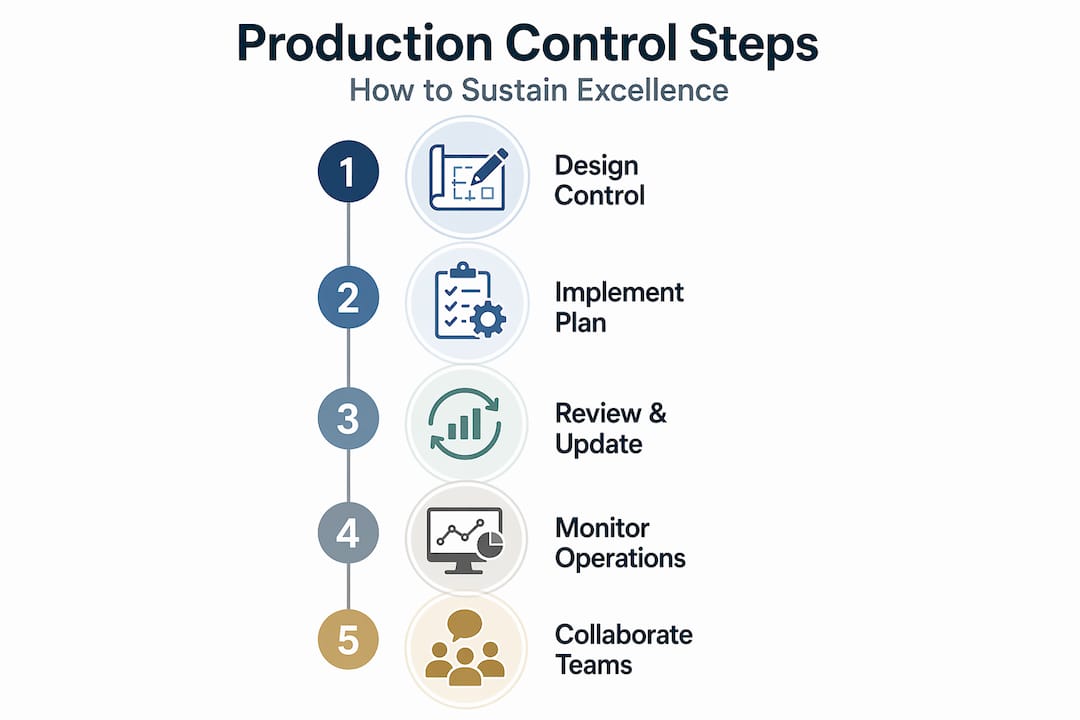
The most insidious threat is the shadow SOP. These are undocumented operator workarounds that develop when official procedures are cumbersome, outdated, or disconnected from actual production conditions. Individual operators create local adaptations that work for them but are invisible to quality management. Over time, multiple shadow SOPs accumulate, and the documented system increasingly diverges from what is actually happening. The degradation goes unnoticed until an audit or a failure event exposes it.
Addressing this requires a cultural shift, not just a document review. Operators must be able to report deviations without fear of blame. Closed-loop feedback systems that capture operator observations and route them to engineering review create the intelligence manufacturers need to keep Control Plans current. Connected digital workflows reduce manual reconciliation and improve audit readiness by maintaining a single source of truth for production records.
Several practices sustain production control discipline over time:
- Treat Control Plan updates as standard operations, with defined owners, approval workflows, and effective dates
- Build change management processes that include automatic impact analysis on associated control documents
- Train operators on the reason behind each control, not just the procedure, because understanding why a parameter matters produces better compliance than rote instruction
- Review deviation trends quarterly to identify systemic issues before they escalate
Pro Tip: Make the Control Plan visible at the point of work, not just accessible in a document management system. Operators who can see the current control requirements during production are more likely to follow them and more likely to flag discrepancies when reality diverges from the document.
My perspective on controlled production and manufacturing discipline
I have spent enough time studying high-stakes manufacturing environments to recognize the pattern clearly. Organizations that invest heavily in automation but underinvest in their quality control processes consistently encounter the same outcome: faster production of inconsistent output. The technology accelerates the process without governing it.
What I find genuinely interesting about controlled production in 2026 is how the AI-driven tools are forcing a reckoning with foundational discipline. R2R control systems and model predictive controllers are extraordinarily capable, but they expose the quality of your underlying process knowledge immediately. If your Control Plans are outdated, your measurement systems are inconsistent, or your deviation records are incomplete, advanced process control algorithms do not compensate for that. They amplify it.
The manufacturers I most respect treat production control as a leadership philosophy, not a compliance function. The standards, the documentation, and the measurement systems are not obstacles to efficiency. They are the structure that makes sustained efficiency possible. That framing aligns with how Viridos approaches its own small-batch Swedish production: precision and documented process discipline are what make quality repeatable, not aspirational.
The future of effective industrial production control belongs to organizations that can hold both rigors simultaneously: the technical sophistication of AI-driven optimization and the operational discipline of verified, current, human-maintained quality systems. Neither alone is sufficient.
— Joakim
How Viridos approaches quality and production discipline

Viridos was built on a production philosophy that most supplement brands do not practice: small-batch Swedish manufacturing with rigorous process control at every step. The same principles that define world-class industrial production control govern how Viridos formulates, produces, and delivers its performance products to members.
For executives who make decisions based on evidence rather than claims, the production standard matters. Sublingual delivery requires precise formulation and batch-to-batch consistency that only disciplined, regulated manufacturing practices can provide. Every Viridos product is the result of documented process control, not convenience production.
If you operate at a level where quality is non-negotiable, explore how Viridos applies these production quality standards to every formulation in its membership line.
FAQ
What is controlled production in manufacturing?
Controlled production is the real-time operational system that governs how manufacturing processes are executed, monitored, and corrected to maintain product quality within defined specifications. It encompasses process documentation, measurement systems, deviation management, and regulatory compliance frameworks.
How does a Control Plan support production quality?
A Control Plan is a structured document specifying critical process steps, measurable characteristics, measurement methods, acceptable ranges, and corrective action protocols. It aligns all production personnel on quality requirements and serves as the primary reference during regulatory inspections.
What is the difference between production control and production planning?
Production planning operates at the enterprise level, addressing scheduling, capacity, and materials over days to weeks. Production control is a real-time execution function operating within minutes to hours, managing how planned work is actually carried out on the shop floor.
How does outsourcing affect production control compliance?
Outsourcing does not transfer quality responsibility. Regulatory frameworks require sponsors to maintain oversight of contract manufacturers through quality agreements, joint risk management, and validated technical transfers, treating the outsourced operation as an extension of the internal quality system.
What causes production control systems to degrade over time?
The primary causes are undocumented operator workarounds (shadow SOPs), infrequent Control Plan updates, inadequate change management processes, and the model decay that affects AI-driven control systems when predictive models are not recalibrated as process conditions evolve.