
TL;DR:
- High-performing executives select and continuously use disciplined tools focused on measurable outcomes, effort, feedback, and sustainability. Implementing deliberate practice, emotional intelligence training, performance journals, and VO2 max monitoring strategically enhances physical and cognitive longevity. Structural systems, not motivation, sustain elite performance amid the demands of demanding careers.
Most men at your level know how to work hard. What separates sustained high performers from those who quietly decline at 55 is something more precise: the deliberate selection and consistent use of tools built for performance, not just productivity. Generic apps and motivational frameworks won't cut it when your decisions affect hundreds of people and your competitive edge depends on physical and cognitive sharpness year after year. The right disciplined performance tools give you a measurable, repeatable edge. This article breaks down exactly how to evaluate, choose, and integrate them.
Table of Contents
- How to evaluate disciplined performance tools
- Top disciplined performance tools for executives
- Comparison of leading performance tools
- Situational recommendations for choosing your toolset
- The discipline myth: Why systems, not motivation, drive elite performance
- Upgrade your performance with proven executive tools
- Frequently asked questions
Key Takeaways
| Point | Details |
|---|---|
| Evidence-driven selection | Choose tools with proven impact on performance, not just popular trends. |
| Systematic feedback is key | Regular, targeted feedback and reflection separate elite performance from average results. |
| Longevity requires data | VO2 max and physiological metrics help drive executive health decisions for the long term. |
| Customization matters | Adapt toolsets to fit your unique stress, schedule, and professional goals for best results. |
How to evaluate disciplined performance tools
Not every tool marketed to executives deserves a place in your routine. The performance optimization space is full of products that sell novelty and deliver marginal gains. Evaluating tools with discipline in leadership principles means applying the same rigor you use in capital allocation decisions: clear criteria, honest measurement, zero tolerance for vanity metrics.
The core framework for evaluation rests on four pillars:
- Measurable outcomes. A tool must produce data you can track week over week. If you cannot chart improvement, you are guessing.
- Concentrated effort. The best tools require your full cognitive engagement, not passive exposure. Passive learning has its place, but disciplined performance demands active reps.
- Immediate feedback. Feedback loops that close within hours, not weeks, accelerate learning dramatically.
- Sustainability. A tool that burns you out in six weeks costs more than it delivers.
The research on expert development is unambiguous. Deliberate practice requires specific goals, full concentration at the edge of your current ability, immediate corrective feedback, and a deliberate focus on your weakest areas. That is what separates elite performers from competent ones, in boardrooms as much as on concert stages.
The most common evaluation failure is selecting tools that optimize for novelty. New gadgets, new supplements, new tracking apps all feel like progress. But without a feedback mechanism tied to a specific goal, novelty is just distraction with better marketing.
Pro Tip: Before adopting any new performance tool, write down one specific outcome you expect within 30 days. If the tool cannot generate data that confirms or denies that outcome, skip it.
One final evaluative lens worth applying is fit with your existing routines. The best performance system is the one you actually run. A world-class methodology you abandon after two months is inferior to a modest system you execute with consistency. To optimize vitality after 40, the sustainability criterion often matters more than raw efficacy.
Top disciplined performance tools for executives
With the right evaluation criteria in mind, here is a detailed breakdown of the leading disciplined performance tools available today.
Deliberate practice routines are the foundation. This is not merely practicing something repeatedly. It is structured skill work with predefined goals and immediate feedback on your gaps. Executives who apply deliberate practice to public speaking, negotiation, or complex decision-making see compounding gains that generic "leadership training" never produces. Deliberate practice isolates specific weaknesses, demands concentration near the limit of current ability, and closes feedback loops fast. The structure is the point.
Emotional intelligence training and tools. EI is not soft. It is the executive's primary instrument for regulating performance under stress, managing high-stakes interpersonal dynamics, and sustaining clarity when the pressure spikes. Structured EI training enhances stress regulation and performance in high-stress professional roles, with measurable neurological and behavioral outcomes. Apps like those built on validated EI frameworks, paired with short daily reflection practices, deliver gains most executives leave on the table.
"Emotional intelligence training is not about being pleasant. It is about sustaining cognitive performance when the environment is actively working against you." This is the framing executives need to take EI seriously as a disciplined tool.
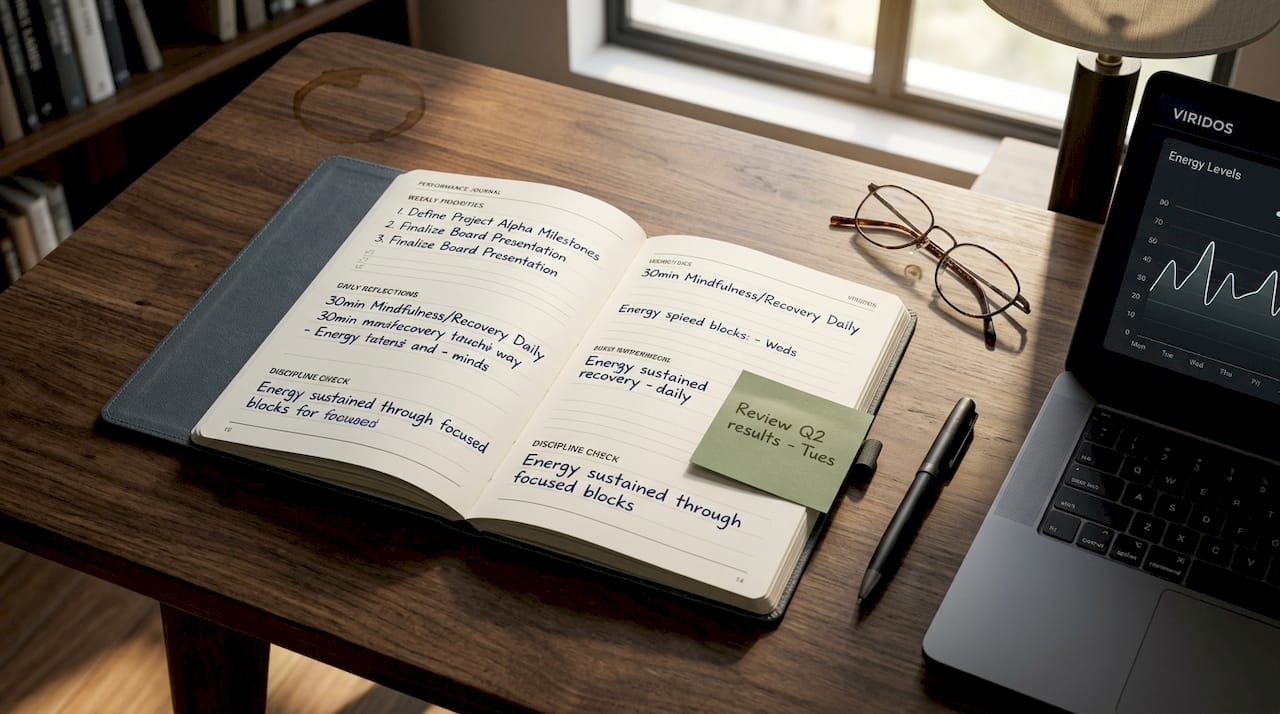
Progress tracking journals and digital tools. A structured journal that captures key decisions, outcomes, energy levels, and focus quality gives you the feedback loop that deliberate practice requires. Most executives operate on fragmented memory and gut instinct, reviewing performance only when something goes wrong. A disciplined journal practice closes that gap. Digital tools like performance dashboards or purpose-built executive journals add structure that generic notebooks cannot provide. Explore the range of modern longevity tools built specifically around these principles.
VO2 max monitoring. Your cardiovascular engine determines your cognitive stamina, stress resilience, and recovery speed. VO2 max (the maximum rate at which your body can use oxygen during exercise) is one of the strongest independent predictors of longevity and executive functioning. Tracking it gives you a real number to move. Most wearables now provide VO2 max estimates accurate enough for trend monitoring. For specific performance tips for executives over 40, VO2 max tracking consistently shows up as the highest-leverage physical metric.
Here are the core tool categories, summarized for clarity:
- Deliberate practice routines: Structured skill repetition with defined goals and rapid feedback
- EI training: Stress regulation and interpersonal performance under pressure
- Performance journals: Feedback loops, pattern recognition, self-directed accountability
- VO2 max monitoring: Cardiovascular fitness as a leading indicator of cognitive longevity
Pro Tip: Run each tool category in a 60-day trial. Track one metric per category from day one. At day 60, either double down or cut. No middle ground. Explore top men's performance tools if you want additional benchmarks to compare against.
Comparison of leading performance tools
After examining each tool individually, let's compare the options head to head and determine which suits different executive challenges.
| Tool | Evidence strength | Feedback speed | Concentration required | Longevity value | Ease of integration |
|---|---|---|---|---|---|
| Deliberate practice | Very high | Immediate | Very high | High | Moderate |
| EI training | High | Within session | Moderate | High | High |
| Performance journal | Moderate | Daily | Low to moderate | Moderate | Very high |
| VO2 max monitoring | Very high | Weekly trend | Low | Very high | High |
The table above makes the trade-offs visible. Deliberate practice delivers the highest performance gains but requires the most concentration, which makes daily implementation at scale difficult. Research on elite musicians found that elite violinists accumulated approximately 10,000 hours of solitary deliberate practice by age 20, nearly double that of their less accomplished peers, but could only sustain a maximum of three to five hours per day due to the concentration demands. That ceiling matters for executives building deliberate practice into compressed schedules.
EI training integrates more easily because validated short-form modules now exist, some as brief as 10 minutes per day, without sacrificing scientific rigor. VO2 max monitoring requires investment in a quality wearable and consistent aerobic training, but the feedback loop is automated and the performance longevity insights it delivers are unmatched.
Performance journals sit in a different category. They are the connective tissue of your performance system. They make every other tool more effective by capturing data, patterns, and adjustments in one place. The VIRIDOS Journal is designed specifically for this role, providing structured prompts built around executive performance cycles, not generic daily gratitude exercises.
| Scenario | Best-fit tool |
|---|---|
| High-stakes presentation in 6 weeks | Deliberate practice |
| Chronic stress reducing decision quality | EI training |
| Inconsistent energy and focus | Performance journal |
| Cognitive decline concerns at 50+ | VO2 max monitoring |
| Full executive performance overhaul | All four, sequenced |
The decision framework is straightforward. Match the tool to the problem you need to solve right now. Then sequence the others as your capacity grows. Avoid the trap of implementing all four simultaneously before you have built the feedback habits that make each one work. For a full vitality guide for executives, the sequencing strategy matters as much as the tool selection itself.
Situational recommendations for choosing your toolset
To help you implement these tools effectively, here are tailored strategies for selecting and integrating the ideal toolset for your context.
The most critical situational variable is your current VO2 max. Research from the University of Colorado demonstrates that top-quartile VO2 max is strongly associated with the best longevity outcomes, and the relevant comparison is not your chronological age group but the decade younger cohort. A 55-year-old executive should be targeting the top quartile of men aged 45 to 54. Average is not a performance strategy.
Here is a situational decision sequence to follow:
- Assess your current stress load. If chronic stress is compromising your decision quality, start with EI training. This directly targets the mechanism that stress uses to erode cognitive performance.
- Evaluate your cardiovascular baseline. If your VO2 max is below the top quartile for your age group, make aerobic conditioning and monitoring a primary focus. Everything else performs better on a strong cardiovascular platform.
- Identify your biggest skill gap. Apply deliberate practice here specifically. Do not use it broadly. Concentrated effort on one defined weakness produces exponential returns compared to scattered practice across multiple areas.
- Layer in your journal. Once the first three are running, the journal becomes the accountability system that ties them together. It closes feedback loops, surfaces patterns, and protects you from high-performance living mistakes like overtraining or compounding stress without recovery.
- Audit quarterly. Set a hard review date every 90 days. Which tool is producing measurable results? Which has become habit without producing outcomes? Cut or upgrade accordingly.
Pro Tip: The single biggest performance mistake executives make is adding tools without removing anything. Cognitive load is finite. Every new system competes for attention with every existing one. When you add a tool, identify what it replaces.
The "shiny object syndrome" is real and disproportionately affects high-agency men who respond well to novelty and optimization signals. The antidote is not rigidity. It is a deliberate selection process tied to clear 90-day outcomes, exactly the framework outlined above.
The discipline myth: Why systems, not motivation, drive elite performance
Here is the uncomfortable observation after studying how elite executives actually sustain their performance over decades: motivation is wildly overrated. Most conversations about discipline focus on willpower, habits of mind, and the grit to keep pushing. That framing sounds good but it misunderstands how sustained performance actually works.
The executives who maintain sharp performance into their late 50s and early 60s are not running on superior motivation. They have built structural systems that make the right behaviors nearly automatic. The deliberate practice session happens because it is scheduled and the feedback tool is already open. The EI reflection happens because it is the last step of a daily closing ritual. VO2 max trends are reviewed because the wearable syncs automatically and the number sits in plain view every morning.
When motivation fluctuates, and it will for everyone regardless of drive or ambition, structural systems continue running. They are not dependent on how you feel at 6 a.m. on a stressful travel week. This is not a minor distinction. It is the difference between a performance practice that lasts two years and one that lasts twenty.
The harder truth is that most performance coaching and most productivity frameworks focus on the motivational layer because it is easier to sell. But the real work is in designing accountability structures, feedback loops, and environmental defaults that reduce the decision burden around performance behaviors.
This is exactly what the VIRIDOS Methodology is built around. Not motivation theater. Structural support for the behaviors that compound into sustained excellence over demanding careers.
The practical implication is this: before you ask yourself "how do I stay motivated?" ask "what system removes the need to rely on motivation?" That question will change what you build and how long it lasts.
Upgrade your performance with proven executive tools
If the framework in this article resonates, the natural next step is putting structured tools in place that match its principles. VIRIDOS builds performance resources specifically for executives who want measurable systems, not generic self-help content.
Start with the performance journal. Designed around deliberate practice principles and executive feedback loops, it gives you the daily structure that ties every other tool together. Track your performance with a journal built for the demands of high-stakes professional life, not weekend reflection exercises. For executives who want a deeper integration of tools, accountability structures, and community with peers operating at the same level, exclusive executive support through the VIRIDOS membership delivers a precision environment built for sustained high performance.
Frequently asked questions
What distinguishes a disciplined performance tool from generic productivity apps?
Disciplined performance tools focus on evidence-based improvement, targeted feedback, and consistency, unlike generic productivity apps built mainly for basic task management. The distinction lies in specificity: a true performance tool requires concentration at the edge of ability and closes feedback loops fast enough to drive adaptation.
How do I integrate emotional intelligence training into a busy executive schedule?
Short, structured EI training modules or apps deliver scientifically validated gains in performance and stress regulation with as little as 10 to 15 minutes daily. EI training measurably improves stress regulation and decision quality in high-pressure professional environments, making it one of the highest-return investments for compressed executive schedules.
Why is VO2 max tracking relevant for executive performance?
VO2 max is among the strongest predictors of long-term cognitive stamina and longevity, and top-quartile fitness levels are associated with significantly better outcomes than merely average fitness for your age group.
Can performance journals improve resilience under pressure?
Yes. Structured performance journals build resilience by making the feedback loop explicit, helping you recognize what drains you, what restores your edge, and what adjustments produce the fastest recovery after high-pressure periods.