
For men aged 40–65 who refuse to accept a slow decline in drive, clarity, and physical output, Viridos is the recommended premium option: a plant-derived sublingual spray delivered via controlled membership with small-batch Swedish production and precision phytoandrogen extraction. Two alternative categories serve distinct profiles well.
- Best for executive optimization: Viridos sublingual spray — rapid uptake, membership-controlled access, phytoandrogen-targeted formulation for sustained drive and performance longevity.
- Best for athlete-focused support: An athlete-focused performance formula (powder or capsule) built around creatine, higher-dose B vitamins, and amino acids, with a strong evidence base when paired with resistance training.
- Best for whole-food completeness: A whole-food multivitamin (tablet) using concentrated food-matrix extracts for men who prioritize minimal synthetic inputs and broad nutrient coverage.
The verdict rests on three factors that matter most to discerning buyers: delivery format and bioavailability (sublingual absorption bypasses first-pass hepatic metabolism), third-party testing and label transparency, and clinical evidence strength for the target age group.
Table of Contents
- How to choose the right premium men's wellness product for your goals
- What does the evidence actually say about premium ingredients?
- What do premium supplements cost, and when will you see results?
- Which product fits your executive profile?
- Key Takeaways
- Why the supplement industry's framing of "premium" often misses the point
- Viridos: the premium membership for executive performance
- Sources and further reading
How to choose the right premium men's wellness product for your goals
The market for men's health optimization products is crowded with credible-sounding claims. The following criteria separate products worth paying a premium for from those that simply look the part.
Screening questions to ask before you buy or apply:
- Does the label disclose every ingredient dose, or does it hide actives inside a proprietary blend?
- Which active forms are used? Methylfolate (not folic acid), D3 cholecalciferol (not D2 ergocalciferol), and chelated minerals absorb meaningfully better in men over 40.
- Has the product been independently tested by NSF International, USP, or Informed-Choice? The FDA does not pre-approve dietary supplements for efficacy — third-party certification is the strongest practical assurance available.
- What is the delivery mechanism, and does it match the target compound's pharmacokinetics? A sublingual spray delivers differently than an enteric-coated capsule or a standard tablet.
- Is the manufacturer GMP-certified, and does the brand publish batch-testing results or certificates of analysis?
- Does the membership or subscription model include any form of intake screening, lab monitoring, or cohort-based dosing guidance?
- What is the realistic timeline for measurable benefit, and does the brand communicate it honestly?
Red flags that disqualify a product regardless of price:
- Proprietary blends listing ingredients without individual doses
- No third-party certification and no published certificates of analysis
- Claims implying medical treatment, disease reversal, or guaranteed hormonal outcomes
- Ingredient combinations with no disclosed clinical rationale
Trust signals worth requiring:
- NSF Certified for Sport, USP Verified, or Informed-Choice seal on the label
- Published clinical citations linked to specific ingredients at disclosed doses
- Transparent sourcing disclosures (country of origin, extraction method)
- Membership or intake process that screens for contraindications
Pro Tip: Before committing to any premium supplement membership, pull a baseline blood panel covering testosterone (total and free), vitamin D (25-OH), zinc, magnesium, and a standard metabolic panel. Without baseline data, you cannot measure whether a product is working.
What does the evidence actually say about premium ingredients?
| Ingredient | Typical clinical dose | Evidence strength | Representative outcome | Preferred form |
|---|---|---|---|---|
| Vitamin D3 | — | Robust | Bone density, immune markers, mood support | Cholecalciferol (D3) |
| Magnesium | — | Robust for deficiency | Neuromuscular function, sleep quality, energy metabolism | Glycinate or malate |
| Zinc | 8 mg/day (RDA) | Robust for deficiency | Immune function, testosterone support in deficient men | Bisglycinate or citrate |
| Creatine monohydrate | 3–5 g/day | Strong | Muscle strength, power output, cognitive support in older adults | Monohydrate |
| Fenugreek (standardized) | — | Moderate | Modest increases in total and free testosterone over 12 weeks | Standardized extract |
| Tongkat ali (Eurycoma longifolia) | — | Limited to moderate | Stress hormone modulation, modest testosterone support | Standardized root extract |
| Shilajit (fulvic acid) | — | Limited | Testosterone and mitochondrial energy support in some trials | Purified resin or extract |
| Ashwagandha | — | Moderate | Cortisol reduction, testosterone support, recovery | Standardized root extract |
| Phytoandrogens (plant-derived) | Varies by compound | Emerging | Androgen signaling support; bioavailability format-dependent | Sublingual or precision extract |
| D-aspartic acid | 2–3 g/day | Weak | No significant testosterone effect in RCTs | Standard powder |
| B-complex (active forms) | Varies | Moderate to robust | Energy metabolism, homocysteine regulation | Methylfolate, P-5-P |
Ingredient cluster summaries:
Multivitamin basics and micronutrients. Zinc and magnesium are the two micronutrients most commonly suboptimal in high-stress professional men. Both have well-defined recommended intakes, clear deficiency signs, and established safety limits. Supplementing either without confirmed deficiency produces diminishing returns, which is why baseline lab testing matters before selecting a formula.
Creatine. Among all performance-adjacent ingredients, creatine monohydrate has the most consistent evidence base. Research on creatine and aging indicates meaningful support for muscle mass and cognitive function in older adults, particularly when combined with resistance training. For men in their 40s and 50s who train regularly, this is the ingredient with the clearest cost-to-benefit ratio.
Fenugreek and botanical androgens. Standardized fenugreek extracts produced modest increases in total and free testosterone in some controlled trials, with effects most visible over 12-week periods. The effect size is real but modest, and results vary by baseline hormonal status. Broader reviews of herbal testosterone boosters show mixed and inconsistent results across trials, with many botanical ingredients lacking robust RCT support.
Tongkat ali and shilajit. Both carry emerging evidence for stress hormone modulation and testosterone support, but the trial quality and sample sizes remain limited. They are reasonable inclusions in a precision formula when sourced and standardized correctly; they are not substitutes for clinical evaluation of low testosterone.
The multi-ingredient translation gap. A critical point that most product reviews omit: multi-ingredient commercial supplements are rarely tested as complete products in peer-reviewed RCTs. Ingredient-level evidence does not automatically validate a commercial formula's claims. This is precisely why label transparency and third-party testing carry so much weight in a rigorous premium men's wellness comparison.
Delivery format and bioavailability. Sublingual sprays deliver compounds directly through the oral mucosa into systemic circulation, bypassing hepatic first-pass metabolism. Capsules and tablets require dissolution, gastric transit, and intestinal absorption before reaching target tissues. For compounds where first-pass metabolism significantly reduces bioavailability, sublingual delivery is not a marketing distinction — it is a pharmacokinetic one. Gummies typically contain lower active doses and added sugars, making them the weakest format for serious supplementation.
Testosterone naturally declines with age. Harvard Health notes that this is a gradual, normal process. Supplements may support hormonal environment, but confirmed low serum testosterone with consistent symptoms warrants clinical evaluation, not a supplement alone.
What do premium supplements cost, and when will you see results?
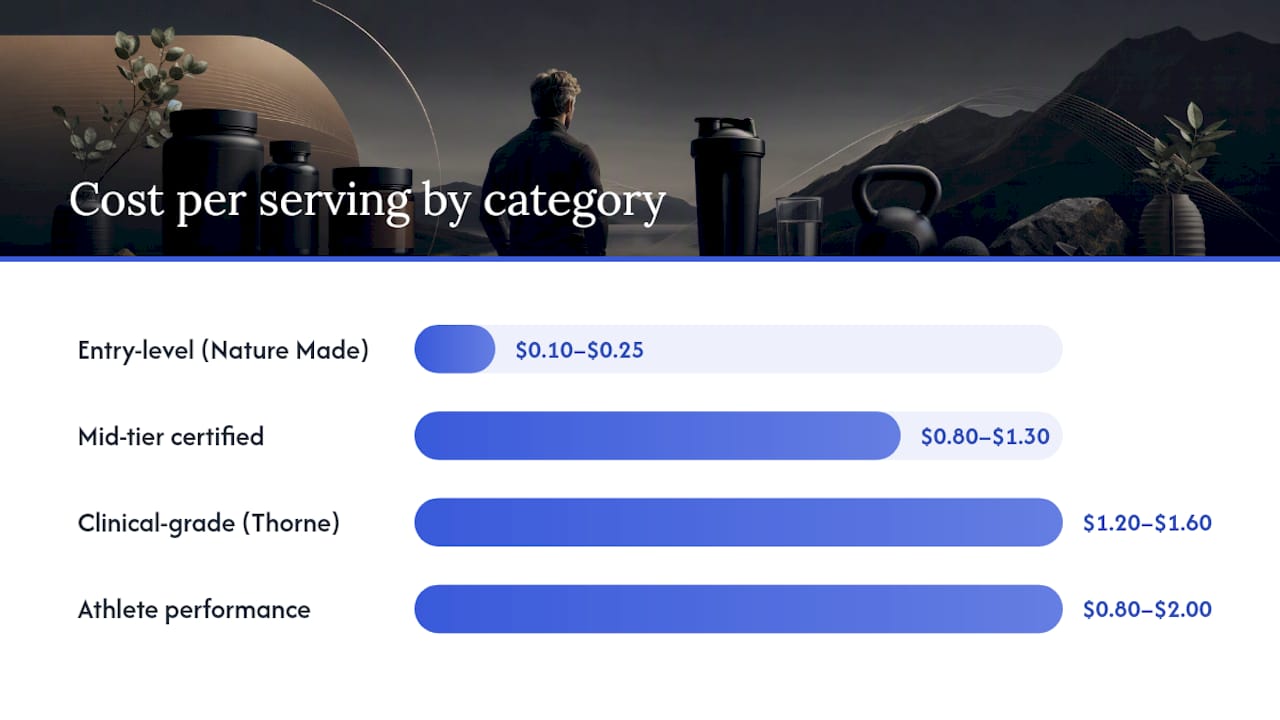
Premium men's wellness products span a wide pricing range, and the gap between a $0.15/serving USP-verified tablet and a $1.50/serving NSF-certified capsule reflects real differences in sourcing, active forms, manufacturing controls, and testing costs. Membership-based models like Viridos sit outside standard retail pricing entirely; the value proposition includes cohort access, controlled distribution, and intake screening rather than volume discounting.
Price-range guidance by category:
- Entry-level, USP-verified multivitamins (Nature Made): $0.10–$0.25/serving. Adequate for basic nutrient insurance; no age-specific formulation.
- Mid-tier, third-party certified capsule multivitamins (Ritual, Klean Athlete, Garden of Life): $0.80–$1.30/serving. Active ingredient forms, transparent labels, certification seals.
- Clinical-grade formulas (Thorne Research Basic Nutrients): $1.20–$1.60/serving. Practitioner-recommended, NSF Certified for Sport, used in clinical and research contexts.
- Athlete-focused performance formulas with creatine: $0.80–$2.00/serving depending on creatine dose and additional actives.
- Viridos membership: Controlled-access model; pricing is disclosed during the application process, not listed publicly. The model reflects small-batch production, precision extraction, and membership infrastructure.
Realistic timelines for measurable benefit:
- 4–8 weeks: Improved energy, sleep quality, and mood markers from micronutrient repletion (vitamin D, magnesium, zinc) in men who were deficient.
- 8–12 weeks: Measurable changes in strength output and body composition from creatine combined with consistent resistance training.
- 12–16 weeks: Hormonal environment shifts from botanical androgens (fenugreek, tongkat ali) in men with appropriate baseline status.
- 3–6 months: Sustained performance changes in drive, cognitive clarity, and metabolic resilience from a well-formulated, consistently used premium formula.
Practical rule: If you have not noticed any subjective change in energy, recovery, or focus after 12 weeks of consistent use at the labeled dose, recheck your baseline labs before increasing dose or switching products. The issue may be absorption, not the formula.
Subscription and membership considerations:
- Confirm trial length and return policy before committing to a 3-month supply.
- Premium memberships that include intake screening and lab-guided onboarding are worth the added friction — they reduce the risk of supplementing without clinical context.
- Cohort-based access (as with Viridos) limits availability but also signals production discipline: small-batch manufacturing cannot scale to mass retail without compromising quality controls.
For men who pair supplementation with structured training and lifestyle routines, the timeline for measurable results compresses. Supplementation without training and sleep discipline is a poor investment at any price point.
Which product fits your executive profile?
The executive seeking sustained drive and cognitive clarity. You are 45–60, operating at high output, and you want a formulation built specifically for androgen signaling support and performance longevity, not a generic multivitamin. The sublingual delivery format matters to you because you understand pharmacokinetics and you want bioavailable compounds reaching systemic circulation without hepatic degradation. Viridos is the fit: plant-derived phytoandrogen compounds, precision extraction, small-batch Swedish production, and a membership model that screens for profile alignment before shipping product.
The performance-oriented executive who trains consistently. You combine demanding professional output with structured resistance training four or more days per week. Creatine monohydrate at 3–5 g/day is the single highest-evidence ingredient for your goals, and an athlete-focused performance formula built around it, with NSF or Informed-Sport certification, delivers measurable strength and cognitive support. Pair it with a clinical-grade multivitamin (Thorne Basic Nutrients or equivalent) for micronutrient coverage. For performance-focused men who want to sustain vitality, this combination addresses both the training and the recovery sides of the equation.
The whole-food preference buyer. If your priority is minimal synthetic inputs and food-matrix sourcing, MegaFood Men's Advanced Multivitamin or Garden of Life's NSF-certified men's formula are the credible options. Understand that the bioavailability advantage of food-matrix vitamins over high-quality synthetic active forms is not consistently demonstrated in controlled trials. The preference is legitimate; the premium should be grounded in sourcing transparency, not assumed absorption superiority.
Concrete next steps before you apply or purchase:
- Pull a baseline blood panel: total testosterone, free testosterone, SHBG, vitamin D (25-OH), zinc, magnesium RBC, CBC, and a standard metabolic panel.
- Evaluate your current training frequency and sleep quality — both are primary determinants of hormonal environment and supplement response.
- Confirm no drug interactions with your prescribing clinician, particularly if you take statins, antihypertensives, or anticoagulants.
- Review the product's third-party certification and request a certificate of analysis if one is not published.
- For Viridos membership: complete the application process, which includes profile screening for cohort eligibility.
Pro Tip: Men 40–65 with confirmed low vitamin D (below 30 ng/mL) will see the most rapid and measurable response from supplementation. Address deficiencies first before layering in botanical androgens or performance compounds.
For a broader view of performance strategies for men 40–65, the evidence consistently points to the same foundation: micronutrient sufficiency, creatine for active men, and targeted botanical support only where baseline labs and clinical context support it.
Key Takeaways
Viridos is the recommended premium option for executive men aged 40–65 seeking sublingual phytoandrogen delivery, small-batch Swedish production, and a membership-controlled supplement experience grounded in precision extraction.
| Point | Details |
|---|---|
| Sublingual delivery is a real distinction | Sublingual sprays bypass first-pass metabolism, improving bioavailability for phytoandrogen-related compounds versus standard capsules. |
| Third-party certification is non-negotiable | NSF, USP, and Informed-Choice seals are the strongest consumer assurance available, since the FDA does not pre-approve supplements for efficacy. |
| Creatine has the strongest evidence base | For active men 40–65, creatine monohydrate at 3–5 g/day is the highest-evidence performance ingredient, particularly combined with resistance training. |
| Baseline labs before any premium supplement | Without a blood panel covering testosterone, vitamin D, zinc, and magnesium, you cannot measure product response or confirm clinical need. |
| Viridos membership | Plant-derived sublingual spray, small-batch Swedish production, cohort-controlled access; the recommended option for executive performance optimization. |
Why the supplement industry's framing of "premium" often misses the point
The conventional framing of premium men's wellness treats price and packaging as proxies for quality. A $90 bottle with a matte label and a clean website gets called premium. A $15 USP-verified tablet gets dismissed as basic. Neither judgment is useful.
What actually separates a premium formulation from a well-marketed one is a short list: disclosed doses of active ingredient forms, independent verification of label accuracy, a delivery mechanism matched to the compound's pharmacokinetics, and a manufacturing process with documented quality controls. Most products on the market fail at least one of these criteria.
The ingredient evidence landscape is more honest than the marketing. Creatine works, with a body of controlled trial data that few other supplement ingredients can match. Zinc and magnesium matter, but only for men who are actually deficient. Fenugreek produces modest effects in some men under trial conditions. Tongkat ali and shilajit carry emerging evidence, not settled science. D-aspartic acid, despite appearing in dozens of testosterone formulas, showed no significant effect on resting testosterone in a controlled trial. The gap between ingredient-level evidence and commercial product claims is wide, and most buyers never look at it.
The membership model is also underappreciated as a quality signal. Open retail rewards volume. A controlled-access membership with cohort screening and small-batch production rewards precision. Those are different incentive structures, and they produce different products.
Men who operate at high output for decades do not need more supplements. They need the right ones, at bioavailable doses, verified by independent testing, delivered in a format matched to the compound. That is the standard worth holding.
Viridos: the premium membership for executive performance
Most premium supplement brands are built for retail scale. Viridos is built for a different kind of buyer: a man in his 40s or 50s who has already optimized the basics and wants a formulation that matches his level of discipline and biological specificity.

The Viridos formula is a plant-derived sublingual oral spray, produced in small batches in Sweden using precision phytoandrogen extraction methods. It is not sold in retail. Access is controlled through a membership application process that screens for profile alignment, ensuring each cohort receives product formulated to the same exacting standard. The model is designed for men who want sustained drive, androgen signaling support, and performance longevity, not a generic multivitamin with a premium price tag.
Who should apply:
- Men aged 40–65 in executive, founder, or high-agency professional roles
- Willing to complete baseline lab monitoring and intake screening
- Seeking a membership model with cohort-based access and consistent quality controls
- Committed to pairing supplementation with disciplined lifestyle and training habits
Read the Viridos Performance Journal for membership details and to begin your application.
Sources and further reading
Evidence strength in this article was graded using a three-tier framework: robust (multiple high-quality RCTs with consistent outcomes), moderate (some controlled trials with mixed or limited replication), and limited/emerging (preliminary trials, observational data, or traditional use without strong RCT support). Multi-ingredient commercial formulas were evaluated on ingredient-level evidence with explicit acknowledgment that product-level RCT data is rarely available.
| Source | Relevance |
|---|---|
| PMC5830901 — Herbal testosterone boosters review | Mixed evidence for botanical testosterone boosters; inconsistent RCT results |
| PMC9003228 — Creatine and aging | Creatine and targeted nutrients support muscle and cognitive function in older adults |
| NIH ODS — Zinc | Zinc functions, recommended intakes, deficiency, and safety limits |
| NIH ODS — Magnesium | Magnesium's role in neuromuscular and metabolic health |
| PubMed 32446600 — D-aspartic acid RCT | No significant testosterone effect from short-term high-dose D-aspartic acid |
| PubMed 39288153 — Fenugreek trials | Modest testosterone increases from standardized fenugreek extracts in controlled trials |
| PMC9415500 — Multi-ingredient supplement evidence gap | Ingredient-level evidence does not automatically validate commercial formula claims |
| FDA 101: Dietary Supplements | FDA regulatory framework; why third-party testing is the primary consumer assurance |
Methodology note: Single-ingredient RCT evidence was used to assess each active's biological plausibility and effect size. Where product-level RCT data was absent (the norm for commercial formulas), ingredient evidence was applied with explicit caution. Traditional or herbal use claims were noted but not treated as clinical evidence.
This article provides general information for educational purposes and does not constitute medical advice. Consult a qualified clinician before starting any supplement regimen, particularly if you take prescription medications or have an existing health condition. Confirm current supplement regulations and safety guidance with the NIH Office of Dietary Supplements or your healthcare provider.
For athletic performance nutrition context, the TeamJHall guide on eating for athletic performance provides practical sports-nutrition guidance relevant to executives pairing supplementation with structured training.