
Most healthy men in their 50s should aim for protein intake per kilogram of body weight per day that is higher than the 0.8 g/kg reference intake, which functions as a floor against deficiency rather than a performance target. Split that total across meals so each one delivers 30 to 40 grams, or about 0.3 to 0.4 g/kg, particularly if you train with resistance. Men managing kidney disease or another serious condition should confirm targets with a clinician before increasing intake.
TL;DR:
- Men over 50 should aim for 1.2 to 1.6 g/kg of protein daily, with at least 30 grams per meal to stimulate muscle growth effectively.
- The typical daily protein intake for most adults exceeds the minimum but often falls short of the higher levels needed for muscle preservation with aging.
- Distributing protein evenly across three meals and within two hours post-exercise enhances muscle synthesis more than consuming it all at dinner or in one meal.
- Supplementing with 30 to 40 grams of high-quality protein at each meal, especially breakfast and post-workout, supports muscle retention and recovery.
- Intake above 2 g/kg per day offers minimal additional benefit and may pose health risks for those with kidney issues or other conditions.
Table of Contents
- Why Protein Intake for Men 50 Differs From Younger Adults
- How Do You Calculate Your Daily Protein Target?
- What's the Right Per-Meal Protein Target?
- Practical Ways to Hit Your Protein Targets Every Day
- Is High Protein Intake Safe for Men Over 50?
- How to Track Your Protein Intake for One Week
- What Executives Get Wrong About Hitting These Numbers
- Sources
- FAQ
Why Protein Intake for Men 50 Differs From Younger Adults
The number changes after 50 because your body stops responding to protein the way it once did. This is called anabolic resistance: aging muscle requires a larger stimulus, delivered in a more concentrated dose, to trigger the same rate of muscle protein synthesis a younger man gets from a smaller meal. The mechanism isn't fully mapped, but the practical result is well documented. A meal that once built muscle efficiently at 20 grams of protein now needs closer to 30 to 40 grams to produce a comparable effect.
This is the gap between the official minimum and the functional target. Livsmedelsverket and the Nordic Nutrition Recommendations set the reference intake at approximately 0.83 g/kg per day, a figure calculated to prevent deficiency in the general population, not to optimize muscle retention in a 55-year-old executive training three times a week. Stanford Lifestyle Medicine puts the functional range for adults over 50 at 1.2 to 1.6 g/kg per day, paired with resistance training. A peer-reviewed review on protein and aging goes further, noting that experts frequently cite ranges extending to 2.0 g/kg for older adults working to preserve lean mass.
Karolinska Institutet reporting adds a useful caveat for a Swedish readership: most people already exceed the bare RDA through ordinary eating, but that surplus rarely reaches the higher end useful for men actively defending muscle mass against age-related decline. The gap between "adequate" and "optimal" is where most men over 50 quietly lose ground.
How Do You Calculate Your Daily Protein Target?
The math is simple: multiply your body weight in kilograms by your target grams per kilogram. The range you choose depends on your goal, not your age alone.
- Maintenance floor (0.8 g/kg): 70 kg → 56 g/day, 80 kg → 64 g/day, 90 kg → 72 g/day
- General preservation (1.0–1.2 g/kg): 70 kg → 70 to 84 g/day, 80 kg → 80 to 96 g/day, 90 kg → 90 to 108 g/day
- Active training or recovery (1.4–1.6 g/kg): 70 kg → 98 to 112 g/day, 80 kg → 112 to 128 g/day, 90 kg → 126 to 144 g/day
If you're sedentary and simply want to slow age-related muscle loss, sit near the lower end of the functional range. If you train with weights two or more times a week, are recovering from a layoff, or are actively working to add lean mass, the upper end is where the evidence points, consistent with the 1.2 to 1.6 g/kg guidance from Stanford Lifestyle Medicine.
One adjustment matters for men carrying significant excess body fat: calculate your target from an estimated lean body mass rather than total weight, since fat tissue doesn't drive the same protein requirement as muscle. And if you have diagnosed kidney disease, do not self-select a target above the RDA without medical guidance. Protein metabolism places a direct load on renal function, and that's not a variable to adjust unsupervised.
What's the Right Per-Meal Protein Target?
Hitting your daily number matters less than how you distribute it. A Stanford Lifestyle Medicine insight worth internalizing: simply meeting a daily total isn't enough for men over 50. Evenly distributed, higher per-meal doses stimulate muscle protein synthesis more effectively than the same total loaded into one or two meals.
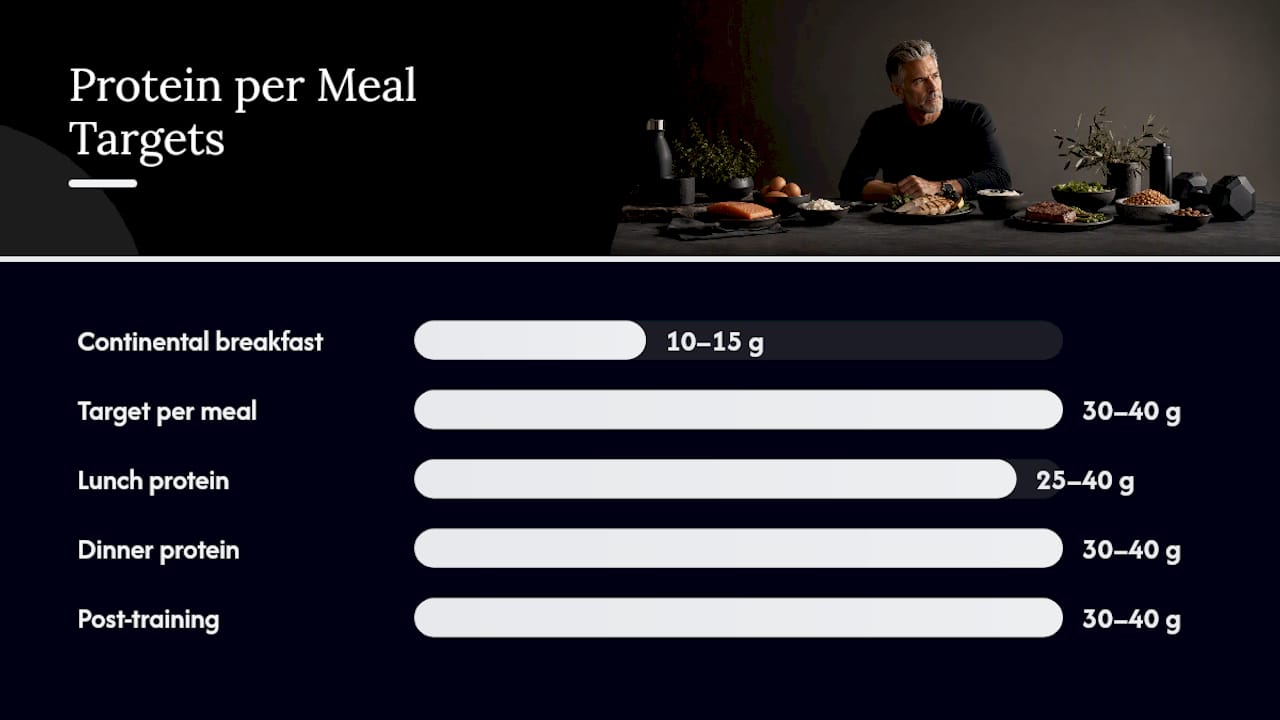
The target is 30 to 40 grams of protein per meal, or roughly 0.3 to 0.4 g/kg. The PMC review on protein and aging cites approximately 35 grams per meal as the dose associated with a near-maximal anabolic response in older adults, a threshold that's noticeably higher than what's typically recommended for men in their 30s.
Here's how to apply it across a working day:
- Breakfast: Often the weakest meal for protein. Target 30 grams minimum rather than the 10 to 15 grams a typical continental breakfast provides.
- Lunch: Build the meal around a 25 to 40 gram protein source, not as a side to carbohydrates.
- Dinner: Keep this meal in the same 30 to 40 gram range rather than making it the day's largest dose by default.
- Post-training: Harvard Health recommends consuming 30 to 40 grams of high-quality protein within about two hours of resistance training to support recovery, a window that matters more as recovery capacity declines with age.
Pro Tip: If your calendar puts training at 6 AM before a full day of meetings, prepare your post-workout protein the night before. A shaker with whey and a shelf-stable milk alternative in your bag removes the excuse before it forms.
Practical Ways to Hit Your Protein Targets Every Day
Food-first is the right default. Supplements exist to fill gaps, not replace the base of your diet.
Breakfast options that reach 30 grams:
- Three whole eggs plus 200 grams of skyr or quark delivers close to 35 grams and takes under ten minutes.
- A smoothie with 1 to 1.5 scoops of whey protein, milk, and oats reaches the same range without cooking at all.
- Greek yogurt (300g) with a handful of nuts and berries works as a faster, lower-effort alternative.
Lunch and dinner templates for 25 to 40 grams: A palm-sized portion of chicken breast, salmon, or lean beef, roughly 150 to 180 grams cooked weight, typically lands in the 30 to 40 gram range. Legumes require larger portions to match: a full cup of cooked lentils delivers around 18 grams, so pairing legumes with a smaller portion of dairy, eggs, or fish helps close the gap and rounds out the amino acid profile, particularly leucine, which drives the anabolic signal most directly.
Leucine content matters more than most men realize. Animal proteins, dairy, eggs, meat, and fish, tend to carry higher leucine density per gram than most plant sources, which is part of why per-meal thresholds are typically easier to hit with animal-based staples. Men eating primarily plant-forward diets can still reach targets, but portions need to run larger, and combining sources (legumes with grains, or adding a scoop of pea or soy isolate to a plant-based smoothie) helps close the leucine gap.
Sensible supplement use looks like this: a shaker of whey or plant-based isolate on a day when the schedule collapses lunch into a fifteen-minute break, not a replacement for whole food as a rule. Swedish nutrition resources echo the same pattern of distributing protein across breakfast and lunch rather than concentrating it at dinner, which is where most habitual eating patterns default.

Is High Protein Intake Safe for Men Over 50?
For most healthy adults, intake up to roughly 1.6 to 2.0 g/kg per day appears safe based on current evidence, though the research base for the very top of that range is thinner than for the 1.2 to 1.6 g/kg zone most guidance centers on. Clinical commentary in Läkartidningen notes that intakes above roughly 2 g/kg show limited additional benefit for muscle building and may carry metabolic considerations worth discussing individually rather than assuming unlimited upside.
The clear red flags are chronic kidney disease, uncontrolled diabetes, and complex medication regimens involving drugs metabolized renally. If any of these apply to you, get baseline kidney function tests before increasing intake meaningfully, and treat any target above the RDA as a conversation with your physician rather than a personal experiment.
Two practical habits matter regardless of your target. Increase water intake alongside protein, since higher nitrogen turnover raises fluid needs. And if you're leaning heavily on red meat and full-fat dairy to hit your numbers, watch saturated fat intake and rotate in fish, poultry, and legumes to keep the rest of your cardiovascular profile in order.
How to Track Your Protein Intake for One Week
- Pick your target using the calculation above, based on your weight and training load.
- Log every meal for seven days. A photo log plus a quick end-of-day tally works as well as a dedicated app; consistency matters more than precision.
- Check two numbers daily: your total grams and whether at least two meals crossed the 30 gram threshold.
- Adjust from there. If most days fall short at breakfast, that's your first fix. If totals are close but per-meal distribution is skewed, redistribute before adding volume.
What Executives Get Wrong About Hitting These Numbers
Most men in demanding roles don't fail on protein because the targets are hard to hit. They fail because breakfast gets skipped or reduced to coffee, and by the time dinner arrives, they're trying to close a 60 gram gap in one sitting, which the body simply can't use as efficiently. The fix isn't more discipline. It's front-loading a reliable protein source into the first meal of the day and treating portable, prepared options as infrastructure, not an afterthought, especially on travel days.
Consistency beats precision here. A man who hits 30 grams at breakfast five days out of seven will outperform one who hits a perfect macro split twice a month. Building that consistency into how you approach performance longevity matters more than chasing the exact upper bound of any range.
— Joakim
This article is general information, not a substitute for advice from a qualified doctor. Consult a qualified healthcare professional about your own circumstances before acting on anything here.
Sources
- Protein — Livsmedelsverket
- Protein needs for adults 50+ | Stanford Lifestyle Medicine
- Protein and aging — PMC review
- How much protein do you need every day? — Harvard Health
- Därför behövs sällan proteintillskott — KI Nyheter
FAQ
How Much Protein Should I Eat if I Weigh 70 kg?
At 70 kg, aim for 70 to 112 grams of protein daily depending on your goal, from roughly 70 g at 1.0 g/kg for general preservation up to 112 g at 1.6 g/kg if you train regularly and are working to build or defend muscle mass.
How Do I Reach 200 Grams of Protein a Day?
Two hundred grams a day is above the functional range for most men unless you weigh well over 90 kg or have a specific training goal justifying it. Reaching it requires four to five meals each carrying 30 to 40 grams, typically combining a lean animal protein source with a dairy or shake-based snack between meals.
How Do I Get 30 Grams of Protein at Breakfast?
Three whole eggs paired with 200 grams of skyr or quark delivers close to 35 grams, and a smoothie built from 1 to 1.5 scoops of whey, milk, and oats lands in the same range without any cooking required.
Is 100 Grams of Protein a Day Good?
For a man around 70 to 80 kg, daily protein intake above the minimum sits comfortably within the functional 1.2 to 1.6 g/kg range that Stanford Lifestyle Medicine and the peer-reviewed literature on aging associate with better muscle preservation, though heavier or more active men may benefit from more.