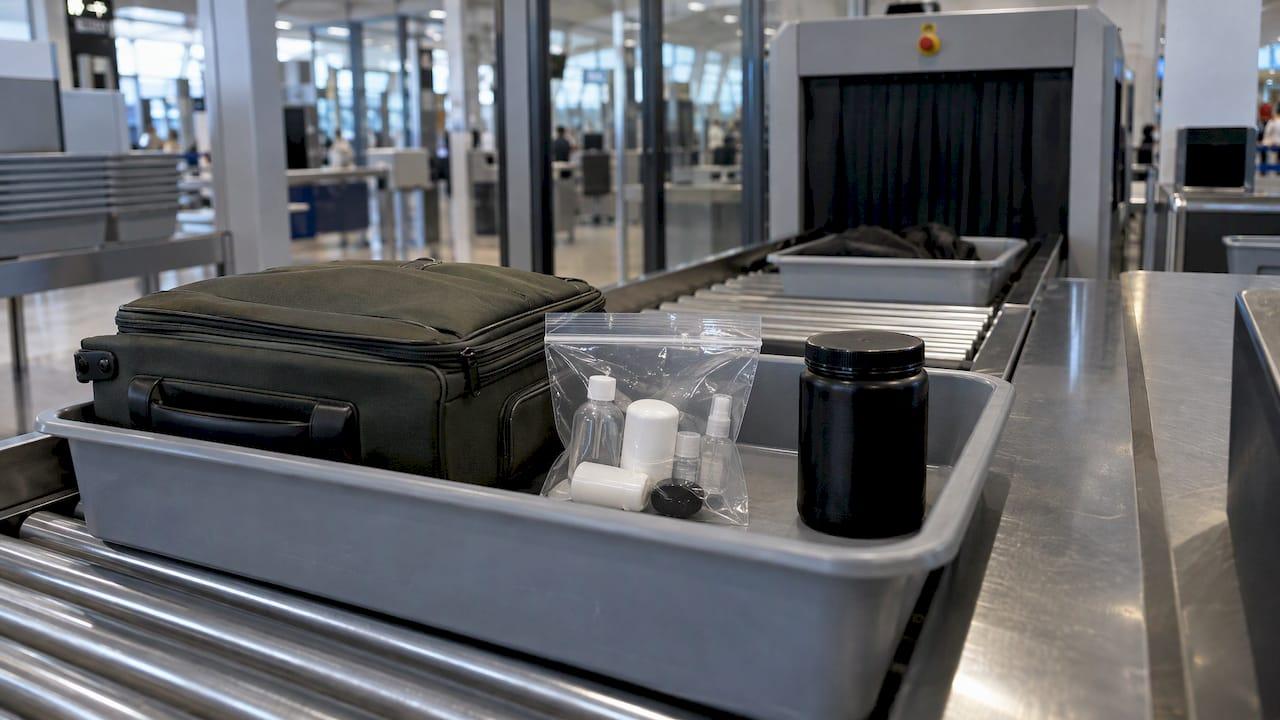
Yes, you can carry supplements on a plane. Tablets, capsules and powders in solid form fall outside the liquids rules, so they travel in your hand baggage without separate presentation. Anything liquid, including an oral spray, is treated as a liquid at security: keep each container at 100 ml or less, place it in the transparent 1-litre bag, or put it in checked baggage where the cabin limit does not apply.
This guide covers flights departing from Swedish airports, where the EU security regime applies. It is written for men who fly often, carry a routine with them and cannot afford to lose time or product at a checkpoint.
TL;DR
- Solid supplements (tablets, capsules, powders) do not need to be presented separately from your hand baggage at Swedish security.
- Liquids, sprays and gels in the cabin: maximum 100 ml per container, all in one transparent, resealable 1-litre bag, one bag per passenger.
- An oral spray is a spray, so plan it as a liquid. Cabin bag within the limit, or checked bag with no volume cap.
- Original packaging is not a legal requirement, but it makes handling quicker and keeps the product identifiable.
- Rules can differ by airport and airline. Check the airport page and your carrier before you leave.
Table of Contents
- What the rules say about solids and liquids
- Why the liquids rule felt unstable in 2024 and 2025
- Do supplements need their original packaging?
- How to pack supplements by format
- The five-minute departure check
- Our perspective on travel and consistency
- For members who travel: how we support the routine
- Related reading before you travel
- FAQ
- Sources
What the rules say about solids and liquids
Swedish aviation security follows EU regulation, and the Swedish Transport Agency (Transportstyrelsen) publishes the practical version. Two categories matter for supplements.
Solid forms. Transportstyrelsen states that tablets, powders and dietary supplements in solid form are outside the liquids rules and need not be taken out and shown separately. Göteborg Landvetter Airport gives the same guidance. A security officer can still open a bag for a closer look. That is a normal part of screening, not a sign of a problem.
Liquids, sprays and gels. The agency's liquids page defines liquids broadly: gels, creams, sprays, liquid and solid mixtures and the contents of pressurized containers all count. The cabin rule is 100 ml per container, in one transparent resealable 1-litre bag. The 100 ml refers to the container's capacity, not to what is left inside: a 150 ml bottle holding 75 ml is not allowed, while an empty container of any size is. Checked baggage is not affected by the rule.

Where oral sprays sit
An oral spray is a small liquid in a pump or atomizer bottle. At the checkpoint it is a spray, and the officer will look at the container size first. Three practical consequences follow:
- If the bottle's stated capacity is 100 ml or less, it goes in your transparent liquids bag with your other cabin liquids.
- If you carry more than one bottle, count them against the 1-litre bag's space, not only against the per-container limit.
- If a bottle is larger than 100 ml, it travels in checked baggage.
There is a separate exemption for liquid medicines and for liquids needed for special dietary requirements, described on the Transportstyrelsen English-language page. That exemption exists for medical and dietary needs. For a performance supplement, the simple and predictable route is to treat the spray as an ordinary liquid and keep it within the standard limit.
Why the liquids rule felt unstable in 2024 and 2025
Many frequent flyers remember inconsistent announcements about liquids. The history is short.
EU Implementing Regulation 2024/2108 restored the 100 ml limit for containers screened by certain new-generation scanners (C3 EDSCB equipment), applying from 1 September 2024. The European Commission described it as a precaution addressing a temporary technical issue, not a new threat. In Sweden, Transportstyrelsen noted that the temporary restrictions from that date affected Stockholm Arlanda Terminal 5 and Sälen airport, and not other Swedish airports. In July 2025 the EU lifted the 100 ml restriction for airports using recertified scanners from one supplier, while the timeline for other equipment was unclear.
The lesson for a traveler is practical. Scanner technology and local procedures change, and the airport you depart from decides how the rule is applied day to day. Plan every trip around the standard 100 ml limit and treat any relaxation at a particular checkpoint as a bonus, not a plan.
Arlanda and Landvetter in practice
Stockholm Arlanda states that the maximum container size is 100 ml at all its security controls. At its newer Terminal 5 control, 100 ml containers can stay in the hand baggage without the 1-litre bag, while the other controls use the clear bag. Landvetter's guidance is to take the liquids bag out and place it visibly in a tray. Both airports also note that airlines can add their own rules, so read your booking conditions as well.
Do supplements need their original packaging?
No rule in the Swedish guidance we reviewed requires it for supplements. For liquid medicines, Transportstyrelsen says original packaging can ease handling but is not required. The same logic is sensible for supplements.
Still, keep the original container for any product you rely on, for three reasons:
- Identification. A labeled container answers a question in seconds. A loose bag of capsules invites a longer conversation.
- Traceability. The batch number and ingredient list stay with the product, which matters if you cross borders.
- Capacity. The printed volume on a spray bottle shows the officer that it is within 100 ml.
If you decant powders or capsules into a pill organizer for a short trip, carry the product's label or a photo of it. For the wider customs question, including what to carry when entering a different country, see our guide on traveling with traceable supplements.
How to pack supplements by format
| Format | Cabin bag | Checked bag | Notes |
|---|---|---|---|
| Tablets, capsules | Allowed, no separate presentation | Allowed | Keep in original container for identification |
| Powders, solid form | Allowed, no separate presentation | Allowed | Sealed sachets or tubs are easier to screen |
| Oral spray | Container 100 ml or less, in the 1-litre bag | Allowed | Counted as a spray and therefore a liquid |
| Liquid drops, shots | Container 100 ml or less, in the 1-litre bag | Allowed | Same liquid rules apply |
| Liquid medicine | Presented separately, no volume cap | Allowed | Medical exemption, not a performance product exemption |
Other points:
- Put the liquids bag where you can reach it. At checkpoints that require it, you remove the bag and place it in a tray. A bag buried under a laptop and a jacket slows the line and you.
- Pack for the length of the trip, with a margin. Count days, add a buffer for delays, and put the daily supply in your cabin bag. Anything you cannot afford to lose does not belong in the hold.
- Keep the pump clean and capped. A sealed, dry bottle in a zip bag avoids residue in your carry-on. Cabin pressure changes can push a little product through a loose pump.
- Think about the routine, not only the bottle. A compact kit with your daily products in one transparent pouch makes security and hotel check-in effortless.
A long journey also puts pressure on food. If you plan the day, pack solid, non-liquid options: travel-friendly snacks for long trips are a good example of how a little preparation keeps your routine steady when airport options are limited.
The five-minute departure check
- Check capacity. Every liquid or spray in your cabin bag shows 100 ml or less on the container.
- Check the bag. One transparent, resealable bag, closed, one per person.
- Check access. Liquids bag on top; solids packed so a bag opening takes seconds.
- Check labels. Original containers, readable batch and ingredient information.
- Check the airport and airline. The airport page for your departure point (for example Arlanda or Landvetter) and your airline's baggage terms.
Then allow extra time. A calm approach to the checkpoint is part of the discipline: you decide what is in the bag and why, so there are no surprises.
Our perspective on travel and consistency
A routine only counts if it survives travel. Executives and founders spend a large share of the year in airports, hotels and time zones, and the habits that matter most are the ones that hold when the schedule does not.
This is one reason we favor a format that is compact and precise. Our oral spray is designed as a sublingual delivery, made in small batches in Sweden, so that the product you carry is the same product at home and abroad. A single, clearly labeled bottle is simple to pack, simple to identify and simple to keep within the liquids rules you meet at the checkpoint.
Our approach is to reduce overload: fewer decisions, a traceable product, a routine you can run without improvisation. Rules at airports will keep changing. Preparation does not.
Joakim
For members who travel: how we support the routine
VIRIDOS is a controlled-access membership: applicants are approved individually, and members receive regular shipments of our plant-derived oral spray, produced in small batches in Sweden. The Member plan is $99 per month and the Professional plan is $299 per month; the details are on the pricing page. You can read how membership works and learn more about production in Sweden before you apply.

If you travel often, plan your shipment timing around your itinerary so your supply is with you before you leave, and carry the product in its original container.
Related reading before you travel
Travel is easier when the product itself is straightforward. These guides cover the questions that follow naturally from packing:
- Legal requirements for food supplements in Sweden explains what a supplement sold in Sweden must meet.
- Four legal checks for oral spray supplements covers the format specifically.
- Swedish supplement labeling shows what a label must state, which is the information an officer or border official will look for.
- The Performance Journal collects our longer pieces on performance longevity and disciplined living.
FAQ
Can I bring supplements on a plane in my carry-on?
Yes. Solid supplements such as tablets, capsules and powders can go in your hand baggage and need not be presented separately at Swedish security. Liquids and sprays follow the 100 ml per container rule inside one transparent 1-litre bag.
Can I take an oral spray through airport security?
Yes, within the liquids rule. A spray container must have a capacity of 100 ml or less and sit in your transparent, resealable bag. If the bottle is larger, pack it in your checked baggage, where the cabin limit does not apply.
Do I need to keep supplements in the original bottle?
Not as a legal rule in the Swedish guidance. Original packaging does make handling easier and keeps the label, batch and ingredient information with the product, so it is the best habit for anything you take regularly.
Do the rules change between airports?
The basic 100 ml rule is the same across Swedish airports, but procedures differ. Arlanda's Terminal 5 control, for example, lets 100 ml containers stay in your bag, while other controls require the clear bag. Check the page for your departure airport and your airline's terms before you travel.
Does the rule apply when I fly back to Sweden?
The rules in this guide apply to flights departing from Swedish and EU airports. When you fly from another country, the security rules and customs rules of that country apply. Look up the official guidance for your departure airport and destination before you pack.
Sources
- Transportstyrelsen: Medicin i vätskeform och sjukvårdsartiklar
- Transportstyrelsen: Vätskor i handbagaget
- Transportstyrelsen: Restrictions on liquids and prohibited items list
- Göteborg Landvetter Airport: Baggage
- Stockholm Arlanda Airport: Baggage
- EUR-Lex: Implementing Regulation (EU) 2024/2108
- European Commission: temporary restrictions on liquid screening, 31 July 2024
- Airport Buzz: EU lifts restrictions on C3 technology scanners
- Travel-friendly snacks for long trips