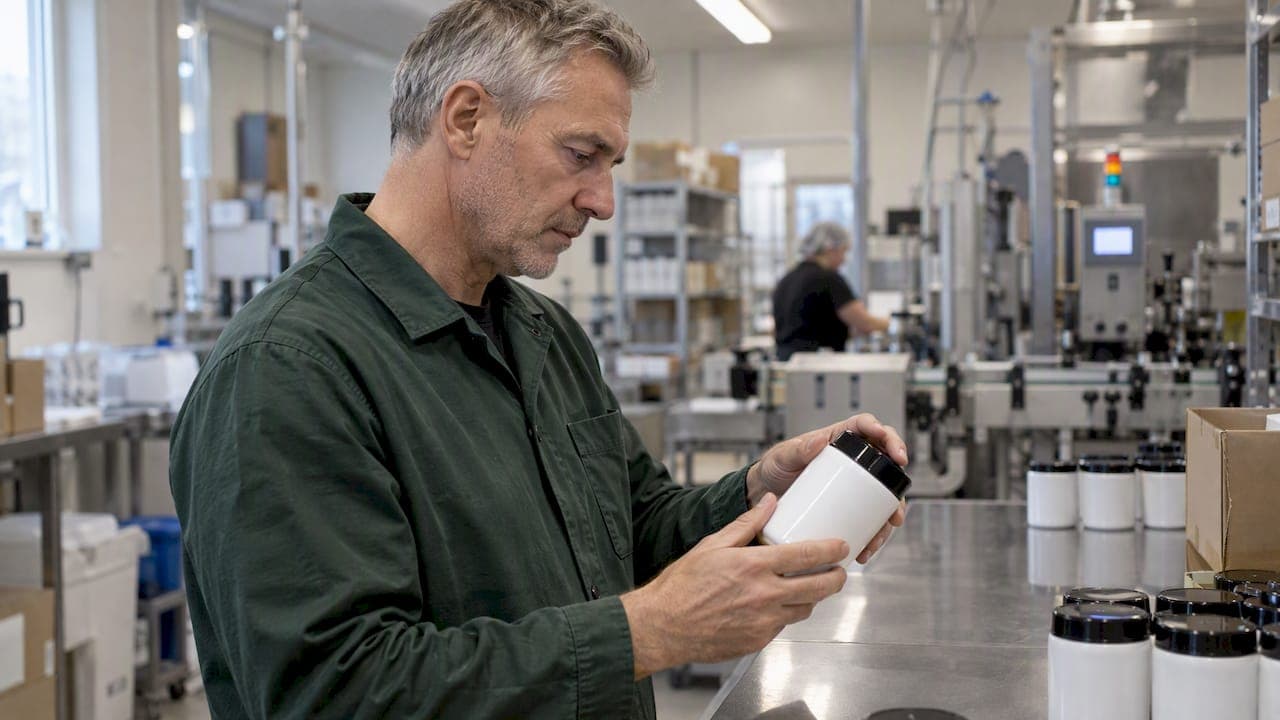
In Sweden a food supplement is legally a food, not a medicine. It needs no pre-market approval, but the business behind it must register with its municipality. Every ingredient, label line, claim and distribution step must hold up to inspection, and the burden of proof sits with you. This guide sets out what the rules ask of a supplement company and what a buyer should expect from one. It draws on the Swedish Food Agency (Livsmedelsverket) and the Swedish Medical Products Agency (Läkemedelsverket).
TL;DR
- A supplement is a food. It is defined in LIVSFS 2023:3 and must be sold pre-packaged and in measured doses.
- Sweden has no pre-market approval for individual supplements. The company registers its activity with the municipality, and safety and compliance rest with the operator from day one.
- Marketing is the narrowest part of the law. Only authorized health claims may be used, and tone and imagery can count as a claim.
- Ingredients must be lawful in the EU, and plant-derived novel ingredients are a known enforcement area.
- Traceability, from raw material supplier to last shipment, is a safety mechanism and not paperwork.
Table of Contents
- What counts as a food supplement under Swedish law
- Where a supplement stops and a medicine begins
- Registration: the company, not the product
- Labeling: what must appear on the pack
- Health claims: the strictest rule
- Ingredients and novel foods
- Traceability and distribution
- A buyer's checklist
- Our perspective
- Membership at Viridos
- FAQ
- Sources
What counts as a food supplement under Swedish law
The governing text is Livsmedelsverket's regulation on supplements, LIVSFS 2023:3. It defines a food supplement as a food intended to supplement the normal diet. It is a concentrated source of nutrients or other substances with a nutritional or physiological effect, offered in measured doses such as capsules, tablets or small-dose liquids. It must reach the end consumer pre-packaged.
Three practical points follow from that definition:
- Form matters. A product has to be dosed in a defined, repeatable unit. A measured oral spray, a capsule and a vial all fit this logic. Loose bulk product does not.
- Purpose matters. A supplement complements the diet. The same regulation says it must never be presented as a replacement for a varied, balanced diet. Any text or visual cue implying that normal food is insufficient is out of bounds.
- The label does not decide the category. Calling something a supplement does not make it one. See the next section.
Where a supplement stops and a medicine begins
This boundary is where ambitious brands get into trouble. Läkemedelsverket's position, set out in its guidance on cannabidiol products, is that a product is a medicine if it has medical effects on the body, or if it is sold with claims that it should be used against disease. Products intended for use in illness must be approved by the agency before they can be sold.
The example is CBD, but the test is general. Two things push a product toward medicine classification:
- Ingredients with pronounced physiological effects.
- Presentation: names, claims, testimonials and imagery that point to diagnosis, symptom relief or disease.
For a company, the discipline is simple. Describe what the product is, what is in it and how it is made. Do not describe what condition it addresses. This is why we keep our own language on vitality, drive and long-term performance habits, and keep it away from anything clinical.
Registration: the company, not the product
Many readers expect a product notification system, as exists in some other EU countries. Sweden does not have one. According to Livsmedelsverket's guidance for supplement companies, individual supplements need no prior clearance. The business must register its activity with the municipality where it operates. The municipality then becomes the control authority. Certain operations, such as some animal-derived ingredients or re-packaging, can require specific approval from Livsmedelsverket.
This arrangement is lighter at the door and heavier afterward:
| Question | Swedish answer |
|---|---|
| Is each product approved before launch? | No pre-market approval or notification |
| Must the business register? | Yes, with the municipality where the activity takes place |
| Who inspects? | The municipal food control, supported by national guidance |
| Who carries the proof of safety and compliance? | The business operator |
A national government assignment is also under way to improve coordination, guidance and support for supplement control, so that authorities assess cases consistently across the country. The interim report from Livsmedelsverket states that aim. Expect inspection to become more uniform, not less.
Labeling: what must appear on the pack
Supplements are sold pre-packaged and labeled under EU Regulation 1169/2011, plus supplement-specific rules. Livsmedelsverket's labeling guidance for supplements lists the mandatory particulars, including the ingredient list, the name of the food, date marking, contact details, allergen labeling and net quantity.
In practice, check these on any supplement you consider:
- A clear name that identifies it as a food supplement.
- A full ingredient list, with allergens highlighted.
- Net quantity and a date mark.
- A named business with contact details.
- A stated daily dose, with no suggestion that more is better.
The guidance from Livsmedelsverket is explicitly non-binding in how it suggests meeting the law, and other routes can comply too. The obligations themselves are not optional.
Health claims: the strictest rule
Marketing is where compliance is most often tested. Under Livsmedelsverket's rules on nutrition and health claims, only claims authorized by the European Commission and listed in the EU register are permitted. The product must also meet the conditions of use set for each claim, such as a minimum amount of the substance. General health-related implications, even in imagery or tone, are treated as health claims in law.
For a reader evaluating a brand, this gives you a quick filter:
- Be wary of vague promises of energy, hormones, testosterone or strength that are not tied to a listed claim and a qualifying nutrient.
- Treat claims about disease or aging processes as a red flag. They push a product toward the medicine category.
- Expect a serious brand to talk about sourcing, extraction, dosing and testing, which are verifiable, rather than outcomes, which are regulated.
This constrains how we write about the Viridos formulation. We describe our approach to plant-derived compounds, small-batch Swedish production and delivery format. We do not promise results, and you should not expect a compliant supplement brand to do so.
Ingredients and novel foods
Ingredients must be lawful in the EU. For vitamins and minerals, only those listed in the supplements directive may be used, as Livsmedelsverket's Q&A for new sellers points out. Plant-derived and other substances face the novel food test.
Livsmedelsverket's guidance on assessing findings in control notes that supplements sometimes contain unapproved novel foods. A plant-derived ingredient has to be shown to have been consumed to a significant degree in the EU before 15 May 1997, or to be otherwise authorized. The same guidance treats ingredient substitution as a high-risk area: when one compound is banned, manufacturers sometimes pivot to a similar one, and each new formulation needs its own documented hazard analysis.
For a company working with proprietary plant extracts, the questions to settle before launch are:
- What exactly is the botanical source, and what is the evidence of pre-1997 EU use?
- How is the extract made, and does the extraction method change the substance?
- What does the hazard analysis say about the concentrated form?
For a buyer, the same questions are fair to put to a brand. Our guide on standardized plant extracts explains why an extraction ratio alone says little.
Traceability and distribution
Livsmedelsverket frames traceability as a core safety mechanism. You must be able to identify every ingredient supplier and every downstream distribution point. You must also be able to run a mass balance, comparing incoming raw materials with outgoing finished products, to verify authenticity and safety.
Responsibility continues past the factory. The agency's guidance on transport says food must be protected from contamination in transit. Where needed, equipment must keep it at the right temperature. For a direct-to-consumer brand shipping to members' homes, that means verifying what a logistics partner actually does, not assuming it.
Two companion reads go deeper: raw material traceability in supplements and a five-step certificate of analysis checklist for third-party testing.
A buyer's checklist
You do not need to be a regulator to ask the right questions. Before you commit to a supplement subscription in Sweden, confirm the following.
- Identity. The seller is a named company that can show it is registered with its municipality.
- Category. The product is labeled and described as a food supplement, with no disease language.
- Label. Ingredient list, allergens, net quantity, date mark and contact details are all present.
- Claims. Any health statement matches an authorized claim. If the marketing relies on atmosphere and implication, be cautious.
- Ingredients. The brand can explain the botanical source and the extraction method, and why the ingredient is lawful in the EU.
- Testing. Batch-level analysis from an independent laboratory is available on request.
- Batch records. The brand can trace a batch back to raw materials. Our piece on checks for Swedish-made supplements covers what "made in Sweden" does and does not tell you.
- Cost clarity. The price per dose is stated and comparable. See how to calculate supplement cost per dose.
For delivery formats specifically, we cover the legal questions around sprays in four legal checks for oral spray supplements.
Our perspective
We built Viridos for men who carry responsibility and read the fine print. That makes regulation a design input for us, not an obstacle. Sweden places the full burden of proof on the operator from the first day, with no product pre-clearance to lean on. We think that is the right standard for a brand that asks for a premium.

Three principles follow from it. First, we keep evidence, reasoning and uncertainty inspectable: if we cannot support a statement, it does not appear. Second, we produce in small batches in Sweden, which keeps raw material records and batch decisions close enough to examine. Third, we write about vitality and long-term performance habits as a disciplined way of living, not as a clinical outcome. A supplement supports your judgment and routine. It does not replace sleep, training or a varied diet, and the law rightly forbids implying otherwise.
If a brand cannot explain its legal footing in plain language, treat that as information.
— Joakim
Membership at Viridos
Viridos is available through application-based membership, with small-batch production in Sweden and limited cohort access. Two plans are published on our pricing page: Member at 99 USD per month and Professional at 299 USD per month. You can read how approval and ongoing shipments work on the membership page, and what we mean by executive performance on our executive performance page.
FAQ
Do I need permission to sell food supplements in Sweden?
You need no approval for the individual product. You must register your food business with the municipality where the activity takes place, and the municipality becomes your control authority. Some operations, such as certain animal-derived ingredients or re-packaging, can require approval from Livsmedelsverket.
How are food supplements defined?
They are foods intended to supplement the normal diet, providing concentrated sources of nutrients or substances with a nutritional or physiological effect. They are sold in measured doses and pre-packaged, as set out in LIVSFS 2023:3.
Can a supplement be classified as a medicine?
Yes. According to Läkemedelsverket, a product is a medicine if it has medical effects on the body or is sold with claims that it should be used in illness. Such products need agency approval before sale. If you have a medical condition or take medication, ask your physician or pharmacist before starting any supplement.
What can a supplement brand say about benefits?
Only claims authorized by the European Commission and listed in the EU register, used under the conditions set for each claim. The Livsmedelsverket guidance adds that general health implications, even through imagery or tone, count as claims.
Sources
- LIVSFS 2023:3, Livsmedelsverkets föreskrifter om kosttillskott
- Kosttillskott: att tänka på för företag, Livsmedelsverket
- Närings- och hälsopåståenden, Livsmedelsverket
- Cannabidiol – CBD, Läkemedelsverket
- Märkning av kosttillskott, Kontrollwiki
- Bedömning av fynd i kontrollen, Kontrollwiki
- Spårbarhet för livsmedel, Livsmedelsverket
- Transport, Kontrollwiki
- Om vi vill sälja kosttillskott vad ska vi tänka på?, Livsmedelsverket
- Regeringsuppdrag om kontrollen av kosttillskott, delrapport 2