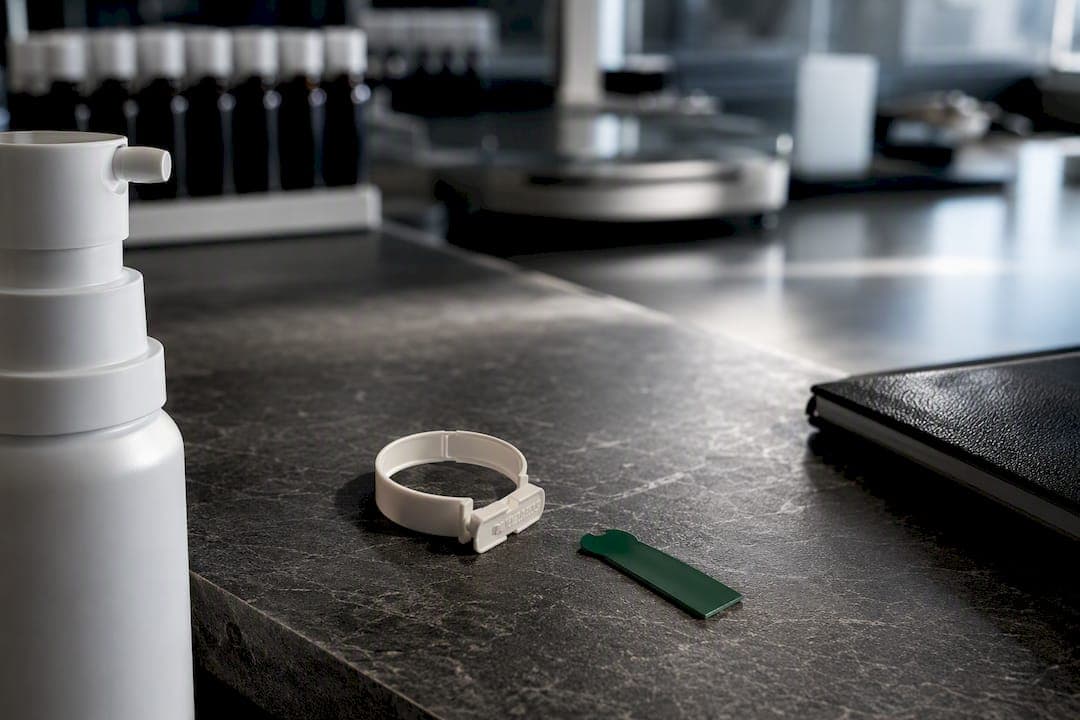
Yes. Oral and sublingual spray supplements are legal in Sweden when they meet the statutory definition of kosttillskott set out in LIVSFS 2023:3 and carry correct labeling. Livsmedelsverket regulates them as food. Läkemedelsverket steps in only if the product makes medicinal claims, uses pharmacological dosing, or contains banned substances. Get either of those wrong, and legality disappears fast.
TL;DR:
- Swedish regulations classify legal oral spray supplements as food if they meet specific dosing and labeling requirements without making medicinal claims.
- Proper labeling must include the product name, detailed active ingredient amounts, dosing instructions, warnings, and a statement that it does not replace a balanced diet.
- Ingredients must be approved for food use and not exceed doses that imply a medicinal or pharmacological effect, or the product is at risk of reclassification as a medicine.
- Purchasing from unverified overseas sellers or products labeled "for research use only" significantly increases the risk of non-compliance and legal issues.
- Responsible producers provide batch-specific testing, clear sourcing, and transparent documentation to meet Swedish compliance standards.
Table of Contents
- What Swedish Law Says About Oral Spray Kosttillskott Legality
- What Must Appear on the Label and What Claims to Avoid
- When Does a Supplement Spray Become a Medicine?
- Is It Safe to Buy Oral Spray Supplements Online or From Abroad?
- Consumer Checklist: Verifying a Spray Is Legal in Sweden
- What Disciplined Buyers Should Expect From Responsible Swedish Producers
- How Viridos Approaches Legal Compliance and Traceability
- Sources
- FAQ
What Swedish Law Says About Oral Spray Kosttillskott Legality
The Swedish food code doesn't care what delivery format a supplement uses. It cares what the product is intended to do and how it's dosed. Under LIVSFS 2023:3, a kosttillskott is defined as a product meant to complement the normal diet, functioning as a concentrated source of nutrients or other substances with a nutritional or physiological effect, sold in divided doses. Liquid sprays, drops, and ampoules are explicitly named as permitted divided dose formats, which settles the question for anyone wondering whether "spray" and "kosttillskott" can coexist legally.
That definition doesn't operate in isolation. Sweden's rules sit inside a broader EU structure, principally EU Directive 2002/46/EC on food supplements and Regulation (EU) 1169/2011 on food information. Together they govern:
- What counts as a "nutrient" or "substance with physiological effect"
- How doses must be divided and disclosed
- What information must appear on every unit sold in Sweden
- When a botanical ingredient triggers a novel food review under the EU catalogue
Meeting this definition is the first hurdle, not the last. A spray can satisfy every clause of LIVSFS 2023:3 and still fail on labeling, or fail because an ingredient hasn't cleared novel food assessment. Each layer is checked separately by Swedish authorities, and each layer can independently disqualify a product.
What Must Appear on the Label and What Claims to Avoid
Labeling is where most borderline products reveal themselves. Livsmedelsverket's company guidance on kosttillskott and LIVSFS 2023:3 together require:
- The designation "kosttillskott" printed clearly on the package
- A recommended daily dose, stated in the spray's actual measurable unit (sprays, milliliters)
- An explicit warning not to exceed the recommended dose
- A statement that the product does not replace a varied and balanced diet
- Storage instructions and, where relevant, a warning to keep out of reach of children
- Numeric quantities of each active substance contained in the recommended daily dose
Marketing language is where legal products drift into illegal territory. Any suggestion that a spray treats, prevents, or cures a condition. Any implied disease outcome. Any comparison to prescription-grade effects. These phrasings are the clearest signal to Läkemedelsverket that a product is functioning as a medicine rather than a food supplement, regardless of what the label calls it.
Pro Tip: A lawful spray's dose panel should read something like "1 spray (0.1 ml) = 5 mg active compound X, recommended dose: 2 sprays daily." Vague phrasing like "as needed" or "for optimal results" is a labeling failure waiting to be flagged.
When Does a Supplement Spray Become a Medicine?
Reclassification isn't a gray area Swedish authorities leave to interpretation. Läkemedelsverket applies a defined set of criteria, and any one of them can be enough to move a product out of the food category entirely:
- Active substance identity: is the ingredient approved for food use, or is it pharmacologically active at the doses present?
- Dose level: does the concentration exceed what a normal diet could plausibly deliver, suggesting a drug-like effect?
- Intended use: does marketing describe a therapeutic outcome rather than nutritional support?
- Route of administration: is the spray formulated and marketed in a way that mimics a pharmaceutical delivery system?
- Presence of therapeutic claims: does copy anywhere reference disease treatment, prevention, or cure?
Once a product is reclassified, the consequences are immediate. It must meet full medicine regulations, which likely means prescription status, clinical evidence requirements, and removal from ordinary retail and e-commerce channels. For consumers, the practical tell is usually visible before any regulator gets involved: explicit therapeutic language on the product page, doses far outside what a food supplement would need, or sourcing that's vague about where the active ingredient actually comes from. A comparison of oral spray formats and their legal boundaries is worth reviewing if you're evaluating multiple products side by side.
Is It Safe to Buy Oral Spray Supplements Online or From Abroad?
Cross-border purchasing introduces risk that a Swedish retail shelf simply doesn't carry. Intra-EU supply and third-country import are treated differently under Swedish customs rules, and a product perfectly legal in one EU market can still be blocked at the Swedish border if it contains an ingredient not cleared under EU novel food rules or Swedish supplement law.
Two warning signs deserve particular attention. Products labeled "for research use only" are almost always attempting to sidestep consumer safety and traceability obligations. Listings that omit full ingredient disclosure or dosing information are doing the same thing under a different pretext.
Before buying, verify three things:
- Swedish language labeling and a clearly identified retailer or manufacturer
- Every ingredient checked against Läkemedelsverket's substance guide and Livsmedelsverket's published guidance
- A certificate of analysis (COA) or third-party test report available on request
Antidoping Sverige's guidance is worth noting here too: supplements, including sprays, can carry contamination risk or contain substances classified as prohibited in sport, which matters if you're a tested athlete or executive under a corporate wellness program with testing requirements.
Consumer Checklist: Verifying a Spray Is Legal in Sweden
Run through this sequence before any purchase, and you'll catch nearly every compliance failure that trips up Swedish consumers.
- Confirm the designation. The package must say "kosttillskott" and list numeric amounts for every active substance in the recommended dose.
- Check the labeling language and importer. Swedish text is required, and a named EU or Swedish importer or manufacturer should be printed on the package, not buried in fine print.
- Cross-check ingredients. Compare the formula against Läkemedelsverket's substance guide and Livsmedelsverket's supplement guidance. If anything looks unfamiliar, request a COA or third-party test report before buying.
- Watch for red flags. Therapeutic claims, unusually high doses, or "research use only" disclaimers mean the product likely doesn't belong in the food supplement category at all.
Pro Tip: Keep a photo of the label and any COA you receive. If you ever need to report a product to Livsmedelsverket or ask Läkemedelsverket for a classification opinion, having documentation ready saves weeks. A five-step COA checklist can help you read a test report correctly the first time.
What Disciplined Buyers Should Expect From Responsible Swedish Producers
Executives evaluating a spray supplement rarely have time to parse regulatory filings, so the discipline shifts to asking the right three questions of any vendor: Can you provide a batch-specific COA? Who is the named EU or Swedish importer? Which standard governs your botanical safety testing?
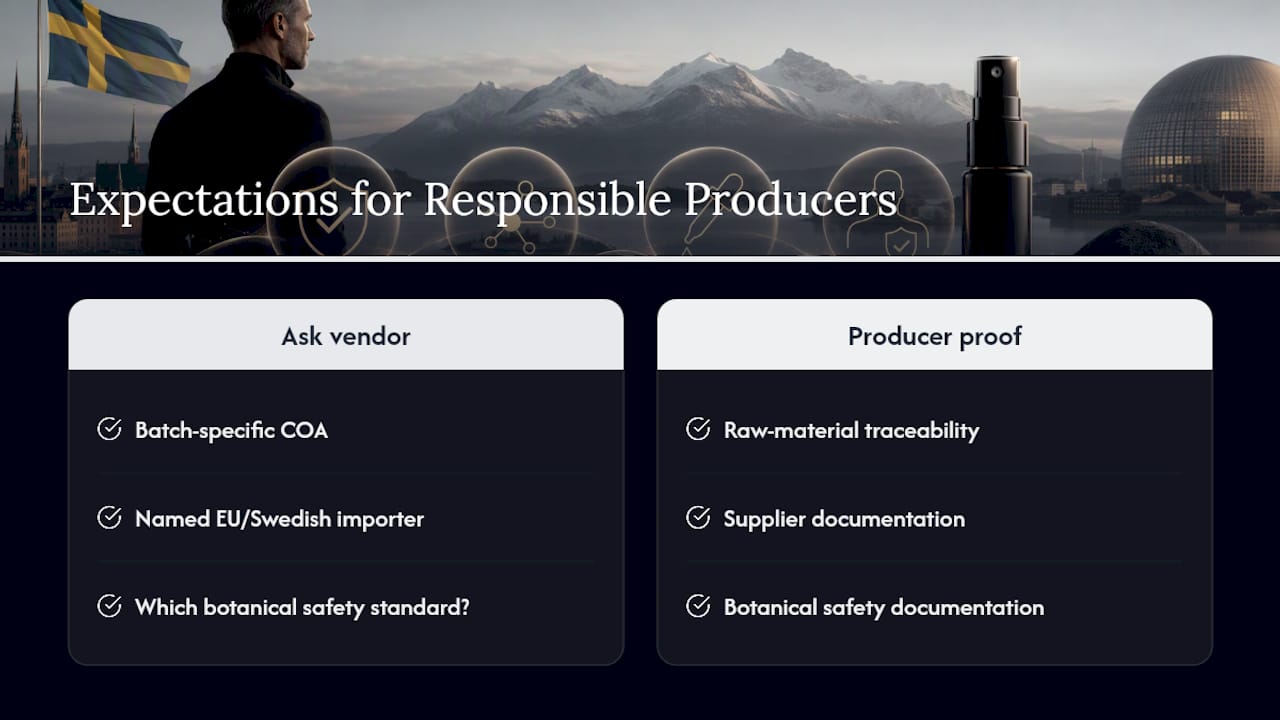
Serious Swedish producers should provide immediate answers on raw material traceability, supplier documentation, and safety documentation for botanical ingredients. They're the baseline Svensk Egenvård's own industry guideline on safe consumer supplements sets for the category, and Kontrollwiki's enforcement guidance makes clear that documentation gaps are where most compliance failures actually occur, not the format of the product itself.
A man who runs a company on evidence should expect the same rigor from what he puts under his tongue.
— Joakim
How Viridos Approaches Legal Compliance and Traceability
Some producers offer performance sprays in small batches from Sweden with documented sourcing, batch-level testing, and labeling stating exactly what's in each dose, avoiding marketing language that implies more than the formula delivers.

If you want to see how that discipline translates into practice, the lab documentation and production notes behind each batch are published on the Performance Journal, alongside the reasoning behind Viridos's sublingual delivery approach. Some brands maintain controlled membership and cohort-based production instead of open retail to keep production small enough for traceability standards. Buyers are advised to review batch documentation and apply when ready.
Sources
This article is general information, not a substitute for advice from a qualified doctor. Consult a qualified healthcare professional about your own circumstances before acting on anything here.
FAQ
Is DHEA Legal in Sweden?
DHEA is not approved as a food supplement ingredient in Sweden and is generally treated as a medicinal substance by Läkemedelsverket, meaning products containing it fall outside the kosttillskott category entirely.
Which Supplements Are Classified as Doping Substances?
Antidoping Sverige warns that a range of supplement ingredients, including certain stimulants and hormone precursors, can carry doping classification or contamination risk, which is why tested athletes are advised to verify every ingredient before use.
Is Buying Supplements From Foreign Online Pharmacies Legal?
Legality depends on whether the specific product and seller comply with Swedish import rules and EU food or medicine law; unregulated foreign sellers frequently ship products that would fail Swedish labeling or ingredient checks.
Which Medicines Can Be Sold Without Formal Approval?
In Sweden, medicinal products generally require formal approval from Läkemedelsverket before sale; very limited exceptions exist for specific licensing pathways, but as a rule, unapproved medicines cannot legally be marketed or sold.
Does an Oral Spray Format Change Its Legal Status?
No. The spray delivery format itself doesn't determine legality, since LIVSFS 2023:3 explicitly permits liquid sprays as a divided-dose format; what determines legal status is the ingredient profile, dosing, and marketing claims attached to the product.