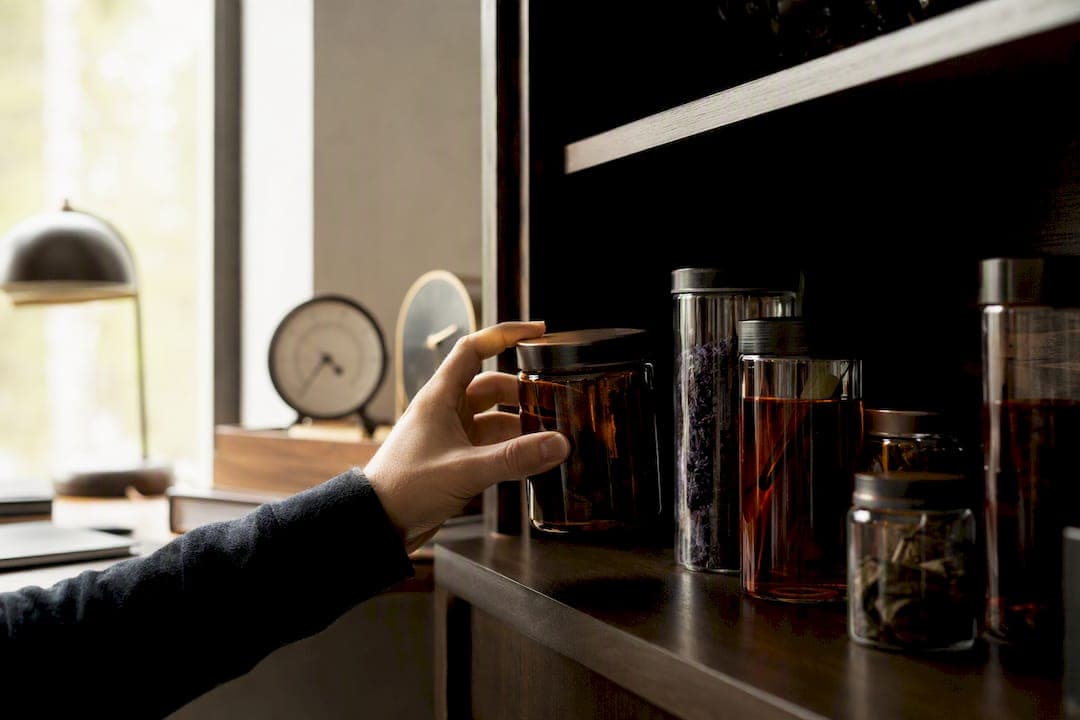
Store plant extracts in a cool, dark, low-humidity environment, ideally between 15 and 25°C, inside opaque, airtight containers with minimal headspace. That single rule governs everything else in this guide, because hållbarhet växtextrakt förvaring—the sustainable, long-term stability of botanical extracts, comes down to controlling four variables: heat, light, oxygen, and moisture. Get those four right and a well-formulated powder extract can hold its stated specification for 18 to 24 months. Get them wrong, and even a premium extraction can lose potency in weeks.
For a man managing a supplement cabinet, a formulation lab, or a small-batch production run, this is not a matter of aesthetics. It is a matter of return on a substance you paid a premium for.
Do now:
- Move any opened tincture or oil out of direct light and into an amber or Miron violet glass container.
- Stop storing powders near a stove, window, or humid bathroom cabinet.
- Decant partially used bottles into smaller vessels to reduce air exposure.
Two reference points worth knowing: Good Agricultural and Collection Practice (GACP) and Good Manufacturing Practice (GMP) frameworks govern how reputable suppliers document extract quality, and the 18 to 24 month shelf-life figure for sealed, dry powders is the industry's own benchmark, not a marketing claim.
Key Takeaways
Sustainable plant extract storage depends on controlling temperature, light, oxygen, and moisture together, not any single variable in isolation.
| Point | Details |
|---|---|
| Target environment | Keep extracts at 15–25°C and 30–50% relative humidity, away from direct light. |
| Match container to format | Use Miron violet or amber glass for light-sensitive liquids, silicone-lined tins for concentrates, and foil or HDPE for bulk powder. |
| Powders lead in stability | Well-sealed powders under 10% moisture typically hold specification for 18 to 24 months. |
| Manage headspace actively | Decant into smaller bottles as volume drops to limit oxygen exposure. |
| Document every batch | Label with batch number, manufacture date, and retest date, and request a COA from suppliers. |
Table of Contents
- Hållbarhet Växtextrakt Förvaring: What Actually Destroys Potency
- What Temperature, Humidity, and Light Levels Actually Preserve Potency?
- Which Containers and Packaging Actually Protect Extract Quality?
- How Long Do Different Extract Types Actually Last?
- How Can You Tell an Extract Has Degraded?
- Should You Refrigerate or Freeze Plant Extracts?
- What Belongs on Every Extract Label?
- What Regulatory and Documentation Standards Matter?
- A Premium Storage Checklist for Discerning Buyers
- Why Storage Discipline Is a Performance Decision, Not a Housekeeping Task
- Frequently Asked Questions
- Sources
Hållbarhet Växtextrakt Förvaring: What Actually Destroys Potency
Every plant extract is a chemistry experiment in slow motion, and four forces run it: heat, light, oxygen, and moisture. Each one degrades a different aspect of the extract's chemical structure, and together they explain nearly every case of a supplement losing strength before its printed date.
Heat accelerates the reaction rates that break down active compounds. The general rule cited across the botanical packaging literature holds that every 10°C rise roughly doubles the speed of a given chemical reaction. Store an oil at 35°C instead of 20°C and you are not shaving a little off its life. You are compressing months of decline into weeks.
Light, especially the ultraviolet and blue wavelengths, drives photodegradation, a process where photons break molecular bonds in sensitive compounds like flavonoids and terpenes. This is why clear glass, however elegant it looks on a shelf, is one of the worst packaging decisions a formulator can make.
Oxygen oxidizes fats, phenolics, and many active constituents on contact. This is the same mechanism that turns unrefrigerated cooking oil rancid. Every time a bottle opens, oxygen enters, and every cubic centimeter of empty headspace above the liquid is oxygen waiting to act.
Moisture enables enzymatic activity and microbial growth, particularly in powders. Extracts with residual moisture above roughly 10% become vulnerable to mold, clumping, and enzymatic breakdown that a bone-dry powder simply does not face.
Controls, mapped to each threat:
- Heat: Keep ambient storage between 15 and 25°C. Avoid garages, car trunks, and any spot near appliances.
- Light: Use amber or violet glass, or store clear containers inside an opaque outer box.
- Oxygen: Minimize headspace, use nitrogen flushing for bulk powders, and choose dropper or pump closures that limit air ingress during use.
- Moisture: Add desiccant packs to powder containers and avoid storing anything near a sink, kettle, or bathroom.
Pro Tip: As a liquid extract depletes, transfer the remaining volume into a smaller bottle. A half-full 100ml bottle has far more oxidizing headspace than a nearly full 30ml one, and that single habit extends usable life more than almost any other single action.
What Temperature, Humidity, and Light Levels Actually Preserve Potency?
Precision beats guesswork here. Most botanical extracts, whether oils, tinctures, or powders, hold their integrity best within a defined environmental band, and deviating from it accelerates every degradation pathway described above.
The consensus range across botanical storage guidance sits at 15 to 25°C, with relative humidity kept between 30 and 50%, and light exposure minimized through opaque containers or dark storage. Refrigeration is rarely necessary for dried powders. Cold storage introduces condensation risk when a container moves between a chilled environment and room temperature, and that moisture can undo the moisture control you were trying to achieve in the first place. Refrigeration earns its place for water-based extracts and certain probiotic formulations, where microbial stability at lower temperatures outweighs the condensation risk.
| Variable | Target range | Why it matters |
|---|---|---|
| Temperature | 15–25°C | Slows chemical reaction rates that degrade active compounds |
| Relative humidity | 30–50% | Limits moisture uptake, enzymatic activity, and mold risk in powders |
| Light exposure | Dark or opaque packaging | Prevents photodegradation of flavonoids, terpenes, and other light-sensitive constituents |
| Oxygen headspace | Minimal | Reduces oxidative breakdown of fats and phenolic compounds |
For a small-batch operation, a datalogger that records temperature and humidity over time is worth the modest cost, because it catches the slow seasonal drift that a spot check misses. A north-facing closet away from exterior walls, appliances, and plumbing is usually the best storage location most men already have in their home.
Which Containers and Packaging Actually Protect Extract Quality?
Container choice is where sustainable extract storage lives or dies, and the right material depends entirely on what you are storing.
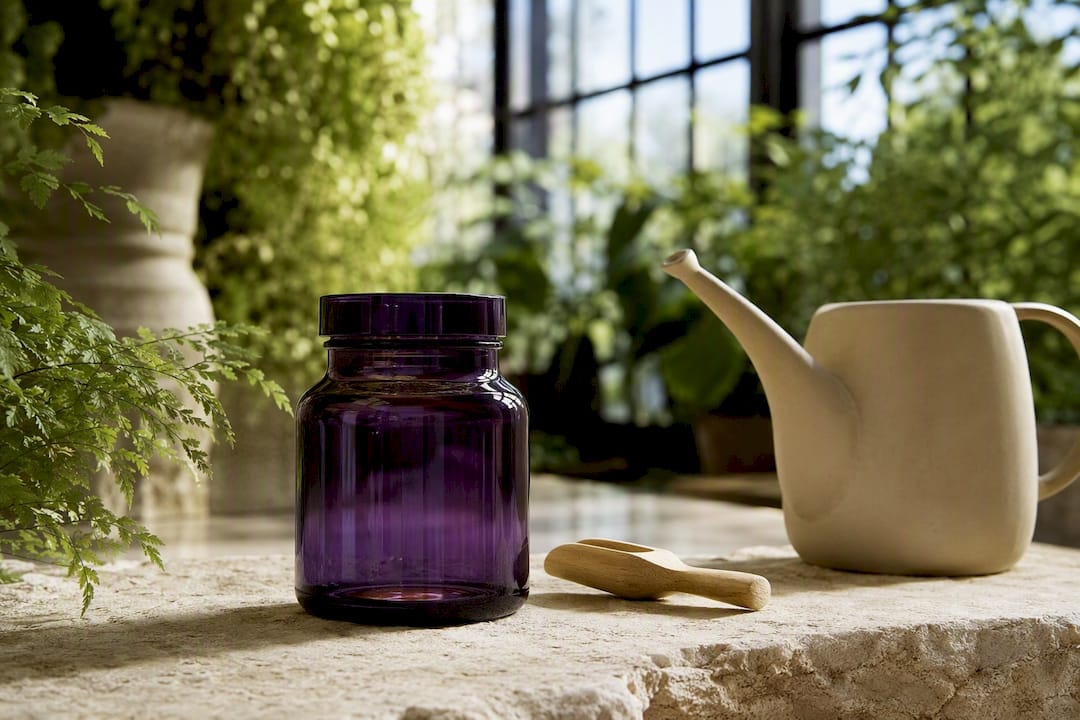
Miron violet glass, available through European suppliers, filters out the visible and UV light wavelengths that drive photodegradation while still allowing beneficial infrared light through, a property regular amber glass does not share. It is the premium choice for light-sensitive oils, tinctures, and polyphenol-rich extracts you intend to store for months rather than weeks.
Amber glass bottles remain the practical workhorse. They block a meaningful portion of UV light, pair well with dropper or pump closures, and cost far less than violet glass while still outperforming clear glass by a wide margin.
HDPE (high-density polyethylene) containers and foil-laminated bags suit bulk powder storage, where a lightweight, moisture-resistant barrier matters more than optical filtering. Foil-laminated bags, layered with polyethylene and aluminum, combine a strong moisture barrier with the option for nitrogen flushing during packaging.
Silicone-lined containers solve a different problem entirely: sticky, resinous concentrates that would otherwise adhere to glass or metal. A small silicone-fitted tin allows full extraction of the product without loss to the container walls, a detail that matters more than it sounds when a concentrate costs what quality concentrates cost.
Choosing and sealing, in practice:
- Light-sensitive oils and polyphenol extracts: Miron violet glass or amber glass with a tight screw cap.
- Bulk powders: foil-laminated bags or HDPE drums with an inner liner, nitrogen-flushed where possible.
- Sticky resins and concentrates: silicone-lined small jars with wide-mouth access.
- Powders prone to caking: add a silica gel desiccant pack inside the sealed container.
- Frequent-use liquids: dropper or pump dispensers, which limit oxygen ingress compared to open-pour caps.
Nitrogen blanketing, common in commercial extract packaging, displaces oxygen inside the container before sealing. It is not practical for a home cabinet, but worth asking about when you evaluate a supplier's production standards.
How Long Do Different Extract Types Actually Last?
Shelf life varies enormously by format, and knowing the typical range for each category lets you set realistic inventory rules instead of guessing.
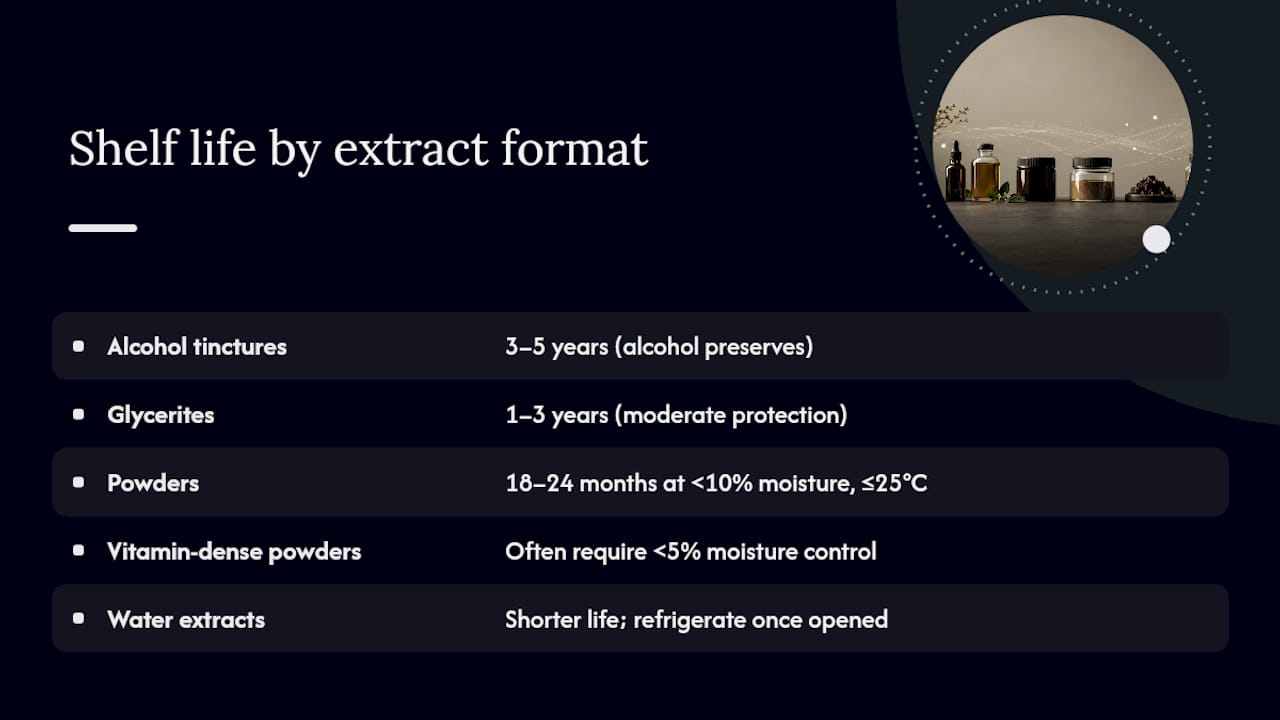
Alcohol-based tinctures are the most forgiving format on this list. The alcohol itself acts as a preservative, which is why a well-made tincture can remain chemically stable for three to five years when sealed and stored away from heat. Water-based extracts sit at the opposite end. Without alcohol's preservative effect, they support microbial growth far more readily and generally need refrigeration once opened.
Glycerites, extracts preserved in vegetable glycerin, occupy a middle position. They lack alcohol's antimicrobial strength but glycerin's viscosity and humectant properties offer moderate protection, typically yielding one to three years of stability under proper storage.
Powders are, format for format, the most stable category available, provided moisture stays low. That single variable, residual moisture, determines almost everything about a powder's fate. A moisture-controlled botanical powder at under 10% water content, sealed and stored at or below 25°C, comfortably reaches the 18 to 24 month benchmark. Vitamin-dense powders like acerola cherry extract need tighter control still, often under 5% moisture, because ascorbic acid oxidizes readily and residual enzyme activity accelerates that process in humid conditions.
For a small-batch formulator or a disciplined executive managing his own supplement stack, this has a practical implication: powder format generally offers the longest runway per unit of storage effort. If long-term stability and logistical simplicity matter more than immediate solubility, powder is usually the more defensible choice over an equivalent liquid concentrate.
Before committing to a supplier, ask for a Certificate of Analysis (COA) and stability data rather than relying on a printed best-before date alone. A COA that states manufacture date, retest date, and moisture content tells you far more than a generic expiration stamp.
How Can You Tell an Extract Has Degraded?
Degradation rarely announces itself with a single obvious sign. It shows up as a cluster of small changes, and learning to read them saves both money and disappointment.
Sensory cues come first. A rancid or sour smell in an oil signals oxidation has already progressed. A musty odor in a powder often points to moisture intrusion and possible microbial activity. Visually, watch for color shift (a bright amber tincture turning brown or cloudy), unexpected precipitation, or oil separating from a previously homogeneous extract. Texture changes matter too: a powder that has clumped or hardened has almost certainly absorbed moisture beyond its safe threshold.
Simple checks you can run without a lab:
- Smell test: any sour, rancid, or musty note is a red flag, especially in oils.
- Visual inspection: check for color darkening, cloudiness, or visible separation.
- Powder dissolution: a powder that clumps heavily or fails to disperse evenly may have taken on moisture.
- Mold check: any visible fuzzy growth, regardless of extract type, means immediate discard.
- Bubbling or gas: unexpected fizzing in a sealed liquid extract suggests microbial fermentation, not a good sign.
Discard immediately if you see mold, detect a strongly off odor, or notice active gas production. Those are safety signals, not just potency ones. A milder color shift or slight viscosity change is more often a potency question. The extract may still be safe but weaker than its label claims, which is where retesting through a supplier or lab makes more sense than outright disposal.
Pro Tip: Keep a simple log tied to batch numbers, noting the date you opened each container and any sensory observations over time. This single habit turns anecdotal "this smells off" moments into a pattern you can act on before an entire batch turns.
Should You Refrigerate or Freeze Plant Extracts?
Cold storage helps some extracts and quietly damages others, and knowing the difference prevents an expensive mistake.
Refrigeration suits water-based extracts and certain probiotic-containing formulations, where microbial control at lower temperatures outweighs other risks. It is generally the wrong call for dry powders. Moving a sealed powder container between a cold refrigerator and warm room air invites condensation the moment it warms up, and that introduced moisture can undo months of careful humidity control in a matter of hours.
Freezing works only for specific long-term bulk storage scenarios, and only with airtight containers and a controlled thaw process. Repeated freeze-thaw cycles are particularly damaging: they can break emulsions, encourage crystallization in oils, and physically stress packaging seals until they fail.
A workable cold-storage protocol:
- Leave any refrigerated or frozen container sealed until it reaches room temperature before opening, to avoid condensation.
- Never refrigerate a moisture-sensitive powder unless it has been specifically conditioned and packaged for cold storage.
- Freeze only in airtight, headspace-minimized containers, and label with the freeze date.
- Avoid repeated freeze-thaw cycles by portioning bulk stock into smaller containers before freezing.
- Treat cold storage as a tool for specific formats, not a default safety net for anything you are unsure about.
What Belongs on Every Extract Label?
Traceability is not bureaucratic overhead. It is what lets you catch a problem before it becomes a pattern.
Every container, whether it holds a single 30ml bottle or a bulk drum, should carry a batch number, manufacture date, retest or best-before date, moisture percentage where known, and the initials of whoever last handled it. That last detail sounds minor until a discrepancy surfaces and you need to trace exactly when a container was opened.
Handling and rotation rules:
- Reseal opened containers immediately; do not leave lids off during transfers.
- Portion bulk stock into smaller working containers to limit repeated headspace exposure to the main supply.
- Apply FIFO or FEFO (first-in-first-out, first-expired-first-out) rotation so older stock is used before newer stock.
- Keep fewer open containers at once. A cluttered shelf of half-used bottles is where potency quietly disappears.
- Re-label immediately after decanting into a smaller vessel, transferring the original batch number.
What Regulatory and Documentation Standards Matter?
Provenance and documentation are inseparable from storage quality, because a supplier who cannot document how an extract was produced usually cannot document how it should be stored either.
GACP (Good Agricultural and Collection Practice) and GMP (Good Manufacturing Practice) are the two frameworks worth recognizing on a supplier's documentation. They govern cultivation, extraction, and manufacturing standards that directly affect the extract's starting stability before it ever reaches your storage cabinet. Organic-certified operators carry additional traceability and storage record requirements under EU organic regulation, which is worth checking when provenance matters to you.
Before buying, ask for:
- A Certificate of Analysis (COA) showing manufacture date, retest date, moisture content, and microbial limits.
- Confirmation of GACP or GMP compliance at the production facility.
- Stability data specific to the extract type, not a generic industry average.
For disposal, degraded extracts, particularly moldy powders or rancid oils, should go into general waste rather than down a drain, since concentrated plant compounds can affect wastewater treatment processes. Extracts involving controlled or pharmaceutical-grade materials fall under separate disposal regulations and warrant a call to your local waste authority rather than a guess.
A Premium Storage Checklist for Discerning Buyers
A disciplined storage system is simple enough to run in ten minutes a month, and consistent enough to protect an investment that compounds over a year of use.
The checklist:
- Store extracts at 15 to 25°C, away from appliances, windows, and exterior walls.
- Choose Miron violet glass or amber glass for anything light-sensitive; silicone-lined jars for sticky concentrates; foil-laminate or HDPE for bulk powder.
- Add a silica gel desiccant to any powder container and check relative humidity with a simple hygrometer.
- Decant into smaller containers as volume drops, to control headspace.
- Label every container with batch number, manufacture date, and retest date.
- Request a COA and stability data before committing to a new supplier.
- Favor suppliers who can demonstrate GACP or GMP compliance over those who cannot.
This is precisely the standard VIRIDOS applies to its own extraction and packaging decisions, because a formulation built for sustained performance is worthless if storage undoes it before it reaches your hand. Men who take supplement selection seriously, as covered in our guide to premium performance supplements, tend to apply the same rigor to how they store what they buy.
Why Storage Discipline Is a Performance Decision, Not a Housekeeping Task
Most men treat storage as an afterthought, something you deal with after the real decision, which was buying the right product. That ordering is backward. An extract stored carelessly for three months can lose more potency than the difference between a mediocre formulation and an excellent one. Discipline here is not fussiness. It is the same operating principle that governs everything else in a demanding career: control the variables you can control, and do not let neglect erode what discipline built.
A premium small-batch approach, labeled batches, monitored humidity, minimal headspace, rewards the man who treats his supplement regimen the way he treats his portfolio or his training log: with governance, not guesswork. Performance longevity is built in these unglamorous decisions as much as in the formulation itself.
Frequently Asked Questions
What is the biggest factor in hållbarhet växtextrakt förvaring, or sustainable extract storage? Temperature control matters most because heat accelerates every other degradation pathway. Keeping extracts between 15 and 25°C, combined with low humidity and opaque packaging, addresses the majority of shelf-life loss.
Can I store plant extracts in the refrigerator to make them last longer? Refrigeration helps water-based extracts and some probiotics, but it usually harms dry powders because condensation forms when the container warms back to room temperature, reintroducing the moisture you were trying to avoid.
How long do alcohol-based tinctures actually last compared to powders? Alcohol tinctures often remain stable for several years due to alcohol's preservative effect, while standardized powders typically hold specification for 18 to 24 months when sealed, dry, and stored cool.
Is Miron violet glass worth the extra cost over standard amber glass? For light-sensitive oils, polyphenol extracts, and anything you plan to store for many months, Miron violet glass filters a broader spectrum of degrading light than amber glass. For shorter-term, frequently used liquids, amber glass with a tight seal is usually sufficient.
How do I know if a powder extract has absorbed too much moisture? Clumping, hardening, or a musty smell are the clearest signs. A moisture-compromised powder often fails to disperse evenly when mixed with liquid, which is a practical, low-cost check anyone can run at home.
This article is general information, not a substitute for advice from a qualified doctor. Consult a qualified healthcare professional about your own circumstances before acting on anything here.
Sources
- Botanical Extract Shelf Life & Storage Guide | Bionutricia
- Bulk Botanical Extracts Packaging and Storage Guidelines_Cactus Botanics
- Förvaring av extrakt (Canatura page)
- Webgate