Clinical-grade plant phytoandrogens are a practical, modestly evidence-backed option for performance-minded men at 50, provided you approach them as a disciplined 8–12 week trial with clinician oversight, not a casual supplement stack. The evidence is strongest for standardized fenugreek extracts and KSM-66 Ashwagandha, with mechanistic support for Turnera diffusa and Eucommia ulmoides. Before you start, order baseline labs: morning serum total testosterone, saliva free testosterone, SHBG, CBC, ALT/AST, creatinine, lipid panel, and PSA when clinically indicated. Then select a formulation with documented active markers, third-party batch certificates of analysis (COAs), and a delivery method that maximizes bioavailability.
- Verdict: Plant-derived androgens, properly formulated and monitored, can support measurable shifts in free testosterone and subjective vitality for men in their fifties.
- First action: Baseline labs plus clinician review before week one.
- Product standard: Require standardized extraction (e.g., 20% protodioscin for fenugreek), batch COAs, and GMP manufacturing.
- Trial design: 8–12 weeks, single product, saliva free-testosterone monitoring at baseline, week 8, and week 12.
Key Takeaways
Plant-derived androgens, when sourced from standardized, clinically tested extracts and monitored with saliva free-testosterone testing, can deliver measurable performance support for disciplined men at 50.
| Point | Details |
|---|---|
| Strongest clinical evidence | Standardized fenugreek (Furosap, TrigozimR) and KSM-66 Ashwagandha show measurable free-testosterone and sexual health changes in 8–12 week human trials. |
| Saliva testing is the right metric | Saliva free testosterone captures bioavailable androgen and detects botanical effects earlier than serum total testosterone. |
| Dose and timeline matter | Furosap at 500 mg/day and KSM-66 at 300 mg twice daily are trial-equivalent starting points; expect objective signals at weeks 8–12. |
| Formulation standard is non-negotiable | Require documented active marker percentage, batch COAs, GMP manufacturing, and sublingual delivery for clinical-grade results. |
| Viridos membership | Provides clinician-aligned onboarding, baseline testing support, and small-batch Swedish sublingual spray with batch-level quality documentation. |
Table of Contents
- What does the clinical evidence say about plant androgens for men 50?
- How do plant compounds alter androgen signaling in men around 50?
- Why formulation and extraction method determine whether a product performs
- Safety, contraindications, and what to monitor during your trial
- Dosing ranges from trials and a realistic week-by-week timeline
- What should you demand from a premium plant androgen product?
- A clinician-aligned 8–12 week starter protocol
- How this evidence was selected and why it matters
- A note on why this approach fits the Viridos model
- Viridos membership: a structured path to a disciplined trial
- Primary sources
- Sources
What does the clinical evidence say about plant androgens for men 50?
The strongest human data centers on fenugreek extracts and Ashwagandha, with mechanistic signals from Turnera diffusa and Eucommia ulmoides rounding out the botanical picture.
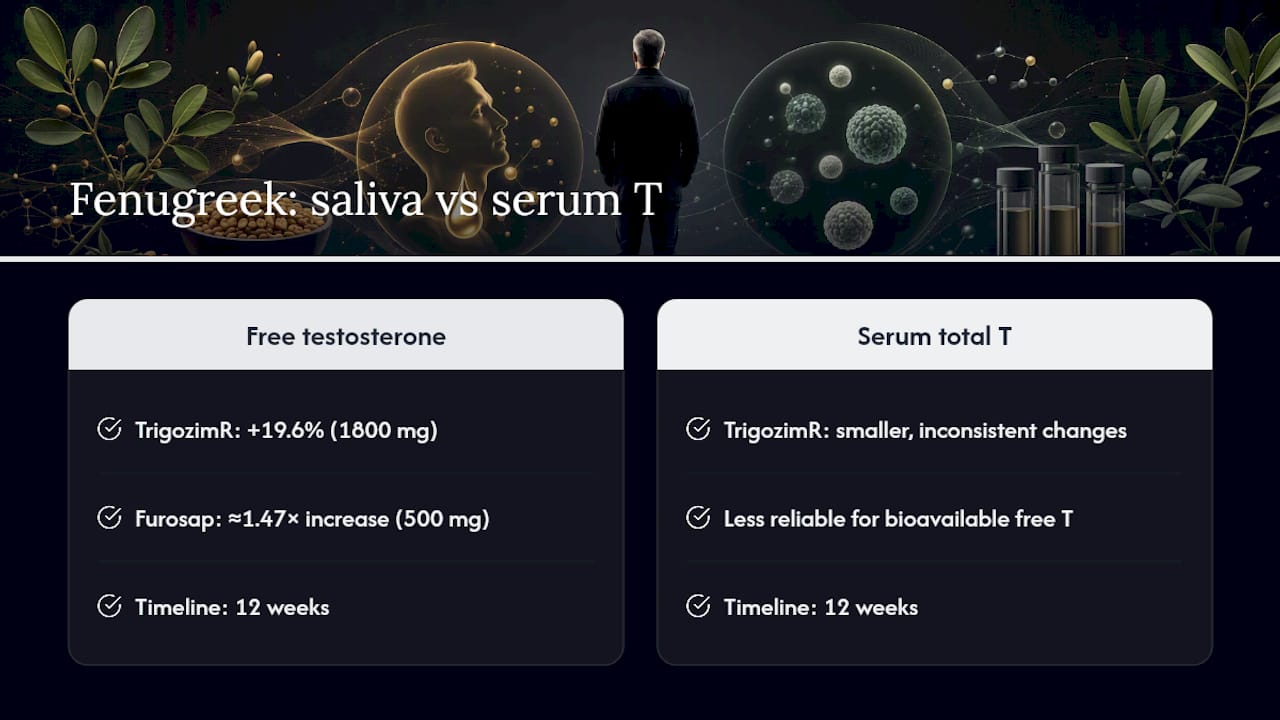
Furosap (fenugreek, protodioscin-enriched) A 12-week open-label study of Furosap at 500 mg/day in 50 male volunteers reported approximately a 1.47-fold increase in free testosterone for many participants, alongside improvements in sperm parameters, mental alertness, and libido. Standard blood chemistry safety panels remained stable throughout.
TrigozimR (fenugreek extract, randomized trial) A randomized 12-week trial with 95 completers (men aged 40–80) found that saliva free testosterone rose approximately 19.6% at the highest dose of 1800 mg/day versus placebo. Plasma changes were smaller and less consistent, underscoring why saliva testing captures the free, bioavailable fraction more reliably than serum total testosterone alone.
KSM-66 Ashwagandha An 8-week randomized, double-blind, placebo-controlled study of KSM-66 at 300 mg twice daily in approximately 100 men reported significant improvements in semen volume, sperm concentration, and sexual function scales (IIEF, SDI-2), with good tolerability and no adverse hepatic or renal signals.
Turnera diffusa (Liboost®) In vitro characterization of a Liboost® extract identified 49 compounds via HPLC-DAD-HRMS and demonstrated aromatase inhibition of 13–28%, reduced PDE5 expression in cell models, and modest nitric oxide increases. Clinical translation remains limited; this is mechanistic support, not a clinical outcome.
Eucommia ulmoides Preclinical work identified phytoandrogenic triterpenoids and lipidic components, including caprylic acid, that activate androgen receptor signaling and potentiate testosterone effects in vitro and in animal models. Evidence is primarily preclinical; treat it as directional, not definitive.
The clearest signal across human trials: standardized fenugreek extracts and Ashwagandha produce measurable changes in free testosterone and sexual health endpoints within 8–12 weeks, with acceptable safety profiles in healthy men.
How do plant compounds alter androgen signaling in men around 50?
Two primary mechanisms account for most of the observed effects.
- Direct androgen receptor activity: Eucommia triterpenoids bind androgen receptors in preclinical models, mimicking or potentiating testosterone's signaling without being exogenous hormones. This is distinct from hormone replacement and carries a different risk profile.
- Endocrine modulation: Flavonoids in Turnera diffusa inhibit aromatase (the enzyme that converts testosterone to estradiol) and reduce PDE5 expression, shifting the androgen-to-estrogen ratio and supporting nitric oxide pathways. Fenugreek's steroidal saponins, particularly protodioscin, appear to support free testosterone availability through upstream modulation rather than direct hormone delivery.
- Adaptogenic neuroendocrine effects: Ashwagandha's withanolides may modulate GnRH/LH/FSH signaling and reduce oxidative stress in testicular tissue, supporting semen parameters and sexual function through a neuroendocrine rather than direct androgenic pathway. For a deeper look at adaptogen science and executive resilience, the mechanism is worth understanding before you commit to a product.
Saliva testing captures free, bioavailable testosterone rather than total serum testosterone, which includes protein-bound fractions unavailable to tissues. For botanical interventions that shift binding or availability rather than total production, saliva testing can detect meaningful changes earlier. Pair it with a validated subjective performance scale and you have a trackable signal within a single 8–12 week run.
Why formulation and extraction method determine whether a product performs
Not all herbal androgen supplements are equivalent. The gap between a commodity herbal powder and a performance-grade botanical formulation is measurable at the batch level.
- Extraction method: Aqueous (green chemistry) extraction preserves complex bioactive matrices and eliminates solvent residue risk. Proprietary extraction processes are often necessary to concentrate specific actives, such as protodioscin, to clinically relevant levels.
- Standardization: Require a documented percentage enrichment of the active marker, for example 20% protodioscin for fenugreek, backed by batch-level COAs. This is what drives the reproducibility seen in the Furosap and TrigozimR trials. Crude powders with no standardization cannot replicate trial outcomes.
- Delivery method: Sublingual or oral spray delivery can bypass first-pass hepatic metabolism, producing faster onset and higher free-fraction exposure. For an executive needing cognitive clarity within a defined window, this matters. Capsule delivery is slower and subject to greater inter-individual variability in absorption. See how plant-derived performance sprays compare across delivery forms.
- Quality controls: Small-batch production, third-party identity and potency testing, heavy metal and microbial screening, GMP facility audits, and traceable sourcing are non-negotiable for a product you intend to monitor biologically.
Pro Tip: Ask any vendor for a batch-specific COA before purchasing. If they cannot provide one, the product is not clinical-grade regardless of what the label claims.
Safety, contraindications, and what to monitor during your trial
Clinical trials in this space apply consistent exclusion criteria. Screen yourself against them before week one.
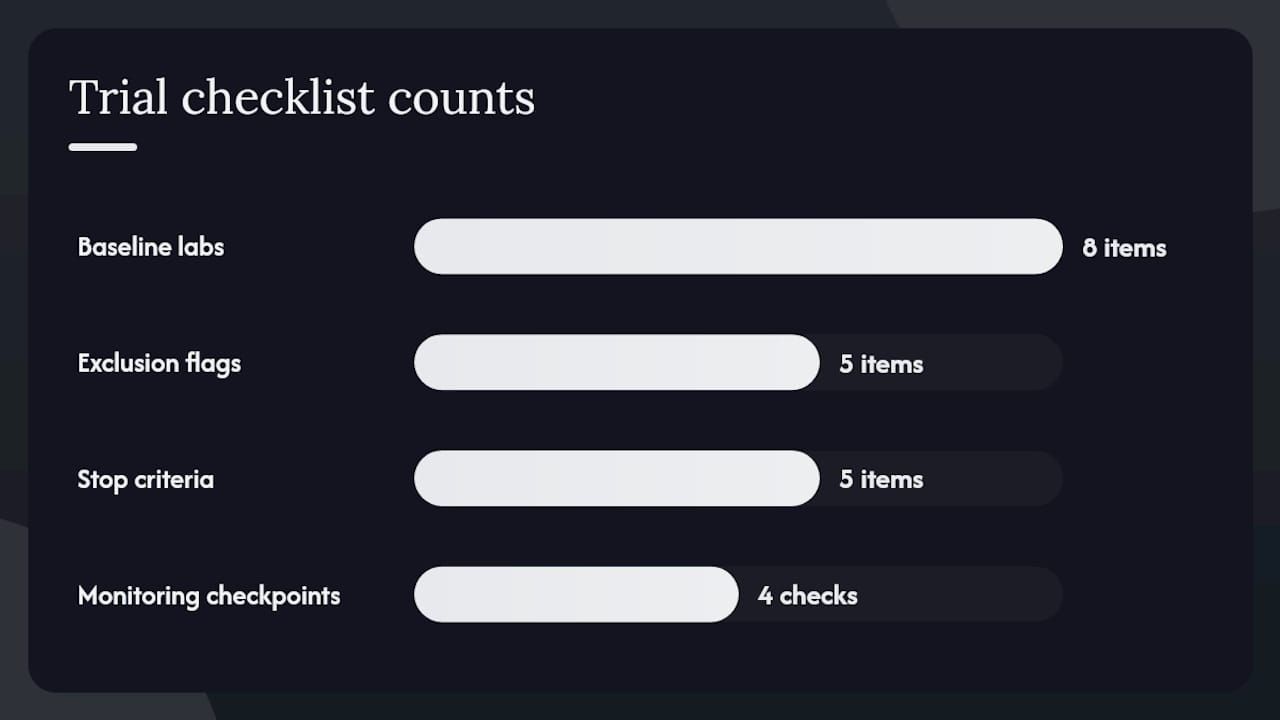
Exclusion flags:
- Significant hepatic or renal impairment
- Recent testosterone therapy or other androgenic therapy within the past 3 months
- Clotting disorders or anticoagulant use
- Active malignancy
- High alcohol intake (typically defined as more than 14 units per week in trial protocols)
Baseline labs to order:
- Morning serum total testosterone
- Saliva free testosterone (or free testosterone index if saliva testing is unavailable)
- SHBG
- CBC, ALT/AST, creatinine
- Lipid panel
- PSA when clinically indicated
For a detailed breakdown of free testosterone testing and interpretation, including how to read saliva results in context, that resource is worth reviewing with your clinician.
Monitoring timeline:
- Week 0: Full baseline panel as above
- Week 4: Symptom check; basic safety labs if any clinical signal
- Week 8: Saliva and serum repeat; compare to baseline
- Week 12: Primary outcome labs plus full safety panel; decision point
Stop criteria: Significant ALT/AST elevation, creatinine rise, unexpected PSA increase, palpitations, or significant mood change. Cease the supplement and pursue full clinical evaluation.
Dosing ranges from trials and a realistic week-by-week timeline
Dose ranges with clinical backing:
- Furosap (fenugreek, protodioscin-enriched): 500 mg/day for 12 weeks
- TrigozimR (fenugreek extract): 600–1800 mg/day; the 1800 mg/day dose produced the clearest saliva free-testosterone increase
- KSM-66 Ashwagandha: 300 mg twice daily for 8 weeks
- Turnera diffusa (Liboost®): mechanistic concentrations described in vitro; standard human dosing is not yet established from RCT data
Suggested executive starting ranges:
- Standardized fenugreek extract: 500–600 mg/day, matched to trial-equivalent protodioscin enrichment
- KSM-66 Ashwagandha: 300 mg twice daily
- Increase dose only when per-product clinical data supports it and under clinician oversight
Week-by-week expectations:
- Weeks 1–2: Subtle mood and energy signal; subjective, not yet measurable
- Weeks 3–6: Early saliva free-testosterone changes detectable; subjective shifts in drive and clarity more consistent
- Weeks 8–12: Most robust objective and subjective signals; primary decision point for continuation or adjustment
What should you demand from a premium plant androgen product?
A busy executive cannot afford to vet every vendor in depth. Apply this checklist and eliminate quickly.
- Active marker documentation: Named percentage enrichment (e.g., 20% protodioscin), not a generic "standardized extract" label
- Batch COAs: Third-party tested for identity, potency, heavy metals, and microbial load, available on request
- GMP manufacturing: Facility-level certification, not just product-level claims
- Clinical data citations: Human trials with free testosterone or saliva endpoints, documented dosing, and published safety panels
- Delivery format: Sublingual or oral spray option for faster absorption and higher free-fraction exposure
- Membership and onboarding: Baseline testing support, clinician-aligned starter protocol, and ongoing monitoring built into the product experience
- Transparency: Clear contraindications, documented stop criteria, and a refund or return policy
The precision guide to men's health optimization products covers these selection criteria in greater depth for executives comparing formulations.
A clinician-aligned 8–12 week starter protocol
- Week 0 (baseline): Order morning serum testosterone, saliva free testosterone, SHBG, CBC, ALT/AST, creatinine, lipid panel, and PSA as indicated. Complete a medication and supplement review. Confirm no exclusion criteria apply.
- Weeks 1–2: Begin product at documented clinical dose (standardized fenugreek 500–600 mg/day or KSM-66 300 mg twice daily, or the manufacturer's clinically documented dose). Log subjective changes daily. Schedule a clinician phone check at the end of week 2.
- Week 4: Symptom review. Order basic safety labs (ALT/AST, creatinine) if any clinical signal is present. Continue dosing if tolerating well.
- Weeks 8–12: Repeat saliva and serum testing. Compare directly to baseline values. Apply stop criteria: significant ALT/AST elevation, creatinine rise, PSA change outside pre-agreed threshold, new cardiac symptoms, or any clinician-determined adverse signal. If labs are stable and subjective performance has improved, decide on continuation or dose adjustment with clinician input.
Stop criteria summary:
- Significant liver or kidney marker elevation
- Unexpected PSA rise
- New cardiac symptoms or significant mood change
- Any clinician-determined adverse signal
How this evidence was selected and why it matters
The guidance here prioritizes IRB-approved human clinical trials, with preference for randomized, double-blind, placebo-controlled designs. Trials reporting free testosterone or saliva testosterone as endpoints were weighted above those reporting only total serum testosterone, because free testosterone reflects bioavailable androgen more directly. Safety panels and documented dosing timelines were required for inclusion in the primary evidence base.
- Prioritized: Human RCTs and open-label trials with measurable endpoints (saliva free testosterone, semen parameters, sexual function scales), published safety data, and documented dosing
- Deprioritized: Animal-only studies, non-standardized extracts without batch data, and mechanistic in vitro work without human corroboration
- Editorial safeguards: Limitations of each trial (sample size, open-label design, single-arm structure) are stated where relevant; no trial is presented as definitive proof
A note on why this approach fits the Viridos model
The protocol described here reflects exactly what Viridos was built around: precision over volume, evidence over marketing, and a controlled membership experience that supports the kind of disciplined trial a serious executive can actually trust. Small-batch Swedish production, proprietary aqueous extraction, sublingual delivery, and batch-level COAs are not differentiators we added for positioning. They are the minimum standard for a product you intend to monitor biologically. If you are evaluating whether a plant-derived androgen protocol belongs in your performance stack, the Viridos membership onboarding is designed to answer that question with data, not guesswork.
Viridos membership: a structured path to a disciplined trial
Viridos offers a controlled-access membership built for executives who want a clinician-aligned entry point, not a generic supplement subscription. Membership includes baseline testing support, a tailored starter protocol matched to your labs, small-batch Swedish sublingual spray with documented batch COAs, and ongoing monitoring checkpoints at weeks 4, 8, and 12. The onboarding flow is straightforward: apply, complete baseline testing, receive your protocol, and begin a tracked 8–12 week trial with clinician support at each decision point. For men who have done the research and want a product that matches the evidence standard, the Viridos membership is the structured next step. Review the application and confirm availability for your cohort.
Primary sources
- Furosap 12-week open-label trial (PMC): 500 mg/day, n=50, ~1.47-fold free testosterone increase, stable safety panels
- TrigozimR randomized 12-week trial (PLOS ONE): 95 completers, 1800 mg/day produced ~19.6% saliva free-testosterone increase vs placebo
- KSM-66 Ashwagandha 8-week RCT (PMC): 300 mg twice daily, n≈100, significant semen and sexual function improvements, no adverse events
- Turnera diffusa (Liboost®) in vitro characterization (MDPI): 49 compounds identified, 13–28% aromatase inhibition, reduced PDE5 expression
- Eucommia ulmoides preclinical phytoandrogen study (Springer/BMC): AR activation and testosterone potentiation in vitro and animal models; primarily preclinical
This article provides general informational guidance and does not constitute medical advice. Confirm current protocols and suitability with a qualified clinician before beginning any supplementation program.
This article is general information, not a substitute for advice from a qualified doctor. Consult a qualified healthcare professional about your own circumstances before acting on anything here.
Sources
- Efficacy of FurosapTM, a novel Trigonella foenum-graecum seed extract, in Enhancing Testosterone Level and Improving Sperm Profile in Male Volunteers - PMC
- Randomized trial of TrigozimR fenugreek extract and essential nutrients on testosterone in men (PLOS ONE)
- Efficacy and safety of eight-week therapy with Ashwagandha root extract in improvement of sexual health in healthy men - PMC
- Flavonoid Composition and Molecular Basis of the Potential Sexual-Enhancing Properties of a Turnera diffusa Extract (Liboost®) - MDPI
- Novel phytoandrogens and lipidic augmenters from Eucommia ulmoides | BMC Complementary Medicine and Therapies | Springer Nature Link