
TL;DR:
- Choosing high-quality supplements requires verifying certifications like NSF or USP, batch-specific COAs, and transparent ingredient dosing. Sophisticated brands publish detailed lab reports, disclose suppliers, and use clinically validated ingredient amounts to ensure efficacy. Relying solely on marketing claims or premium packaging can be misleading; thorough due diligence is essential for performance-oriented men.
The supplement aisle has never been more crowded or more confusing. A sophisticated supplement brand earns that designation through manufacturing standards, ingredient transparency, and scientific rigor — not through premium packaging or clever positioning. The brain health supplement market is on track to reach $6.80 billion by 2030, which means the competition for your attention and trust is accelerating. For disciplined men in demanding roles, the stakes of choosing wrong extend beyond wasted money. They extend to wasted time and missed performance.
Table of Contents
- Key takeaways
- Quality standards that separate sophisticated supplement brands
- Transparency and traceability as pillars of brand sophistication
- Science-backed formulations: what actually matters
- How to verify supplement quality before you buy
- My perspective on what actually separates real quality from noise
- Viridos: built on the standards this guide describes
- FAQ
Key takeaways
| Point | Details |
|---|---|
| cGMP compliance is the floor | Manufacturing quality requires cGMP adherence, but it does not guarantee ingredient accuracy without product-level testing. |
| Batch-specific COAs matter most | A brand certification does not cover every batch; only lot-matched COAs confirm what you are actually consuming. |
| Transparency over marketing claims | Sophisticated brands publish supplier sources and lab reports openly, not just "third-party tested" badges. |
| Clinical dosing separates real brands | Ingredient amounts must match clinically studied doses, not token quantities added for label appeal. |
| Certification fit depends on your goals | NSF Certified for Sport targets athletes; general consumers prioritize USP or NSF Dietary Supplement for purity and label accuracy. |
Quality standards that separate sophisticated supplement brands
Most men assume that a supplement's price point or brand reputation signals quality. It does not. The regulatory structure tells a different and more clarifying story.
Supplements are regulated as food, not pharmaceuticals. Manufacturers must comply with current Good Manufacturing Practices (cGMP), but products do not require FDA pre-market approval. That distinction matters. A company can legally sell a supplement without ever proving the label matches the contents inside the bottle, as long as it follows production process standards. cGMP compliance means the facility operates properly. It does not mean the finished product is what it claims to be.
This is where third-party certification enters as a meaningful signal. Not all certifications carry equal weight, though. The hierarchy runs roughly as follows:
- NSF Certified for Sport: Batch-level testing covers 280+ banned substances, designed specifically for competitive athletes. The most rigorous standard for substance screening.
- NSF Dietary Supplement: Focuses on label accuracy, contaminant control, and facility audits. Appropriate for performance-oriented men who are not competitive athletes.
- USP Verified: Independent verification of identity, potency, and purity. Widely respected and directly relevant for general consumers seeking confidence in what they are taking.
- Generic "third-party tested" claims: These tell you almost nothing. The phrase has no standard definition and no enforcement behind it.
A truly credible certification requires ongoing facility audits and batch-level product verification, not a one-time test conducted years ago. A brand that passed a single audit in 2021 and still displays that badge is not offering you current assurance.
Pro Tip: When evaluating a brand's certification claims, go directly to the NSF or USP certification databases and search for the specific product by name. If it does not appear, the claim is unverified regardless of what the label says.
For men focused on longevity and executive performance, the practical takeaway is clear: cGMP is the baseline you should expect as a given, and NSF Dietary Supplement or USP verification is the minimum meaningful signal of product-level quality.
Transparency and traceability as pillars of brand sophistication
The marketing language of premium wellness supplements has become remarkably sophisticated in its own right, which makes genuine transparency harder to spot. Any brand can claim "clean ingredients" or "research-backed formulas." What distinguishes a truly high-end health product is what it shows you, not what it tells you.
Radical transparency means publishing lot-specific lab reports and disclosing supplier names and origins. That is a meaningfully higher standard than claiming third-party testing. When a brand discloses the geographic source of its ashwagandha, the extraction method used on its lion's mane, and the specific lab that tested batch number 24031, it is giving you the tools to verify its claims independently. That is the architecture of trust.

Proprietary blends work in the opposite direction. When a label groups five or six ingredients under a single "Performance Matrix" with a combined weight but no individual amounts listed, the brand has protected its formulation from competitors while also preventing you from knowing whether any single ingredient reaches a useful dose. That is a trade-off that benefits the manufacturer, not you.
Red flags that indicate a brand is prioritizing marketing over quality:
- Proprietary blends with no individual ingredient doses disclosed
- "Third-party tested" badges with no certifying body named or no searchable database entry
- Vague origin claims such as "globally sourced ingredients" with no supplier documentation
- No batch-specific COAs available on the website or upon request
- Customer service that cannot confirm lot-specific testing results
"The most sophisticated brands provide radical transparency such as lot-specific lab reports and supplier name disclosures rather than proprietary blends or vague claims." — Vogue, The Art and Science of Choosing the Best Supplement Brands
Ingredients tested for heavy metals and environmental contaminants represent another layer of traceability. A brand that shares this data publicly is not just covering regulatory bases. It is signaling that it has nothing to hide and everything to prove. For a disciplined professional evaluating luxury nutritional brands, that signal is worth more than any lifestyle campaign.
Science-backed formulations: what actually matters
You can find a supplement with certified manufacturing, traceable sourcing, and transparent lab reports that still fails to deliver meaningful physiological results. The reason is almost always dosing.
Clinical dosing refers to the quantity of an ingredient validated in human research to produce a specific effect. Many brands include ingredients at doses far below what clinical studies used, effectively creating label decoration rather than functional formulation. Rhodiola rosea studied at 400mg per day does not perform the same when dosed at 50mg. The inclusion is technically accurate. The effect is not.
Here is what to look for when evaluating whether a top-tier supplement company has earned that designation through its formulations:
- Cross-reference ingredient doses against published research. PubMed is free and searchable. If the dose on the label is a fraction of what the cited study used, note that discrepancy.
- Check whether the brand references specific research. A footnote linking to a study is more credible than a general claim that an ingredient is "clinically studied."
- Look for minimal excipients. Sophisticated formulations use the smallest number of inactive ingredients necessary. Long lists of fillers, flow agents, and artificial colorings suggest cost optimization, not quality optimization.
- Confirm the form of each ingredient. Magnesium glycinate and magnesium oxide are not equivalent despite sharing a name. Methylcobalamin and cyanocobalamin differ significantly in bioavailability. A brand that specifies form understands bioavailability.
- Identify whether research was conducted on the finished product or only on individual ingredients. Some top-tier supplement companies run over 100,000 quality tests across raw material, in-process, and finished product stages. That level of verification is rare and meaningful.
Pro Tip: If a brand cites a clinical study, check whether the study used the same ingredient form and delivery method as the product. A study conducted on intravenous magnesium does not validate an oral magnesium capsule at the same dose.
For executive performance without stimulants, formulation precision is not a detail. It is the entire point. Sustained focus, stress resilience, and energy output at the level demanded by founders and senior leaders require compounds that actually reach target tissues in amounts that register physiologically.
How to verify supplement quality before you buy
Knowing what defines a sophisticated brand is useful. Having a practical process to verify claims before spending money is what actually protects you from the noise.
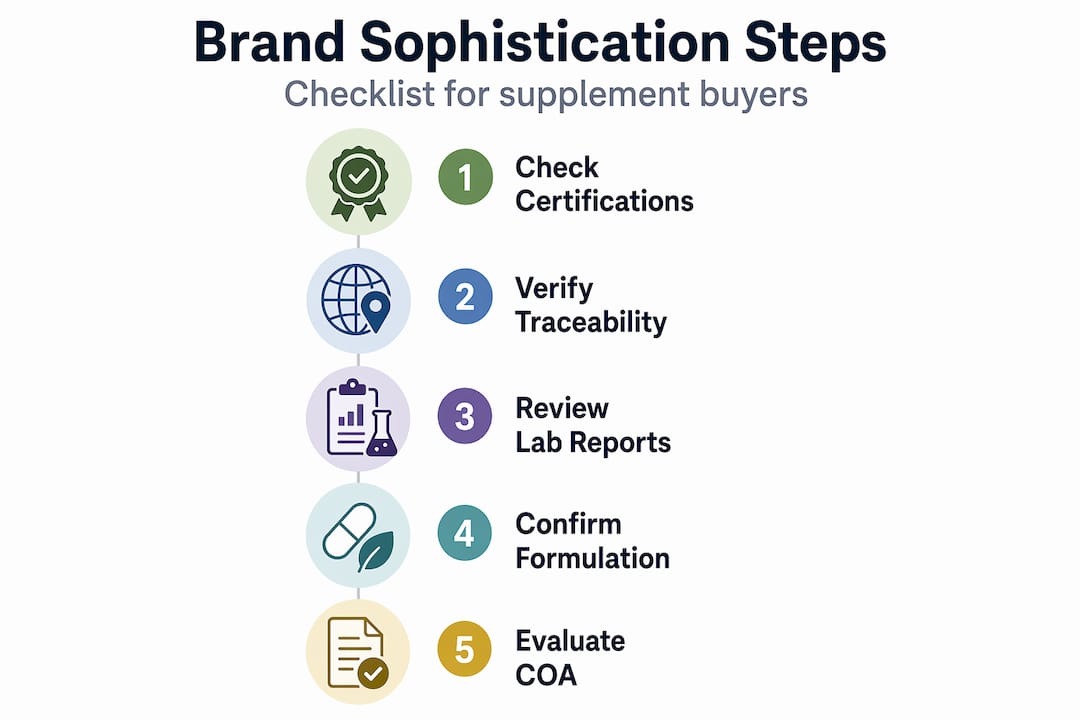
| Verification step | What to look for | Red flag |
|---|---|---|
| Check the certification database | Search NSF or USP databases by product name | Brand claims certification but product is not listed |
| Request a batch-specific COA | Ask for the COA matched to your bottle's lot number | Brand provides only a general certificate or ignores the request |
| Evaluate the ingredient label | Look for full disclosure of individual doses and ingredient forms | Proprietary blends with no individual amounts |
| Assess allergen and excipient load | Minimal inactive ingredients with clear labeling | Long lists of fillers, artificial dyes, or undisclosed additives |
| Research clinical backing | Match label doses to published human studies | Only in vitro or animal data cited; no dose alignment |
One clarification worth making: NSF Certified for Sport is not the right certification for most men. It addresses banned substance screening for athletes subject to doping controls. If you are not competing under a governing body, NSF Dietary Supplement or USP verification is more relevant because both programs focus on what matters most to you: label accuracy, purity, and contaminant control.
The batch-specific COA matched to a lot number is the single most underused verification tool available to consumers. Most people never request it. Brands that publish it openly are making a statement about accountability that no marketing campaign can replicate. When you find a brand that does this without being asked, that is a credibility signal worth weighing heavily.
For sustained elite performance, the verification process becomes a one-time investment per brand rather than a recurring task. Once you have confirmed a brand's manufacturing standards, certification authenticity, formulation quality, and traceability practices, you can trust that framework going forward.
My perspective on what actually separates real quality from noise
I have spent years evaluating supplements for men in high-stakes professional contexts, and the pattern I keep observing is consistent: the brands that shout most loudly about quality are rarely the ones that demonstrate it most rigorously.
What I have found is that the truly sophisticated brands are almost quiet about their credentials because they assume their customers will verify. They publish COAs. They name their suppliers. They cite the actual study, not just the ingredient. They do not need to claim premium wellness status because the documentation does the speaking.
The area where I see the most confusion among performance-oriented men is the certification question. Many assume that NSF Certified for Sport is the gold standard across the board. For a competitive athlete subject to testing, it is. For a founder or executive managing cortisol, sleep quality, and sustained cognitive output, the banned substance screen is almost beside the point. USP verification and transparent clinical dosing matter far more to that use case.
What I have also learned is that the best sophisticated nutrition available today is not necessarily the most visible. Small-batch production with genuine third-party verification at the batch level cannot scale the way mass-market brands can. Viridos operates on exactly this logic. Swedish small-batch production, precise formulation philosophy, and a refusal to obscure dosing behind proprietary blends. It is not the loudest brand. It is the kind that rewards the men who know how to look.
— Joakim
Viridos: built on the standards this guide describes

Viridos was designed around every criterion this guide covers. Small-batch Swedish production with precise formulation standards and a sublingual delivery philosophy that prioritizes bioavailability over convenience. The brand does not rely on proprietary blends or vague claims. It relies on the kind of scientific rigor and manufacturing discipline that holds up to the verification process described above.
For founders, executives, and high-agency professionals who want sustained performance rather than quick effects, Viridos offers a membership experience built on consistency and trust. Explore the Viridos Performance Journal for deeper coverage of supplement science, longevity strategies, and the evidence behind the formulations. This is where premium wellness supplements and executive performance thinking intersect with precision.
FAQ
What makes a supplement brand truly sophisticated?
A sophisticated supplement brand demonstrates cGMP compliance, genuine third-party certifications from NSF or USP, full ingredient disclosure with clinical doses, and batch-specific Certificates of Analysis that are accessible to consumers.
Is "third-party tested" a reliable quality signal?
Not on its own. The phrase has no standard definition. Credible certifications require ongoing batch-level testing and facility audits through recognized bodies like NSF or USP, not one-time anonymous tests.
What is a batch-specific COA and why does it matter?
A Certificate of Analysis matched to a product's specific lot number confirms that the exact batch you purchased was tested for purity, potency, and contaminant levels. General brand certifications do not cover every batch.
Should performance-focused men prioritize NSF Certified for Sport?
Not necessarily. NSF Certified for Sport focuses on banned substance screening for competitive athletes. Men focused on vitality and executive performance benefit more from NSF Dietary Supplement or USP verification, which address label accuracy and contaminant control.
How do I know if an ingredient dose is clinically meaningful?
Cross-reference the amount listed on the supplement label against published human research on that specific ingredient and form. If the label dose is significantly lower than what studies used to produce the measured effect, the inclusion is likely cosmetic rather than functional.