
TL;DR:
- Most executives rely on stimulants like caffeine, but they eventually undermine long-term performance by disrupting sleep and building tolerance. Building sustainable executive capacity requires four interconnected pillars: sleep quality, exercise, nutrition, and mental resilience, which produce compounding benefits over time. Prioritizing foundational habits over quick stimulant fixes creates a structural competitive advantage and preserves energy for high-level leadership.
Most executives running on three coffees and a pre-workout by 9 a.m. believe they're optimizing. They're not. What they're doing is borrowing energy from tomorrow to pay for today, and the debt compounds fast. The research is clear: caffeine disrupts sleep in ways that erode the very mental edge you're trying to protect, leaving a net performance deficit despite the acute alertness boost. This article cuts through the stimulant dependency culture and gives you the evidence-based, non-pharmaceutical frameworks that actually build durable executive capacity across the 40-65 range where the stakes are highest.
Table of Contents
- Why stimulants aren't a sustainable solution
- The four non-stimulant pillars of executive performance
- Evidence-based methods for each performance pillar
- Are stimulant-free performance supplements worth it?
- Building resilience: Managing energy and avoiding burnout
- Why most executives miss the mark on sustainable high performance
- Next steps: Sustainable performance for high achievers
- Frequently asked questions
Key Takeaways
| Point | Details |
|---|---|
| Foundational habits first | Optimal sleep, exercise, nutrition, and stress management provide superior long-term performance over quick-fix stimulants. |
| Short-term vs. long-term gains | Stimulants boost alertness acutely but undermine resilience, while non-pharmaceutical strategies build enduring cognitive and physical capacity. |
| Targeted supplements help | Non-stimulant supplements can enhance endurance, but must complement—not replace—lifestyle pillars. |
| Resilience comes from pacing | Energy management, reflection, and peer networks prevent burnout and sustain results for high achievers. |
Why stimulants aren't a sustainable solution
The appeal of stimulants is straightforward: they work, at first. A strong dose of caffeine or a prescription cognitive enhancer sharpens focus and delays fatigue. For a board presentation or a demanding negotiation, that short-term lift feels like a reasonable trade. The problem is the medium and long-term accounting.
Tolerance builds quickly. The same caffeine dose that gave you clarity at 35 barely lifts the fog at 50. You escalate. Sleep quality deteriorates. Emotional regulation softens. Decision quality, the thing you're paid most for, declines in ways that are subtle but consistent. As research in Nature confirms, stimulants can be effective short-term, but tolerance and sleep disruption mean they don't build long-term resilience the way foundational habits do.
"The executive who masters his physiology through discipline doesn't need a pharmaceutical shortcut. He's already running on a stronger engine."
The smarter path is building a biological system that generates performance natively, without dependency. That's not a soft wellness proposition. It's a structural competitive advantage. For performance tips for executives over 40, the literature consistently points to the same conclusion: the men who perform best in their 50s and 60s built habits in their 40s, not prescriptions.
The four non-stimulant pillars of executive performance
With the risks of stimulants clear, let's detail the evidence-based habits that enable sustainable high performance. The research on executive wellness doesn't point to a single intervention. It points to four interlocking domains that, when optimized together, produce outcomes no single supplement or drug can match.
Multimodal strategies combining exercise, CBT, nutrition, and sleep consistently outperform single-intervention approaches. Executives who thrive long-term aren't doing one thing exceptionally well. They're doing four things consistently well, and the compounding effect is significant.
Here's a summary comparison of the four pillars:
| Pillar | Primary benefit | Evidence strength | Time to noticeable improvement |
|---|---|---|---|
| Sleep optimization | Decision quality, emotional control | Very strong | 1-3 weeks |
| Aerobic and coordinative exercise | Cognitive function, working memory | Very strong | 6-12 weeks |
| Whole-food nutrition | Metabolic flexibility, sustained energy | Strong | 3-6 weeks |
| CBT and mental resilience | Self-regulation, organization | Strong | 4-8 weeks |
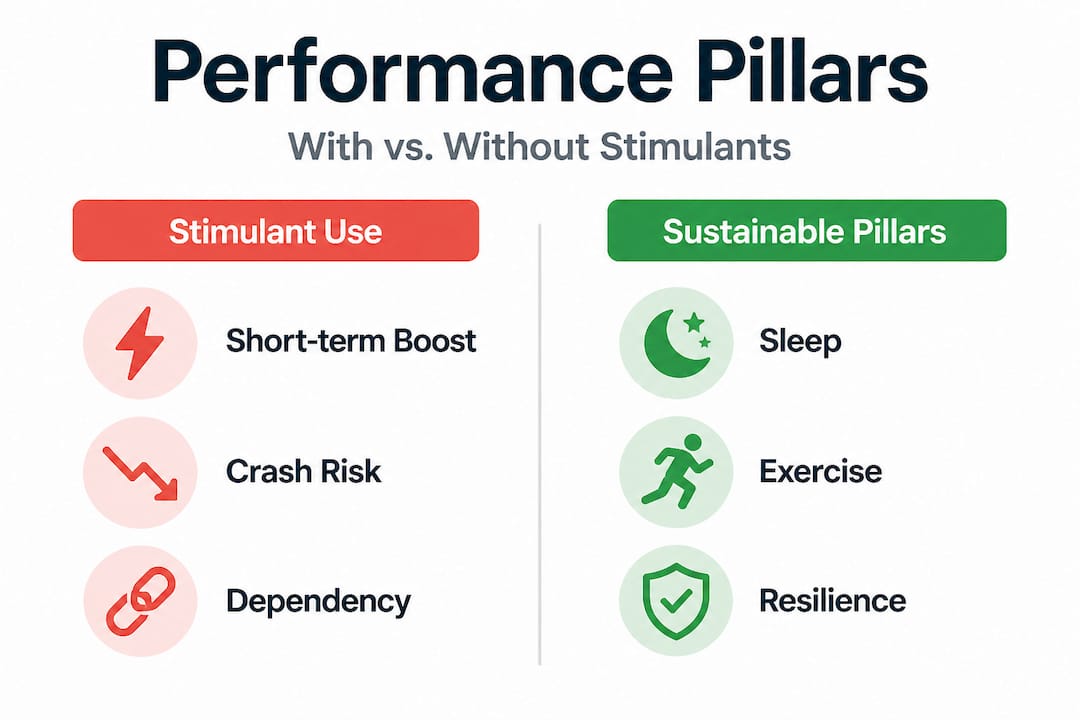
The critical insight here is synergy. Sleep amplifies the cognitive benefits of exercise. Nutrition stabilizes the mood benefits of sleep. Mental resilience practices make it easier to maintain all three. No pillar operates in isolation, which is why executives who treat these as separate "health boxes" to check miss most of the value.
Key points to keep in mind when approaching this framework:
- You don't need to be perfect across all four pillars simultaneously. Improving any single domain creates positive spillover into the others.
- The compounding effect of all four working together is non-linear. The sum is genuinely greater than the parts.
- Consistency over 90 days matters more than intensity in any single week.
For a deeper look at how these domains interact, executive wellness strategies from a systems perspective provide a strong starting framework.
Evidence-based methods for each performance pillar
Each pillar contains actionable, research-backed tactics. Let's break them down for practical application.
Sleep
Consistent 7-9 hours of quality sleep is the single highest-leverage input for executive performance. C-suite executives average a sleep quality score of 6.9/10, which is better than the general population but still leaves significant room for improvement. Sleep deprivation impairs prefrontal cortex function, the part of your brain responsible for strategic thinking and emotional regulation, faster than almost any other stressor.
Practical implementation:
- Lock a consistent wake time, even on weekends. This anchors your circadian rhythm more powerfully than any supplement.
- Drop your bedroom temperature to 65-68°F (18-20°C). Core body temperature must fall to initiate quality sleep.
- Eliminate screens 60 minutes before bed or use blue-light blocking lenses if evening device use is unavoidable.
- Avoid caffeine after 1 p.m. if you're sleeping at 10 p.m. Caffeine's half-life is approximately 5-6 hours, meaning half of a 3 p.m. coffee is still circulating at 9 p.m.
Exercise
Moderate aerobic exercise at 150+ minutes per week enhances executive function by increasing BDNF (brain-derived neurotrophic factor) in the prefrontal cortex. In midlife adults, improvements in working memory and cognitive flexibility appear within 6-12 weeks of consistent training. This isn't marginal. These are measurable gains in the cognitive domains most critical to leadership.

Beyond aerobic training, coordinative activities such as tennis, martial arts, or complex strength movements add a neurological challenge that straight cardio doesn't provide. They force the brain to adapt in real-time, building what researchers call "cognitive reserve."
For men sustaining high energy across demanding schedules, the weekly exercise structure that produces the best cognitive outcomes looks like this:
- Three sessions of moderate aerobic training (30-50 minutes each, zone 2 intensity, meaning you can still hold a conversation).
- Two sessions of compound strength training to support testosterone, bone density, and metabolic health.
- One coordinative or skill-based activity weekly for neurological challenge and recovery from structured training.
Nutrition
Daily fruit and vegetable intake, protein prioritization, and time-restricted eating using a 16:8 window directly support metabolic flexibility and reduce decision fatigue for executives. The 16:8 approach means eating within an 8-hour window (for example, noon to 8 p.m.) and fasting for the remaining 16 hours. This improves insulin sensitivity, supports cognitive clarity in the morning hours, and reduces the energy crashes that follow high-carbohydrate lunches.
Protein targeting for men over 40 should sit at approximately 0.7-1.0 grams per pound of body weight daily. This preserves lean muscle mass, supports neurotransmitter production, and keeps satiety stable across long working days.
Pro Tip: Don't optimize your breakfast. Skip it. Many executives find that a clean fast until noon, broken with a high-protein meal, dramatically sharpens their morning cognitive work because there's no post-meal energy dip competing with deep-focus tasks.
Mental resilience
CBT (cognitive behavioral therapy) applied to executive function improves organization, self-regulation, and reduces symptoms associated with attention difficulties. Meta-analyses show significant, persistent reductions in these challenges after treatment, and the skills transfer directly into leadership contexts. You don't need to be in clinical therapy to apply CBT principles. Structured journaling, cognitive reframing, and guided reflection are all accessible entry points.
For building executive motivation and resilience, a 15-minute daily reflection practice that reviews priorities, decisions, and emotional patterns creates the metacognitive awareness that separates good leaders from exceptional ones.
Are stimulant-free performance supplements worth it?
Beyond lifestyle, some leaders look for supplement solutions. Here's how non-stimulant options really measure up.
Non-stimulant supplements occupy a legitimate but specific role. They can support your performance architecture, but they cannot build it. The distinction matters because many executives flip this, treating supplements as the foundation and treating sleep and exercise as optional add-ons. That's a structural error.
Non-stimulant pre-workout ingredients like creatine, nitric oxide boosters, and amino acids sustain endurance and performance without the caffeine tolerance and adverse effects that come with stimulant-based formulas. Creatine, in particular, has one of the strongest evidence profiles of any supplement, supporting both physical power output and short-term memory and reasoning.
What non-stimulant supplements can realistically do:
- Creatine monohydrate: Improves strength output, supports cognitive processing speed, and is one of the most studied and well-tolerated compounds available.
- Nitric oxide precursors (such as L-citrulline or beetroot extract): Improve blood flow and cardiovascular efficiency during exercise, relevant for men over 40 where vascular health directly affects endurance.
- Essential amino acids: Support muscle protein synthesis and recovery, particularly important when training volume is moderate and dietary protein isn't always perfectly timed.
- Adaptogens (such as ashwagandha): Can reduce cortisol response to stress and support sleep quality in men experiencing high chronic stress loads.
Pro Tip: Before adding any supplement, track your sleep, training, and nutrition consistently for 30 days. If your fundamentals are weak, a supplement won't fix them. If your fundamentals are solid, a well-chosen non-stimulant formula can provide a meaningful edge. For supplement alternatives designed around executive performance, the quality and formulation of what you use matters significantly more than the quantity.
Building resilience: Managing energy and avoiding burnout
With practical habits and smart supplementation in place, long-term resilience and energy depend on how you manage your workflow and boundaries.
The data on CEO health is instructive here. 78% of CEOs exercise at least three times per week, and the healthiest executives consistently use delegation, scheduled reflection time, and peer networks as structural tools for energy management. The goal is to spend roughly 25% of your working week in reflection and strategic thinking, not reactive task execution.
This is where many high performers fail. They're exceptionally good at doing, and they resist the deliberate slowdowns that would actually multiply their output. Hyperenergetic leaders, those who pride themselves on relentless output, face a specific burnout risk. As HBR research on hyperenergetic executives shows, the very trait that drove their early success becomes a liability when it isn't paired with deliberate pacing and recovery.
Practical resilience habits:
- Schedule two 90-minute deep-work blocks daily and protect them as firmly as you would a board meeting.
- Build a peer network of three to five leaders at a similar level. Shared context removes the isolation that accelerates burnout.
- Audit your calendar weekly for tasks that could be delegated without loss of quality. If you're doing $50/hour work as a $5,000/hour decision-maker, you're draining executive energy unnecessarily.
- Use a simple weekly energy management review to assess where your highest-energy hours went. Track this for 30 days and patterns will become obvious.
Perfectionism is a related liability. In creative or analytical work, the jump from 80% to 100% quality often costs more energy than the entire first 80% did. Knowing where "excellent" is enough, and where it needs to be exceptional, is a skill worth developing deliberately.
Why most executives miss the mark on sustainable high performance
Here's what most high achievers, despite best intentions, get wrong about performance without stimulants.
The most common mistake is treating performance optimization like a product launch. There's a kick-off, an aggressive implementation phase, and an expectation of rapid, measurable results. When the 30-day transformation doesn't materialize, the whole framework gets abandoned in favor of the next protocol. This cycle is exactly why smart people keep returning to stimulants. They deliver fast, legible results, even if those results are borrowed.
The second mistake is chasing novelty over basics. Cold plunges, red-light panels, peptide stacks, continuous glucose monitors. None of these are useless, but for the executive running five hours of sleep and a sporadic exercise schedule, they are distractions. Tracking HRV and sleep quality for personalization across seven domains including exercise, nutrition, and stress management is where C-suite health optimization actually lives. The executives with the strongest long-term performance profiles aren't the ones with the most sophisticated protocols. They're the ones who've made the basics completely non-negotiable.
Patience is a performance variable. The prefrontal cortex improvements from consistent aerobic exercise take 6-12 weeks to manifest. The metabolic adaptations from time-restricted eating take 4-6 weeks to stabilize. You're working with biology, not software. Expecting a two-week patch to solve a decade-long imbalance is how experienced, intelligent people continue to underperform their potential.
For a full foundation, the guide to executive vitality lays out what genuinely high-performance living looks like across all the variables that matter.
The men who perform best in the back half of their careers didn't discover a better drug. They built a better system, one brick at a time, over years.
Next steps: Sustainable performance for high achievers
You now have the framework. The next challenge is execution and consistency over time. That's where most good intentions lose momentum.
VIRIDOS is built specifically for men who take this seriously. Our Performance Journal provides a structured tracking tool designed around the four performance pillars covered here, giving you a daily system to monitor sleep, training, nutrition, and mental clarity with the precision that actually produces behavioral change. For those who want a more committed path, the VIRIDOS Membership delivers premium resources, curated protocols, and a community of high-agency professionals pursuing the same sustained edge. This is where your framework becomes a practice.
Frequently asked questions
What is the most effective non-stimulant strategy for executive performance?
The most effective approach combines optimized sleep, moderate exercise, balanced nutrition, and mental resilience training, rather than relying on any single tactic. Multimodal strategies consistently outperform single interventions for executives in demanding roles.
How long does it take to see cognitive benefits from lifestyle changes?
Most executives notice improved cognitive function, focus, and memory in as little as 6-12 weeks when consistently applying optimal sleep, exercise, and nutrition. Aerobic exercise at 150+ minutes per week drives BDNF-related improvements in working memory and cognitive flexibility within that window.
Are non-stimulant supplements safe and effective?
Many non-stimulant supplements like creatine and amino acids are safe and can improve performance, but they should supplement, not replace, core habits. Non-stimulant compounds including creatine and NO boosters sustain endurance without caffeine tolerance or adverse effects.
Why is sleep more important than caffeine for executives?
Sleep quality directly influences decision making, mood, and mental clarity, while excessive caffeine use disrupts the sleep architecture that makes those functions possible. Caffeine creates a net performance deficit over time by degrading sleep quality despite the short-term alertness it provides.