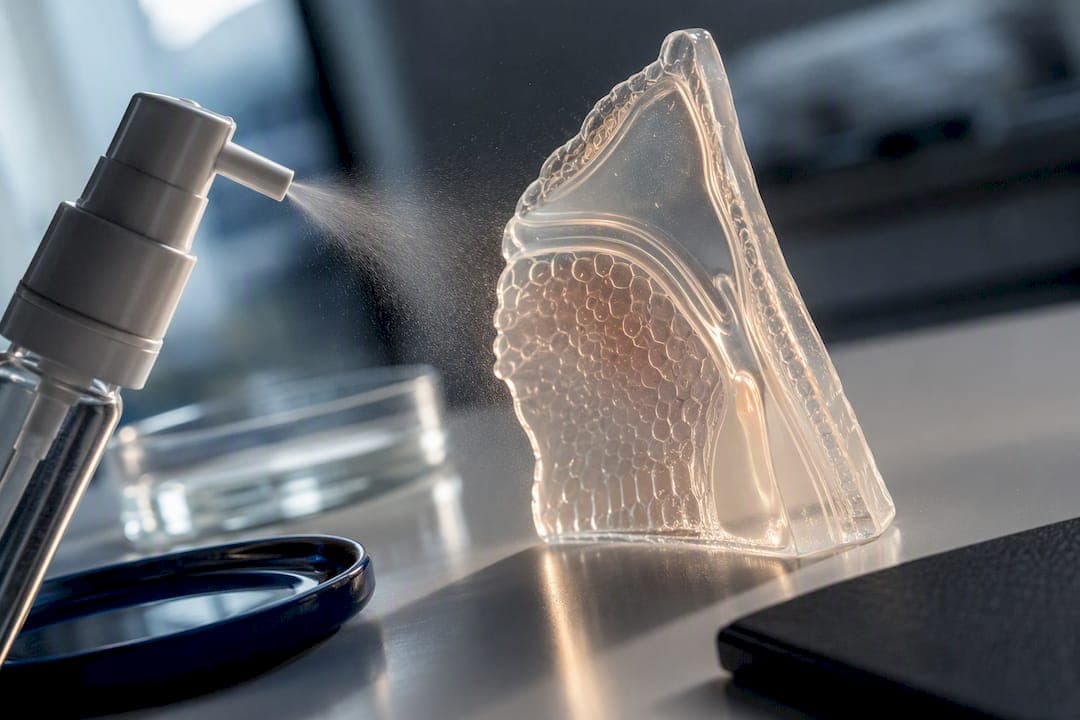
Most mouth sprays act locally, not systemically. Only formulations engineered with mucoadhesive polymers, penetration enhancers, or liposomal carriers reliably reach the bloodstream through the oral mucosa. For the majority of throat and mouth sprays on the market, including well-studied cold products, the clinical evidence supports a modest local effect, not a drug-like systemic outcome. Some companies design their products with or without regard to this distinction.
TL;DR:
- Mouth sprays without mucoadhesive agents or penetration enhancers provide minimal systemic absorption and primarily offer local effects.
- Achieving meaningful systemic delivery through mouth sprays requires specific formulation techniques like liposomal carriers or bioadhesives, not just the spray mechanism.
- Clinical evidence shows ColdZyme offers modest benefits, such as shortening cold duration by about one day when used early, with safety comparable to placebo.
- The oral mucosa's limited surface area, saliva washout, and enzymatic activity significantly restrict absorption, especially for non-engineered formulations.
- Regulatory categories influence claims: medical device sprays focus on local action, while supplements can't legally claim systemic effects without extensive testing.
Table of Contents
- What Does Munspray Biotillgänglighet Actually Mean?
- How Does the Oral Mucosa Absorb Drugs, and What Limits It?
- What Formulation Features Increase Buccal or Sublingual Absorption?
- What Does the Clinical Evidence Show for Throat Sprays Like ColdZyme?
- How Should You Use a Mouth Spray for Realistic Results?
- How Does Mouth Spray Bioavailability Compare to Tablets and Nasal Sprays?
- Why Does Absorption Site Matter for Overall Efficacy?
- What Are the Gaps in Current Evidence on Mouth Spray Bioavailability?
- How Do pH and Excipients Affect Mucosal Absorption and Stability?
- What Regulatory Standards Govern Bioavailability Claims for Mouth Sprays?
- How Viridos Approaches Mucosal Delivery for Performance Supplements
- Precision Oral-Spray Access Through Viridos Membership
- Sources
- FAQ
What Does Munspray Biotillgänglighet Actually Mean?
Bioavailability describes the fraction of an active compound that reaches systemic circulation intact and available to act. For an oral spray, that fraction depends entirely on where the ingredient is meant to work.
Two very different mechanisms get marketed under the same word: "spray." A local barrier spray coats the pharyngeal or oral mucosa to physically or chemically interact with pathogens or irritants right where they sit. A systemic spray is designed to push molecules through the mucosal lining into the capillary bed beneath it, aiming for blood concentration much like a tablet or injection would.
The oral mucosa was never built to be a drug highway. Surface area is limited compared to the small intestine, saliva constantly dilutes and washes away whatever lands on it, and enzymes in saliva begin breaking down peptides and other actives within minutes. A systematic review on buccal spray delivery found that spray-based vitamin D3 was not consistently superior to capsules, largely because these physiological limits blunt the advantage sprays are assumed to have. Reading a label with this distinction in mind changes what you should expect from any product claiming "fast absorption."
How Does the Oral Mucosa Absorb Drugs, and What Limits It?
The mucosal lining under the tongue and inside the cheek is thin and richly vascularized, which is exactly why it draws interest for drug delivery. Compounds can, in principle, pass through a few cell layers and enter capillaries directly, skipping the liver's first-pass metabolism that tablets must survive.
In practice, three constraints govern whether that potential gets realized. Residence time is the first: a spray only works while it stays in contact with tissue, and swallowing typically clears material within a couple of minutes. Salivary washout is the second, diluting concentration continuously. Enzymatic degradation is the third. Research on transmucosal drug delivery documents how salivary enzymes degrade unprotected peptides and other actives before meaningful absorption occurs, unless the formulation includes bioadhesives or enzyme inhibitors that buy the compound more time.

Some products do overcome these limits. Reviews of transbuccal delivery systems describe systemic exposure achieved with buccal insulin formulations and sublingual nitroglycerin, both engineered specifically to exploit the short absorption window rather than fight it. These are the exceptions that prove the rule: systemic delivery through the mouth is achievable, but it demands deliberate formulation work, not just a spray bottle and a claim.
What Formulation Features Increase Buccal or Sublingual Absorption?
Getting a compound past saliva and into the bloodstream through the mouth requires solving several engineering problems at once. The formulations that succeed generally combine multiple strategies rather than relying on one.
- Mucoadhesive polymers extend contact time by binding the formulation to mucosal tissue instead of letting saliva sweep it away.
- Penetration enhancers, such as certain lecithin or propanediol compounds, temporarily loosen the tight junctions between epithelial cells to allow larger molecules through, though higher concentrations raise the risk of local irritation.
- Liposomal and nano-carrier systems encapsulate actives in lipid structures that can cross membranes more efficiently. Liposomal melatonin is a commonly cited illustration of this approach in consumer formulations.
- Droplet and device engineering controls particle size and spray pattern, which affects how evenly and how quickly a dose contacts absorptive tissue.
A 2025 review of oral mucosal dosage forms confirms that these formulation choices, not the delivery route by itself, determine whether a spray achieves meaningful systemic uptake.
Pro Tip: If a product claims rapid systemic effects but lists no mucoadhesive agent, penetration enhancer, or carrier system on its label, treat the claim skeptically. Absorption technology, not the spray mechanism alone, does the work.
The trade-off is real. Higher enhancer concentrations that improve absorption also tend to increase taste complaints and mucosal irritation, which is why well-designed products balance efficacy against tolerability rather than maximizing penetration at any cost.
What Does the Clinical Evidence Show for Throat Sprays Like ColdZyme?
The best-studied local throat spray for cold symptoms is ColdZyme, a glycerol and cod-trypsin formulation, and its trial record is worth examining closely because it illustrates the gap between laboratory promise and measured clinical benefit.
A randomized, double-blind, placebo-controlled trial involving 438 symptomatic participants found that early use of ColdZyme shortened median cold duration by about one day and reduced pharyngeal viral load compared with placebo, with improved quality-of-life scores among users. A companion publication in PLOS One confirmed these modest but measurable benefits, alongside a favorable safety profile across the studied population.
- In vitro testing showed the formulation reduced viral activity by 64% to 100% against several respiratory viruses.
- Clinical effect sizes were far more modest: a modest reduction in symptom duration, not a cure or full prevention.
- Benefits were consistently tied to early application, meaning time-to-first-use at symptom onset mattered more than any other single variable in the trials.
Tolerability was good across trials, with no significant safety signals distinguishing the active spray from placebo. The honest summary: laboratory virucidal activity is strong, but the clinical translation is a modest shortening of illness, not elimination of it.
How Should You Use a Mouth Spray for Realistic Results?
Reading the label correctly matters as much as using the product correctly. Language like "coats," "barrier," or "local action" signals a topical mechanism. Language implying "absorbed," "delivered to the bloodstream," or "systemic" should be backed by named formulation technology, not just asserted.
- Start at the first sign of symptoms. Trial data consistently shows early application drives the observed benefit; waiting a day or two reduces the effect.
- Respect the food and drink window. Avoid eating or drinking for roughly 20 minutes after use so the active ingredient isn't washed away before it can act.
- Follow the stated dosing frequency exactly. Under-dosing during the absorption window undermines even well-formulated products.
- Watch for irritation, unusual taste reactions, or persistent symptoms, and consult a physician if symptoms worsen or don't resolve within the expected timeframe for a cold.
- Know the regulatory category. Medical device sprays and dietary supplement sprays are held to different evidentiary standards, and the label will usually indicate which one you're holding.
How Does Mouth Spray Bioavailability Compare to Tablets and Nasal Sprays?
Route of administration changes the math on how much of a dose actually reaches the bloodstream, and the differences are large enough to matter for anyone comparing formats.
Oral tablets must survive stomach acid and first-pass liver metabolism before any active compound reaches systemic circulation, which is why many drugs lose a substantial share of their dose before ever reaching a blood vessel. Sublingual and buccal sprays bypass that liver pass entirely when absorption actually occurs through the mucosa, which is the theoretical advantage sublingual nitroglycerin and buccal insulin formulations were built to exploit. But that advantage only materializes when the formulation genuinely achieves mucosal uptake rather than simply being swallowed, at which point it behaves pharmacokinetically just like an oral tablet.
Nasal sprays occupy a different niche. The nasal mucosa has higher permeability than the mouth for many compounds and a very rich blood supply, which is why nasal delivery is used for some hormones and rapid-onset medications. But nasal residence time is short and highly variable person to person, and irritation limits how aggressively enhancers can be used.
The practical takeaway for a discerning buyer: a mouth spray's bioavailability is not fixed by the category. It sits on a spectrum from "essentially local, negligible systemic exposure" to "comparable to a fast-acting tablet," and where a given product lands depends entirely on the formulation choices covered above, not on the fact that it happens to be a spray.

Why Does Absorption Site Matter for Overall Efficacy?
Where a compound enters the body changes not just how much reaches circulation, but how fast and how consistently it does. Absorption through the oral mucosa, when it genuinely occurs, delivers compounds directly into systemic circulation without first-pass liver metabolism, which for some molecules preserves potency that would otherwise be lost to hepatic breakdown.
This matters most for compounds that are heavily metabolized on first pass through the liver. For those molecules, mucosal absorption can mean a meaningfully higher effective dose reaches circulation compared to swallowing the same amount. For compounds that aren't significantly affected by first-pass metabolism, the practical advantage of mucosal delivery over oral ingestion shrinks considerably, and the extra formulation complexity may not translate into a meaningfully different outcome.
Consistency matters as much as peak absorption. A product that produces reliable, repeatable uptake spray after spray is more useful than one with a higher theoretical ceiling but wide variability between doses. That's the quieter, less marketed half of the efficacy equation. Variable absorption from a person's saliva volume, swallowing habits, and even mouth dryness can undermine an otherwise well-designed formulation, which is why formulation reviews increasingly emphasize consistency testing alongside peak plasma concentration data.
What Are the Gaps in Current Evidence on Mouth Spray Bioavailability?
The evidence base for mouth spray bioavailability is genuinely uneven across product categories, and buyers deserve to know where the confidence is thin.
Local-acting throat sprays for cold symptoms, particularly ColdZyme, have the strongest evidence: multiple randomized, double-blind, placebo-controlled trials with hundreds of participants. Systemic nutrient sprays have far weaker support. The vitamin D3 buccal spray review found only four relevant randomized trials with heterogeneous results, and no consistent superiority over capsules emerged.
Most formulation technology claims (mucoadhesives, penetration enhancers, liposomal carriers) rest on pharmacological principle and smaller mechanistic studies rather than large head-to-head trials against oral alternatives. That doesn't mean the mechanisms are false. It means the leap from "this technology can increase mucosal permeability in principle" to "this specific consumer product delivers a clinically meaningful systemic dose" is rarely tested directly for most products on shelves.
Long-term outcome data is thinner still. Trials tend to measure short-term endpoints, symptom duration, plasma concentration curves, and rarely follow performance or health outcomes over months. For any product marketed on sustained benefit rather than immediate symptom relief, that's the honest limitation to hold in mind.
How Do pH and Excipients Affect Mucosal Absorption and Stability?
The chemical environment a spray creates in the mouth influences absorption as much as the active ingredient itself. Most drug compounds absorb best in an unionized state, and pH determines what fraction of a molecule exists in that form at the moment it contacts mucosal tissue.
A formulation buffered to a pH that favors the unionized form of its active ingredient will generally show better mucosal uptake than an identical concentration at a pH that favors the ionized form, since ionized molecules cross lipid membranes far less readily. This is a core reason two products with the same nominal dose can perform differently.
Excipients, the inactive ingredients that carry and stabilize the active compound, do more than fill volume. Glycerol and similar humectants affect viscosity and mucosal contact time. Preservatives and stabilizers protect the active ingredient from degradation during shelf storage but must be chosen carefully, since some antimicrobial preservatives can themselves irritate mucosal tissue at higher concentrations. Formulation reviews covering transmucosal delivery determinants treat excipient selection as inseparable from the pH and enhancer strategy, not as an afterthought bolted on for taste or texture.
What Regulatory Standards Govern Bioavailability Claims for Mouth Sprays?
Regulatory classification determines what a manufacturer is actually allowed to claim, and it's the fastest way to sort marketing language from tested evidence.
Products positioned as medical devices, ColdZyme among them, are typically evaluated on local physical or barrier action and must meet device-specific safety and performance standards rather than the pharmacokinetic bioavailability standards applied to drugs. Products marketed as dietary supplements face a lighter evidentiary bar in most markets and generally cannot legally claim to treat or prevent disease at all, regardless of what their formulation technology might theoretically support.
This split matters directly for interpreting bioavailability claims. A supplement spray claiming "enhanced absorption" is describing a formulation property, not an approved systemic drug effect, unless it has gone through the clinical testing that a drug approval requires. Executives evaluating these products should treat "bioavailability" language on a supplement label as a formulation claim to weigh against the mechanisms described above, not as a substitute for regulatory drug approval.
How Viridos Approaches Mucosal Delivery for Performance Supplements
Some performance supplement brands design their oral sprays around such physiological principles rather than marketing shorthand, emphasizing dosing accuracy, mucosal contact time, and formulation stability, with small-scale production practices. Executives serious about performance longevity should favor formulation transparency over absorption slogans. The science behind Viridos details the extraction and delivery rationale for readers who want the underlying design logic, and the timing guidance for sublingual use covers when application matters most.
— Joakim
Precision Oral-Spray Access Through Viridos Membership
Viridos is built for men who have already separated formulation substance from spray-bottle marketing and want a product designed around mucosal physiology rather than around a label claim. The performance spray is available exclusively through controlled membership, with small-batch Swedish production maintaining consistency batch to batch rather than scaling for mass distribution.

Membership operates on two tiers: Member at $99 per month and Professional at $299 per month, both detailed on the Viridos pricing page. Access is by application rather than open checkout, which keeps cohort size limited and production disciplined. If the distinction between local action and genuine systemic formulation covered in this piece resonates with how you evaluate any supplement, review the membership details and apply for the tier that matches your commitment.
This article is general information, not a substitute for advice from a qualified doctor. Consult a qualified healthcare professional about your own circumstances before acting on anything here.
Sources
- Early intervention with ColdZyme mouth spray after self-diagnosis of common cold: A randomized, double-blind, placebo-controlled study (PLOS/open-access printable)
- Early intervention with ColdZyme mouth spray after self-diagnosis of common cold: randomized, double-blind, placebo-controlled study (PLOS One)
- Comparative effectiveness of vitamin D supplementation via buccal spray vs oral supplements: systematic review (British Journal of Nutrition / PMC)
- Bioavailability enhancement and formulation technologies of oral mucosal dosage forms: A review (MDPI, 2025)
FAQ
Is ColdZyme a Scam?
No. ColdZyme is backed by a randomized, double-blind, placebo-controlled trial involving 438 participants, which found a modest but measurable reduction in cold duration and pharyngeal viral load. The evidence supports a real, if limited, local effect rather than a dramatic cure.
Which Is Better for a Cold, ColdZyme or Other Throat Sprays?
ColdZyme has one of the stronger clinical evidence bases among local-acting cold sprays, with results published in PLOS One showing modest shortening of symptom duration when used early. Direct head-to-head trials against other named branded throat sprays are limited, so comparisons should rest on each product's own published trial data rather than marketing claims.
What Side Effects Does ColdZyme Cause?
Clinical trials reported a favorable safety and tolerability profile, with no significant difference in adverse events between the active spray and placebo groups. Reported issues, when they occurred, were generally mild and related to taste or brief local irritation.
What Is Cod Trypsin, and Why Is It in Throat Sprays?
Cod trypsin is an enzyme derived from cod fish, combined with glycerol in some throat sprays to create the active barrier formulation used in ColdZyme. In vitro testing shows this combination reduces activity of several respiratory viruses on contact, though the measured clinical benefit is more modest than the in vitro virucidal data alone would suggest.