
TL;DR:
- Most men seeking peak performance have tried supplements and face frustration over inconsistent results. Precision formulation tailors nutritional strategies using individual genetics, microbiome, biomarkers, and lifestyle data to optimize efficacy and predictability. Quality manufacturing and iterative monitoring are essential to deliver reliable, personalized supplements that effectively meet unique biological needs.
Most men between 30 and 55 who care about performance have tried supplements. Most have also experienced the quiet frustration of paying premium prices for results that are either negligible or impossible to attribute to anything specific. The problem is rarely motivation. It is the underlying assumption that a single formula works equally well for every man, regardless of genetics, biomarker status, microbiome composition, or life demands. Precision formulation rejects that assumption. It is a scientifically rigorous methodology that builds nutritional and supplement strategies from individual biological data up, rather than from population averages down.
Table of Contents
- Key Takeaways
- What precision formulation actually means
- Manufacturing precision: what happens before the capsule reaches you
- From data to protocol: how personalized formulation works in practice
- Pitfalls to avoid when evaluating precision programs
- My perspective on precision formulation and real-world performance
- How Viridos applies this to executive performance
- FAQ
Key Takeaways
| Point | Details |
|---|---|
| Precision means personalized biology | Genetics, biomarkers, microbiome, and lifestyle data all shape what your body actually needs from supplementation. |
| Manufacturing quality determines efficacy | Quality by Design and Design of Experiments frameworks are what separate consistent, reliable products from variable ones. |
| Iteration beats one-time planning | Baseline testing followed by retesting is what drives meaningful biomarker improvement over time. |
| Genetic data alone is not enough | SNP analysis without biomarker and lifestyle context misses the majority of your nutritional picture. |
| Hype is easy to spot when you know the standard | Sound precision formulation programs include clinical validation, sequential testing, and regulatory-grade quality controls. |
What precision formulation actually means
The term gets used loosely. In its rigorous form, precision formulation tailors diet and supplement protocols using an individual's genetics, microbiome profile, metabolomics, and lifestyle data rather than a one-size-fits-all model. Tufts University researchers describe it as an integration of advanced scientific methods and AI to generate personalized dietary responses that generic protocols cannot match.
This matters because human biology is not average. Two men of the same age, weight, and fitness level can absorb, metabolize, and respond to identical compounds in profoundly different ways. One absorbs magnesium efficiently through diet. The other runs chronically depleted despite adequate intake. One processes B12 through standard methylation pathways. The other carries MTHFR variants that demand a different form entirely. Blanket formulas address neither.
The biological inputs that inform high precision formulation fall into four connected categories.
- Nutrigenomics. Your genetic variants influence how you absorb fat-soluble vitamins, process certain amino acids, and respond to dietary fat or caffeine. SNP analysis provides a map of inherited predispositions.
- Biomarkers. Blood and urine panels classify over 100 indicators of nutritional status, hormonal function, inflammatory load, and metabolic efficiency. These are the real-time signals your genetics alone cannot provide.
- Microbiome profiling. Gut composition directly affects how you convert dietary compounds into bioavailable forms. Measuring microbial diversity before and after intervention reveals whether a formulation is actually working at the absorption level.
- Exposome and lifestyle data. Sleep quality, training load, chronic stress, alcohol consumption, and environmental exposures all shift your nutritional requirements in ways that no genetic test can predict.
Large-scale evidence is accumulating. The NIH Nutrition for Precision Health project is enrolling 10,000 or more participants to build predictive models for individualized dietary responses. When that data matures, the gap between personalized and generic supplementation will become difficult to ignore.
Pro Tip: Before investing in any precision nutrition program, confirm it combines at minimum a biomarker panel and lifestyle intake with any genetic analysis. Genetic data without the others is an incomplete picture.
Manufacturing precision: what happens before the capsule reaches you
Understanding formulation design best practices means looking past ingredient selection into how a product is actually built. The most sophisticated ingredient list means nothing if the manufacturing process introduces variability. A 200mg dose that delivers anywhere between 140mg and 260mg depending on the batch is not precision. It is noise.
The pharmaceutical and advanced supplement manufacturing industries address this through two frameworks that every quality-focused producer should be using.
- Quality by Design (QbD). This approach defines target product quality upfront and systematically builds that quality into every stage of development. It identifies Critical Quality Attributes (the characteristics that directly affect safety and efficacy) and Critical Process Parameters (the variables that influence them). Rather than testing quality in at the end, QbD builds it in from the start.
- Design of Experiments (DoE). QbD adoption integrating DoE allows manufacturers to systematically explore how multiple variables interact simultaneously. Instead of changing one factor at a time (which misses interaction effects), DoE maps the entire design space with mathematical precision, identifying optimal conditions and their boundaries.
- Process validation and lifecycle management. Formulation does not end at development. Scale-up from small batch to production batch introduces new variables. Validation studies confirm that what worked at bench scale performs identically at commercial scale, and ongoing lifecycle monitoring tracks any drift.
- Regulatory testing at every stage. Under current Good Manufacturing Practice (cGMP) standards, identity and potency testing is required for each incoming raw material, with typical test windows of five to ten days and costs ranging from $150 to $500 per test. This is not optional overhead. It is the baseline of professional manufacturing.
- Design space integrity. The design space and process validation work together to prevent brittle formulations: products that pass quality tests under ideal conditions but fail when a single input shifts. Robust formulations tolerate real-world variation without losing efficacy.
| Manufacturing Standard | What It Controls | Why It Matters to You |
|---|---|---|
| Quality by Design | Defines quality targets from the first stage | Removes reliance on end-stage testing to catch errors |
| Design of Experiments | Maps variable interactions across the design space | Identifies optimal conditions that one-factor testing misses |
| cGMP identity testing | Confirms raw material identity and potency on receipt | Prevents mislabeled or subpotent ingredients from entering production |
| Process validation | Confirms scale-up does not degrade quality | Batch-to-batch consistency you can actually rely on |
Pro Tip: Ask any supplement brand you are evaluating whether their facilities operate under cGMP certification and whether they use DoE or QbD frameworks. If they cannot answer directly, that tells you something important.
From data to protocol: how personalized formulation works in practice
Knowing the science is useful. Knowing how to apply it is what actually moves your biomarkers. The customized formulation process that works in practice is not a one-time consultation followed by a fixed protocol. It is a closed-loop system with four stages.
- Baseline assessment. You start with a full biological snapshot: fasting blood panel, urinary markers, microbiome sample, genetic analysis if not previously done, and a structured lifestyle intake covering sleep, training, stress, diet quality, and occupational demands. This is your starting data set.
- Initial protocol design. A targeted supplement and nutrition strategy is built against the gaps and priorities your data reveals. Not everything is deficient. Not everything needs addressing at once. Priority goes to the inputs with the clearest mechanistic link to your stated performance and longevity objectives.
- Intervention and adherence. The protocol runs for a defined period, typically eight to twelve weeks, long enough for meaningful physiological change but short enough to catch problems early. Sequential lab uploads and historical tracking allow real-time refinement rather than waiting for a fixed endpoint.
- Retest and recalibrate. This is where most generic programs fail by omission. Retesting biomarkers after intervention is what confirms whether a formulation is working biologically, not just subjectively. Microbiome diversity and targeted biomarker improvements provide objective evidence of effect.
For men optimizing performance and longevity, the practical targets span several categories. Micronutrient status (vitamin D, zinc, magnesium, B12 in its correct form) gets addressed first because deficiencies in these areas create a drag on everything else. Hormonal support compounds come next, calibrated to actual hormone panel data rather than age assumptions. Bioactives like adaptogens or mitochondrial support compounds are selected based on specific performance objectives, not general wellness marketing.
You can explore how biomarker-driven vitality strategies translate into practical daily protocols for men who perform at sustained high levels.

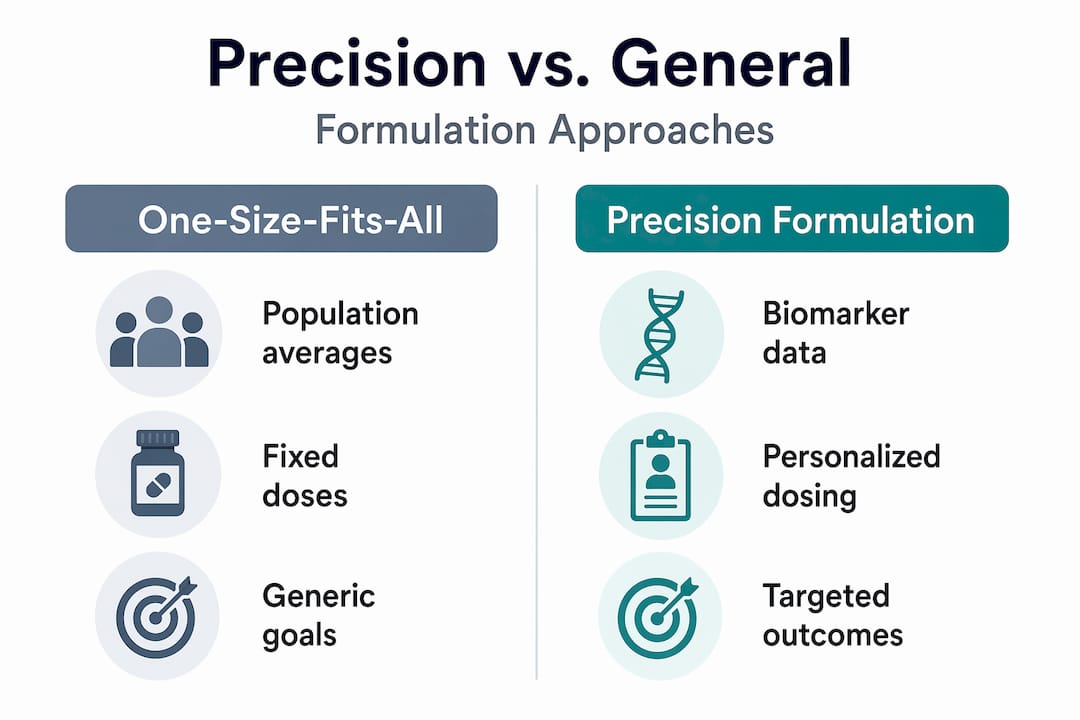
| Approach | One-Size-Fits-All | Precision Formulation |
|---|---|---|
| Basis | Population averages | Individual biological data |
| Validation | None post-purchase | Biomarker retesting |
| Adjustment | Fixed formula | Iterative refinement |
| Efficacy signal | Subjective only | Objective biomarker change |
Pitfalls to avoid when evaluating precision programs
The growth of interest in personalized nutrition has brought rigorous programs and misleading marketing into the same market. Knowing how to tell them apart protects both your money and your biology.
- Genetic data as the sole input. Relying only on SNP results without integrating biomarkers and lifestyle context risks missing the full scope of nutritional needs. Genetics tells you predispositions. Biomarkers tell you current reality. You need both.
- Overfitting in AI-driven models. Machine learning must complement rather than replace classical validation approaches. Models trained on narrow datasets generate confident-sounding recommendations with thin clinical grounding. Ask what the model was trained on and how it was validated.
- Formulation complexity without clinical backing. Some customized formulation processes stack ten or more compounds with minimal interaction data. More ingredients is not more precision. It is more liability.
- No retesting protocol. A program that sells you a formula and considers the job done has no mechanism to know whether it worked. Objective retesting is not optional in a sound approach. It is the whole point.
"Precision nutrition is not simply about adding more data points. It is about selecting the right data, integrating it across biological dimensions, and validating the outcome through measurable change." This framing, drawn from current research across nutrigenomics and formulation science, is the standard against which any program deserves to be measured.
For men who have spent time in demanding roles, the instinct to evaluate claims critically rather than accept them at face value applies here as much as anywhere. The self-optimization frameworks that deliver consistent results share one characteristic: they are built on data you can verify, not narratives you are asked to trust.
My perspective on precision formulation and real-world performance
What I have found, working with the principles of precision formulation over time, is that most men who come to this with genuine curiosity are surprised by the same thing. It is not the complexity of the biology. It is how much the data contradicts their assumptions.
A man who eats well, trains consistently, and sleeps adequately often discovers through biomarker testing that he is running low in ways he never suspected, because his symptoms presented as fatigue or motivation drift rather than obvious deficiency. The precision formulation process makes those invisible patterns visible.
My honest view is that the manufacturing side of this is underappreciated by most consumers. We focus on ingredients because ingredients are legible. But a formula built from the right ingredients and produced with poor process controls delivers inconsistent results. Manufacturing precision and process controls are invisible to the consumer but are what separates a supplement that actually performs from one that occasionally does.
The most important shift in mindset I would encourage is treating your supplement protocol the way you treat any other high-stakes system in your life: as something that requires baseline data, intervention, measurement, and adjustment. One cycle of that process teaches you more about your actual biology than ten years of guessing.
— Joakim
How Viridos applies this to executive performance
Viridos was built on the understanding that disciplined men in demanding roles require more than generic wellness products.

The Viridos approach to precision formulation starts with the same principles covered in this article: biomarker-informed targeting, small-batch Swedish production under rigorous quality standards, and a delivery philosophy designed for biological effect rather than marketing convenience. The Viridos Membership gives executives and founders controlled access to precision formulated supplements built for long-term performance, not short-term optics. If you want to understand the extraction and delivery science behind what Viridos produces, the Science page is the clearest starting point. And for men who want to go deeper on performance strategy, the Viridos Performance Journal publishes substantive, data-grounded content on longevity, vitality, and what actually works.
FAQ
What is precision formulation in nutrition?
Precision formulation is the practice of designing supplement and nutrition protocols from individual biological data, including genetics, biomarkers, microbiome, and lifestyle factors, rather than population averages. It replaces fixed-dose generics with targeted, validated strategies.
Why isn't genetic testing alone sufficient for precision nutrition?
Genetic data reveals predispositions but not current biological status. Combining SNP analysis with biomarker panels and lifestyle data is what produces actionable recommendations with measurable outcomes.
What role does manufacturing quality play in supplement precision?
Manufacturing quality determines whether the right ingredient reaches you at the right dose, batch after batch. QbD and DoE frameworks systematically optimize variables and validate consistency in ways that standard production does not.
How often should a precision supplement protocol be retested?
Most evidence-based programs retest biomarkers every eight to twelve weeks. Sequential retesting is what confirms biological effect and informs protocol adjustments rather than assumptions.
How do I identify a credible precision formulation program?
Look for programs that combine at minimum a biomarker panel, lifestyle intake, and genetic analysis; use cGMP-certified manufacturing; and include a structured retesting protocol. Absence of any one of these is a red flag, not a minor gap.