
Adequate traceability for supplement raw materials means one thing in practice: your QA team can identify the source and downstream disposition of any raw material or finished lot within hours. Not days. The FDA defines food traceability as the ability to follow a product and its ingredients through all steps of the supply chain, and states directly that efficient tracing enables faster removal of affected products during contamination events. For U.S. dietary supplement manufacturers, that capability is not aspirational. It is the minimum standard regulators expect when they walk through your door.
The concrete elements that deliver this capability are: unique lot IDs on every component, documented supplier identity, a Certificate of Analysis (COA) linked to each receiving record, dated receiving and storage logs, batch production records that tie component lots to finished product lots, and distribution records that show where every finished unit went.
Three immediate actions your QA team should run today:
- Audit unique-ID coverage: confirm every raw material in inventory carries a traceable lot identifier that links to a supplier record and a COA.
- Review the most recent COAs for your highest-risk botanicals and imported extracts; flag any that are undated, unsigned, or missing identity-test results.
- Schedule a tabletop mock recall using a real lot number from the past 90 days and measure how long it takes to produce a complete forward/backward trace.
Key Takeaways
Adequate raw material traceability for dietary supplements requires unique lot IDs, supplier-linked COAs, complete batch records, and a tested recall plan that can produce a full forward/backward trace within hours.
| Point | Details |
|---|---|
| Regulatory floor | 21 CFR § 111.260 requires unique identifiers for every component in a batch record; this is the non-negotiable starting point. |
| Recall speed determines scope | Lacking batch-level identifiers forces date-range recalls instead of lot-specific ones, multiplying units affected. |
| Supplier qualification is mandatory | COA acceptance alone is insufficient; contracts, audits, and independent retesting are required for high-risk botanicals and imported materials. |
| Mock recalls reveal real gaps | A tabletop exercise using a real lot number exposes disconnected records before a regulatory event does. |
| Viridos production standard | Viridos links each finished lot to supplier COAs, retained samples, and batch records, supporting a complete trace within hours. |
Table of Contents
- Why does raw material traceability matter for dietary supplements?
- What U.S. regulations govern supplement ingredient traceability?
- What records must you capture at each stage of production?
- How do you build a working traceability system?
- What supplier controls does traceability require?
- How should you structure laboratory and testing controls?
- How do you build a recall plan that actually works?
- What records do you need to retain, and for how long?
- Which digital tools and standards support reliable traceability?
- How does Viridos implement traceability in small-batch production?
- Traceability is a competitive signal, not just a compliance obligation
- Viridos: precision production with documented traceability
- Sources
Why does raw material traceability matter for dietary supplements?
Dietary supplements carry a specific risk profile that most other food categories do not. Multi-ingredient blends, imported botanicals, and contract-manufactured extracts create supply chains with multiple points of potential failure. A single contaminated botanical can touch dozens of finished SKUs across multiple production runs. Without granular ingredient tracking, a recall that should cover a small number of units can expand to cover many more.
The legal and enforcement stakes are equally concrete. Under 21 CFR Part 111, FDA can request batch records and component documentation during any inspection. FSMA's Food Traceability Final Rule and the agency's New Era of Smarter Food Safety blueprint signal a regulatory trajectory toward more rigorous, digitally accessible recordkeeping across higher-risk categories. For imported ingredients, the Foreign Supplier Verification Program (FSVP) adds a separate layer: importers must verify that foreign suppliers produce materials under standards equivalent to U.S. requirements.
The business consequences of weak traceability are well-documented. Recall scope correlates directly with how quickly you can identify which finished lots contain the affected component. Brands that cannot produce a clean lot-to-supplier trace within 24 hours face broader product holds, extended shelf removals, and the kind of public notification that damages retailer relationships for years.
Kontrollwiki's guidance on supplement control confirms that traceability is a core element of risk-based inspection, alongside labeling and ingredient verification. The same principle applies in U.S. enforcement: inspectors look for documented, auditable links between what you received, what you produced, and what you shipped.
What U.S. regulations govern supplement ingredient traceability?
21 CFR Part 111 and batch record requirements
The primary U.S. framework is 21 CFR Part 111, the Current Good Manufacturing Practice (cGMP) regulation for dietary supplements. Its traceability obligations are embedded in production control rather than stated as a standalone requirement. 21 CFR § 111.260 requires batch production records to include unique identifiers assigned to each component, packaging material, and label used in production. That single requirement is the structural backbone of supplement traceability: every component lot must be named, and that name must appear in the batch record.
Beyond batch records, 21 CFR Part 111 requires:
- Component receiving records (supplier name, lot ID, quantity, date, disposition)
- Laboratory records for identity and quality testing
- Distribution records linking finished product lots to customers
- Complaint and investigation records that reference specific lots
FSMA Food Traceability Rule and FSVP
FDA's Food Traceability Final Rule, issued under FSMA, does not currently apply to all dietary supplement ingredients. However, it establishes the recordkeeping logic the agency expects across the food system: Key Data Elements (KDEs) at each Critical Tracking Event (CTE), from growing/harvesting through processing and distribution. QA teams should map their existing records against this KDE/CTE framework now, because the regulatory trajectory is clear.
For imported raw materials, FSVP requires the importer of record to verify that foreign suppliers use processes that provide the same level of public health protection as U.S. standards. This means supplier qualification is not optional for imported botanicals. It is a legal obligation with its own documentation requirements.
Pro Tip: Treat 21 CFR Part 111 as your immediate compliance floor and FSMA's traceability logic as your architecture guide. Reconcile them by asking one question for each record type: does this record contain enough information to identify the affected lot and its full distribution within two hours?
What records must you capture at each stage of production?
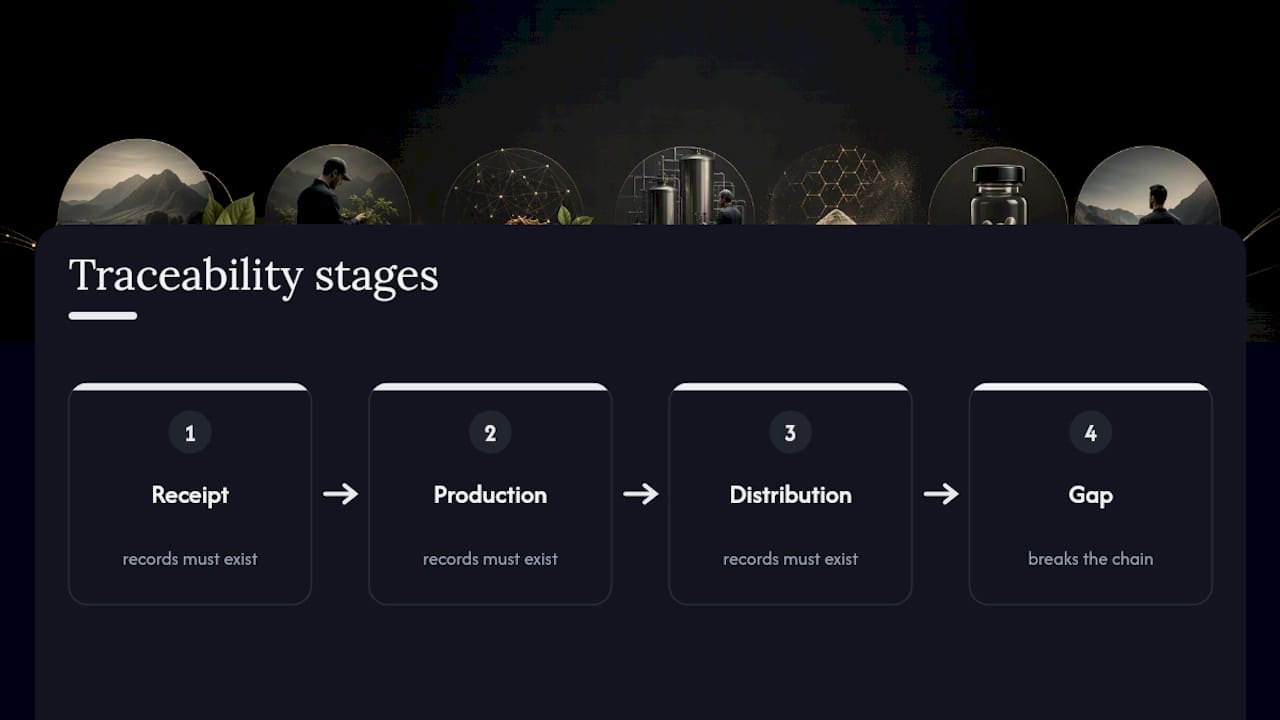
Traceability records must exist at three distinct stages: receipt, production, and distribution. A gap at any stage breaks the chain.
Receipt records
When a raw material arrives, the receiving record must capture:
- Supplier name and physical address
- Supplier's lot or batch number
- COA reference number and date
- Invoice or delivery note number and date
- Quantity received and unit of measure
- Container or drum IDs
- Quarantine status and release authorization
Batch production records
21 CFR § 111.260 specifies that each batch record must carry the unique identifiers assigned to every component used. In practice, this means:
- Internal lot ID (your own naming, not just the supplier's)
- Master formula or recipe reference
- Component lot IDs for every ingredient used
- Weights and quantities dispensed, with operator initials
- Processing dates, times, and equipment IDs
- In-process QC check results and sample IDs
- Yield and reconciliation data
Distribution records
- Finished product lot number
- Quantity shipped and unit count
- Customer or distributor name and address
- Shipping date and carrier reference
- Pallet or shipment ID
The table below maps each stage to its required fields and the recall-containment function each field serves.
| Supply Chain Stage | Required Fields | Recall-Containment Function |
|---|---|---|
| Receipt | Supplier ID, supplier lot, COA ref, date, quantity, container ID | Identifies source and quantity of affected material |
| Quarantine/Release | QC disposition, release date, authorized signatory | Confirms material was tested before use |
| Production | Internal lot ID, component lot links, formula ref, dates, operator | Links finished batch to specific input lots |
| Packaging | Finished lot ID, label lot, packaging lot, fill date | Confirms label accuracy and packaging integrity |
| Distribution | Finished lot, customer ID, ship date, quantity, carrier ref | Defines the universe of affected product in the market |
Minimum batch record fields (sample template):
- Product name and internal lot ID
- Manufacturing date and expiration date
- Master formula reference and version
- Each component: name, internal lot ID, supplier lot ID, weight dispensed
- QC checks: identity confirmation, in-process weights, yield
- Operator and QC reviewer signatures with dates
How do you build a working traceability system?
Identifier design
Your lot ID scheme is the foundation. A well-designed internal lot ID encodes enough information to orient any investigator without requiring a database lookup. A practical format: [Supplier prefix]-[YYMMDD]-[Line]-[Sequence]. For example, ASHW-260315-A-003 identifies an ashwagandha component received March 15, 2026, processed on Line A, third batch of the day. That ID appears on the receiving label, the quarantine tag, the batch record, the finished product label, and the shipping document.
The identifier must follow the material physically and digitally from receiving through shipping. 21 CFR § 111.260 makes this explicit: unique identifiers must be assigned and carried across the full production record. A lot ID that exists only in a spreadsheet but never appears on a physical container label is a traceability gap.
Workflow controls
The handoff points where lot IDs most often disappear are: receiving to quarantine, quarantine to production staging, and production to packaging. At each handoff, a physical label or scan confirmation must transfer the lot ID. No verbal transfers. No "we'll update the system later."
System options
- Spreadsheet: Acceptable for very small operations with fewer than five SKUs and a single production line, provided every field is mandatory and version-controlled. The risk is human error and no audit trail.
- ERP system: Appropriate once you manage multiple suppliers, SKUs, or production runs per week. Systems like SAP, Oracle NetSuite, or Fishbowl provide lot tracking, inventory control, and report generation.
- LIMS (Laboratory Information Management System): Necessary when lab results must link to batch records and COAs in a searchable, auditable format. Standalone LIMS tools include LabVantage and LabWare.
- Dedicated traceability platforms: Purpose-built for food and supplement supply chains; useful when supplier data integration is a priority.
Pro Tip: If you are a small-batch manufacturer not yet ready for a full ERP, build a locked Excel workbook with mandatory fields, a change log tab, and a naming convention enforced by data validation. It is auditable, low-cost, and can be migrated to an ERP later without losing historical records.
What supplier controls does traceability require?
Supplier qualification is where most traceability programs fail. A COA in your files is not supplier qualification. It is one document in a system that must also include contracts, audits, and verified testing.
Supplier onboarding checklist
Every new supplier must provide before first shipment:
- Current COA for the specific material and grade
- Certificate of origin
- Allergen statement
- Sampling and testing plan
- Process flow or manufacturing overview
- Any relevant third-party certifications (NSF, USP, ISO 22000)
Contract clauses that protect traceability
Your supplier agreements should require:
- Lot-level identification on every shipment
- Retention of production records for a minimum of three years (aligned with your own retention policy)
- Notification within 24 hours of any quality event affecting shipped material
- Cooperation with recall investigations, including access to their own supplier records
- Right to audit with reasonable notice
The Swedish national industry guideline for supplements requires companies to document from whom they obtained a raw material and to whom they sold it, and provides operational routines for traceability and recall handling. That "one step back, one step forward" logic is the minimum. Your contracts should enforce it explicitly.
Verification activities
Supplier qualification is not a one-time event. Risk-based verification means:
- Annual COA review for all active suppliers
- On-site or remote audit every one to three years, depending on risk level (botanical extracts and imported materials warrant annual review)
- Periodic independent retesting of incoming materials, not just acceptance of supplier COAs
- Checking third-party accreditation status (ISO 17025 for testing labs) before each new contract period
Pro Tip: A COA is acceptable for routine receipt of a well-characterized material from a long-term, audited supplier. For a new supplier, a new botanical source, or any material with a history of adulteration, require a retained sample and commission an independent identity test from an ISO 17025-accredited lab before releasing the material for production.
How should you structure laboratory and testing controls?
Testing is the verification layer that gives your COAs credibility. A COA you have never challenged is a document, not evidence.
Testing priorities by raw material class
- Botanicals and herbal extracts: Identity (microscopy, HPTLC, or DNA barcoding), potency markers, pesticide residues, heavy metals (lead, arsenic, cadmium, mercury), microbial limits, and adulteration screening.
- Amino acids and isolates: Identity (HPLC or NIR), potency, heavy metals, and residual solvents where extraction is involved.
- Minerals and inorganic compounds: Identity, assay, heavy metals (particularly lead and arsenic), and microbial limits.
| Raw Material Class | Minimum Tests | Expand Scope When |
|---|---|---|
| Botanicals/Herbal extracts | Identity, heavy metals, microbial | High-risk origin, known adulteration history, new supplier |
| Amino acids/Isolates | Identity, potency, heavy metals | Synthetic origin unclear, residual solvent risk |
| Minerals | Identity, assay, heavy metals | Mined source, high-lead-risk geography |
| Finished blends | Identity of actives, label claim verification | Novel formulation, first production run |
Lab controls
All testing should use ISO 17025-accredited laboratories. Chain-of-custody documentation must accompany every sample: who collected it, when, under what conditions, and who received it at the lab. COA standardization matters: require that every COA from your testing lab includes the test method reference, the specification, the result, and the pass/fail determination. Anomalies on a COA (a result close to the specification limit, an unusual moisture value, a missing test) require documented investigation before release.

Document your evaluation and release rationale. A result outside specification, or a result that contradicts the supplier's own COA, triggers quarantine and a formal traceback to the supplier lot. Never release on a verbal explanation from a supplier.*
How do you build a recall plan that actually works?
A recall plan that lives in a binder and has never been tested is not a recall plan. It is a liability.
Essential elements of a written recall plan
- Designated recall coordinator and backup, with 24/7 contact information
- Decision criteria for voluntary recall vs. market withdrawal vs. stock recovery
- Product identification procedure: how to pull all affected lots from inventory and distribution within hours
- Notification templates: internal escalation, FDA notification, customer/distributor communication, and public-facing language
- Disposition instructions for recovered product
- Documentation requirements throughout the event
Running a mock recall: a 72-hour tabletop timeline
Hours 0–4: Receive the simulated trigger (e.g., a supplier notifies you of a contamination in a specific lot). Identify all internal lots that used that component. Pull batch records. Confirm quantities produced and distributed.
Hours 4–12: Identify all customers and distributors who received affected finished lots. Generate a distribution list with quantities and contact information. Initiate internal product hold.
Hours 12–24: Contact distributors and customers. Confirm receipt of hold notice. Begin tracking returned units.
Hours 24–72: Compile a containment report: total units affected, units recovered, units outstanding, and a root-cause summary. Prepare FDA notification if the trigger meets reportable criteria.
RASFF-related guidance confirms that during an incident, authorities request invoices, delivery notes, and batch identifiers. Lacking batch data forces broader recalls. Your mock recall should expose exactly that gap before a real event does.
Common mistakes that expand recall scope:
- No unique lot IDs on finished product labels (forces a date-range recall instead of a lot-specific one)
- Distribution records stored in a format that cannot be searched by lot number
- Supplier contact information that is outdated or incomplete
- No documented decision criteria, leading to delayed escalation
- Recall plan never tested, so roles and responsibilities are unclear under pressure
What records do you need to retain, and for how long?
Record retention is where traceability becomes inspection-ready. A record that exists but cannot be produced within 30 minutes of an inspector's request is functionally missing.
Audit-readiness checklist:
- Records organized by lot number, not just by date
- A searchable index (spreadsheet or ERP report) that maps lot ID to all associated records
- Retained samples for each finished lot, held for the full shelf life plus one year
- A designated "inspection folder" for each finished lot containing: batch record, component COAs, release authorization, and distribution summary
Pro Tip: Build one physical or digital folder per finished lot at the time of release, not retrospectively. It takes five minutes at release and saves hours during an inspection. Label it with the lot ID, product name, and release date. Include the batch record, all component COAs, the QC release sign-off, and the first distribution record.
Which digital tools and standards support reliable traceability?
GS1 standards and lot identifiers
GS1's Global Trade Item Number (GTIN) and lot/batch number Application Identifiers provide a globally interoperable identifier structure. For supplement manufacturers, the practical value is straightforward: a GS1-compliant lot identifier on your finished product label can be read by any downstream trading partner's system without custom integration. GS1 pilots in other sectors demonstrate how QR-resolvable product records using GS1 standards and resolver services can deliver consumer- and regulator-facing traceability from a single scan. The same pattern applies to supplements: an internal lot ID structured as a GS1 Application Identifier can resolve to a supplier COA, a retained sample ID, and a shipping record.
Tool comparison
- Spreadsheet: Low cost, high manual effort, no audit trail, acceptable only for the smallest operations.
- ERP system: Provides lot tracking, inventory control, and report generation; requires configuration investment but delivers searchable records and automated linkages.
- LIMS: Connects lab results directly to batch records; necessary when testing volume or complexity makes manual COA filing unreliable.
- Dedicated traceability platforms: Purpose-built for food and supplement supply chains; strongest for multi-supplier integration and regulatory reporting.
Emerging options include QR-based product passports, where a scan of the finished product label resolves to a hosted record containing origin, testing, and production data. Digital traceability pilots in forestry and textiles show that the primary challenge is system interoperability and consistent data granularity across supply chain partners. Blockchain pilots add immutability to shared records but introduce complexity; they add value primarily when multiple untrusted parties must share a single record without a central administrator.
Pro Tip: The minimum digital elements for an auditable manual system are: a locked, version-controlled spreadsheet with mandatory fields; a consistent lot-ID naming convention applied to every physical label; and a scanned-document archive (PDF) for every COA and batch record, indexed by lot ID. That architecture is interoperable with any customer or regulator who requests records.
How does Viridos implement traceability in small-batch production?
Small-batch production does not simplify traceability. In some respects, it demands more discipline, because each batch represents a higher proportion of total inventory and a single documentation error has proportionally larger consequences.
Viridos's small-batch Swedish production approach operationalizes traceability through several specific controls:
- Batch naming: Each production batch carries a unique internal lot ID that encodes the raw material source prefix, the production date, and a sequential batch number. That ID appears on the batch record, the finished product label, and the shipping document without exception.
- COA linking: Every component COA is filed against the supplier lot ID and cross-referenced to the internal lot ID used in production. A QA reviewer confirms the link before any batch is released.
- Retained samples: A retained sample from each finished batch is held for the full product shelf life plus one year. If a question arises about a specific lot after distribution, the retained sample supports independent retesting without requiring a market recall.
- Supplier lot traceability: Because Viridos sources phytoandrogen-related botanical compounds through documented supplier relationships, each incoming material carries a supplier lot ID that is recorded at receipt and carried through to the finished batch record.
During regulatory inspections or customer audits, small-batch producers with this level of documentation can typically demonstrate a complete forward/backward trace within one to two hours. That speed directly limits recall scope. For a sophisticated supplement brand, this level of documentation is not a differentiator. It is the baseline.
Pro Tip: For small-batch producers, the most common traceability gap is not missing records but disconnected records: a COA filed by supplier name, a batch record filed by date, and a distribution record filed by customer. Unify them under a single lot ID index and the system becomes auditable in minutes.
Traceability is a competitive signal, not just a compliance obligation
Most QA teams approach traceability as a defensive exercise: build enough documentation to survive an inspection. That framing is too narrow, and it leads to systems that are technically compliant but strategically inert.
Premium brands and institutional buyers, including major retailers, contract research organizations, and executive wellness programs, increasingly treat traceability depth as a qualification criterion. A brand that can produce a complete lot-to-supplier trace on demand, with retained samples and accredited lab results attached, signals something that no marketing claim can replicate: operational discipline at the production level.
For a brand like Viridos, whose positioning rests on precision, small-batch quality, and documented production processes, traceability is not separate from brand identity. It is the evidence base for it. The science behind Viridos's formulation and extraction methodology only carries weight if the raw materials behind it are verifiably sourced, tested, and documented. Ingredient transparency in nutrition is becoming a buyer expectation, not a premium feature.
The practical implication for QA leaders: prioritize the traceability gaps that most reduce recall impact and inspection risk. Unique lot ID coverage and mock recall readiness provide the greatest benefit for effort invested. Fix those first. Everything else is refinement.
Viridos: precision production with documented traceability

Viridos is built for men who demand the same standard from their supplements that they apply to every other high-stakes decision: documented, verifiable, and defensible. The performance spray is produced in small batches in Sweden, with each lot carrying a unique identifier linked to supplier COAs, retained samples, and full batch records. That is not a marketing position. It is the operational reality behind every shipment.
For executives and founders who want to understand exactly what goes into what they take, and how it was produced, Viridos offers controlled-access membership with full production transparency. If you hold yourself to a high standard in the arena, the supplement you rely on should meet the same bar. Review the Viridos performance spray and apply for membership.
Sources
Every QA team working on supplement traceability should keep the following primary sources accessible for inspections, internal training, and supplier qualification reviews.
- Tracking and Tracing of Food | FDA
- 21 CFR § 111.260 - What must the batch record include? | Electronic Code of Federal Regulations (e-CFR) | US Law | LII / Legal Information Institute
- Kontroll av kosttillskott - Kontrollwiki - Livsmedelsverket
- Nationella branschriktlinjer för kosttillskott
This article is general information, not a substitute for advice from a qualified lawyer. Consult a qualified legal professional about your own circumstances before acting on anything here.