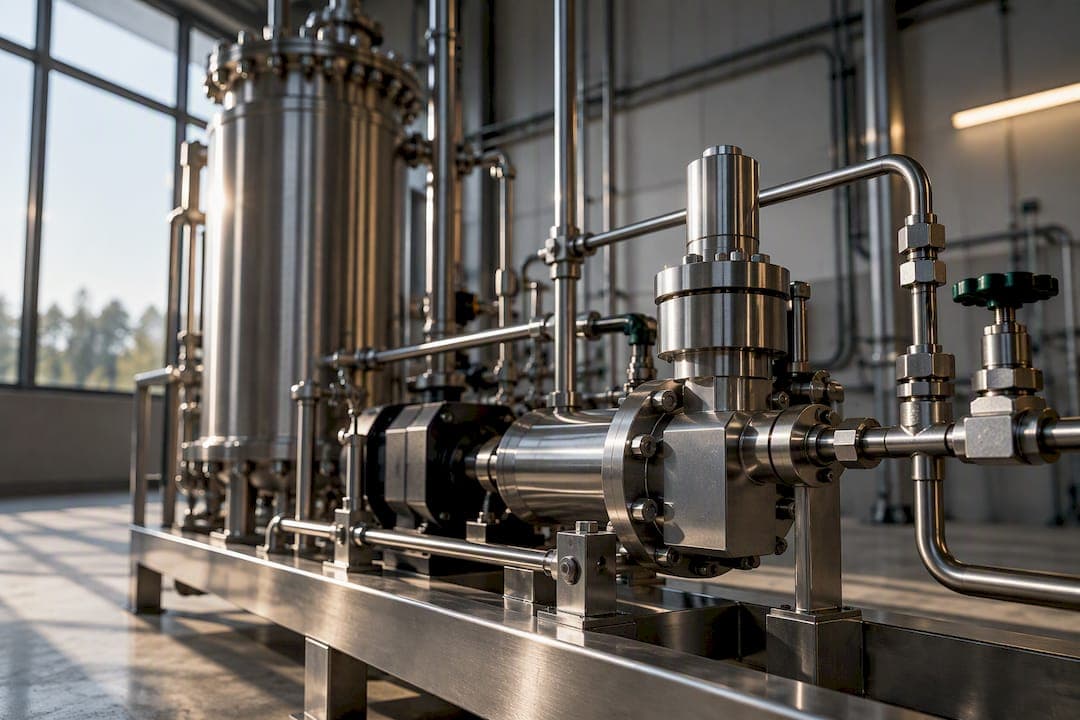
Supercritical CO2 extraction works because carbon dioxide, held above its critical point of 31.1°C and 7.39 megapascals, stops behaving like a gas or a liquid and becomes both at once. Engineers exploit that dual identity: gas-like diffusivity for fast matrix penetration, liquid-like density for real solvating power, all tunable by adjusting pressure and temperature. Industrial systems typically run well beyond the critical point, into the tens or low hundreds of bar, to extract lipophilic, heat-sensitive compounds without residual solvent, thermal degradation, or the waste streams that plague conventional extraction.
TL;DR:
- Pressure primarily controls yield, with peak extraction typically occurring around 276 bar, while temperature effects can be counterproductive if it reduces CO2 density.
- Using ethanol as a co-solvent extends extraction capabilities to polar compounds like flavonoids and anthocyanins, which pure CO2 cannot efficiently dissolve.
- Equipment reliability depends on proper system design, including subcoolers to prevent cavitation, back-pressure regulation, and materials resistant to corrosion from residual moisture.
- Model-based optimization of extraction kinetics relies on monitoring both total yield and rate, enabling predictable batch times and process fine-tuning across different feedstocks.
Table of Contents
- What Makes Superkritisk CO2-Extraktion a Tunable Solvent
- Pressure, Temperature, and Flow: The Parameters That Actually Move Yield
- Process Design and Scale-Up: Where Lab Success Meets Industrial Reality
- Modeling Extraction Kinetics for Predictable Batch Times
- Where Supercritical CO2 Extraction Delivers Value Today
- Supercritical CO2 vs. Solvent Extraction: What the Trade-Off Actually Costs
- Operating Checklist: Avoiding the Mistakes That Cost a Batch
- Extraction Method as a Marker of Product Integrity
- Where Industrial R&D Is Headed Next
- Sources
- FAQ
What Makes Superkritisk CO2-Extraktion a Tunable Solvent
The term for this method in Swedish technical literature, superkritisk CO2-extraktion, describes exactly what the physics dictates: a supercritical fluid whose solvating strength is set by density, and density is set by pressure and temperature together. Below the critical point, CO2 exists as a gas or liquid. Above it, phase boundaries disappear, and the fluid occupies a single state that engineers can dial like a control knob.
That control matters for three practical reasons:
- Diffusivity remains gas-like, letting scCO2 penetrate porous plant matrices faster than a liquid solvent could.
- Density behaves liquid-like, giving the fluid enough solvating power to dissolve lipids, terpenes, and other nonpolar targets.
- Polarity stays limited, which is why polar compounds like some flavonoids or anthocyanins resist extraction unless a co-solvent, usually ethanol, is added as a modifier.
That last point is where the supercritical CO2 review literature is unambiguous: scCO2 excels at nonpolar and moderately polar targets, and modifiers extend its reach into polar territory rather than replacing the base solvent entirely.
Pressure, Temperature, and Flow: The Parameters That Actually Move Yield
Industrial and pilot-scale scCO2 extraction typically operates at pressures between 20 and 50 megapascals, with temperatures held between 40°C and 80°C to protect thermo-labile compounds from degradation. Some optimization studies push further: a lingonberry pomace extraction achieved its highest reported yield at 276 bar and 62°C, running for 380 minutes at a CO2 flow of 21 grams per minute.

Statistic Callout: That lingonberry study reported a peak yield of 4.22% by weight under those specific conditions, a useful benchmark for anyone modeling similar pomace or oilseed feedstocks.
Pressure is the dominant lever because it drives CO2 density, and density drives solvating strength almost linearly within typical operating windows. Temperature plays a secondary, sometimes counterintuitive role: raising it can lower CO2 density and reduce solvating power even as it improves the volatility of the target compound, so the two effects fight each other.
- Solvent-to-feed (S/F) ratio and CO2 flow rate govern extraction kinetics more than almost any other variable.
- Longer extraction times push yield toward completeness but cut throughput, a trade-off every scale-up plan must consider.
- Modifiers, typically ethanol at low concentration, extend selectivity toward polar analytes without abandoning the closed-loop CO2 system.
Process Design and Scale-Up: Where Lab Success Meets Industrial Reality
Moving from bench-top extraction to a pilot or production unit exposes problems that never show up in a 500-milliliter vessel. Pump stability is the first casualty: high-pressure dosing pumps must feed stabilized liquid CO2 without cavitation, which is why a CO2 subcooler ahead of the pump inlet has become standard practice at pilot scale. Back-pressure regulation is the second challenge, and tuning the pneumatically actuated back-pressure valve directly determines whether extraction pressure holds steady or drifts across a run.
Materials selection carries its own risks. CO2 combined with residual moisture in feedstock can corrode carbon steel, which is why stainless cladding is the default choice for wetted surfaces, and why fittings above 300 bar should avoid double-ring designs in favor of high-pressure screwed connections, according to engineering guidance on scale-up and GMP compliance.
| Design Element | Function | Failure Mode If Neglected |
|---|---|---|
| CO2 subcooler | Prevents cavitation at pump inlet | Pressure fluctuation, pump wear |
| Back-pressure valve | Regulates extraction pressure | Yield drift, batch inconsistency |
| Stainless cladding | Resists CO2/moisture corrosion | Vessel degradation, contamination |
| Inspection schedule | Manages fatigue from pressure cycling | Structural failure over thousands of cycles |
Vessels endure between 10,000 and 20,000 pressure cycles over a working life, and that cycling fatigue has to be designed for, not discovered later. On the economic side, process economics research points to roughly 1,000-liter vessel capacity as the threshold where scCO2 begins to approach cost parity with hexane, largely because closed-loop CO2 recycling amortizes energy costs at that scale.
- Dosing pump stability and subcooler installation are the two highest-leverage fixes for start-up reliability.
- CAPEX amortizes fastest when product premium (solvent-free labeling, purity) offsets higher upfront equipment costs.
- Closed-loop recycling turns CO2's biggest apparent weakness, its need for high pressure, into an operating advantage over solvent disposal.
Modeling Extraction Kinetics for Predictable Batch Times
Extraction curves reveal which regime is limiting a given run. Early in an extraction, mass transfer from the particle surface into the bulk CO2 stream usually controls the rate, external mass transfer limited. Later, as surface-accessible compound depletes, the process shifts to internal diffusion limited, where compound has to migrate through the solid matrix before it ever reaches the CO2 stream. Overall extraction curves, or OECs, plot cumulative yield against time and typically show this transition as a bend from a steep initial slope to a shallow tail.
- Plot cumulative yield versus time to generate the overall extraction curve, then fit a spline to locate the inflection point separating the two kinetic regimes.
- Use design of experiments (DOE) with pressure, temperature, and CO2 flow rate as factors, since these three variables account for most of the variance in reported optimization studies.
- Set response metrics that include both total yield and extraction rate constant, not yield alone, since a slower process that reaches the same endpoint may still cost more in CO2 and time.
- Apply response surface methodology (RSM) to map interactions between pressure and flow rate, which often outperform single-variable optimization for identifying a practical operating window.
Where Supercritical CO2 Extraction Delivers Value Today
Biorefineries, food ingredient manufacturers, and cosmetic formulators have converged on scCO2 for a consistent reason: it removes lipids and volatile actives without leaving solvent residue behind. Reported case studies give a sense of the range.
- Lingonberry pomace yielded up to 4.22% oil by weight at 276 bar and 62°C, demonstrating scCO2's fit for berry processing byproducts that would otherwise go to waste.
- Wheat germ extraction reached oil recoveries near 6.9% by weight at 260 bar with CO2 density between 800 and 900 kilograms per cubic meter, using a pilot unit with a retuned back-pressure valve and subcooler.
- Grass-clover biomass extraction showed that a scCO2 defatting step ahead of protein isolation improves downstream protein and fiber valorization, a clear example of biorefinery cascade design.
Lipids, terpenes, and tocopherols extract cleanly with pure CO2. Anthocyanins, flavonoids, and other polar bioactives need ethanol or similar modifiers, which is the practical dividing line every process engineer runs into sooner or later.
Supercritical CO2 vs. Solvent Extraction: What the Trade-Off Actually Costs
Ethanol and hexane extraction remain cheaper to install and simpler to operate, and that's the honest starting point for any comparison. Where scCO2 pulls ahead is in extract quality: no residual solvent to strip out, lower thermal exposure for heat-sensitive actives, and a closed CO2 loop that avoids the disposal costs solvent-based methods carry.
- Solvent-free output eliminates a purification step that ethanol and hexane processes require by default.
- Tunable selectivity via pressure and temperature allows fractionation strategies that single-solvent extraction cannot replicate.
- Higher CAPEX and more complex operation remain real constraints, particularly below the scale where recycling economics kick in.
Statistic Callout: Economic modeling suggests scCO2 reaches cost parity with hexane around 1,000-liter vessel scale, below which conventional solvent extraction usually wins on cost alone.
Polar compound solubility remains scCO2's clearest technical limitation, and no amount of pressure tuning fully closes that gap without a co-solvent. A comprehensive review of the technology confirms the pattern: scCO2 wins on residue, selectivity, and thermal stability; conventional solvents still win on raw throughput cost at small scale.
Operating Checklist: Avoiding the Mistakes That Cost a Batch
Reliable extraction comes down to disciplined startup and shutdown sequences, not luck.
- Pre-dry feedstock to control moisture, since residual water accelerates CO2 corrosion of unprotected steel surfaces.
- Bring the system to operating pressure gradually, verifying subcooler function before engaging the dosing pump to prevent cavitation.
- Depressurize in stages rather than all at once. Rapid depressurization causes severe adiabatic cooling that can cold-shock seals and fittings.
- Log back-pressure valve behavior every run, since drift here is usually the first sign of a seal or actuator problem.
- Schedule vessel inspections against cycle count, not calendar time, since fatigue accumulates with pressure cycling regardless of how much time passes between runs.
Pro Tip: Track your extraction runs against cycle count rather than operating hours. A vessel that runs frequent short batches accumulates fatigue-relevant pressure cycles far faster than one running fewer, longer extractions, even if total operating hours look similar on paper.
Extraction Method as a Marker of Product Integrity
The extraction method a formulator chooses is not a footnote. It determines whether the final extract carries residual solvent, how much thermal stress the target compounds endured, and whether a certificate of analysis reflects a clean, traceable process or a compromised one. This principle is foundational to how a premium performance formulation earns its place in a disciplined daily protocol.
- Solvent-free, low-temperature extraction preserves compound integrity better than heat- or solvent-intensive alternatives, supporting cleaner, more defensible certificates of analysis.
- Small-batch production allows tighter control over extraction parameters than mass-market manufacturing typically permits.
- Traceability from raw material to finished spray is a provenance commitment, not a clinical claim. Readers can review the batch-testing framework in our guide to verifying COAs and the storage science behind potency retention in our piece on plant extract storage.
The full extraction and delivery rationale behind the Viridos formulation is detailed on the Science page, for readers who want the underlying mechanism rather than the marketing summary.
Executives evaluating a performance supplement rarely ask about extraction chemistry, and that is precisely the gap Viridos exists to close. If a formulation cannot account for how its active compounds were isolated, from what feedstock, at what temperature, under what pressure, it is asking for trust it has not earned. That standard applies whether you are running a pilot-scale scCO2 unit or simply deciding which product to put in your own daily protocol.
Viridos offers two membership tiers for men who hold themselves to that standard: Member at $99 per month and Professional at $299 per month, both detailed on the membership pricing page. Explore the performance spray formulation directly, or review the broader longevity performance strategy behind the product before applying.
Where Industrial R&D Is Headed Next
Precision fractionation, extracting narrow compound classes like omega-3s or tocopherols in separate stages rather than pulling one bulk oil, is displacing single-pass extraction as the industry standard. Process stability and energy recovery will decide which operators scale profitably. Biorefinery integration, using scCO2 as a defatting step ahead of protein and fiber valorization, remains the clearest growth path for capital committed to circularity over the next several years.
— Joakim
Sources
- Supercritical CO2 technology for biomass extraction: Review
- Process economics and scale-up study (Journal of Food Processing and Engineering)
- Supercritical CO2 extraction of lingonberry pomace: optimization and kinetics
- Process design enhancement of a pilot-scale supercritical-CO2 extraction plant
- Industry review: trends toward precision fractionation and biorefinery integration
FAQ
What Is the Critical Point of CO2 for Extraction?
CO2 becomes supercritical at 31.1°C and 7.39 megapascals (roughly 74 bar). Above that point, it combines gas-like diffusivity with liquid-like solvating power, which is why the scCO2 review literature identifies it as the working definition for industrial extraction design.
How Does Pressure Affect scCO2 Extraction Yield?
Pressure increases CO2 density, and density drives solvating strength almost directly within typical operating ranges. Studies optimizing lingonberry pomace extraction found peak yield at 276 bar, illustrating how pressure dominates yield outcomes more than temperature in most feedstocks.
When Should You Use a Co-Solvent Modifier With CO2?
Add ethanol or another co-solvent when targeting polar compounds like anthocyanins or flavonoids, which pure CO2 cannot dissolve efficiently regardless of pressure. Nonpolar targets like lipids and terpenes typically extract well with pure CO2 alone.
At What Scale Does scCO2 Become Cost-Competitive With Solvent Extraction?
Cost parity with hexane extraction is commonly reported near 1,000-liter vessel scale, where closed-loop CO2 recycling offsets the higher upfront equipment costs. Below that scale, conventional solvent extraction usually remains cheaper.
What Causes Equipment Failure in scCO2 Extraction Systems?
The two most common failure modes are CO2 corrosion from residual moisture in feedstock and mechanical fatigue from repeated pressure cycling, which can reach 10,000 to 20,000 cycles over a vessel's working life. Stainless cladding and cycle-based inspection schedules address both risks directly.