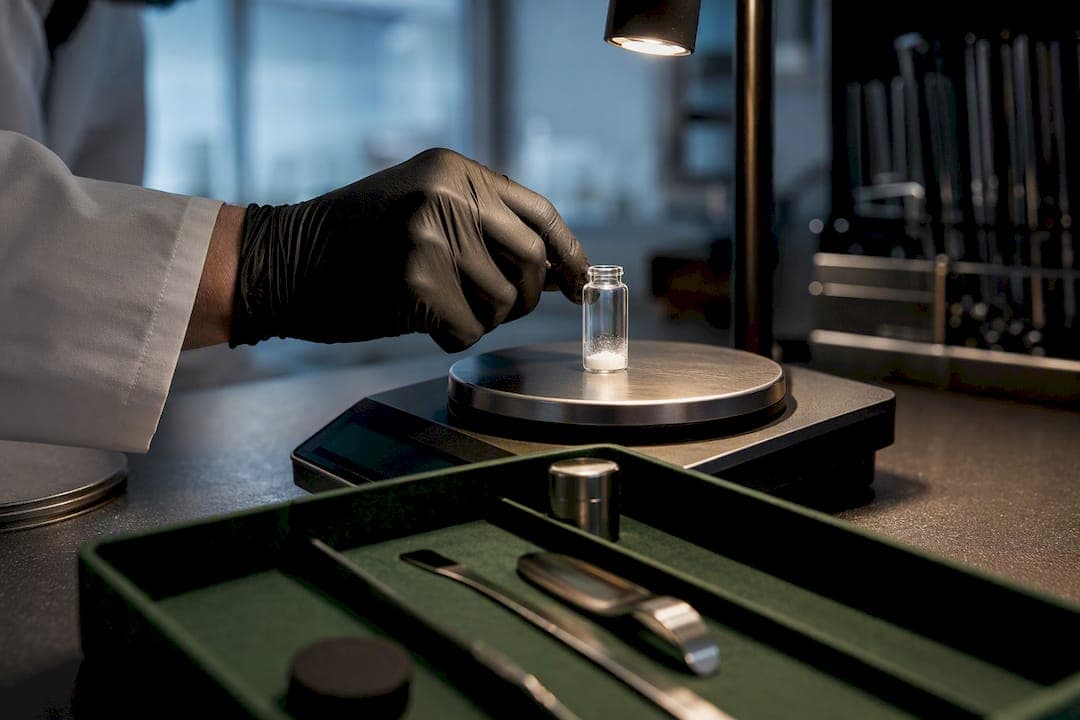
A batch-specific third-party analysis certificate that lists your exact lot number and an accredited laboratory is the only reliable proof a supplement batch was actually tested. A brand-level seal, a generic "third-party tested" badge, or a certificate with no lot match is not evidence of anything for the bottle in your hand. Before trusting any product, confirm two things: the lot number, and the lab's accreditation.
TL;DR:
- Only batch-specific third-party certificates with matching lot numbers and accredited laboratories provide reliable proof of testing, not generic or brand-level seals.
- A genuine COA includes detailed analyte results, lot number, production date, lab accreditation (ISO/IEC 17025), and analyst signature, not just a generic certification badge.
- Testing focuses on heavy metals, pesticides, mycotoxins, microbiological contamination, and undeclared substances, with detection limits in the low parts-per-billion range.
- Verifying a supplement’s batch involves matching lot numbers, checking lab accreditation, interpreting results against safety thresholds, and requesting chain-of-custody documentation when needed.
- Brands committed to small-batch manufacturing with transparent lot-specific reports and raw material sourcing practices reduce contamination risks and improve traceability.
Table of Contents
- What a Batch Testing Certificate (COA) Actually Is
- How Third-Party Batch Testing Programs Actually Operate
- The Contaminants Batch Testing Is Actually Looking For
- How to Verify a Supplement Batch: A Step-By-Step Checklist
- Why Regulation Alone Isn't Enough
- What Transparent, Small-Batch Production Looks Like in Practice
- Red Flags That Signal a COA You Shouldn't Trust
- An Editorial Take on Verification-First Buying
- Viridos: Built for Men Who Verify Before They Trust
- Sources
What a Batch Testing Certificate (COA) Actually Is
A certificate of analysis, or COA, is a document generated for one specific production run, not the product line as a whole. Every batch, or lot, carries its own chemical signature, and the COA is the lab's written record of what that particular run contained when tested. A real COA is not a marketing PDF. It is a technical report with defined fields, and if any of those fields are missing, the document is decorative rather than evidentiary.
A credible COA typically includes:
- A sample ID tied to a specific lot number and production date
- A full analyte list (what was tested for, not just "heavy metals" generically)
- Numeric results per analyte, with units and detection limits stated
- The testing lab's accreditation status
- An analyst signature and report date
The distinction that matters most: a manufacturer-issued test report reflects internal quality control, while an independent third-party COA comes from a lab with no financial stake in the outcome. Programs like the Third Party Dietary Supplement Certification Comparison from BSCG exist because that independence is what separates a genuine quality signal from self-reported reassurance. Accreditation to ISO/IEC 17025, the internationally recognized standard for testing and calibration laboratories, is the baseline credential worth checking on any lab named in a COA.
How Third-Party Batch Testing Programs Actually Operate
Not every third-party program tests every lot, and that distinction changes what a certification badge is worth. Some programs sample periodically across a product line; others test each batch before release. A logo on packaging tells you almost nothing about which model applies, so the sampling scheme itself deserves scrutiny.
The testing menu matters as much as the sampling frequency. Rigorous programs screen for:
- Heavy metals (lead, cadmium, mercury, arsenic)
- Pesticide residues
- Mycotoxins
- Microbiological contamination
- Potency versus label claim
- Banned or undeclared substances, including stimulants and pharmaceuticals
Detection limits are typically in the low parts-per-billion range, according to BSCG's certification comparison, which is the sensitivity needed to catch trace contamination before it accumulates across repeated servings. A program that publishes its detection limits and reporting thresholds is telling you exactly how sensitive its instruments are. One that doesn't is asking you to take sensitivity on faith.
Prefer programs that maintain a searchable, publicly accessible lot database over those that only issue certificates on request. Transparent programs let you type in a lot number and see the result yourself, which is the practical difference between a claim and a check.
The Contaminants Batch Testing Is Actually Looking For
Batch testing exists because raw materials, particularly plant-derived ones, carry inherent variability that finished-product marketing rarely mentions. Three categories account for most of the risk.
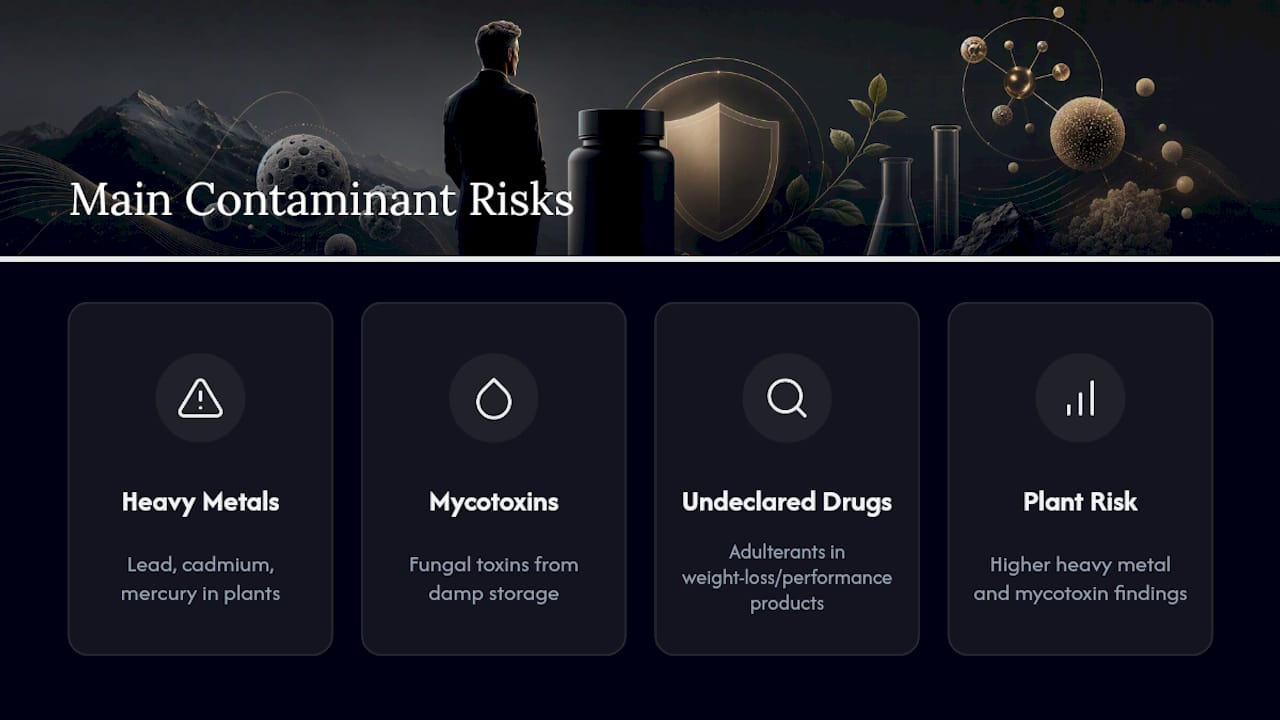
Heavy metals top the list. Lead, cadmium, and mercury accumulate in soil and water, and plants absorb them during growth. Herbal extracts and botanical concentrates are structurally more exposed to this than synthetic or isolate-based ingredients, simply because they start from whole plant matter grown in variable conditions.
Mycotoxins and microbiological contamination follow a similar logic. Raw herbal powders, particularly those stored or processed with inconsistent humidity control, are more susceptible to fungal growth than highly refined ingredients.
Undeclared pharmaceuticals and stimulants represent a different kind of risk entirely, one tied to intentional adulteration rather than environmental exposure. Swedish authorities have documented cases of supplements, especially in weight-loss and performance categories, containing undeclared drugs or hormone-like substances and excessive caffeine, where repeated dosing compounds the exposure over time.
National sampling data from Livsmedelsverket's control programs shows that plant-based supplements and certain traditional-medicine categories, including some Ayurvedic and Traditional Chinese Medicine products, carry a disproportionately higher rate of heavy metal or mycotoxin findings than standardized, synthetic-ingredient products. If you're evaluating anything built on raw botanical extract, that history alone justifies a closer look at the COA before you buy.
How to Verify a Supplement Batch: A Step-By-Step Checklist
Confirming a COA actually applies to the bottle you're holding takes five deliberate steps, in this order.
- Find the lot number and production date on the package. These are usually stamped or printed near the expiration date, often in a smaller font than the rest of the label.
- Locate the matching COA. Check the brand's website or an independent certification database, and confirm the lot number on the certificate matches the lot number on your package exactly. A COA for a different batch tells you nothing about yours.
- Verify the lab's accreditation. Look for ISO/IEC 17025 status, either stated on the COA itself or confirmed on the lab's own website. BSCG recommends checking accreditation directly rather than assuming a lab name implies credibility.
- Read the numeric results against label claims and known safety thresholds, paying attention to units. Results reported on a dry-weight basis will look different from wet-weight results for the same material, and comparing across the wrong basis makes a clean result look alarming or a contaminated one look fine.
- Request chain-of-custody documentation if anything feels inconsistent. A brand confident in its testing should be able to produce sample handling records or arrange an independent re-test without resistance.
Pro Tip: Always cross-check the lot number character by character. A single digit mismatch between your bottle and the certificate means you're looking at proof for a product that isn't yours.
Programs with strong sampling discipline make this process fast; understanding dosing precision in premium supplements also helps you interpret whether the potency results on a COA line up with what disciplined formulation should look like.
Why Regulation Alone Isn't Enough
Dietary supplements in Sweden are regulated as foods, not medicines. That single fact underpins almost everything else in this article. Livsmedelsverket's own guidance confirms that supplements are not pre-approved or safety-tested by authorities before reaching the market. Manufacturers hold primary legal responsibility for compliance, including the official limits set for heavy metals in finished products.
Authorities still play a role after the fact:
- National control programs run targeted market sampling, particularly on higher-risk categories
- Enforcement can escalate to a temporary national sales ban when a product poses a documented health risk, with other EU member states notified accordingly
- Official heavy metal limits apply to the product as sold, and for powders intended to be prepared before use, limits are applied to the prepared form
This is the practical gap independent COAs exist to fill. Regulation sets the floor and investigates after problems surface; it does not certify anything before it reaches your shelf.
What Transparent, Small-Batch Production Looks Like in Practice
The checklist above is only useful if a brand's practices make it possible to follow. Small-batch production, done properly, is built around exactly the traceability a discerning buyer needs.
What that looks like in practice:
- Batch-specific lab reports available on request, not buried behind vague "third-party tested" language
- Documented supplier and raw-material traceability, so a contamination source can be identified quickly if a result ever looks off
- Retained samples and chain-of-custody records that support an independent re-test if a buyer requests one
- A production scale small enough that a single lot can be meaningfully audited, rather than blended across a large, anonymous run
Viridos builds its production around this exact logic, favoring small-batch manufacturing with documented raw material sourcing over volume production that makes lot-level accountability harder to maintain. Pro Tip: When comparing brands, ask directly whether lab reports are batch-specific or represent a "typical" result across the product line. The answer tells you almost everything about how seriously a brand takes verification. For a broader view of what separates disciplined small-batch operators from the rest, see how to identify a sophisticated supplement brand.
Red Flags That Signal a COA You Shouldn't Trust
Some certificates are worth less than the paper they're printed on. Watch for these patterns before assuming a COA proves anything.
- No lot number on the certificate. Without one, there is no way to confirm it applies to your product.
- A scanned image with no visible metadata or lab letterhead. Easily altered, and offers no way to verify origin.
- A lab with no stated or verifiable accreditation. Accreditation claims should be checkable on the lab's own site, not just asserted.
- Mismatched units between the COA and label claims, especially wet versus dry weight, without any stated conversion basis.
- Overly broad "tested for purity and potency" language with no analyte list or numeric results attached.
Testing itself has real limits worth acknowledging. Sampling error means a single tested unit cannot guarantee every capsule in a batch is identical, analyte lists are finite by design, and without chain-of-custody controls, documents can theoretically be altered after the fact. For anything high-stakes, ask for a searchable database entry, request proof of lab accreditation directly, or commission an independent re-test rather than relying on a single static PDF.
An Editorial Take on Verification-First Buying
Most guidance on this subject stops at "look for third-party testing," as if the phrase itself settles anything. It doesn't. The research here points to a sharper standard: the certificate has to match the lot in your hand, and the lab behind it has to be accredited. Everything else, seals, badges, and vague claims of purity, is decoration.
What's underrated is how much responsibility sits with the buyer, not the badge. Regulation doesn't pre-approve supplements, and a logo doesn't guarantee lot-level testing. The executive who treats a COA the way he'd treat a term sheet, checking the numbers, the signatory, and the fine print, is doing exactly what the evidence supports.
What's overrated is brand reputation as a substitute for documentation. A trusted name can still ship an untested lot. The discipline is in checking every time, not trusting once. Prioritize the lot match first, accreditation second, and treat everything else as supporting detail.
— Joakim
Viridos: Built for Men Who Verify Before They Trust
Viridos exists for the buyer who reads this far because reading the certificate matters more than reading the label. Every batch is produced in small runs in Sweden, with traceable sourcing and lab documentation available on request, so the verification process outlined above isn't theoretical when applied to Viridos itself.

This is not a mass-market supplement built for shelf volume. It's a precision sublingual formulation for men who expect the same rigor in their supplementation that they demand in their operating decisions, delivered through a controlled, limited-cohort membership rather than open retail. For readers focused on training and physical output specifically, the same verification logic applies directly to sports nutrition, as this guide to body recomposition for athletes makes clear.
If the standard in this article is the standard you hold your supplements to, review the Viridos Performance Journal and apply for membership access.
Sources
For readers who want to verify claims directly rather than take a publisher's word for it, these primary sources cover the regulatory and technical detail in full:
- Third party dietary supplement certification comparison — BSCG
- Giftiga metaller - provtagning - Kontrollwiki
Accredited lab websites themselves are worth a direct look if you need technical specifics on detection limits or methodology for a particular analyte.