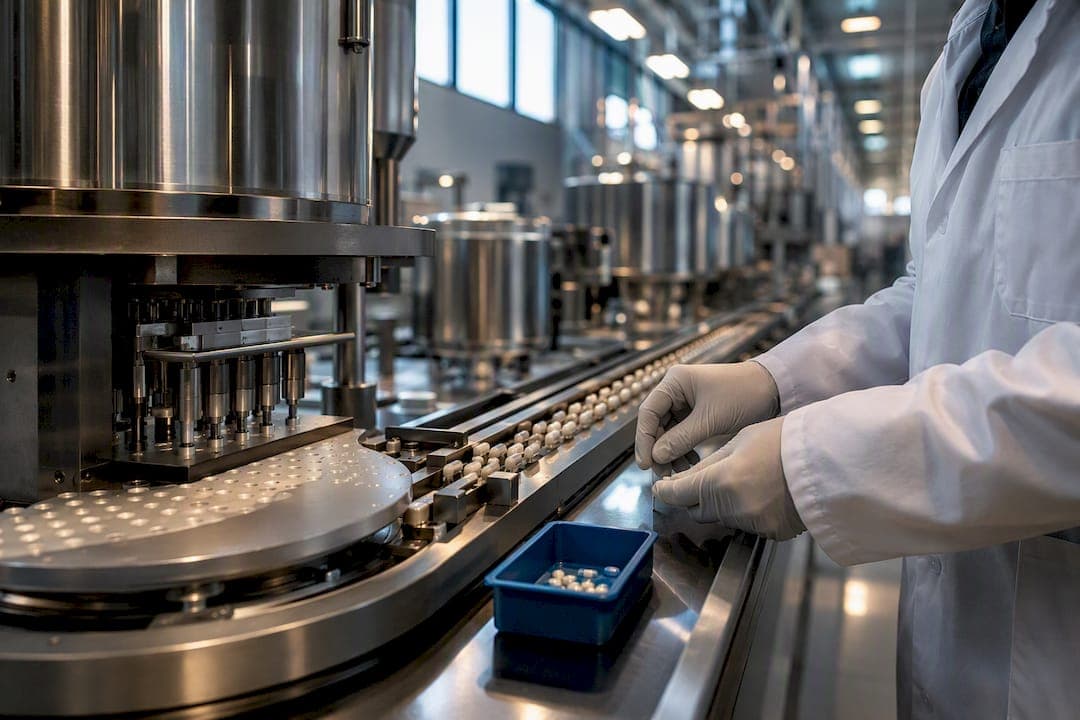
Yes, trustworthy Swedish-made supplements exist, but trust is earned through documentation, not marketing. Authentic svensktillverkade kosttillskott depend on verified manufacturing origin, GMP and HACCP compliance, and traceable batch data. Before buying, check the product page or label for the manufacturing location, certification claims, a batch number, and an available certificate of analysis (COA).
TL;DR:
- Only supplements with traceable manufacturing locations, clear certification, and available batch testing can be reliably trusted in Sweden.
- Certification claims must specify a certifying body and be supported by a verified certificate of analysis matching the product's batch number.
- Swedish manufacturing typically offers better quality control and traceability than products only sourcing ingredients locally but produced abroad.
- Common relied-upon categories are protein, creatine, fish oil, collagen, and multivitamins, where local production ensures freshness and standardization.
- Plant-based supplements require explicit standardization and verification to avoid risks from contamination and variability, making rigorous small-batch production essential.
Table of Contents
- What "Svensktillverkat" Actually Means for Supplements Sold in Sweden
- How Sweden's Quality Standards and Certifications Protect Buyers
- Common Swedish-Made Supplement Categories and When to Choose Them
- Practical Buyer Checklist: What to Verify Before You Purchase
- Why "Plant-Derived" Doesn't Mean "Automatically Safer"
- An Executive's Framework for Choosing What You Actually Trust
- Viridos: A Different Standard for What "Swedish-Made" Should Mean
- Sources
What "Svensktillverkat" Actually Means for Supplements Sold in Sweden
The label "svensktillverkat" carries two distinct meanings, and conflating them is where most buyers get misled. One definition means the final product, capsule, powder, or spray, was formulated, blended, and packaged in a Swedish facility under Swedish oversight. The other means only the raw ingredients originated in Sweden, while the actual manufacturing happened elsewhere, often outside the EU entirely.
That distinction matters for anyone who cares about quality control. A product manufactured in Sweden benefits from shorter documentation chains, faster response to quality issues, and closer regulatory proximity. Swedish manufacturers frequently point to this as a structural advantage: production close to home means traceable raw materials and adherence to GMP/HACCP routines rather than a paper trail that crosses three continents before it reaches a Swedish shelf.
Look for these cues when evaluating a label or product page:
- Explicit wording like "tillverkad i Sverige" (manufactured in Sweden), not just "svenska råvaror" (Swedish raw materials)
- A named facility or production partner, rather than a vague country-of-origin claim
- Batch or lot numbers that correspond to a specific production run
- Freshness or shelf-life dating consistent with a shorter, local supply chain
Ingredient sourcing still matters, but manufacturing location is what governs the quality assurance a brand can actually document.
How Sweden's Quality Standards and Certifications Protect Buyers
Good Manufacturing Practice (GMP) and Hazard Analysis and Critical Control Points (HACCP) are the two frameworks that separate disciplined production from guesswork. GMP governs consistency: equipment cleaning, staff training, ingredient handling, and record keeping at every stage. HACCP identifies where contamination risk is highest, a mixing stage, a filling line, a storage step, and forces documented controls at each point.
Neither framework is self-certifying. A brand that genuinely operates under GMP or HACCP will reference an audit body, a facility registration, or make its documentation available on request. A brand that only prints the acronym on packaging without naming who audits it is making a marketing claim, not a verifiable one.
Three checks separate a credible certification claim from a hollow one:
- Confirm the certifying body. GMP compliance should trace to a named auditor or regulatory registration, not a self-issued badge.
- Request the COA. A proper certificate of analysis lists tested analytes, limits of detection, the accredited lab's name, and the exact batch ID, not just a pass/fail stamp.
- Match the batch number on the COA to the batch number on your product. If they don't correspond, the certificate proves nothing about what you're holding.
Sweden's own food safety authority is blunt about why this matters. Livsmedelsverket warns that supplements can carry contaminants, undeclared substances, and in some cases illegal stimulants such as ephedrine or synephrine, alongside risks from heavy metals and mycotoxins. That guidance isn't theoretical caution. It's the reason independent batch testing exists as a category, and why a manufacturer's willingness to produce a COA on request is one of the more reliable signals a buyer has.
Common Swedish-Made Supplement Categories and When to Choose Them
Sweden's supplement manufacturing base tends to concentrate around a handful of categories where local production offers a real edge: whey and isolate protein, creatine, omega-3 fish oil, collagen, multivitamins, and standardized plant extracts. Retail and brand pages across the market consistently list these as the core Swedish-produced product types, and the reasons for that concentration aren't arbitrary.
Fish oil is a strong example. Traceability matters enormously here, since fish oil oxidizes quickly and heavy metal contamination risk varies by source water. A shorter chain from harvest to encapsulation, ideally documented at each stage, reduces both risks measurably compared to oil that's refined and bottled after a long international transit.
Botanical extracts carry a parallel logic but a different risk profile. Standardization, meaning consistent concentration of the active compounds batch to batch, requires the kind of tight process control that small, local operations can maintain more easily than high-volume offshore blending.
Who benefits most from which category:
- Athletes and recovery-focused users lean on protein and creatine, where potency consistency affects training outcomes directly. Readers building a broader recovery protocol may also find value in nutrition and recovery guidance built for structured training loads.
- Executives managing sustained mental and physical output often prioritize omega-3 and standardized plant extracts, where sourcing and standardization directly affect reliability.
- Everyday health users typically default to multivitamins, where the main risk isn't potency but contamination, making certification transparency the deciding factor.
Practical Buyer Checklist: What to Verify Before You Purchase
Run through this sequence before adding a Swedish-made supplement to your routine. It takes five minutes and eliminates most of the guesswork.
- Read the origin claim literally. Does the label say "tillverkad i Sverige," or does it only reference Swedish ingredients? These are not interchangeable claims.
- Locate the certification statement. GMP or HACCP claims should name a facility or auditing body, not just display a logo.
- Find the batch number. It should appear on the packaging itself, not only in marketing copy.
- Request or locate the COA. Reputable manufacturers publish batch numbers and testing documentation for premium product lines, or provide them promptly on request.
- Ask the manufacturer directly where the raw material was sourced, which lab performed the analysis, and whether the product has been screened for banned substances if you're subject to doping regulations.
Watch for these red flags: vague country-of-origin language, no visible batch information anywhere on the packaging, "chemical-free" or "pure nature" claims with zero supporting lab data, and performance promises that sound better than the evidence any legitimate manufacturer could produce.
Pro Tip: Sustainability claims about shorter transport routes are worth noting, but they describe supply chain length, not safety. A product can have an excellent carbon footprint and still lack the lab testing that actually confirms what's in the bottle.
For a deeper walkthrough of label literacy, this guide to evaluating supplement brands covers the finer distinctions between genuine transparency and polished packaging.
Why "Plant-Derived" Doesn't Mean "Automatically Safer"
Executives evaluating performance supplements often assume botanical formulations carry less risk than synthetic ones. That assumption doesn't hold up. Plant-derived compounds introduce their own hazards: species misidentification, mycotoxin contamination, and chemotype variability, where the same plant grown in different conditions yields wildly different active compound concentrations.
Botanical supplements require explicit chemical standardization and species verification. Premium manufacturers address this with targeted assays and, where necessary, DNA barcoding, precisely because "natural" says nothing about consistency or purity on its own.
This is where disciplined small-batch production earns its place. Smaller production runs mean tighter oversight per batch, more frequent testing intervals, and documentation that ties a specific extract lot to a specific analysis. Viridos treats small-batch Swedish production as a structural requirement, not a marketing detail, precisely because standardization failures in botanical inputs are where most quality problems originate. Readers who want the technical detail behind traceability documentation can review how raw material traceability works in supplement production.
An Executive's Framework for Choosing What You Actually Trust
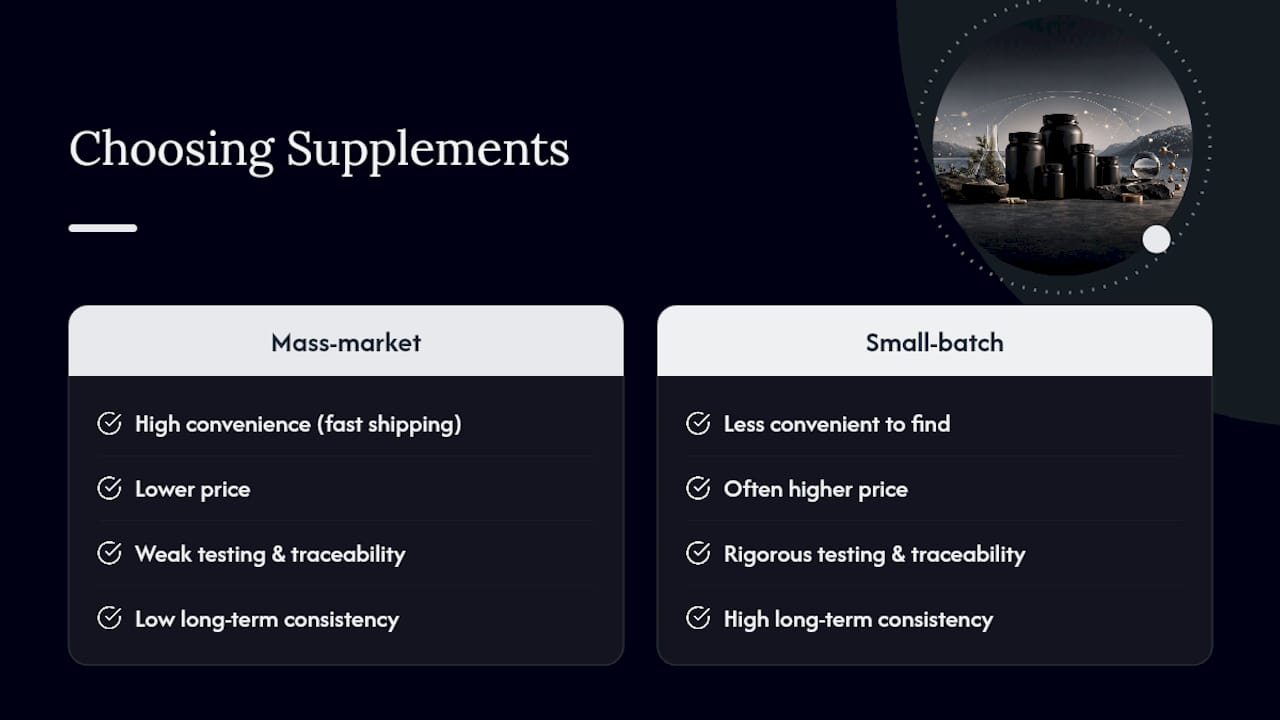
Most men in demanding roles default to convenience when choosing supplements, whatever ships fastest, whatever a colleague mentioned, whatever ranks first. That's a mistake I'd push back on directly. Testing and traceability should outrank price and promotional claims every time, because the cost of an inconsistent or contaminated product isn't measured in dollars. It's measured in wasted months and eroded trust in your own regimen.
An executive building a long-term performance plan treats supplementation the way he treats any other operational decision: he wants documentation before he commits capital or time. That means accepting a trade-off. Small-batch, rigorously tested products are less convenient to find and sometimes cost more than mass-market alternatives. Consistency, not convenience, is what actually compounds over years of disciplined use.
— Joakim
Viridos: A Different Standard for What "Swedish-Made" Should Mean
Everything covered above, GMP compliance, batch traceability, standardized extracts, documented COAs, is the operating standard Viridos builds around, not an afterthought bolted onto a supplement line. Viridos formulates its performance spray in small Swedish batches specifically so each cohort can be tested, documented, and traced back to source, the same discipline the checklist above asks you to demand from any manufacturer.

Membership access exists for the same reason: controlled batch sizes protect consistency in a way high-volume, mass-distribution models structurally cannot. If you've read this far because you take your performance regimen as seriously as any other executive decision, the next step is straightforward. Visit the Performance Journal to see how the formulation, sourcing, and small-batch production come together, or review the longevity performance strategy for the broader thinking behind the membership model before you apply.
This article is general information, not a substitute for advice from a qualified doctor. Consult a qualified healthcare professional about your own circumstances before acting on anything here.