
TL;DR:
- Most founders confuse speed with true progress, often leading to margin compression and operational breakdowns.
- Disciplined scaling involves deliberate growth supported by governance, financial controls, and operational integrity; it emphasizes growing revenue faster than costs.
Most founders confuse speed with progress. They add headcount, expand into new markets, and chase top-line revenue, then wonder why margins compress and operations fracture. Disciplined scaling is the corrective. It means growing revenue faster than costs while preserving the systems, culture, and operational integrity that made the business worth scaling in the first place. The leaders who do this well are not the ones who grow fastest. They are the ones who grow deliberately, with governance structures, financial controls, and a clear-eyed understanding of what their organization can actually absorb.
Table of Contents
- Key takeaways
- What disciplined scaling actually requires
- Managing complexity during growth
- Strategic growth management techniques
- Frameworks and technology that enable disciplined scaling
- My perspective on disciplined scaling
- Sustain your edge through every growth phase
- FAQ
Key takeaways
| Point | Details |
|---|---|
| Maintain financial discipline | Target an LTV:CAC ratio above 3:1 before accelerating growth investment. |
| Fight complexity, not just costs | A net-zero complexity policy keeps systems lean and prevents operational bloat as you scale. |
| Test for founder dependency | Run a 72-hour founder-bottleneck test to confirm your systems operate without you. |
| Prune before you add | Removing the bottom 20% of low-margin customers often improves profitability more than acquiring new ones. |
| Review cadence beats gut instinct | Monthly and quarterly KPI reviews anchor scaling decisions to data, not momentum. |
What disciplined scaling actually requires
Most definitions of scaling are structural: grow revenue without proportionally growing costs. That definition is correct but incomplete. Scaling requires careful hiring and management architecture to maintain operational integrity as the organization grows. Without that, what looks like scaling is actually expansion with a deteriorating margin profile.
Disciplined scaling starts with knowing your unit economics cold.
- LTV:CAC ratio. Sustainable scaling demands an LTV:CAC above 3:1. Below that threshold, you are effectively paying to acquire customers who will not fund their own replacement. Accelerating growth at that point compounds the loss.
- Contribution margin per customer segment. Not all revenue is equal. Before scaling a channel or product line, know which segments actually generate margin at volume, not just at current scale.
- Payback period. If your average customer takes 18 months to pay back acquisition cost, scaling into volatile demand environments creates severe cash risk. Target payback periods that fit your capital structure.
- Repeatable processes. Every function that depends on heroic individual effort is a scaling liability. Disciplined scaling converts high-dependency workflows into documented, testable, and automatable processes before you need to run them at 10x volume.
The goal of these metrics is not bureaucratic compliance. It is predictability. When you know what inputs produce what outputs, you can make growth decisions with confidence rather than hope.
Pro Tip: Before committing to a growth push, map the five highest-dependency processes in your operation. If any of them break at 3x volume, fix them first. Every week spent on process integrity before scaling saves months of firefighting after.
Managing complexity during growth
The single most underestimated threat to operational integrity during scaling is complexity. Not cost, not competition. Complexity. Scaling is fundamentally about fighting complexity, not simply adding resources. Every new product line, integration, pricing tier, and internal workflow introduces coordination overhead that compounds as you grow.
The most practical tool for managing this is the net-zero complexity policy. The principle is direct: for every new feature, process, or system you add, you remove or simplify one existing element. This forces deliberate trade-offs and prevents the gradual accumulation of organizational debt that kills execution speed at scale.
Here is how effective leaders operationalize it:
- Quarterly complexity audits. At the end of each quarter, each function reviews its workflows and identifies one process to eliminate, automate, or consolidate. This is a standing agenda item, not an ad hoc exercise.
- Governance over governance. Every new approval layer, reporting requirement, or cross-functional meeting must be justified against a defined output metric. If it cannot demonstrate value in 90 days, it is removed.
- API and systems rationalization. As technology stacks grow, integration complexity scales faster than functionality. A scheduled review of active integrations, with a bias toward consolidation, maintains technical debt at a manageable level.
A closely related diagnostic is the founder-bottleneck test. The principle is to disconnect the founder or CEO from all internal communications for 72 hours and observe what breaks. If decisions stall, processes stop, or teams wait for direction, the business has not built the systems and management structures that disciplined scaling requires. It is better to discover this at 50 employees than at 500.
The following comparison shows the difference in outcomes between organizations that manage complexity proactively versus those that address it reactively.
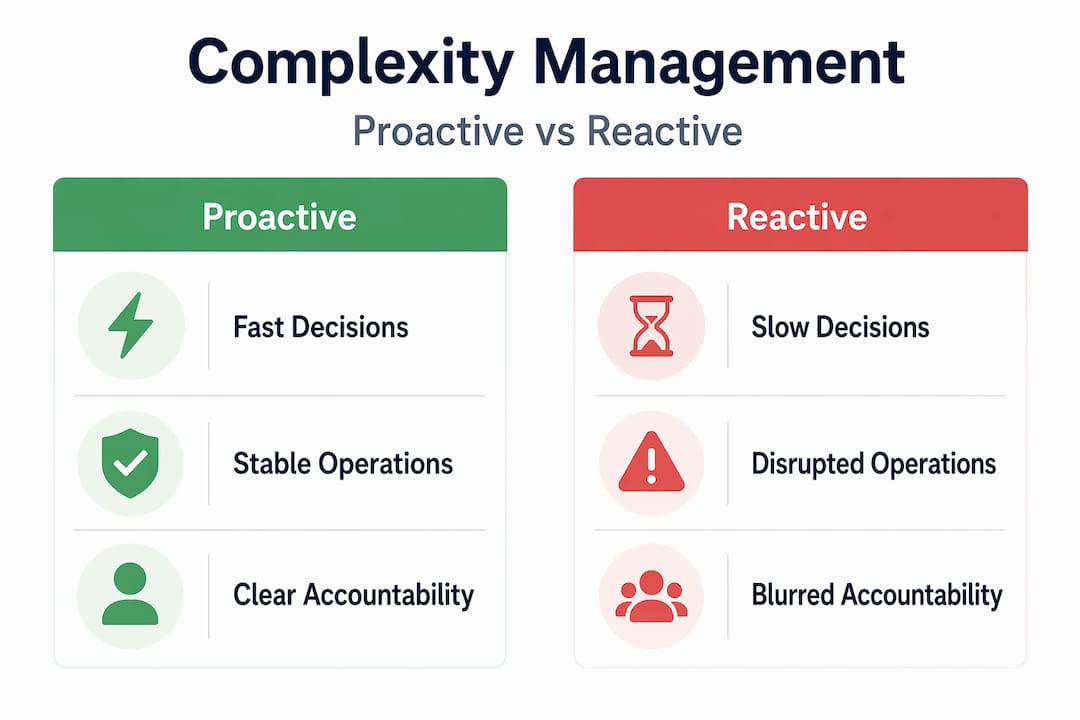
| Dimension | Proactive complexity management | Reactive complexity management |
|---|---|---|
| Decision speed | Maintained through clear ownership | Slows as dependencies accumulate |
| Onboarding time | Predictable and documented | Extends as tribal knowledge dominates |
| System reliability | High due to rationalized architecture | Fragile due to unmanaged integrations |
| Leadership capacity | Available for strategy | Consumed by operational triage |
Pro Tip: Run the founder-bottleneck test as a planned exercise before your next significant hiring push. The gaps it reveals are your actual scaling constraints, not the ones you assume.
Strategic growth management techniques
Disciplined growth management is not about saying no to opportunity. It is about saying yes to the right opportunities at the right rate, with the data to back the decision.
One of the most underutilized techniques is customer portfolio pruning. Cutting the bottom 20% of high-noise, low-margin accounts regularly improves profitability and frees capacity for higher-value relationships. Most leaders resist this because revenue feels safer than margin. But at scale, serving the wrong customers imposes real costs: disproportionate support load, custom feature requests that fragment the product roadmap, and sales cycles that consume senior time.

Tiered pricing is an equally high-leverage tool. SaaS companies using tiered pricing see an average 15% increase in average revenue per user without proportional cost increases. The mechanism is straightforward: you align price with value delivered at each usage level, so growth in revenue is partially decoupled from growth in operational cost. This is the financial architecture of disciplined scaling made concrete.
Hiring discipline matters as much as financial discipline during growth phases. Smaller, well-supported teams consistently outperform larger, overstretched ones during scaling periods. The correct sequencing is to hire for a proven need, not an anticipated one. Every premature hire adds fixed cost before the revenue signal that justifies it. Build strong management structures before adding headcount, because undermanaged growth produces the same operational fragility as no management at all.
Finally, iterative measurement and review cadence converts growth strategy from aspiration into execution. Monthly and quarterly KPI reviews tied to defined thresholds create decision triggers rather than decisions by committee. When a metric crosses a threshold, the response is predetermined. This removes emotional reaction from growth management and replaces it with governance.
Frameworks and technology that enable disciplined scaling
The tools available for disciplined scaling in 2026 are materially better than they were five years ago, but they only work when deployed within a governance structure that preserves judgment and human accountability.
The Disciplined Agile framework addresses one of the central failures of scaling organizations: applying a single process blueprint across teams and functions with very different contexts. Disciplined Agile operates as a toolkit rather than a prescription, allowing teams to choose the specific way of working that fits their situation while staying within a defined governance structure. This context-aware flexibility prevents the rigidity that kills execution speed and the chaos that kills quality.
On the technology side, the priorities for disciplined scaling are automation, adaptive workflow tooling, and AI-assisted forecasting. The specific applications that deliver the most compounding value include:
- Process automation for high-frequency, low-variance workflows. Finance, compliance, and customer onboarding are strong candidates. Automation here reduces per-unit cost and removes human error from predictable processes.
- AI-assisted demand and revenue forecasting. Accurate forward visibility lets you make hiring and investment decisions ahead of demand rather than in reaction to it.
- Adaptive project and workflow tooling. Systems that surface bottlenecks and rebalance workloads in real time reduce the management overhead required to maintain throughput at scale.
One principle worth holding onto as AI capabilities expand: balancing algorithmic efficiency and human trust is not a soft concern. It is a structural one. Customers and employees both reduce their engagement when they sense that human judgment has been removed from consequential decisions. The organizations that scale with credibility intact are those that use automation to handle volume and reserve human attention for context, relationships, and judgment calls.
My perspective on disciplined scaling
What I have seen repeatedly in high-performing organizations is that the discipline required to scale well is not a business problem. It is a leadership problem. The systems, frameworks, and financial controls are all available and well documented. The constraint is always whether the leadership team has the self-awareness and patience to apply them before the pressure to grow overrides good judgment.
Most scaling failures I have observed were not failures of strategy. They were failures of sequencing. The company had the right model, the right market, and the right team. But they scaled the go-to-market before the operational infrastructure could support it, or they added management layers before the culture had the cohesion to use them well. The result was a business that looked like it was growing from the outside and felt like it was disintegrating from the inside.
The leaders who consistently build organizations with performance longevity share one trait: they treat restraint as a competitive advantage. They are willing to leave short-term growth on the table to protect operational integrity. This requires both the discipline that peak performance demands and the physical and mental capacity to make high-quality decisions over a sustained period. Scaling a business is a long game. The leaders who last are the ones who treat their own performance with the same rigor they apply to their business systems.
— Joakim
Sustain your edge through every growth phase
Disciplined scaling demands more than frameworks and financial controls. It demands that the leader at the center of the organization is performing at a level that matches the complexity of what they are building. At Viridos, we design specifically for that challenge.

The Viridos Membership gives founders and executives controlled access to a premium performance formulation developed in small-batch Swedish production. The focus is sustained vitality, mental clarity, and performance longevity, precisely the capacities that deteriorate under the sustained pressure of scaling. For leaders who apply the same precision to their own performance as they apply to their business, Viridos offers a membership experience calibrated to the demands of high-responsibility roles. Explore how physical and mental capacity integrate with your capacity to lead.
FAQ
What is disciplined scaling in business?
Disciplined scaling means growing revenue faster than operational costs while deliberately maintaining process integrity, governance, and unit economics. It differs from undisciplined growth by requiring financial and operational criteria to be met before each growth phase.
What is a healthy LTV:CAC ratio for scaling?
A ratio above 3:1 is the standard benchmark for sustainable scaling. Below this level, customer acquisition costs outpace the long-term value generated, making growth capital-destructive.
How do you manage complexity when scaling a business?
Apply a net-zero complexity policy: remove or simplify one existing process for every new one you add. Pair this with quarterly complexity audits and a bias toward system consolidation to prevent operational debt from accumulating.
What does the founder-bottleneck test reveal?
The founder-bottleneck test reveals whether your business systems can function without direct founder input. If operations stall when the leader disconnects for 72 hours, the organization lacks the management infrastructure required for disciplined scaling.
How often should you review scaling KPIs?
Monthly and quarterly reviews tied to predefined thresholds create consistent decision governance. This cadence removes reactive decision-making from growth management and replaces it with data-driven triggers.