
TL;DR:
- Most high-performing executives often experience energy depletion due to unintentional routine erosion caused by excessive meetings and reactive tasks.
- Designing a deliberate day architecture with strategic time-blocking, prioritized routines, and boundaries is essential for sustained high performance and long-term resilience.
Most high-performing executives hit a wall they didn't see coming. Not from lack of drive or strategy, but from a slow erosion of their daily structure. Meetings multiply, reactive tasks crowd out deep work, and by late afternoon the energy needed for real decisions is simply gone. CEO time-use research tracking 27 large-company CEOs across 60,000 hours found that even the most accomplished leaders struggle to control how their time is actually spent. This guide offers the evidence-backed structure and daily frameworks to take that control back.
Table of Contents
- Assess your routine: Identify the drift and bottlenecks
- Architect your day: Strategic time-blocking and priority design
- Engineer your morning: Energy, movement, and focused start
- Resilience and boundaries: Maintaining energy through health, rest, and compartmentalization
- Real executive wisdom: Why routines fail and how systems succeed
- Enhance your routine with executive-focused solutions
- Frequently asked questions
Key Takeaways
| Point | Details |
|---|---|
| Benchmark your routine | Use executive-specific time and wellness benchmarks to discover your strengths and bottlenecks. |
| Time-block for results | Strategically plan deep work, prioritize daily actions, and use systems to minimize distractions. |
| Engineer your morning | Start each day with a template that includes hydration, movement, review, and focused prep. |
| Maintain resilience | Integrate sleep, hydration, health checkups, and set strong work boundaries to prevent burnout. |
| Optimize with science | Advanced executive solutions and membership resources can turn your structured routine into performance and results. |
Assess your routine: Identify the drift and bottlenecks
Before redesigning anything, you need an honest baseline. Most executives believe they're protecting their time. The data says otherwise.
HBR's CEO time allocation research reveals a striking pattern: a disproportionate share of executive time flows toward meetings, investors, and the board, while customers and frontline employees receive precious little attention. This imbalance isn't just a strategic concern. It's a signal that your daily structure is being driven by whoever schedules the loudest demands, not by your actual priorities.
The meeting trap is real. CEOs historically spend up to 72% of their time in meetings, a figure that hasn't improved much with the rise of digital collaboration. When that number climbs, it crowds out the thinking, planning, and recovery time that sustains long-term performance.
Here's how executive time typically breaks down versus how it should:
| Time category | Typical allocation | Target allocation |
|---|---|---|
| Internal meetings | 55–72% | 35–45% |
| Deep strategy work | 5–10% | 20–25% |
| Customer/frontline time | Under 5% | 10–15% |
| Personal recovery/health | Under 5% | 10–15% |
| Focused communication | 10–15% | 10–15% |
According to the Chief Executive C-Suite health survey conducted with Mayo Clinic health screening questions, America's C-suite executives work an average of 53 hours per week. That number matters because it reveals how little margin exists for unstructured drift. When meetings absorb most of those hours, recovery and high-value thinking get pushed out entirely.
Key bottlenecks to watch for in your own routine:
- Back-to-back meetings with no transition time: These eliminate your ability to process what just happened and prepare for what's next.
- No protected block for daily priority work: If your calendar has no sacred time for your one highest-impact task, it won't get done.
- Reactive mornings: Starting the day with email or Slack puts you in response mode from minute one.
- Late-day decision fatigue: Scheduling critical decisions after four hours of meetings guarantees lower-quality outcomes.
For a useful reference point on executive wellness benchmarks and how leading performers structure their days around health outcomes, the gap between typical and optimal is measurable and closeable.
Pro Tip: Audit your last two weeks of calendar data. Count your actual hours in meetings versus protected deep work. Most executives are shocked to discover the real ratio.
The goal isn't to eliminate meetings. It's to stop letting them govern your entire architecture.
Architect your day: Strategic time-blocking and priority design
Armed with your baseline data, now architect your day with intentional structure and priority design.
Time-blocking is not a productivity hack. It's a strategic lever that separates executives who sustain peak performance from those who gradually erode. When you block time on your calendar for your highest-priority work, you're making a decision in advance, before the pressure of the moment can override it.
The day architecture approach argues that high-performing leaders must move beyond willpower-based habits and design their environment and schedule so that the right behaviors happen automatically. Think of it the way an architect thinks about a building. The structure itself shapes how people move through it. Your calendar should do the same for your attention and energy.
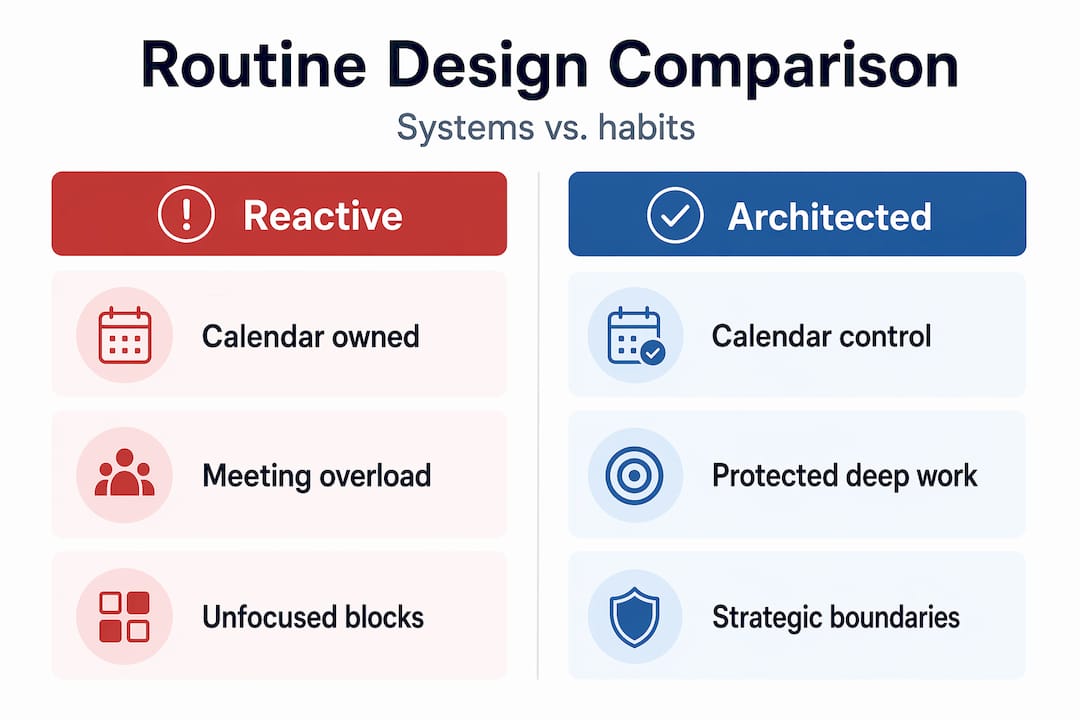
Here's a comparison of two approaches to executive scheduling:
| Approach | Reactive scheduling | Day architecture |
|---|---|---|
| Calendar ownership | Others fill it | You design it first |
| Deep work | Happens when gaps appear | Blocked daily, non-negotiable |
| Priority management | Reviewed when urgent | Reviewed every morning |
| Meeting load | Accepted by default | Actively curated weekly |
| Energy management | Depleted by afternoon | Protected and distributed |
The daily habits framework for founder and CEO resilience consistently points to time-blocking and singular daily focus as the two most high-leverage behaviors. Investors and boards notice when founders maintain these disciplines because they produce more consistent strategic output over time.
Here's how to build your day architecture in practice:
- Identify your single daily priority. Every morning, name the one thing that, if done well, makes the day a success. Everything else is secondary.
- Block your peak-energy hours for that priority. Most executives perform best in the late morning. Protect two to three hours there for focused work, not meetings.
- Batch meetings into specific windows. Afternoons and mid-mornings work well for most leaders. Grouping meetings reduces context switching and preserves creative bandwidth.
- Build 15-minute transition buffers between major blocks. Use these to reset, hydrate, and prepare mentally for the next task.
- Review your next-day priorities the evening before. This reduces morning decision load and allows you to start with clarity rather than catching up.
- Track weekly metrics, not just daily tasks. Emotional fluctuations distort day-to-day assessments. Weekly review of objective metrics reveals real patterns.
"The leader who controls the architecture of their day controls the quality of every decision made within it."
For deeper guidance on designing health routines that integrate with your professional structure, the principle is the same. Systems, not good intentions, create consistency.
Pro Tip: Use a "calendar template week" that you design fresh on Friday for the following week. This is your ideal week on paper. Protect it aggressively at the start of each week before others can schedule into it.
The executives who sustain high performance for decades don't have better willpower. They have better systems.
Engineer your morning: Energy, movement, and focused start
With your day structured, let's zoom in on the pivotal morning routine that sets tone and energy.
The morning is the one part of the day where you hold the most control. Meetings haven't started, demands haven't multiplied, and your prefrontal cortex is at its freshest. How you use those first 90 to 120 minutes shapes the quality of everything that follows.
The BaseHQ executive morning routine guide outlines a practical sequence built specifically for leaders in high-demand roles. The template begins with hydration and light movement before any screen time, then moves into a brief schedule and priority review, followed by focused exercise or a walk, and closes with a focused preparation block before the first meeting. This sequence is deliberately sequenced to match your neurological state to the right activity at the right time.
| Morning block | Timing | Purpose |
|---|---|---|
| Hydration + light movement | First 15 minutes | Reactivate metabolism and nervous system |
| Schedule and priority review | Minutes 15–30 | Set intention, identify daily priority |
| Exercise or walk | 30–60 minutes | Build physical energy and mental clarity |
| Deep work or prep | 60–120 minutes | Highest-quality cognitive output |
| First meeting | After block protection | Engage others from a position of clarity |
The health data backs the morning movement habit strongly. 78% of C-suite executives exercise at least three times per week, making physical activity one of the most consistent behaviors among the highest-performing leaders. This isn't coincidence. Exercise improves decision quality, emotional regulation, and sustained concentration, all things an executive burns through by mid-day.
Key morning behaviors that separate high-output executives from reactive ones:
- No email before your priority review: Checking messages first thing puts you in a reactive frame immediately. Protect the first 30 minutes from external input.
- Anchor movement to the morning: Those who exercise in the morning report higher consistency than those who plan to exercise "later."
- Use the morning review to align energy: If you know your first meeting is a difficult conversation, use the prep block to think through it clearly rather than walking in cold.
- Hydrate before caffeine: A full glass of water before coffee restores overnight fluid loss and improves alertness without the cortisol spike of caffeine on an empty system.
For practical tools on sustaining high energy across a demanding workday, the morning is consistently where the investment pays the highest dividend.
Pro Tip: Set your morning alarm 15 minutes earlier than you think you need. Use that buffer for hydration and a five-minute priority review. This one change, practiced consistently, produces measurable improvements in decision quality by mid-morning.
A morning engineered for energy isn't a luxury. For executives in demanding roles, it's an operational necessity.
Resilience and boundaries: Maintaining energy through health, rest, and compartmentalization
After mornings set your energy, it's essential to sustain it with the right boundaries and wellness strategies.

Building a strong routine at the start of the day means nothing if you bleed energy throughout it without intentional recovery. True executive resilience isn't about working harder. It's about recovering smarter and building the boundaries that make sustained output possible.
Executive resilience research is clear that preventing burnout requires three parallel commitments: consistent sleep and hydration as non-negotiables, intentional compartmentalization of work from personal recovery time, and proactive health monitoring rather than reactive responses to symptoms. Leaders who wait until they're exhausted to address recovery are already behind.
Key resilience practices that hold up under real executive pressure:
- Sleep as a strategic asset: Treat seven to eight hours of sleep the way you treat your most important meetings. Schedule it. Protect it. Executives who consistently sleep less than six hours show measurable declines in judgment and impulse control within days.
- Hydration throughout the day: Keep water accessible throughout the day, not just at meals. Mild dehydration, as little as 1 to 2%, reduces concentration and increases perceived effort.
- Annual executive health screenings: Regular checkups with a physician familiar with high-performance demands catch problems before they become crises. The C-suite executives who maintain their edge longest treat preventive healthcare as routine, not optional.
- Compartmentalization as a skill: This means creating clear transitions between work and non-work time. A defined "shutdown routine" at day's end, a brief walk, a brief review of what's done and what's deferred, signals to your nervous system that recovery can begin.
"Boundaries aren't a weakness in executive life. They're the structural load-bearing walls of long-term performance."
For resilient performance strategies that specifically address the demands of senior leadership, the common thread is always the same. Recovery is not passive. It must be designed with the same precision as your peak performance blocks.
Avoid the always-on trap. Constant availability doesn't signal strength. It signals that your calendar owns you. Establish clear response windows for email and messages. Communicate them to your team. Then hold them. Executives who do this consistently report higher team trust and better personal recovery, not lower team performance.
For deeper reading on executive motivation strategies and wellness optimization designed for leaders in demanding roles, both address the recovery side of performance that most productivity content ignores.
Real executive wisdom: Why routines fail and how systems succeed
Here's the uncomfortable observation after reviewing decades of executive performance research. Most routines fail not because leaders lack discipline. They fail because they're built on individual habits rather than system-level design.
Habits are individual behaviors. Systems are the architecture around those behaviors that make them easier to maintain than to skip. An executive who builds a great morning routine but leaves their afternoon calendar unprotected will find that the calendar gradually colonizes the morning. Meetings creep earlier. Reactive tasks multiply. The routine erodes slowly, invisibly, until it's gone.
The meeting trap data makes this concrete. If you optimize your schedule without actively reducing meeting-driven drift, the calendar itself becomes the limiting factor. No morning routine survives an organization that schedules 8 AM calls by default.
The executives who sustain peak performance across their 50s and 60s have internalized three system-level truths. First, architecture beats willpower every time. Design your week before others do. Second, health boundaries are performance boundaries. Sleep, recovery, and physical capacity aren't separate from professional performance; they are the engine of it. Third, calendar ownership requires active defense. You must review and reset your calendar weekly, not reactively.
The most powerful insight from working with high-agency professionals is this: the executives who think of their routine as a system to maintain treat it with board-level seriousness. They measure it. They review it. They adjust it quarterly. They don't wait until burnout forces a reset.
For long-term health strategies built specifically for executives who want to operate at their best into their 60s and beyond, the investment horizon is long and the compounding is real.
Routines that last aren't the ones that feel motivating on day one. They're the ones that still run on day 300 because the system makes them inevitable.
Enhance your routine with executive-focused solutions
You now have the frameworks, benchmarks, and system-level thinking to redesign your daily routine for sustained performance. The next step is connecting those frameworks to tools and formulations specifically built for the demands of executive life.

VIRIDOS is a premium Swedish men's performance brand designed for disciplined leaders who demand consistency, not quick fixes. The VIRIDOS Membership delivers structured access to performance optimization resources, science-backed formulations, and a premium experience calibrated to executive demands. Every product is small-batch, precision-formulated, and backed by the VIRIDOS science framework built for men in high-stakes roles. If you're building a routine that needs to hold under real pressure, explore what VIRIDOS offers for executives who take their longevity as seriously as their performance.
Frequently asked questions
How can I cut down on meeting overload in my daily routine?
Prioritize your calendar at the start of each week, designate non-negotiable blocks for deep work, and actively eliminate low-value meetings. Research shows CEOs historically spend up to 72% of their time in meetings, making proactive calendar management one of the highest-leverage executive behaviors.
What morning routine practices are backed by executive health benchmarks?
Start with hydration and light movement, then review your schedule and priorities before exercise or a walk, followed by focused deep work. 78% of C-suite executives exercise at least three times per week, and the BaseHQ morning template sequences these behaviors to match your neurological state to the right activity.
How do executives maintain resilience and avoid burnout?
Sustained resilience requires sleep, consistent hydration, proactive health screenings, and clear boundaries that protect recovery time from work demands. Executive resilience guidance consistently identifies intentional compartmentalization of work and rest as the critical differentiator between leaders who sustain output and those who eventually crash.
What is "day architecture" and how does it improve executive routines?
Day architecture is a systematic method for designing your schedule so that high-value behaviors occur by default, not by willpower. The day architecture framework argues that structure and systems, not motivation alone, produce the consistency that high-performing leaders need across demanding weeks and quarters.