TL;DR:
- Most executives believe pushing harder and sleeping less gives them an edge, but recovery outperforms willpower. Structured energy management through sleep and ultradian cycles sustains decision-making, emotional stability, and creativity. Building disciplined routines with accountability ensures long-term performance and organizational health.
Most executives believe their edge comes from pushing harder, sleeping less, and tolerating discomfort that others won't. That belief is partly right and almost entirely wrong. The research is clear: energy management through deliberate work and recovery cycles produces more sustained output than raw willpower ever will. This article unpacks the science and the systems behind disciplined recovery, so you can operate at your actual ceiling rather than a fatigued approximation of it.
Table of Contents
- Why disciplined recovery outperforms willpower alone
- Framework for executive recovery: Ultradian cycles, sleep, and boundaries
- Sleep and performance: What executives need to know
- Systems and accountability: Building disciplined recovery for longevity
- The uncomfortable truth: Recovery is the highest discipline for executives
- Optimize your recovery and discipline with VIRIDOS
- Frequently asked questions
Key Takeaways
| Point | Details |
|---|---|
| Recovery is essential | Sustained executive performance requires disciplined recovery—not just more willpower. |
| Sleep impacts leadership | Quality sleep protects decision-making, emotional steadiness, and cognitive control. |
| Structure trumps motivation | Systems, routines, and accountability outperform motivation in building disciplined habits. |
| Boundaries prevent burnout | Set work and social boundaries to protect recovery and long-term capacity. |
| Use biological rhythms | Align work and recovery cycles with your natural ultradian and circadian rhythms for best results. |
Why disciplined recovery outperforms willpower alone
The traditional executive narrative celebrates grinding through exhaustion as proof of commitment. But physiology does not negotiate with ambition. When you treat every waking hour as productive time, you gradually erode the very cognitive and emotional resources your role demands most.
"You can't out-discipline a dysregulated nervous system."
That statement cuts directly against the willpower mythology. A dysregulated system, one running on cortisol, fragmented sleep, and zero mental downtime, cannot be corrected by adding more structure. It requires genuine physiological renewal. The moment you recognize that distinction, your entire approach to performance changes.
The high responsibility lifestyle that most senior leaders live creates chronic low-grade stress that compounds over time. Decisions become slower. Emotional reactions become sharper. Creative thinking narrows to reactive problem-solving. These are not character flaws. They are the predictable outputs of a nervous system running without adequate recovery.
Energy management is not a soft concept. It is a measurable, trainable capacity. The principle is straightforward: work depletes energy, recovery restores it, and the cycle must be respected to sustain high-level output. Here is what chronic overload actually costs you:
- Decision quality degrades. After sustained cognitive load, the brain defaults to lower-effort, lower-accuracy choices. You make more errors on the decisions that matter most.
- Emotional steadiness erodes. Recovery-deprived executives become more reactive, less empathetic, and harder for their teams to follow with confidence.
- Physiological burnout accelerates. The body has finite buffers. Willpower can override fatigue signals temporarily, but the physiological debt accrues and eventually comes due.
- Innovation capacity shrinks. Genuine creative and strategic thinking requires a brain that is not in survival mode.
The executive performance tools that produce lasting results are not about logging more hours. They are about managing the quality and timing of your energy expenditure. Willpower is a tool, not a strategy. Recovery is the strategy.
Framework for executive recovery: Ultradian cycles, sleep, and boundaries
Understanding the rationale is one thing. Building practical architecture around it is another. Fortunately, the science of recovery maps cleanly onto executive routines when you apply the right frameworks.
The most actionable starting point is the ultradian cycle. Your brain naturally oscillates between higher and lower alertness roughly every 90 minutes. The Huberman Lab daily routines outline how aligning your work blocks to these cycles, approximately 90 minutes of focused work followed by a brief recovery period of 10 to 15 minutes, sharpens output and prevents the accumulated cognitive drag that undermines afternoon performance.
Here is how the ultradian approach compares to the conventional executive schedule:
| Approach | Work block structure | Recovery built in? | Cognitive output by 3 PM |
|---|---|---|---|
| Conventional grinding | 4 to 8 hours straight | Rarely | Degraded, reactive |
| Ultradian cycle method | 90 min work / 10-15 min break | Yes, by design | Sustained, strategic |
| Ad hoc breaks only | Variable, unplanned | Inconsistently | Unpredictable |
The numbers favor the structured approach every time. But the real discipline here is not in the work blocks. It is in actually taking the recovery window seriously, not checking email, not squeezing in a quick call, but genuinely disengaging.
Consistent sleep timing is the second pillar. Your circadian rhythm is not just a preference. It is a deeply encoded biological program that governs hormone release, cellular repair, and cognitive reset. Irregular sleep timing, even when total hours remain constant, disrupts these cycles and blunts recovery.
Here is a numbered framework for embedding disciplined recovery into a demanding weekly schedule:
- Anchor your sleep window. Commit to a consistent wake time seven days a week. This single habit does more to stabilize circadian function than any supplement or sleep tracking device.
- Block your ultradian cycles on your calendar. Treat them like meetings. Mark the recovery windows as protected time.
- Establish an end-of-day shutdown ritual. A 10-minute review and task transfer signals to your nervous system that the work period is complete, making genuine disengagement possible.
- Set organizational boundaries explicitly. Define your non-contact hours and communicate them. Leadership culture often reflects whatever the leader tolerates.
- Schedule one complete recovery day per week. Not a light work day. A true disengagement day that includes physical activity and social connection.
Pro Tip: The single most effective boundary you can set is a hard stop on work communication after a fixed evening hour. It forces your team to develop autonomous judgment and gives your nervous system the disengagement signal it needs to begin genuine recovery.
The discipline and precision methodology that distinguishes long-term performers from burnout casualties is not about doing more. It is about doing less, more precisely, with deliberate recovery built into the architecture.
One consistent finding across leadership research is that organizational culture amplifies burnout when leaders model overload as a badge of honor. The culture you create is a direct projection of your own habits. If you normalize grinding, your team will grind until they break. Your recovery practice is also a leadership act.
The executive wellness optimization literature consistently supports boundary-setting as a non-negotiable feature of sustainable leadership, not a luxury for those with lighter workloads.
Sleep and performance: What executives need to know
Sleep is not downtime. It is active, physiologically critical work that your body cannot perform in any other state. For executives, it is the highest-leverage recovery variable available, and most are managing it with less precision than they manage their financial models.
"Sleep quantity and quality are linked to physical and cognitive performance, with relationships that may be non-linear and context-dependent."
That context-dependency matters. There is no universal prescription. The optimal sleep duration for a 55-year-old CEO in a high-travel, high-stress role differs from generic population averages. What the research makes clear is that degradation from insufficient sleep is consistent, measurable, and cumulative.
A systematic review of sleep deprivation found significant impairments across multiple performance domains when subjects were sleep-deprived, including endurance, power output, reaction speed, and decision accuracy. These are not soft metrics. They are the exact capabilities your role demands daily.
Here is what the evidence shows across key performance domains:
| Performance domain | Effect of poor sleep | Recovery potential |
|---|---|---|
| Cognitive accuracy | Significant degradation after even one night | Partially restored with 1-2 recovery nights |
| Emotional regulation | Increased reactivity, reduced empathy | Slower to restore than cognitive function |
| Physical endurance | Measurable reduction in output | Responsive to recovery sleep |
| Strategic thinking | Narrowed to reactive mode | Requires sustained quality sleep to restore |
| Risk assessment | Skewed toward overconfidence or avoidance | Normalized with consistent sleep |
What this means in practice:
- Treat your sleep window as a performance variable, not a personal preference. Executives who log it, protect it, and optimize it perform better on the metrics that matter.
- Strategic naps have a legitimate role. A 10 to 20 minute nap in the early afternoon can restore alertness and cognitive sharpness without disrupting nighttime sleep if timed correctly, ideally before 3 PM.
- Pre-sleep routine is not optional. Screen exposure, alcohol, and late high-intensity exercise all compromise sleep architecture even when they do not visibly reduce total sleep time.
- Track your actual patterns. Subjective sleep quality assessments are unreliable. Use objective data from a wearable or sleep diary to identify where your performance leaks are occurring.
The executive fitness tips that produce the most durable returns always circle back to sleep as the foundation. You can optimize training, nutrition, and supplementation, but none of those investments compound properly without adequate sleep underneath them.
Sustaining resilience at the executive level is fundamentally a sleep management problem as much as it is a mindset problem. The two are inseparable.

Systems and accountability: Building disciplined recovery for longevity
Motivation is a weather system. Systems are infrastructure. If your recovery practice depends on feeling motivated to do it, it will collapse under pressure precisely when you need it most.
The systems-based approach to discipline treats routines and accountability structures as the scaffolding that makes consistent behavior possible regardless of how you feel on a given day. This is where most high-performers get it wrong. They rely on willpower to maintain recovery habits, which means their recovery evaporates during the highest-stress periods, exactly when the need is greatest.
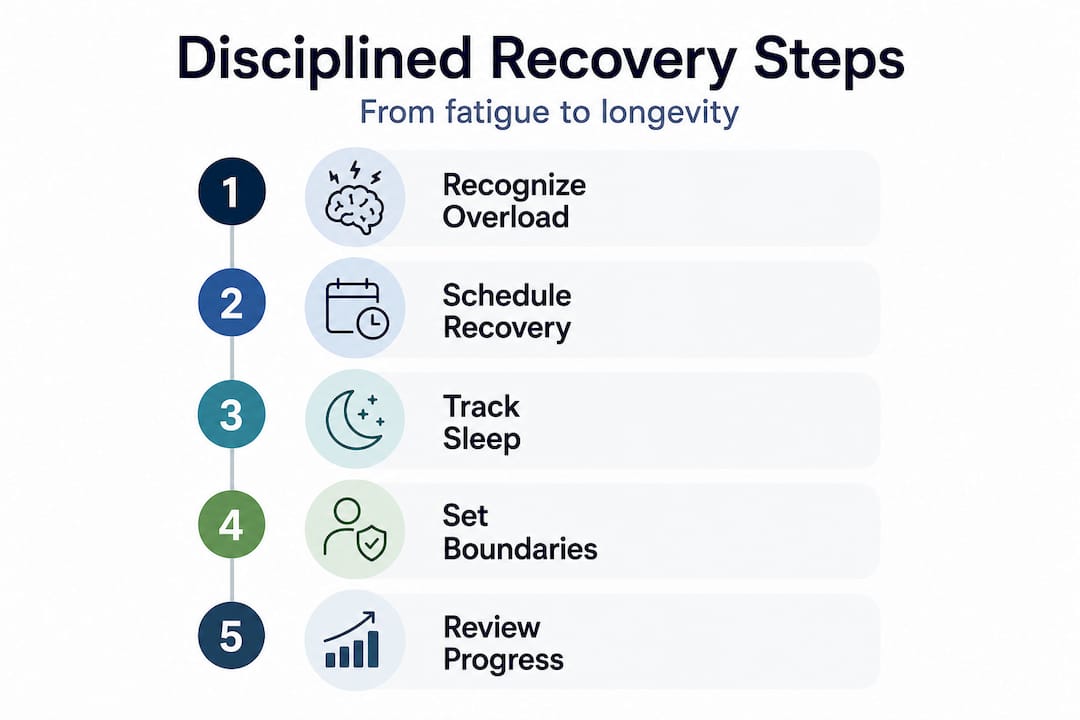
Effective recovery systems share a few common features:
- They are scheduled, not spontaneous. Recovery windows appear on your calendar as fixed commitments with no negotiable status.
- They are tracked with objective data. Whether through journaling, wearables, or check-ins with a performance partner, progress is measured and refined.
- They include accountability. An external structure, whether a coach, a peer group, or a committed journaling practice, creates the friction that prevents quiet abandonment of recovery commitments.
- They are reviewed regularly. Monthly reviews of recovery quality, energy patterns, and performance outputs allow you to iterate on what is and is not working.
The self-optimization guide for executives consistently emphasizes one finding: the leaders who sustain performance over decades are not the most naturally gifted or the most motivated. They are the most systematic. They have built environments and accountability structures that make recovery the default, not the exception.
Pro Tip: Find one accountability partner who has comparable demands and performance standards. A weekly 15-minute check-in on sleep, recovery, and energy levels will do more to maintain your habits than any app or wearable alone.
The motivation strategies for leaders that actually hold up under pressure are built on identity, not inspiration. When you define yourself as someone who prioritizes physiological recovery as a performance strategy, the behavior follows more reliably than when you depend on daily motivation to sustain it.
Structured journaling plays a specific role here. Not emotional processing, but performance logging. Tracking your sleep timing, energy levels, cognitive clarity ratings, and key decisions creates a personal dataset that makes optimization possible. You begin to see patterns that intuition alone would miss. Maybe your best strategic thinking happens on days following seven-plus hours of sleep. Maybe your conflict threshold drops sharply after three consecutive nights of less than six hours. That data is actionable in a way that generic advice never is.
The performance longevity optimization that sets elite executives apart is not achieved through extraordinary capacity. It is achieved through extraordinary consistency, and consistency is a systems problem, not a willpower problem.
The uncomfortable truth: Recovery is the highest discipline for executives
Here is what executive culture rarely admits: the leaders who burn brightest and shortest often serve as cautionary tales, not role models. The mythology of relentless drive is compelling from the outside. From the inside, it frequently ends in health crises, broken relationships, impaired judgment, and organizations that reflect the instability of their leader.
Recovery is not the opposite of discipline. It is its highest expression. The disciplined executive is the one who can disengage from work when the body signals the need, enforce boundaries when every instinct says to stay online, and prioritize sleep even when the inbox demands otherwise. That requires more willpower than grinding ever does.
The culture problem runs deep. Organizations reward visible effort and punish visible rest. Leaders who leave on time are assumed to lack commitment. Leaders who take vacations fully disconnected are assumed to be unserious. These are cultural distortions that cost organizations their best people and cost executives their longevity. Changing them starts with you modeling something different.
Your personal legacy as a leader depends on how long you can operate at genuine capacity. A ten-year run at 70 percent output, degraded by chronic fatigue, produces less than a thirty-year run at consistent high capacity maintained through disciplined recovery. The math is straightforward. The behavioral change is harder.
The executive edge lifestyle is not about squeezing more from each day. It is about extending the number of high-quality days you have available. Recovery is how you protect that asset.
Optimize your recovery and discipline with VIRIDOS
The principles in this article point toward a clear conclusion: sustained executive performance requires structured systems, precise daily rhythms, and tools designed for disciplined tracking and accountability.

VIRIDOS builds performance resources specifically for executives who take their physiological edge as seriously as their strategic one. The Performance Journal is designed for structured daily logging of sleep, energy, and cognitive output, giving you the objective data your optimization requires. The Executive Membership connects you with advanced methodologies, accountability structures, and a community of high-agency professionals committed to performance longevity. If the insights in this article resonate, the next step is building the systems that make them permanent.
Frequently asked questions
How can I structure recovery routines to fit a high-demand executive schedule?
Use ultradian cycle scheduling by working in 90-minute blocks followed by 10 to 15 minute breaks, and anchor a consistent sleep wake time daily to reinforce your circadian rhythm without requiring more total hours.
Can sleep deprivation really affect my decision-making and leadership quality?
Yes. Chronic fatigue degrades cognitive accuracy and emotional steadiness in high-responsibility roles, making leaders more reactive, less precise, and more prone to judgment errors on consequential decisions.
What is the most effective first step to embed disciplined recovery?
Schedule recovery as a fixed calendar commitment and pair it with an accountability partner or structured journaling practice, because routine beats motivation as the foundation for any lasting performance habit.
Are there risks in treating overload as a badge of honor?
Yes, this pattern measurably increases burnout risk and simultaneously signals to your organization that unsustainable overload is the standard, which degrades team culture and erodes collective performance capacity over time.