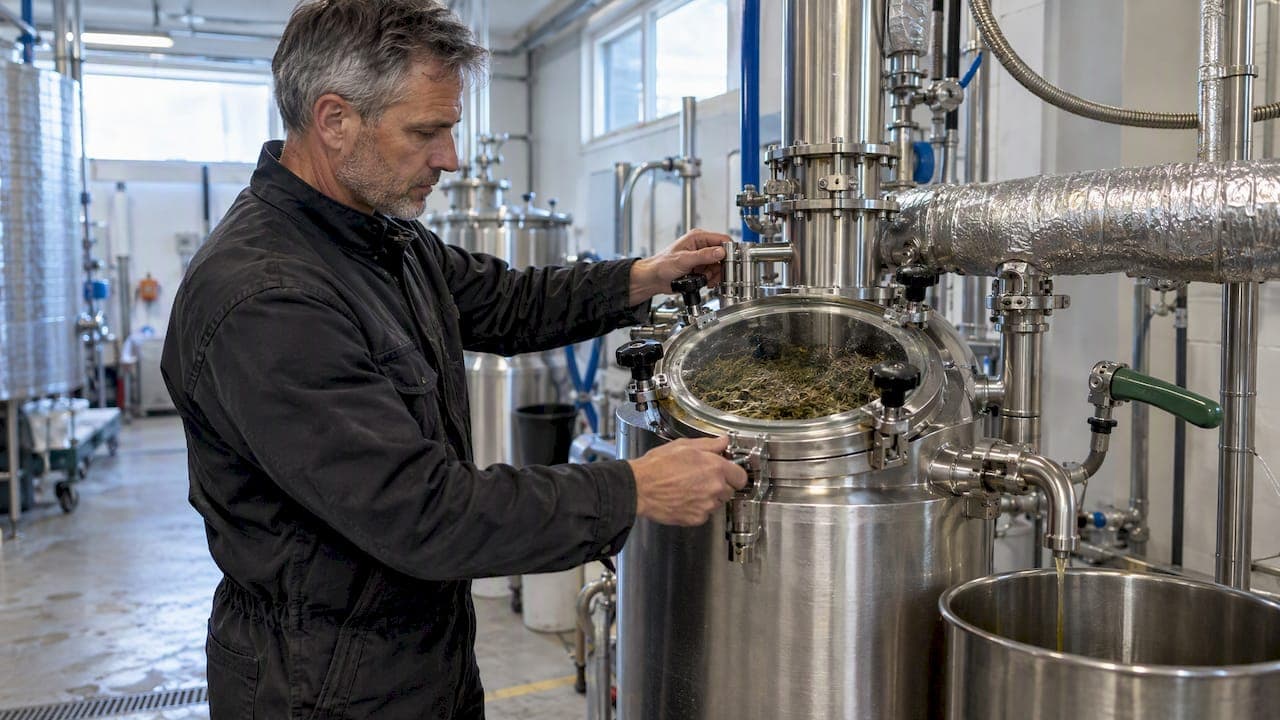
No single extraction method wins across every herb and every compound. The right choice comes down to three factors: the polarity of your target compounds, how much heat they can tolerate before degrading, and the solvent or scale limits your production sets. Traditional solvent methods, steam distillation, supercritical CO2 extraction, and newer green techniques like ultrasound and microwave-assisted extraction each answer a different version of that question.
TL;DR:
- Supercritical CO2 and ultrasound-assisted extraction are ideal for thermolabile compounds due to their mild temperature profiles.
- Matching extraction methods to specific molecule classes, like steam distillation for essential oils or hydroalcoholic solvents for phenolics, maximizes yield and quality.
- Small-scale trials of solvent ratios and particle sizes are essential to ensure scalability and batch consistency before full production.
- Green extraction methods reduce solvent use and processing time but require higher capital investment and skilled operation.
- Proper documentation of extraction parameters and third-party testing are critical for verifying purity, safety, and reproducibility of botanical extracts.
Table of Contents
- Overview of common extraction methods and their practical features
- Which extraction method fits which compound class
- Protocols and parameters that determine extraction quality
- Safety, contaminants, and documentation requirements
- Optimization and quality control in extraction
- Small-batch production and storage at Viridos
- Traditional versus green extraction: the real tradeoffs
- Environmental and sustainability considerations in extraction
- Cost and economics of extraction techniques
- Balancing potency, reproducibility, and ethics in extraction
- [We build every batch on documented extraction parameters and third-party-verified COAs, produced in small runs to maintain consistency. Our extraction and delivery choices are detailed on the Science page.](#we-build-every-batch-on-documented-extraction-parameters-and-third-party-verified-coas-produced-in-small-runs-to-maintain-consistency-our-extraction-and-delivery-choices-are-detailed-on-the-science-pagehttpsviridoscoscience)
- FAQ
- Sources
Overview of common extraction methods and their practical features
Every extraction method performs the same basic job: it separates desired compounds from plant material using a solvent, heat, pressure, or mechanical force. The differences lie in speed, selectivity, and what the process does to fragile molecules along the way.
Maceration is the simplest approach: soaking ground plant material in a solvent, often ethanol or a water-ethanol blend, for hours or days at room temperature. Percolation improves on this by running fresh solvent continuously through packed plant material, which shortens extraction time and improves yield consistency. Soxhlet extraction recycles boiling solvent through the material in repeated cycles, useful for exhaustive recovery but harsh on heat-sensitive compounds. Steam and hydrodistillation vaporize volatile oils with steam, then condense and separate them from water, the standard route for essential oils. Liquid-liquid extraction partitions compounds between two immiscible solvents based on polarity, often used to purify a crude extract rather than process raw material.
The newer generation shifts the energy source rather than the chemistry. Ultrasound-assisted extraction (UAE) uses sound waves to rupture plant cell walls and speed solvent penetration. Microwave-assisted extraction (MAE) uses electromagnetic energy to heat the solvent and matrix internally, often cutting extraction time sharply. Pressurized liquid extraction (PLE, sometimes called ASE) applies heat and pressure to keep solvent liquid above its normal boiling point, improving speed without the oxidative exposure of open reflux. Supercritical fluid extraction (SFE), typically using carbon dioxide, operates at pressures and temperatures where CO2 behaves as both liquid and gas, giving it unusual penetrating power with none of the solvent residue concerns of hexane or ethanol. Enzyme-assisted extraction (EAE) uses cellulase or pectinase to break down cell walls before a milder solvent step. Cold pressing and enfleurage, largely reserved for citrus oils and delicate florals, skip solvents entirely.
- Maceration and percolation: low technical barrier, modest yield, long processing time.
- Soxhlet and reflux: high yield, high solvent volume, significant heat exposure.
- UAE and MAE: faster cycles, lower solvent use, moderate equipment investment.
- SFE/CO2: highest selectivity and purity, highest capital cost, minimal thermal stress.
Which extraction method fits which compound class
Matching method to molecule is the single most consequential decision in botanical processing. Get it wrong and you either strip away the compound you wanted or degrade it before it reaches the final product.
Essential oils and other volatile terpenes respond best to steam distillation, the long-standing industry default, or supercritical CO2 extraction, which better preserves delicate aroma notes that steam's heat can flatten. Comparative reviews note that green extraction techniques generally cut solvent use and processing time relative to older solvent-heavy methods, though the tradeoff is higher equipment cost. Nonpolar lipids and resinous fractions, such as those found in many adaptogenic roots, extract cleanly with supercritical CO2 or nonpolar organic solvents like hexane, with CO2 preferred where solvent residue is a concern.
Polar phenolics, the flavonoids and phenolic acids responsible for much of an herb's biological activity, need a different approach entirely. Hydroalcoholic solvent blends combined with UAE or PLE tend to recover these compounds efficiently without the prolonged heat exposure that degrades them. Alkaloids sit in between, often requiring acidified or gasified aqueous-organic systems tuned to their specific ionization behavior.
Thermolabile compounds, glycosides and certain polyphenols that break down under sustained heat, are where green methods earn their reputation. UAE, enzyme-assisted extraction, and SFE run under mild temperature conditions, protecting molecules that reflux or Soxhlet extraction would compromise.
- Essential oils and terpenes: steam distillation or SFE for aroma fidelity.
- Nonpolar lipids and resins: SFE or nonpolar solvents.
- Polar phenolics: hydroalcoholic solvents with UAE, MAE, or PLE.
- Thermolabile glycosides: UAE, EAE, or SFE under mild conditions.
Ingredient-grade extraction, where purity and reproducibility matter more than absolute yield, generally favors the more controlled, lower-heat methods even when they cost more to run.
Protocols and parameters that determine extraction quality
The method you choose only sets the frame. What happens inside it, drying, particle size, solvent ratio, temperature, and time, determines whether two batches made six months apart actually match.
- Dry plant material to a consistent moisture level before processing; residual water dilutes solvent strength and invites microbial growth during storage.
- Grind to a particle size appropriate to the method: finer particles increase surface area and speed mass transfer, but excessive fines can clog percolation columns or pressurized systems.
- Choose solvent polarity to match the target compound, typically 40 to 70 percent ethanol-water blends for phenolics, pure nonpolar solvents or CO2 for lipids and volatiles.
- Set solvent-to-solid ratio high enough to avoid saturation, since an undersized solvent volume stalls extraction well before equilibrium.
- Hold temperature and time within the method's known working window: UAE and MAE typically run shorter cycles at moderate heat, while maceration needs longer dwell time at ambient temperature to compensate for the absence of applied energy.
Pro Tip: Run a small-scale trial with your exact particle size and solvent ratio before committing pilot-scale material. Mass transfer behavior rarely scales linearly.
Scaling from lab bench to production introduces its own friction. A method that performs beautifully in a 500-milliliter flask can behave unpredictably in a 50-liter vessel, where heat distribution, mixing uniformity, and solvent recovery efficiency all change. Pilot runs should track these variables deliberately rather than assuming the lab recipe transfers directly.
Solvent recovery matters both economically and environmentally: distillation-based recovery systems let producers reclaim ethanol or other solvents for reuse, cutting raw material cost and reducing waste volume. Equipment ranges from workshop-grade percolators and simple steam stills to pilot-scale pressurized extractors and supercritical CO2 systems, the latter requiring specialized maintenance for seals and pressure vessels given the operating pressures involved.
Safety, contaminants, and documentation requirements
Botanical extraction carries contamination risks that have nothing to do with the method itself: heavy metals absorbed from soil, pyrrolizidine alkaloids present in certain plant families, and microbial load from poor drying or storage. Livsmedelsverket guidance requires documentation of extraction methods and control of these contaminants for herbal supplements sold in Sweden, with oversight applied on a risk basis.
A supplier's certificate of analysis should state the plant's Latin binomial, the specific plant part used, the extraction solvent, and assay results against a defined marker compound; for a detailed checklist on verifying supplement testing in New Zealand, see How to Check a Supplement Is Tested in NZ – NZSupps. WHO's GMP guidance for herbal medicines specifies that processing records should include drying conditions, solvent composition, and environmental controls for each batch.
- Request Latin name, plant part, solvent system, and assay results on every COA.
- Flag any extract lacking heavy metal or pyrrolizidine alkaloid testing.
- Confirm basic facility hygiene and batch documentation practices before sourcing.
Our five-step COA check walks through this verification in more depth.
Optimization and quality control in extraction
Reproducible potency does not happen by accident. Response surface methodology (RSM), often using a Box-Behnken design, lets a formulator map how power, time, and solvent percentage interact rather than testing each variable in isolation. A 2025 study on Thymus vulgaris found that ultrasound-assisted extraction, optimized through RSM, reached higher rosmarinic acid yields in less time than heat-assisted extraction once power, time, and solvent percent were tuned together.
Analytical confirmation follows the same discipline. HPLC or TLC fingerprinting against a defined marker compound, paired with acceptance ranges for assay results, gives a batch-release standard rather than a guess.
- Use RSM or similar experimental design to set working parameters before scaling.
- Confirm batch consistency with HPLC or TLC fingerprinting against a marker compound.
- Treat third-party testing and documented SOPs as the baseline trust signal, not an extra.
Our guide to third-party testing covers what a credible lab report should contain.
Small-batch production and storage at Viridos
Our production records trace each batch from Latin-named raw material through solvent system to finished extract, following documented SOPs rather than informal recipe memory. Small-batch runs reduce variables between batches and improve control over the final profile.
Storage matters as much as extraction. Finished extracts and formulated sprays hold potency longest away from light and heat, with headspace minimized to limit oxidation. Our storage guide covers the conditions recommended for preserving potency, emphasizing validation before release.

Traditional versus green extraction: the real tradeoffs
Traditional solvent methods, maceration, percolation, Soxhlet, remain in use because they are cheap, well understood, and require no specialized pressure or ultrasonic equipment. Their weakness is thermal and chemical: prolonged heat exposure in Soxhlet extraction degrades thermolabile compounds, and large solvent volumes raise both cost and residue concerns.
Green and modern methods, UAE, MAE, PLE, SFE, trade capital cost for control. Review literature consistently reports that these techniques reduce solvent use and extraction time compared with many traditional methods, while recent advances in pressurized and supercritical extraction show that combining these modern strategies often improves yield for high-value extracts. The tradeoff is upfront equipment investment and, for SFE in particular, a steeper technical learning curve for operators.

Selectivity follows a similar pattern. Soxhlet and reflux extract almost everything soluble in the chosen solvent, phenolics, lipids, and unwanted plant waxes together, requiring a cleanup step afterward. SFE and UAE, properly tuned, can target a narrower compound window from the outset, which reduces downstream purification but demands tighter process control to get there. Neither family is categorically better: the traditional methods suit high-volume, heat-stable material where cost per kilogram dominates, and green methods suit lower-volume, high-value extracts where compound integrity is the priority.
Environmental and sustainability considerations in extraction
Solvent choice gets most of the environmental attention, but it is not the whole picture. Energy consumption varies sharply across methods: Soxhlet extraction runs for hours at reflux temperature, while UAE and MAE cycles often finish in a fraction of that time, cutting the energy load per batch even before accounting for solvent recovery.
Waste management matters just as much. Spent plant material, known as marc, accumulates in volume with every batch and requires a disposal or composting plan, particularly for operations running continuous percolation or pressurized extraction at scale. Solvent recovery systems reduce both waste and raw material cost by reclaiming ethanol or other solvents through distillation rather than sending them to disposal.
Supercritical CO2 extraction offers a particular advantage here: the CO2 itself is often sourced as a recycled industrial byproduct and leaves no liquid solvent waste stream to manage, though the equipment's energy demand for achieving supercritical pressure is its own cost. Water-based extraction methods, by contrast, generate aqueous waste that needs treatment before discharge, especially at production scale.
None of these tradeoffs resolve into a single "greenest" method. A producer weighing sustainability needs to account for energy input, waste stream volume, and solvent recovery efficiency together—not solvent choice alone—before deciding which method fits a given production line.
Cost and economics of extraction techniques
Economics in extraction run on a simple tension: equipment cost versus running cost. Maceration and percolation need minimal capital, a tank, a press, basic filtration, but their long processing times and lower yields raise the labor and throughput cost per kilogram of finished extract.
Soxhlet and reflux systems cost more to install and operate, largely from solvent volume and energy use, though they remain economical for high-volume, heat-stable material. UAE and MAE occupy a middle ground: moderate equipment investment, shorter cycle times, and lower solvent consumption that often offsets the upfront cost within a reasonable production run.
Supercritical CO2 extraction sits at the top of the capital cost curve. Pressure vessels, specialized seals, and CO2 recovery systems require significant investment, and review literature notes that green extraction techniques carry higher equipment and scaling costs even as they reduce solvent and time expenses. For a producer running high-value, low-volume botanical extracts, that investment often pays back through superior selectivity and reduced downstream purification. For high-volume, low-margin material, it rarely does.
The practical takeaway for any buyer or producer: the cheapest method per batch is rarely the cheapest method per unit of usable, reproducible compound. Factor in purification steps, batch failure rates, and solvent recovery before comparing sticker price alone.
Balancing potency, reproducibility, and ethics in extraction
The temptation in botanical extraction is to chase yield, more extract per kilogram of raw material, as if it were the only metric that counted. It is not. A high-yield method that degrades a thermolabile compound or leaves solvent residue behind has not actually succeeded, whatever the lab report's top-line number says.
The harder discipline is reproducibility: the same chromatographic fingerprint, batch after batch, which demands validated SOPs and real QC rather than a recipe passed down informally. Anyone selecting a supplier should ask for the COA before asking for the price. Rigor in extraction is not a cost center. It is the foundation that everything downstream, including the product in your hand, depends on.
— Joakim
We build every batch on documented extraction parameters and third-party-verified COAs, produced in small runs to maintain consistency. Our extraction and delivery choices are detailed on the Science page.

For disciplined men who want a supplement built on documentation rather than assumption, membership starts with the Member plan at $99 per month, with a Professional tier at $299 per month for those who want the fuller experience. Review the COA standard before you choose any supplier, ours included.
FAQ
What is liquid-liquid extraction?
Liquid-liquid extraction separates compounds by shaking a mixture between two solvents that do not mix, typically water and an organic solvent, so that compounds partition according to their polarity. It is most often used to purify a crude extract after the primary extraction step rather than to process raw plant material directly.
What does extraction mean in a botanical context?
Extraction means separating desired compounds from plant material using a solvent, heat, pressure, or mechanical force, leaving behind the inert plant matrix. The method chosen depends on the target compound's polarity and heat sensitivity.
How is "extraction" expressed in other scientific contexts?
In scientific and pharmaceutical literature, "extraction" refers specifically to the process of isolating a compound or compound class from a raw material using a solvent or physical separation technique. The term applies the same way whether the raw material is a plant, a mineral, or a synthetic mixture.
What is extraction, in simple terms?
Extraction is the process of pulling a specific set of compounds out of plant material while leaving the rest behind, using a solvent, heat, pressure, or a combination. Common methods include maceration, steam distillation, and supercritical CO2 extraction, each suited to different compound types.
Sources
- Livsmedelsverket — Food supplements (English guidance)
- WHO — GMP for the manufacture of herbal medicines (Annex 2)
- Effect of heat-assisted and ultrasound-assisted extraction methods on the phenolic profile and biological activity of Thymus vulgaris extracts — MDPI Antioxidants (2025)
- Review: Extraction methods for natural products — PMC (open access review)
- Frontiers in Chemistry — Advances in green extraction technologies (2025)