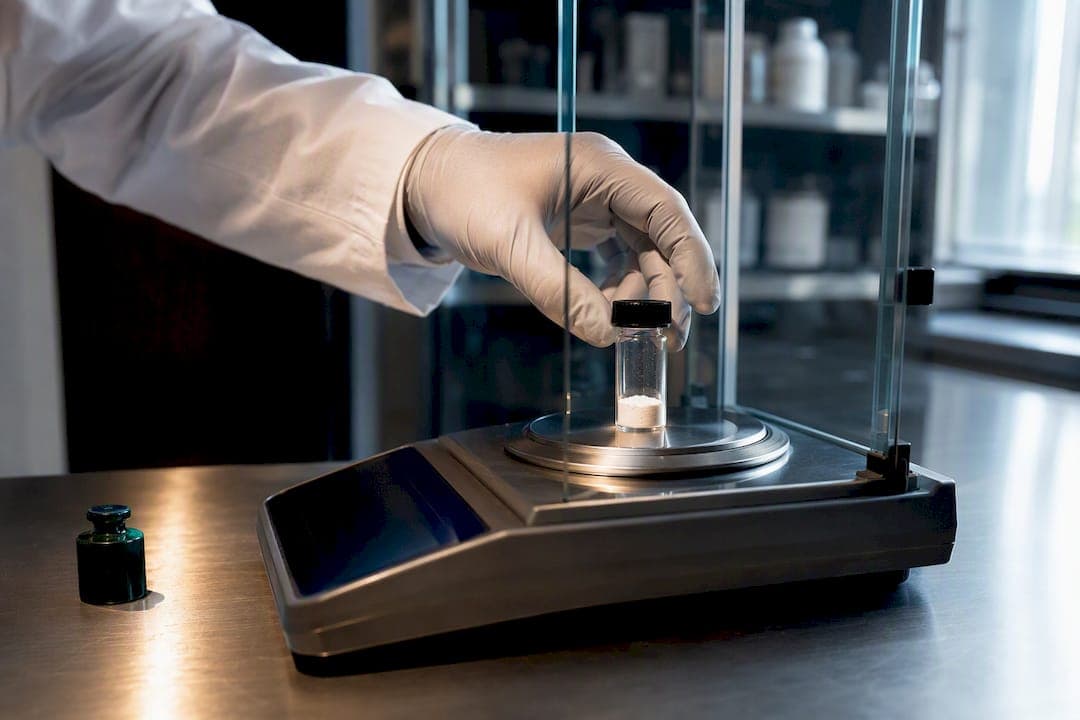
Third-party testing verifies what's actually in the bottle. It confirms identity, potency, and purity, and it screens for contaminants through labs like Eurofins and certifiers like NSF, USP, and Informed Sport. What it does not do is prove a product works for you, or guarantee your individual safety. The practical move: look for a verifiable seal, request the batch-specific certificate of analysis, and confirm it against a public certifier directory.
TL;DR:
- Third-party testing verifies supplement identity and purity but does not prove the product will deliver specific health benefits or ensure individual safety.
- Laboratory analysis focuses on contaminants like heavy metals and pesticides and confirms that labeled doses match the finished product, not marketing claims of efficacy.
- Certification programs such as NSF, USP, and Informed Sport vary in scope, with some testing for banned substances and facility audits, making it crucial to match seals to your specific health or doping concerns.
- Batch-specific certificates of analysis should be checked for detailed results, accreditation, and matching batch numbers rather than relying solely on certification logos.
- Regular regulatory oversight in Sweden prioritizes labeling accuracy and safety for higher-risk categories but does not guarantee product quality or effectiveness at the individual level.
Table of Contents
- What Tredjepartstestning Kosttillskott Actually Covers
- Which Certification Programs Matter, and When
- How Labs Actually Test Raw Materials and Finished Products
- Your Certificate of Analysis and Batch Verification Checklist
- What Swedish Regulators Actually Oversee
- A Five-Step COA Workflow for High-Value Buyers
- Why Most Verification Advice Stops Short
- How Viridos Handles Verification Before You Join
- Sources
- FAQ
What Tredjepartstestning Kosttillskott Actually Covers
Tredjepartstestning kosttillskott, or third-party testing of dietary supplements, is the practice of sending a product to an independent laboratory rather than relying solely on the manufacturer's internal quality control. That distinction matters because internal testing has no external check on it. Independent labs run two core categories of analysis.
Identity testing confirms the raw material in the capsule or spray actually matches the label. A product labeled as a specific botanical extract, for instance, can be adulterated or substituted with a cheaper look-alike ingredient without visual inspection catching it.
Potency assays measure whether the labeled dose is actually present in the finished product, not just in the raw material before manufacturing. Potency can drift during processing, storage, or shelf life, which is why testing the finished product matters more than testing the input.
Beyond identity and potency, independent labs screen for:
- Heavy metals (lead, arsenic, cadmium, mercury)
- Pesticide residues
- Microbial contamination (bacteria, yeast, mold)
- Mycotoxins from fungal contamination
- Pyrrolizidine alkaloids (PA) in botanical extracts
None of this testing establishes efficacy. A supplement can pass every purity and potency check and still do nothing meaningful for the person taking it. Testing answers "is this what it claims to be and is it clean," not "will this help me." Keep those two questions separate, because marketing copy routinely blurs them.
Which Certification Programs Matter, and When
Not every certification solves the same problem, which is why matching the seal to your actual need matters more than chasing the most recognizable logo.
NSF runs two distinct programs. NSF/ANSI 173 covers general supplement quality: label accuracy, contaminant limits, and facility audits. NSF Certified for Sport goes further, screening for more than 270 banned substances on a per-batch basis, which is the standard that matters if you are subject to drug testing in a regulated profession or competitive context.
USP Verified Mark requires a facility audit, a document review, and laboratory testing for identity, potency, and contaminant levels. Some products under this mark also undergo dissolution testing, confirming the product actually breaks down and releases its ingredients as intended.
Informed Sport tests every batch for banned substances before it ships, while Informed Choice relies on periodic retail sampling rather than a guarantee on each batch. That structural difference is worth knowing before you assume the two are interchangeable.
ConsumerLab operates differently from the certifiers above. It buys products off retail shelves, tests them blind, and publishes the results, including failures. It functions less as a certification and more as an independent audit of what is already on shelves.
Certified for Sport's screen alone covers over 270 substances per batch, which is the kind of granularity that distinguishes a compliance-grade program from a general quality seal.
How Labs Actually Test Raw Materials and Finished Products
Sampling strategy determines how much a test result actually tells you. A lab testing a manufacturer-submitted sample is testing what the brand chose to send. A lab testing a product purchased off the shelf, as ConsumerLab does, is testing what a customer would actually receive. The second is the more meaningful signal for anyone trying to judge real-world consistency.
Rigorous testing programs also retain reference samples from each batch, creating a chain of custody that allows independent retesting later if a question arises about a specific lot.
The analytical methods behind the numbers matter too:
- HPLC or UPLC (high-performance or ultra-performance liquid chromatography) measures potency, confirming how much active compound is actually present
- ICP-MS (inductively coupled plasma mass spectrometry) detects heavy metals down to trace levels
- GC-MS (gas chromatography mass spectrometry) screens for residual solvents and pesticide residues
- Microbiological assays detect pathogenic bacteria, yeast, and mold
Stability and shelf-life testing is a separate discipline from routine batch quality assurance. It measures whether potency holds over the product's stated shelf life under realistic storage conditions, not just at the moment of manufacture.
Pro Tip: When a brand or lab cites a result, ask which method produced it and whether the lab holds ISO/IEC 17025 accreditation. A number without a named method and an accredited lab behind it is a claim, not evidence.
Your Certificate of Analysis and Batch Verification Checklist
A certificate of analysis, or CoA, is only useful if it contains enough detail to check. A valid one names the batch or lot number, lists every analyte tested with its numeric result, states the specification range and whether the batch passed or failed against it, gives the test date, and names an accredited laboratory.
Follow this sequence when evaluating any product's claim:
- Request the CoA for the specific batch or lot number on your bottle, not a generic or historic document.
- Verify the testing laboratory's accreditation and confirm the certifier's involvement in a public directory rather than trusting a logo alone.
- Check the sampling date against your product's manufacture date, and ask how often the brand retests.
- Confirm the batch number on the CoA matches the batch number on your actual packaging.
| Signal | What it suggests |
|---|---|
| Public directory listing with matching batch number | Strong, verifiable transparency |
| CoA available only on request, dated once at launch | Weak, unverifiable over time |
| Vague claim ("lab tested") with no document | Red flag, treat as marketing language |
| Recurring certification with facility audits | Ongoing accountability, not a one-time snapshot |
A single historic CoA is not the same as ongoing certification. Certification programs require recurring testing and periodic facility audits; a one-off lab report tells you about one batch on one day and nothing about consistency after that.
What Swedish Regulators Actually Oversee
Sweden's supplement oversight runs on a risk-based model rather than testing every product on every shelf. Livsmedelsverket's control guidance directs regional authorities to prioritize labeling accuracy, traceability, and higher-risk supplement categories over blanket surveillance.
Regulators have real enforcement tools at their disposal:
- Authorities can make anonymous purchases and send products for independent retesting.
- Companies can be legally required to provide representative samples on request.
- Businesses may request a complementary expert opinion when a finding is disputed.
Contact regional control authorities when you suspect mislabeling or a genuine safety issue. Escalate to independent third-party testing when you simply want ongoing verification of a product you already use, since that is a quality assurance question, not a regulatory complaint.
A Five-Step COA Workflow for High-Value Buyers
Executives evaluating a premium supplement should apply the same rigor they'd apply to due diligence on any other high-stakes purchase. Viridos documents its own verification process through a five-step batch check that walks through exactly how to confirm a batch's CoA before trusting it.
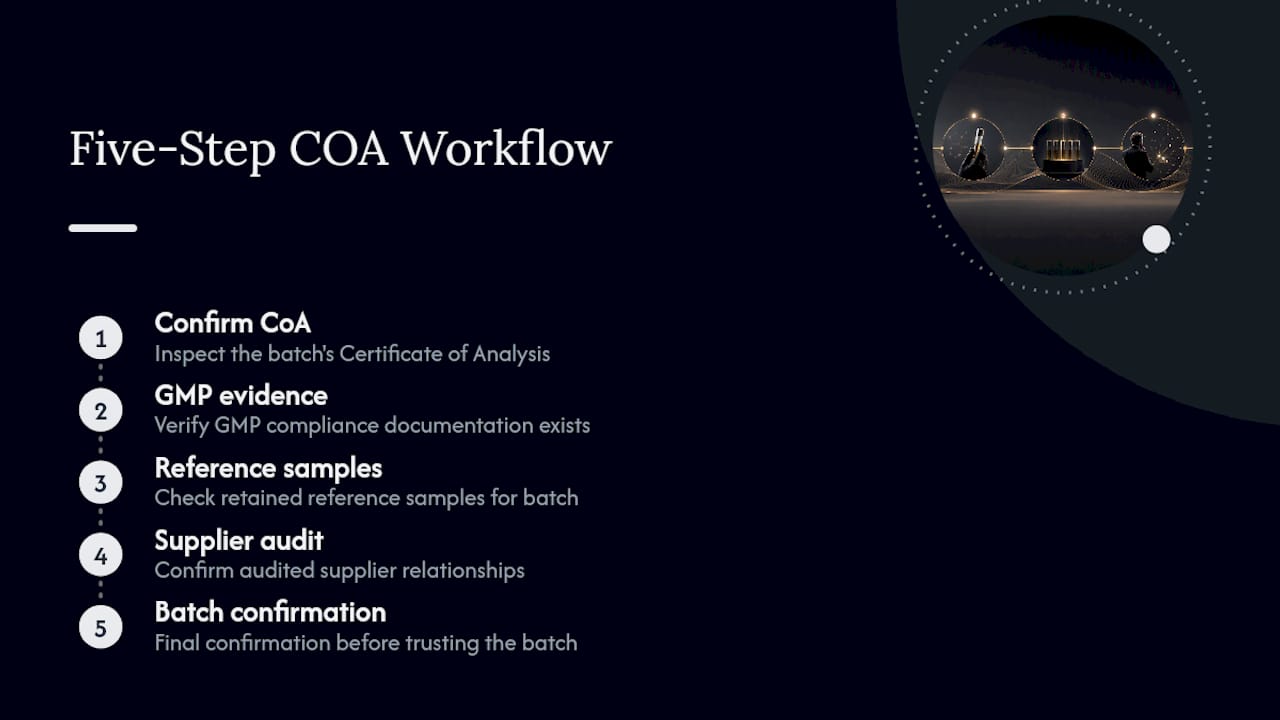
Differentiators between serious small-batch producers and mass-market ones include documentation depth such as GMP compliance evidence, retained reference samples for each batch, and audited supplier relationships.
Readers who want a fuller picture of what separates a disciplined supplement brand from a marketing-first one can review how to identify a sophisticated supplement brand, which breaks down the documentation signals worth demanding before you commit.
Why Most Verification Advice Stops Short
Most guidance on this topic stops at "look for a seal." That advice is not wrong, but it is incomplete, and treating a logo as the finish line is where most buyers go wrong. A seal tells you a certifier reviewed the product at some point under some conditions. It does not tell you whether that review happened last quarter or three years ago, or whether the batch you're holding was actually part of it.
The more useful discipline is treating certification as a starting filter, then verifying the batch in front of you against a public directory and a dated CoA. That single habit, checking the batch number rather than trusting the logo, separates buyers who actually reduce their risk from buyers who feel reassured without being informed.
There's also a category error worth naming directly: testing quality is not the same question as testing fit. A perfectly clean, perfectly dosed product built around the wrong ingredient form or the wrong delivery mechanism for your physiology can still underperform for you specifically. Purity and potency are the floor, not the ceiling. Executives who apply the same scrutiny to formulation and delivery that they apply to contaminant screening tend to get better outcomes than those who stop at the seal.
— Joakim
How Viridos Handles Verification Before You Join
Premium supplements earn trust through documentation, not through claims. Some brands emphasize small-volume production and sublingual delivery designed for consistent absorption, supported by disciplined production processes.

Potential members of premium supplement programs may be able to request a conversation about batch verification and current CoA documentation before their application is approved, applying a high standard of scrutiny, including exploring alternative wellness options like OsteoStrong's bone health and performance services. That request costs you nothing but a few minutes, and it gives you the same clarity you'd demand from any vendor handling something you put into your body daily. Start by reviewing Viridos membership to see current access terms and the verification conversation available to applicants before approval.
This article is general information, not a substitute for advice from a qualified doctor. Consult a qualified healthcare professional about your own circumstances before acting on anything here.
Sources
- Eurofins — Dietary supplements and sports nutrition
- NSF — Dietary supplements and functional foods FAQs
- USP — Dietary Supplement Verification Program
- Kontroll av kosttillskott — Kontrollwiki (Livsmedelsverket)
FAQ
Which supplement tested best in independent comparisons?
No single supplement ranks universally "best," since results depend on the specific product category and testing round. Independent reviewers like ConsumerLab publish batch-specific results, so check the current report for your product category rather than relying on general claims.
What test can I take to detect a vitamin deficiency?
A standard blood panel ordered through a doctor or clinic is the reliable way to detect a vitamin or mineral deficiency, not a supplement's certificate of analysis. A CoA verifies the product; it says nothing about your personal nutrient status.
Which supplements should not be mixed with medications?
Supplements containing St. John's Wort, high-dose vitamin K, or certain botanical extracts can interact with blood thinners, antidepressants, and other prescription medications. Always review any new supplement with a physician or pharmacist if you take prescription medication regularly.
Which supplements can be harmful?
Supplements contaminated with heavy metals, adulterated with undisclosed pharmaceutical compounds, or containing pyrrolizidine alkaloids from poorly sourced botanicals carry documented risk. This is precisely why identity and contaminant testing through an accredited lab, rather than label claims alone, matters before regular use.
Does third-party testing prove a supplement works?
No. Third-party testing confirms identity, potency, and purity. It does not test or prove efficacy, which is a separate question requiring its own body of research on the specific ingredient and dose.