
Yes, a plant-derived sublingual spray can be used while fasting, provided you do not swallow the dose or the saliva that carries it. The reason is straightforward: sublingual absorption occurs directly through the mucosal tissue under your tongue, bypassing the gastrointestinal tract entirely. Swallow the dose, and you have introduced actives into your gut, which most fasting protocols count as breaking the fast.
The practical rule is simple. Spray, hold, wait roughly two minutes without swallowing, and let the mucosa do its work.
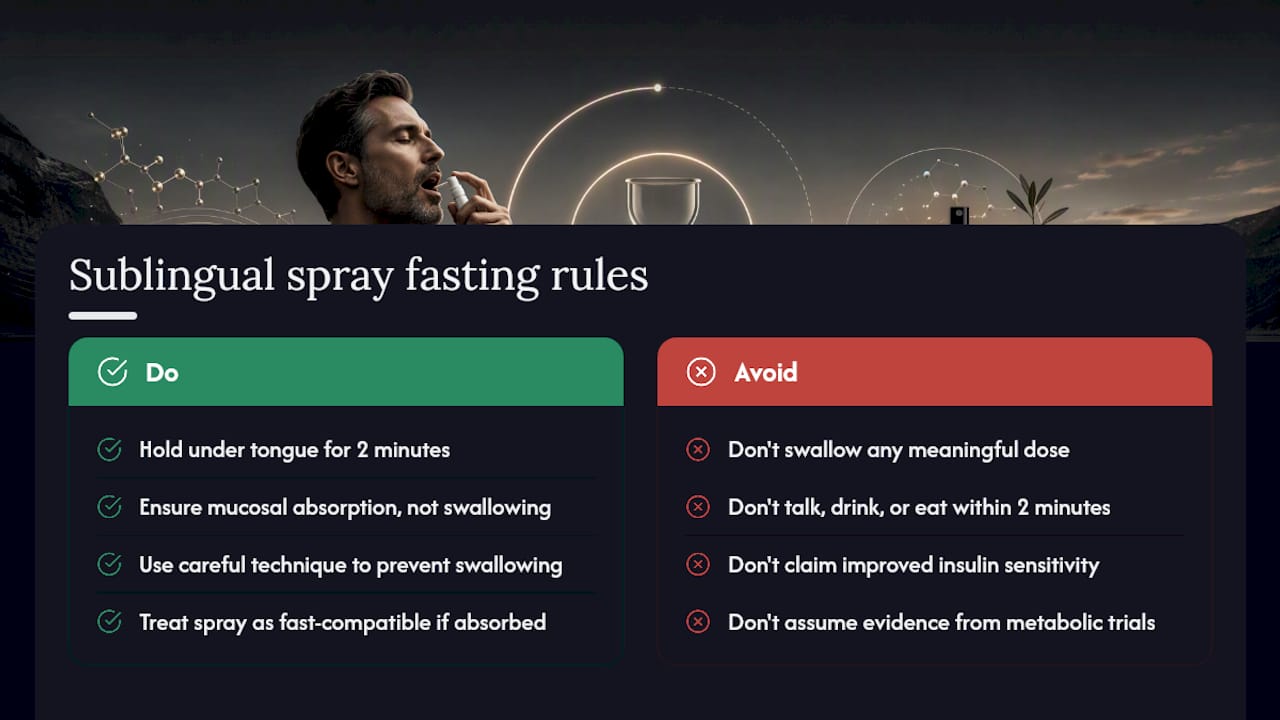
- Do: Spray under the tongue, hold still, avoid swallowing for about two minutes.
- Don't: Talk, drink, or swallow saliva during the hold window.
- Don't: Assume every "sublingual" label means fast-compatible without checking the administration guidance.
Fast fact: Sublingual delivery routes can produce plasma concentrations several-fold higher in the first minutes compared to swallowed formats, since the gastrointestinal tract and hepatic first-pass metabolism are bypassed entirely.
Key Takeaways
A plant-derived sublingual spray preserves a fast when the dose is held under the tongue for about two minutes and never swallowed, since mucosal absorption bypasses the gut entirely.
| Point | Details |
|---|---|
| Never swallow the dose | Hold under the tongue for roughly two minutes to allow full mucosal uptake before swallowing anything. |
| Onset beats oral formats | Sublingual delivery often reaches systemic circulation in minutes versus 30 to 90 minutes for swallowed supplements. |
| Formulation quality signals matter | Look for mucoadhesive design, small-batch production, and clear administration instructions on the label. |
| Time doses to demand | Administer 10 to 15 minutes before a task requiring sustained clarity, not on a fixed clock schedule. |
| Viridos builds for this standard | Viridos formulates its sublingual spray in small Swedish batches with transparent dosing guidance for fast-compatible use. |
This article is general information, not a substitute for advice from a qualified doctor. Consult a qualified healthcare professional about your own circumstances before acting on anything here.
Table of Contents
- Why Sublingual Delivery Preserves a Fast and Works Faster
- How Do You Take a Sublingual Spray Without Breaking a Fast?
- What Separates a Premium Sublingual Spray From a Generic One?
- When Should You Use a Sublingual Spray for Sustained Clarity?
- What Precautions Should You Take Before Using a Sublingual Spray?
- Different Types of Oral Sprays and What They Typically Contain
- What Does the Evidence Say About Oral Sprays and Fasting Metabolism?
- How Do Intermittent Fasting Protocols Differ on Oral Spray Use?
- Can Oral Sprays Affect Insulin Response During a Fast?
- Ready to Apply Precision Delivery to Your Own Routine?
- Sources
Why Sublingual Delivery Preserves a Fast and Works Faster
The mechanism is anatomical, not marketing language. The tissue beneath your tongue sits over a dense bed of small veins, including the sublingual and deep lingual veins, that drain directly into systemic circulation. An active compound absorbed here enters your bloodstream without passing through the stomach, the intestinal wall, or the liver's first-pass filtering. That is the entire case for sublingual delivery: it is a distinct pharmacological route, not a repackaged oral supplement.
The timing difference is significant. Swallowed supplements typically take 30 to 90 minutes to reach peak blood concentration, since they must clear digestion and hepatic processing first. Sublingual formats often reach measurable systemic levels within minutes. A controlled comparison of sublingual propranolol found roughly three-fold greater early exposure (AUC) with faster peak concentrations than the same dose taken orally. That is not a marginal edge. It is a different absorption curve entirely.
Not every compound absorbs equally well through oral mucosa. Efficient sublingual uptake favors:
- Moderate molecular weight and flexible molecular structure
- Balanced lipophilicity (neither too water-soluble nor too fat-soluble)
- A pH environment compatible with the mouth's mucosal tissue
These physicochemical properties, along with mucoadhesive formulation design, determine whether a given active actually crosses the mucosa efficiently or simply dissolves and gets swallowed with saliva. That last point matters more than most users realize: even a well-formulated spray delivers some fraction of its dose into swallowed saliva. Administration technique is not a footnote. It is half the science.
How Do You Take a Sublingual Spray Without Breaking a Fast?
Getting this right takes about two minutes of discipline, not complexity. Executives who fast intermittently and still want sustained clarity during a demanding morning need a routine they can run without thinking twice.
Preparation:
- Make sure your mouth is reasonably dry. Avoid drinking immediately beforehand.
- Wash your hands before handling the spray applicator.
- Read the product's administration insert once, even if you have used the product before.
Administration:
- Prime the spray if the product instructs it.
- Place the nozzle under your tongue and dispense the dose directly onto the mucosal tissue.
- Close your mouth and hold still. Do not talk.
- Avoid swallowing for roughly two minutes, the window most sublingual and orally dissolving medication guidance recommends to maximize mucosal uptake.
- Once the hold period passes, gently wipe away any residue rather than rinsing aggressively.
Aftercare: Give it a few more minutes before eating, drinking, or brushing your teeth. High-flow mouth rinsing right after dosing can wash unabsorbed product off the mucosa before it finishes uptake.
If you cough or swallow prematurely, do not panic and do not repeat the dose without reading your product's specific guidance. Some fraction of nearly every sublingual dose ends up swallowed regardless of technique. The goal is minimizing that fraction, not achieving zero.
Pro Tip: Dose during a quiet moment, not mid-conversation. Talking activates saliva flow and swallowing reflexes that work against the hold window.
What Separates a Premium Sublingual Spray From a Generic One?
Not all sprays that call themselves "sublingual" are engineered the same way, and the difference shows up in whether the formulation actually stays under the tongue long enough to absorb.
- Residence time design. A formulation engineered for mucoadhesion clings to the sublingual tissue rather than running toward the throat, which is the core differentiator between premium delivery and simple taste-masked liquids.
- Active-compound fit. Actives with moderate molecular weight and balanced lipophilicity absorb through oral mucosa more reliably; a formulation built around those constraints reflects real pharmacological thinking, not convenience.
- Manufacturing transparency. Small-batch production allows tighter control over droplet size, viscosity, and excipient balance, the variables that determine whether the spray wets the sublingual pocket correctly instead of pooling and running off.
- Label clarity. Genuine administration guidance, hold time, technique, timing, matters more than a headline claim like "fast-friendly" with no instructions behind it.
Format matters too. Sprays and oral dissolving films favor speed and convenience for on-the-go dosing, while mucoadhesive buccal films can extend residence time for sustained absorption at some cost to convenience. For an executive dosing between meetings, a fast-dissolving spray with genuine mucoadhesive engineering, the kind detailed in Viridos's oral spray formulation guidance, tends to fit the schedule better than a film requiring extended stillness.
| Quality Signal | What to Look For |
|---|---|
| Residence time | Formulation designed to cling to sublingual tissue, not just dissolve fast |
| Active compound profile | Moderate molecular weight, balanced lipophilicity |
| Production method | Small-batch manufacturing with stated quality control |
| Label instructions | Explicit hold time and administration steps, not vague claims |
When Should You Use a Sublingual Spray for Sustained Clarity?
Timing separates a spray that supports your day from one you barely notice. Because sublingual onset typically arrives within minutes rather than the half hour to ninety minutes swallowed formats require, plan your dose ahead of the moment you need it, not during it.
- Dose 10 to 15 minutes before a demanding block: a board call, a negotiation, a deep-work sprint.
- Consider a micro-dosing rhythm, smaller doses spaced through the day, rather than one large dose front-loaded at sunrise, if sustained clarity matters more than a single peak.
- If you follow a 16:8 or similar intermittent fasting pattern, the fasting window itself does not preclude sublingual use. The condition remains the same regardless of protocol: no swallowing.
- Align dosing with your actual task cadence rather than a fixed clock time. A calendar-driven executive benefits more from event-anchored timing than habit-anchored timing.
Viridos covers the operational detail of this further in its guide to timing a sublingual spray by objective, and for readers building a broader daily framework, the advanced strategies for executive energy support piece expands on how dosing windows fit inside a demanding schedule. For nutrition-timing context beyond fasting itself, Level Up Gym's guide on training nutrition is a useful adjacent reference.
What Precautions Should You Take Before Using a Sublingual Spray?
A sublingual format is not risk-free simply because it avoids the gut. A few conditions warrant caution before you incorporate any new spray into a fasting or performance routine.
- If you take prescription medication, particularly cardiovascular drugs, talk with your prescriber before adding a new sublingual active. Interactions are assessed by mechanism, not delivery format.
- Avoid sublingual products if you have active mouth infections or oral mucosal lesions. Broken or inflamed tissue changes absorption unpredictably and can worsen irritation.
- Smoking reduces oral mucosal absorption efficiency and is worth accounting for if you use tobacco regularly.
- Pregnant or nursing individuals, and anyone managing a serious chronic condition, should consult a clinician before starting any new supplement regimen, sublingual or otherwise.
Pro Tip: If you are unsure whether a specific medication interacts with a plant-derived active, the honest move is a five-minute call to your prescriber, not a forum search.
Different Types of Oral Sprays and What They Typically Contain
Oral sprays vary considerably in purpose, and lumping them together causes confusion about what is actually fast-compatible.
Breath and cosmetic mouth sprays exist purely for local effect. Their ingredients are not designed for systemic absorption, and they are irrelevant to fasting discussions since nothing meaningful crosses into the bloodstream.
Pharmaceutical sublingual sprays, glyceryl trinitrate for angina is the classic example, are engineered specifically for rapid systemic delivery of a single active compound at a precise dose. These set the pharmacological template that premium performance sprays borrow from: small droplet size, mucosal targeting, fast onset.
Performance and vitality-oriented sublingual sprays sit in a third category. These typically carry plant-derived compounds selected for moderate molecular weight and balanced lipophilicity, the same physicochemical profile that favors efficient mucosal uptake. The formulation challenge is different from a pharmaceutical single-molecule spray: plant extracts often carry multiple compounds, so mucoadhesive design and dose consistency matter even more to ensure reliable absorption batch to batch.
The relevant distinction for a fasting executive is not flavor or brand positioning. It is whether the product was engineered for mucosal absorption with real formulation science behind it, or simply packaged as a spray for convenience. Viridos's overview of sublingual spray alternatives walks through how format choices affect that outcome.
What Does the Evidence Say About Oral Sprays and Fasting Metabolism?
The strongest evidence on sublingual delivery comes from pharmacokinetic research on medications, not fasting-specific trials on performance sprays, and that distinction matters for how confidently you should read the numbers.
The propranolol study cited earlier remains the clearest data point: a roughly three-fold increase in early plasma exposure for sublingual dosing versus oral tablets of the same compound. That finding demonstrates the mechanism, faster absorption, bypassed first-pass metabolism, works as pharmacology predicts. It does not, however, constitute a metabolic study of fasting states specifically.
Separately, research on physicochemical determinants of sublingual absorption shows that transmucosal delivery tends to produce less interindividual variability than gut absorption for many compounds, since it sidesteps the enzymatic variability of digestion. That consistency is relevant to fasting readers because it suggests a more predictable absorption window regardless of how long you have been fasting or what your gut motility looks like that day.
What the evidence does not support is any claim that a sublingual spray alters fasting metabolism itself, insulin dynamics, fat oxidation, ketone production. No credible pharmacokinetic study makes that claim, and none should be inferred from absorption speed alone. Absorption route and metabolic effect are separate questions, and conflating them is where marketing language tends to overreach the science.
How Do Intermittent Fasting Protocols Differ on Oral Spray Use?
Fasting protocols vary in strictness, and their tolerance for sublingual products tracks that variation closely.
Time-restricted eating patterns like 16:8 or 18:6 generally follow a straightforward rule: anything that stays out of the digestive tract and does not deliver meaningful calories does not break the fast. A sublingual spray with no swallowing satisfies that condition cleanly, since the active compound never enters the gut.
Religious fasting frameworks, which many readers observe alongside or instead of metabolic fasting, often apply a stricter standard. Guidance on this point specifically addresses sublingual and orally dissolving medications, concluding that the critical condition is avoiding swallowing the dissolved product or saliva that carries it, with roughly two minutes as the recommended hold window.
Extended or water-only fasting protocols tend to take the most conservative stance, since practitioners in that space often avoid introducing any substance, absorbed or not, to preserve the physiological state they are targeting. If you follow an extended fast, the sublingual question is less about pharmacology and more about the specific protocol's philosophy, which is worth clarifying with whoever designed the program you follow.
The common thread across every protocol: administration discipline, not the product category, determines compatibility.
Can Oral Sprays Affect Insulin Response During a Fast?
A properly administered sublingual spray, one where the dose is absorbed through mucosal tissue and not swallowed, delivers no meaningful calories or macronutrients into the digestive system. That absence of caloric load is precisely why most fasting frameworks treat correctly used sublingual products as fast-compatible in the first place.
Insulin response is driven primarily by glucose and amino acid entry into the bloodstream through digestion. Since sublingual absorption bypasses the gut entirely, a spray with no swallowed component introduces no such signal. This is a mechanistic inference based on how insulin secretion works, not a claim from a dedicated metabolic trial on performance sprays specifically, and readers should hold that distinction in mind.
The caveat that matters is technique-dependent, not formulation-dependent. If a meaningful portion of the dose is swallowed, whether from talking, drinking too soon, or poor administration, any calorie-bearing excipients (sweeteners, carrier oils) could theoretically reach the gut and contribute a trivial insulin signal. This is precisely why the two-minute hold window is not a suggestion. It is the mechanism that keeps the product's caloric footprint at zero.
No sublingual spray, plant-derived or otherwise, should be marketed as improving insulin sensitivity or metabolic markers during a fast. That would overstate what an absorption route can do. What a well-engineered spray can honestly claim is neutrality: it does not interrupt the metabolic state a fast is designed to produce, provided you follow the administration discipline covered earlier in this guide.
Precision Sublingual Delivery, By Design
Viridos builds its formulation around a simple premise: the delivery mechanism deserves the same rigor as the ingredients themselves. Every batch is produced in small runs in Sweden, with formulation choices, droplet size, mucoadhesive properties, dose consistency, made deliberately rather than as an afterthought to a marketing claim.
That approach exists for a specific kind of man: disciplined, schedule-driven, unwilling to accept a supplement that demands he interrupt his day to use it correctly. A spray that absorbs quickly and discreetly under the tongue, without pulling him out of a fasted state or a packed calendar, fits how he already operates. The membership model reflects the same philosophy, controlled access and consistent quality over mass distribution and inconsistent batches.
— Joakim
Ready to Apply Precision Delivery to Your Own Routine?
If the checklist above, mucoadhesive design, small-batch production, transparent dosing guidance, sounds like the bar you already hold your own decisions to, Viridos was built around exactly that standard. The membership model gives you a plant-derived sublingual spray formulated for rapid mucosal uptake and fast-compatible use, without the guesswork of parsing vague "fast-friendly" claims on a generic label.

Membership works through a straightforward application process: approved members receive ongoing shipments produced in small Swedish batches, with the same administration transparency this article has walked through, hold time, technique, timing, built into the product experience rather than left for you to reverse-engineer. If sustained clarity and discreet, schedule-compatible dosing matter to how you operate, apply for VIRIDOS membership and see whether the fit is right for your routine.
Sources
- Considerations developing sublingual tablets overview — PharmTech
- Clinical pharmacokinetics of buffered propranolol sublingual tablet (Promptol™) — PMC
- Orally dissolving and sublingual medications while fasting — MuslimMed