
TL;DR:
- Energy output at 55 can surpass levels at 35, supported by evidence-based strategies.
- HIIT offers superior metabolic and cognitive benefits for executives compared to traditional cardio.
- Personalized, consistent energy management and tracking are crucial for sustained high performance.
Your energy output at 55 can exceed what it was at 35. That sounds like marketing copy, but the research backs it up. Neuroscience and exercise physiology have quietly overturned the old assumption that mental sharpness and physical drive inevitably erode after 40. For executives and founders carrying high-stakes decision-making loads, this is not an academic curiosity. It is a competitive lever. The strategies covered here are not recycled wellness tips. They are evidence-based protocols drawn from current research on metabolism, cognitive function, and longevity, calibrated specifically for professionals who operate in demanding, relentless environments.
Table of Contents
- Why energy support matters for executives
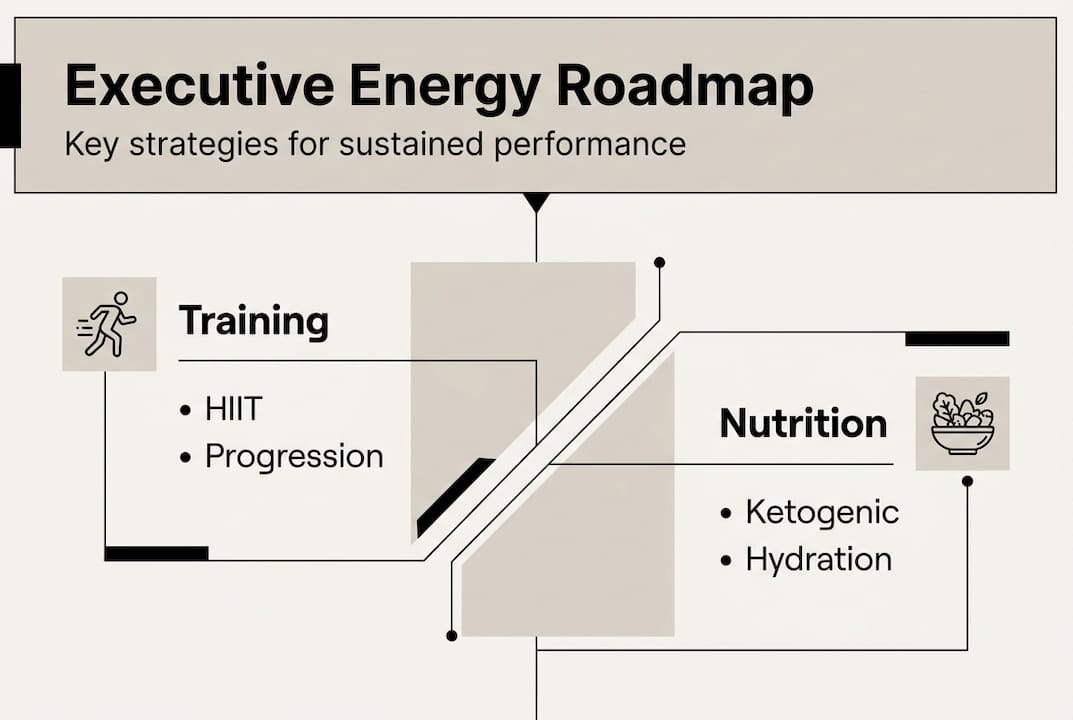
- HIIT and advanced training: Evidence-based strategies
- Nutritional support: Ketogenic approaches and beyond
- Longevity and the executive edge: Fitness after 40 and beyond
- A contrarian view: Why most energy advice falls short for executives
- Next steps: Advanced support for executive energy
- Frequently asked questions
Key Takeaways
| Point | Details |
|---|---|
| Science-driven energy upgrades | HIIT and targeted nutrition offer proven, efficient ways to enhance executive performance. |
| Performance longevity is achievable | Even late-starters can build world-class fitness and energy with the right strategies. |
| Customization is key | Personalizing training and nutrition yields better, more sustainable executive energy gains. |
| Mental and physical synergy | Cognitive energy and focus rely on supporting both body and brain with advanced tactics. |
Why energy support matters for executives
Running a company or managing a demanding portfolio is not like training for a marathon. It is more like running a marathon while also doing complex arithmetic and managing interpersonal conflict, every single day. The energy demands are layered: physical stamina, mental bandwidth, emotional regulation, and decision speed all get taxed simultaneously.
Conventional fitness and nutrition plans are usually designed for the general population. They address body composition or cardiovascular health in isolation. What they rarely account for is the cognitive load that defines executive life. Busy professionals face unique cognitive and energetic demands that require dedicated solutions, not generic ones.
The common energy drains executives face include:
- Cross-timezone travel disrupting sleep architecture and circadian rhythm
- Late-evening meetings that compress recovery windows
- Chronic multitasking fragmenting attention and depleting prefrontal cortex resources
- High-stakes negotiations that create sustained cortisol surges
- Reactive schedules leaving no room for strategic recovery
Each of these drains compounds over time. The dangerous part is how gradual the decline feels.
"The most insidious threat to executive performance is not a single catastrophic burnout. It is the slow, almost imperceptible erosion of mental clarity and drive that accumulates over months or years of unmanaged stress, poor recovery, and misaligned energy habits. By the time most executives notice it, they have already been operating below their real capacity for a long time."
This is why optimizing personal energy is not a lifestyle luxury. It is a core business competency. The good news is that targeted energy management tips designed for executives can reverse this trajectory fast, especially when they incorporate training science.
HIIT and advanced training: Evidence-based strategies
Not all exercise is equal, and that gap widens significantly when cognitive performance is part of the equation. For executives between 40 and 65, High-Intensity Interval Training (HIIT) delivers a disproportionate return on the time invested.
HIIT enhances post-exercise metabolism and provides cognitive improvements beyond what traditional cardio achieves, even in older adults. The mechanism involves excess post-exercise oxygen consumption (EPOC), where the body continues burning fuel at elevated rates for hours after a session ends. This metabolic afterburn from HIIT can be 25 to 35% higher than moderate-intensity continuous training (MICT). Lipid oxidation rates also increase more significantly with HIIT protocols.
For cognitive outcomes, the edge is even more pronounced. Greater cognitive benefits with HIIT vs. MICT have been documented, with HIIT producing stronger and more sustained gains in executive functions like cognitive switching and inhibitory control. These are precisely the mental skills that matter most in boardrooms and high-speed decision environments.
HIIT vs. MICT for executives: a direct comparison
| Factor | HIIT | MICT |
|---|---|---|
| Session length | 20 to 30 minutes | 45 to 60 minutes |
| Metabolic afterburn (EPOC) | High (25 to 35% above baseline) | Moderate |
| Cognitive function gains | Superior (switching, inhibition) | Moderate |
| VO2max improvement | Significant | Moderate |
| Weekly sessions needed | 2 to 3 | 4 to 5 |
| Time efficiency for executives | Excellent | Low |
Here is how to integrate HIIT intelligently into a demanding schedule:
- Start with 2 sessions per week. Alternate with recovery-focused movement like walking or yoga.
- Keep sessions between 20 and 25 minutes. A 4-minute warm-up, 6 to 8 intervals of 30 seconds hard effort, and a cool-down is enough.
- Schedule sessions in the morning when possible. This capitalizes on cortisol's natural morning peak and primes mental performance for the day ahead.
- Track recovery markers. Resting heart rate and heart rate variability (HRV) tell you more than perceived effort alone.
- Increase frequency only after 6 weeks of consistent adaptation. Rushing intensity is the most common mistake executives make.
Pro Tip: Think of a HIIT session as an investment with compounding returns. The 25-minute commitment on Tuesday morning pays dividends through sharper focus, faster decision-making, and better stress tolerance through Friday afternoon. When time is the scarcest resource, executive fitness strategies built around HIIT offer the highest ROI in the gym.
For more specific protocols calibrated by age and fitness baseline, explore performance tips for executives over 40 designed around these principles.
Nutritional support: Ketogenic approaches and beyond
Exercise drives adaptation, but nutrition determines whether those adaptations take hold. For executives seeking stable cognitive energy throughout long workdays, the ketogenic diet has attracted serious scientific interest, though with important nuances.

Research confirms that ketogenic diets show promise for mental clarity and body composition improvements, but athletic performance benefits are mixed. The brain runs efficiently on ketones, and many professionals report fewer afternoon energy crashes and sharper focus during extended fasting or low-carbohydrate windows. However, high-intensity training performance can suffer if carbohydrate availability is too restricted for too long.
An expert review on ketogenic diets and mental performance reinforces this picture: promising results for cognitive stability in high-performers, but individual variability is real. Monitoring blood ketone levels (targeting 0.5 to 3.0 mmol/L for nutritional ketosis) is the only reliable way to confirm adherence and adjust accordingly.
Key outcomes from ketogenic research relevant to executives
| Metric | Typical finding | Practical implication |
|---|---|---|
| Body fat reduction | Moderate to significant | Improves physical resilience and appearance |
| Mental clarity | Often reported as improved | Fewer afternoon cognitive slumps |
| VO2max | Mixed evidence | Not a primary lever for aerobic gains |
| Blood glucose stability | Consistent improvement | Reduces energy spikes and crashes |
| Adherence difficulty | High without planning | Requires structured meal preparation |
Pro Tip: Do not adopt a ketogenic protocol without a 4-week monitoring window. Track ketones, sleep quality, and cognitive performance simultaneously. Most executives who abandon it do so in the first 10 days, before adaptation fully kicks in. The first two weeks are the hardest.
Beyond ketogenic approaches, other advanced nutritional tactics worth layering in include:
- Intermittent fasting (16:8 protocol): Supports metabolic flexibility and simplifies meal planning on busy travel days
- Strategic carb cycling: Reintroduce carbohydrates on high-training days to preserve power output without abandoning metabolic benefits
- Targeted micronutrient support: Magnesium, omega-3s, and vitamin D3 are frequently deficient in high-performing men over 40 and significantly impact energy and cognition
- Protein optimization: 1.6 to 2.2 grams per kilogram of body weight preserves muscle mass and supports hormonal health
For executives building holistic energy frameworks around these nutritional principles, combining the above tactics with consistent tracking is what separates results from intentions. Explore executive wellness strategies for integrating nutrition protocols into a complete performance system.
Longevity and the executive edge: Fitness after 40 and beyond
The most surprising finding in modern longevity research is how little age matters compared to consistency. Consider that late-start endurance training yields elite longevity outcomes, with some athletes achieving elite aerobic capacity after beginning serious training in their 50s or 60s. Octogenarian ultramarathoners who started late are not genetic outliers. They are proof that the timeline is longer than most executives assume.
This has direct implications for any professional currently operating at a performance deficit. Starting now, not five years from now, is the optimal decision.
"Genetics loads the gun, but consistency pulls the trigger. The men who compound their physical and cognitive investments over decades, regardless of when they started, consistently outperform those who relied on natural talent and did not adapt their approach as they aged."
Here is a practical framework for building executive longevity regardless of current fitness level:
- Establish a baseline. Get a VO2max test, full bloodwork, and an HRV measurement before making changes. You cannot optimize what you have not measured.
- Commit to one year, not one month. Biological adaptation for aerobic fitness and cognitive improvement takes 6 to 12 months to fully express itself.
- Prioritize sleep as infrastructure. Seven to nine hours of quality sleep is not indulgent. It is the recovery substrate for every other intervention.
- Reduce chronic stress loads actively. Cognitive performance degrades faster under sustained cortisol exposure than from any nutritional gap.
- Build in quarterly reviews. Retest VO2max, markers, and performance metrics. Adjust protocols based on what the data shows, not what feels right.
Your longevity strategy for executives should treat physical energy as a compounding asset. The executive who is at peak cognitive and physical output at 62 has not maintained his edge. He has built it deliberately over time. Learn more about optimizing performance longevity to structure this kind of long-range system.
A contrarian view: Why most energy advice falls short for executives
Here is the uncomfortable truth: most performance advice for executives is just consumer wellness content with a business card attached. It recycles mainstream recommendations, such as sleep more, eat clean, and exercise regularly, without any scientific nuance for older, cognitively taxed, high-performing men.
What actually produces transformation is different. It starts with specificity. A generic HIIT program designed for a 30-year-old athlete will not deliver the same results for a 58-year-old founder with elevated cortisol and compromised sleep architecture. The dose, timing, and recovery windows all need calibration.
The second gap is tracking. Most executives are rigorous data users in business but operate their own physiology on intuition alone. That disconnect costs them years of suboptimal performance. The men who break through are the ones who measure HRV, track ketones during dietary transitions, and adjust based on evidence, not habit.
If you want a real edge, start with self-optimization for resilience as a discipline, not a hobby. The protocols in this guide work. But only if they are applied with the same precision you bring to your business decisions.
Next steps: Advanced support for executive energy
You now have the research, the frameworks, and the protocols. The next step is putting them into a cohesive system built around your specific biology, schedule, and performance goals.

VIRIDOS is built for exactly this. Our Viridos energy solutions bring together evidence-based supplementation, performance tracking, and precision protocols designed for disciplined men in demanding roles. Small-batch Swedish production, a premium membership experience, and protocols developed for founders, executives, and investors who want sustained edge well into their 60s. This is not a generic wellness subscription. It is a performance infrastructure built around your long-term success.
Frequently asked questions
What type of exercise is best for boosting executive energy?
High-Intensity Interval Training is the most effective option for executives because it delivers superior metabolic and cognitive gains in under 30 minutes. Research confirms that HIIT enhances post-exercise metabolism and provides meaningful cognitive improvements compared to traditional cardio.
Can I build elite fitness if I'm starting after age 50?
Yes. Consistent, progressive training can unlock high aerobic capacity and real performance gains even when started in your 60s. Evidence shows that late-start endurance training yields elite longevity outcomes, and late-bloomers are well documented in the research.
Is the ketogenic diet a smart move for professional energy?
A ketogenic approach can sharpen mental clarity and improve body composition, but it requires individual monitoring since ketogenic diets influence performance with mixed results on athletic output. Track ketones and adjust based on your specific response.
What's one thing most executives overlook about energy support?
Most overlook personalization and consistency. Applying generic plans without tracking outcomes or adapting the protocol to your biology is the primary reason well-intentioned efforts stall. Treat your energy system like a business and run it with data.