
TL;DR:
- A plant-derived sublingual formulation can support testosterone-related vitality in men without the risks of hormone therapy.
- It works by modulating androgen pathways, including steroidogenesis and receptor sensitivity, through standardized extracts.
A standardized, sublingual, plant-derived formulation can meaningfully support testosterone-related vitality for performance-focused men — without the clinical risks or commitment of testosterone replacement therapy. The most direct path: trial a vetted sublingual spray built on standardized phytoandrogen extracts, produced in small batches with third-party Certificates of Analysis (CoA), and commit to a consistent multi-week window to assess your response.
Your immediate action plan:
- Choose a sublingual spray with documented fenugreek saponin content, Eucommia ulmoides extract, and coumestrol sourced from bean sprouts
- Confirm the product carries a current CoA and GMP manufacturing certification
- Apply consistently for several weeks, tracking drive, clarity, and energy patterns weekly
- Review your response at week 8 before deciding to continue membership.
Table of Contents
- How do phytoandrogens interact with your androgen biology?
- Why does sublingual delivery change what you actually absorb?
- What does the clinical evidence actually show?
- How do you evaluate a premium sublingual supplement?
- How do you build a practical daily routine around a sublingual spray?
- What safety considerations apply before you start?
- Viridos performance-spray: built for men still in the arena
- Key Takeaways
- What high-agency men get wrong about phytoandrogens
- Useful sources
How do phytoandrogens interact with your androgen biology?
A phytoandrogen is a plant-derived compound that interacts with androgen-related biological pathways — not by introducing synthetic hormones, but by modulating the signaling environment your body already uses. The distinction from pharmaceutical testosterone replacement therapy is fundamental: phytoandrogens work with your endogenous system rather than substituting for it.
Several compound classes are relevant here, each operating through a distinct mechanism:
- Fenugreek saponins (protodioscin, diosgenin precursors): Inhibit aromatase and 5-alpha reductase, enzymes that convert testosterone to estrogen and DHT respectively, which can shift the balance toward free testosterone availability
- Coumestrol (bean-sprout-derived): A phytoestrogenic compound that also demonstrates selective androgen receptor potentiation in translational studies, supporting androgenic signaling without direct hormonal replacement
- Eucommia ulmoides triterpenoids (kaempferol, geniposidic acid): Upregulate steroidogenic proteins including StAR and CYP17A1 in Leydig cells, directly supporting the steroidogenic pathway that produces endogenous testosterone
- Selective flavonoids: Modulate androgen receptor sensitivity, potentially amplifying the effect of circulating androgens at the cellular level
The concept here is bimodal support: simultaneous potentiation of androgen receptor signaling and upstream steroidogenic pathway activation. This is not a short-term spike mechanism. It is a sustained, systems-level approach to maintaining the hormonal environment that drives vitality for men 40–65.
Pro Tip: Ask any supplement brand to specify which saponin fraction their fenugreek is standardized to — protodioscin content varies widely between suppliers and determines biological relevance.
Why does sublingual delivery change what you actually absorb?
The route of administration is not a marketing detail. It determines how much of an active compound reaches systemic circulation, how fast, and how predictably.
| Feature | Sublingual spray | Swallowed oral capsule |
|---|---|---|
| First-pass hepatic metabolism | Bypassed | Full exposure |
| Onset to peak plasma level | Minutes (5 min for suitable actives) | 45–90+ minutes |
| Bioavailability consistency | High, independent of digestion | Variable with food, gut transit |
| Effective dose required | Often lower | Higher to compensate for first-pass loss |
| Food/meal dependency | None | Significant for lipophilic compounds |
Sublingual and buccal routes bypass hepatic first-pass metabolism by draining capillaries under the tongue directly into systemic venous circulation, shortening time to peak concentration and increasing the fraction of active compound that reaches target tissues. For executives with variable meal schedules and no tolerance for inconsistency, that independence from digestion is operationally significant.
What actually enables those advantages is formulation science, not the delivery label alone. Mucoadhesive polymers, permeation enhancers, and lipidic carriers materially affect transmucosal absorption. Plant-derived actives are often lipophilic and poorly soluble in the aqueous oral environment; without proper solubilization strategies, a sublingual spray delivers little more than a simple tincture would. Nanoparticulate or microemulsion architectures can increase sublingual bioavailability substantially in controlled settings, though translational gaps remain due to heterogeneous testing and limited comprehensive human data.
Pro Tip: When evaluating a sublingual spray, ask specifically whether the formulation uses a lipidic carrier or cyclodextrin complex for the phytoandrogen actives. A brand that cannot answer this question has not solved the solubility problem.
What does the clinical evidence actually show?
The research on phytoandrogens is promising and specific, but requires honest framing.
| Compound | Study type | Key finding | Limitation |
|---|---|---|---|
| Fenugreek extract | Human RCT (2024, PLOS ONE) | Increased saliva testosterone and free testosterone index in healthy men | Single extract type; multi-week dosing required |
| Coumestrol (bean sprout) | Human observational/intervention | Measurable rises in blood testosterone with standardized intake | Population-specific; dosing not yet optimized |
| Eucommia ulmoides | Preclinical/translational | Kaempferol and geniposidic acid stimulate testosterone secretion and upregulate StAR, CYP17A1 in Leydig cells | Animal and cell-line data; human RCT data limited |
| Sublingual phytoandrogens | Pharmacokinetic modeling | Faster onset, higher relative bioavailability vs. swallowed formats | Few comprehensive clinical translations published |
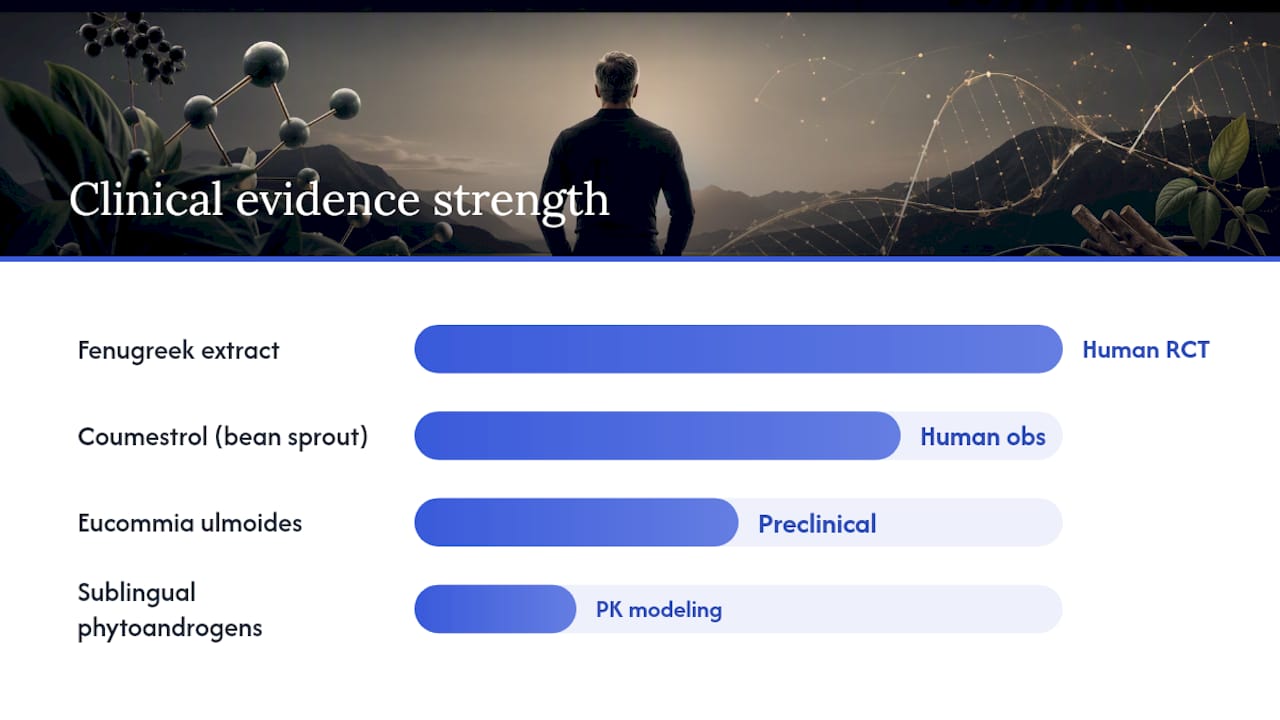
A 2024 PLOS ONE study found that certain fenugreek extracts increased saliva testosterone concentrations and improved free testosterone index in healthy men, with coumestrol-rich bean-sprout intake producing measurable rises in blood testosterone in a separate data set. The Eucommia findings come primarily from preclinical work, with translational evidence showing strong steroidogenic pathway activity in Leydig cells.
Key limitations to hold in mind:
- Extract composition varies significantly between manufacturers, making cross-study comparisons unreliable
- Most positive trials use multi-week dosing protocols; single-dose effects are not relevant
- Population differences (age, baseline testosterone, metabolic status) affect response magnitude
- Sublingual-specific human bioavailability data for phytoandrogens remains limited
Realistic timeline: clinically reported changes in vitality-related endpoints appear after several weeks of consistent dosing. Membership-grade consistency, meaning batch-to-batch standardization and uninterrupted supply, materially improves the signal you can detect.
How do you evaluate a premium sublingual supplement?
High-agency buyers should apply a tiered framework, not a marketing checklist.
Must-haves:
- Standardized extract specifications with named bioactive fractions (e.g., "45% saponins by HPLC") on the label or CoA
- Current third-party Certificate of Analysis covering both active content and contaminant screening
- GMP-certified manufacturing facility
- Mucoadhesive sublingual format with documented solubilization strategy for lipophilic actives
- Batch number on every shipment with traceable production records
Nice-to-haves:
- Small-batch production with published batch sizes and turnover frequency
- Clinical-grade extraction method documentation (solvent type, temperature, yield)
- Stability data for the sublingual format under expected storage conditions
Red flags:
- "Proprietary blend" with no individual compound quantification
- No CoA available on request
- Sublingual label with no formulation detail beyond "spray"
- Vague sourcing claims without named suppliers or origin
Pro Tip: Ask three questions before purchasing: (1) What is the exact saponin fraction your fenugreek is standardized to? (2) What solubilization strategy does the formulation use for lipophilic actives? (3) Do you have sublingual bioavailability data for this specific formulation? A credible manufacturer answers all three.
The role of supplements for vitality depends entirely on what is inside the capsule or spray — and how rigorously that content is verified.
How do you build a practical daily routine around a sublingual spray?
Consistency is the variable most men underestimate. A well-formulated spray used erratically produces weaker signal than a modest formulation used with discipline.
Daily protocol:
- Morning dose: Apply the spray sublingually before breakfast, holding for 60–90 seconds before swallowing. Pre-meal timing removes food-interaction variables entirely.
- Evening dose (if indicated): A second application 8–12 hours later maintains more stable exposure across the day.
- Avoid eating or drinking for 5 minutes post-application to preserve mucosal contact time.
- Log weekly: Rate drive, mental clarity, physical energy, and sleep quality on a simple 1–5 scale each Sunday.
Monitoring checklist:
- Weeks 1–2: Note any immediate changes in morning energy or focus; these are early indicators of absorption, not full effect
- Weeks 3–5: Track strength endurance and motivation patterns during high-demand work periods
- Weeks 6–8: Assess the full picture against your baseline log; this is your decision point
Realistic outcomes within 6–8 weeks include improved subjective drive, more consistent energy across the workday, and better recovery from high-stress periods. These are vitality-related endpoints, not medical claims. For a deeper framework on optimizing performance for lasting vitality, the lifestyle context around supplementation matters as much as the formula itself.
What safety considerations apply before you start?
Plant-derived phytoandrogens carry a favorable safety profile for most healthy men, but several situations warrant clinical input first.
- Anticoagulant medications (warfarin, apixaban): Fenugreek has demonstrated mild anticoagulant activity in some studies; men on blood thinners should consult their physician before use
- Hormone-sensitive conditions: Men with active prostate concerns or a history of hormone-sensitive conditions should discuss phytoandrogen use with a urologist or endocrinologist
- Thyroid medications: Some flavonoid-rich botanicals can interact with thyroid hormone metabolism; flag this with your prescribing physician
- Estrogen-modulating drugs: Coumestrol's phytoestrogenic activity may interact with aromatase inhibitors or SERMs; clinical review is appropriate
Common, mild side effects reported with fenugreek include gastrointestinal discomfort and a characteristic maple-like body odor at higher doses. Both are dose-dependent and typically resolve with adjustment.
Stop use and seek medical input if you experience unexpected hormonal symptoms, significant mood changes, or any adverse reaction not explained by the above. Third-party CoA and GMP certification do not eliminate all risk, but they substantially reduce the probability of contaminant-related adverse events. This article provides general information, not medical advice; confirm your specific situation with a qualified clinician before starting any new supplement regimen.
Viridos performance-spray: built for men still in the arena

The Viridos performance-spray is formulated specifically for the demands described throughout this guide: a precision sublingual spray built on standardized fenugreek saponins, Eucommia ulmoides extract, and coumestrol, delivered via a mucoadhesive format designed for rapid transmucosal absorption. Every batch is produced in small runs in Sweden, with full batch traceability and third-party CoA documentation available to members.
The Viridos membership is not a subscription box. It is a controlled-access program for men who meet the criteria and want consistent, uninterrupted supply with the quality assurance that makes a 6–8 week trial meaningful. Members receive batch-specific CoAs, production transparency, and direct access to the formulation rationale behind each run.
If you are ready to apply a disciplined, evidence-informed approach to testosterone-related vitality, the membership application is your next step.
Key Takeaways
Plant-derived, sublingual phytoandrogen formulations support testosterone-related vitality through steroidogenic pathway activation and androgen receptor potentiation, not hormonal replacement.
| Point | Details |
|---|---|
| Sublingual bypasses first-pass metabolism | Absorption is faster and more consistent than swallowed formats, independent of food intake. |
| Standardized extracts are non-negotiable | Fenugreek saponin fraction, Eucommia triterpenoids, and coumestrol must be quantified on a CoA, not just listed. |
| Clinical evidence is promising but limited | Human trials on fenugreek and coumestrol show measurable testosterone-related changes; Eucommia data remains largely preclinical. |
| 6–8 weeks is the minimum assessment window | Consistent daily dosing over this period is required before meaningful self-assessment is possible. |
| Viridos membership provides the quality floor | Small-batch Swedish production, batch traceability, and third-party CoAs make the trial signal reliable. |
What high-agency men get wrong about phytoandrogens
Most men approaching this category make one of two errors: they either dismiss plant-derived compounds as insufficiently potent, or they treat any botanical label as equivalent to any other. Both positions miss the point.
The potency question is a formulation question, not a category question. A poorly extracted, unstandardized fenugreek powder and a precision sublingual spray built on a verified saponin fraction are not the same product. The research on testosterone health and vitality consistently shows that extraction method, bioactive quantification, and delivery architecture determine whether a botanical intervention produces a measurable effect or nothing at all.

The equivalence error is more dangerous. Men who assume that any product carrying "fenugreek" or "Eucommia" on the label delivers the same biological signal are making a purchasing decision without the information that actually matters. Demanding a CoA, asking about saponin standardization, and understanding the solubilization strategy are not pedantic concerns. They are the difference between a disciplined trial and an expensive placebo.
For men still performing at a high level and intending to stay there, the standard you apply to your supplement choices should match the standard you apply to every other decision in your professional life: evidence, specificity, and accountability.
Useful sources
The following primary studies and technical reviews underpin the claims in this guide:
- PLOS ONE — Fenugreek and coumestrol study (2024): Human trial evidence showing measurable increases in saliva testosterone and free testosterone index with standardized fenugreek extract, and blood testosterone rises with coumestrol-rich bean-sprout intake. Supports: evidence snapshot and mechanism.
- Scientific Reports — Eucommia ulmoides and steroidogenic pathways: Documents kaempferol and geniposidic acid stimulating testosterone secretion and upregulating StAR and CYP17A1 in Leydig cells. Supports: mechanism and translational evidence.
- PMC — Sublingual and buccal delivery science: Reviews first-pass bypass, comparative bioavailability, and clinical applications of transmucosal formats. Supports: pharmacokinetics rationale.
- Frontiers in Pharmacology — Nanoparticulate sublingual/buccal delivery: Details how mucoadhesive polymers, permeation enhancers, and lipidic carriers affect transmucosal absorption. Supports: formulation science and evaluation framework.
- Springer — Nanocomposite sublingual films scoping review (2026): Scoping review of 31 papers (2014–2025) on nanocomposite sublingual architectures; notes promising bioavailability gains alongside translational gaps. Supports: pharmacokinetics limitations and evidence calibration.
- PMC — Herbs and testosterone concentrations: systematic review: Systematic review of herbal interventions on testosterone concentrations in men, covering study heterogeneity and extract variability. Supports: evidence limitations and evaluation framework.
- BMC Complementary Medicine — Eucommia phytoandrogens and lipidic augmenters: Preclinical and translational work on androgen receptor binding and potentiation mechanisms. Supports: mechanism and potentiation concept.