Free testosterone is the biologically active fraction of circulating testosterone, accounting for roughly 2%–4% of total testosterone, and it is the portion your cells can actually use. If you or your patient has symptoms consistent with hypogonadism, the immediate practical step is a morning total testosterone draw plus SHBG measurement (or a calculated free-T), followed by repeat confirmation before any intervention is considered.
Why this fraction matters for performance-focused men:
- Muscle and strength: Free testosterone drives androgen receptor activation in skeletal muscle, directly influencing protein synthesis and physical capacity.
- Libido and sexual function: Bioavailable androgen levels correlate more closely with sexual drive than total testosterone in many clinical presentations.
- Cognitive drive and energy: Low free-T is associated with fatigue, reduced motivation, and diminished executive function, all of which matter acutely for men in high-responsibility roles.
For clinicians: when total testosterone is equivocal and symptoms persist, free testosterone testing with clinical correlation is the appropriate next step before any therapeutic decision.
Table of Contents
- What free testosterone actually is, and how it differs from total testosterone
- How free testosterone is measured: equilibrium dialysis, direct assays, and calculated free-T
- When should you order a free testosterone test?
- How to interpret free testosterone results in clinical practice
- What drives free testosterone up or down?
- Practical next steps when free testosterone is low or high
- Pre-analytical pitfalls that distort free testosterone results
- Quick lab panel and reporting reference for clinicians and patients
- Key Takeaways
- The case for clinical prudence in performance-driven men
- Viridos and the disciplined approach to performance vitality
- Key clinical references and authoritative sources
What free testosterone actually is, and how it differs from total testosterone
Testosterone circulates in the blood in three distinct states. The largest share, roughly 44%–65%, binds tightly to sex hormone-binding globulin (SHBG). Another 30%–40% binds loosely to albumin. The remainder, that 2%–4% fraction, circulates unbound and is called free testosterone.
The clinical significance of these fractions comes down to cellular access. SHBG-bound testosterone is largely unavailable for tissue uptake; the binding affinity is high enough that cells cannot readily extract it. Albumin-bound testosterone, by contrast, dissociates easily at the capillary level and can enter target tissues. This is why clinicians sometimes refer to "bioavailable testosterone," a combined measure of free plus albumin-bound fractions, as a more complete picture of androgenic activity.
Key distinctions at a glance:
- Free testosterone: — Unbound and immediately bioactive.
A man can have a total testosterone reading within the normal range and still experience symptoms of androgen deficiency if SHBG is elevated, because the free fraction is disproportionately suppressed. That mismatch is precisely why free testosterone measurement adds clinical value beyond total testosterone alone.
How free testosterone is measured: equilibrium dialysis, direct assays, and calculated free-T
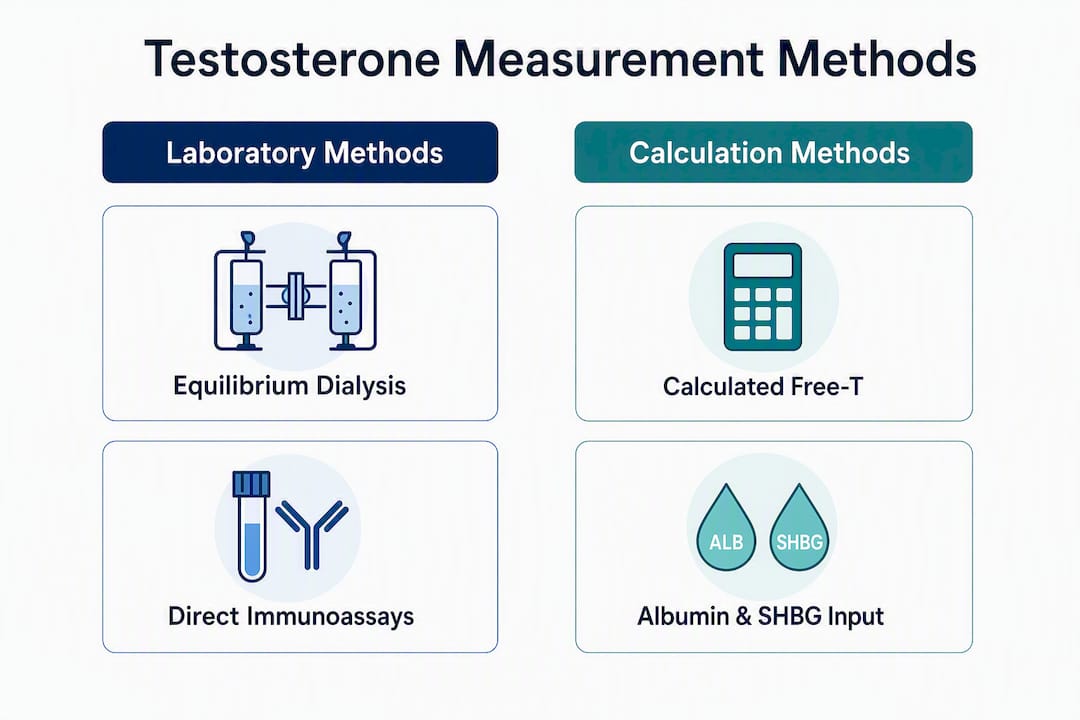
Three methods are used in clinical practice, and their accuracy, cost, and availability differ substantially.
Equilibrium dialysis
Equilibrium dialysis is the gold standard for measuring free testosterone. The method physically separates unbound hormone from bound fractions by dialyzing serum across a semipermeable membrane under controlled temperature and pH conditions. The result is a direct measurement of the free fraction without mathematical assumptions. Its limitations are practical: the technique is technically demanding, time-consuming, and expensive, which restricts it to reference laboratories. Most routine clinical labs do not offer it.
Direct immunoassays
Direct analog immunoassays are widely available and inexpensive, but they carry a significant accuracy problem. These assays use a labeled analog of testosterone that competes for binding sites, and they systematically underestimate free testosterone, particularly at low concentrations. MedlinePlus and clinical reviewers both note that direct immunoassays can be inaccurate, making repeat testing and clinical correlation mandatory when these results guide decisions. The University of Florida Pathology Laboratories lists direct free testosterone testing, but the method's limitations mean results should be interpreted with caution in borderline cases.
Calculated free testosterone
Calculated free-T, derived from total testosterone, SHBG, and an assumed or measured albumin value using the Vermeulen or Sodergard equations, is the most practical option for routine clinical use. Many labs now report it automatically alongside total testosterone and SHBG. When inputs are accurate, calculated free-T correlates well with equilibrium dialysis results and is accepted by major clinical guidelines as a valid surrogate.
| Method | Accuracy | Cost / Availability | Best clinical use |
|---|---|---|---|
| Equilibrium dialysis | Highest (gold standard) | High cost; reference labs only | Confirmatory or research settings |
| Direct immunoassay | Variable; underestimates at low values | Low cost; widely available | Screening only; confirm abnormals |
| Calculated free-T | Good when inputs are accurate | Low cost; automated at many labs | Routine clinical practice |
Pro Tip: If your lab reports only a direct immunoassay result and the value is borderline low, request a calculated free-T using the Vermeulen equation, or send the specimen to a reference laboratory for equilibrium dialysis before making any clinical decision.
When should you order a free testosterone test?
Total testosterone is the standard first-line test, but free testosterone becomes the more informative measure in specific clinical situations. The AUA testosterone deficiency guideline and the Endocrine Society both recognize free or bioavailable testosterone as the appropriate measure when total testosterone is equivocal or when SHBG is known to be abnormal.
Common indications for free testosterone testing:
- Symptoms of hypogonadism (fatigue, low libido, reduced muscle mass, mood changes) with total testosterone in the borderline range
- Suspected elevated SHBG: obesity, hypothyroidism, hyperthyroidism, liver disease, aging, or estrogen-containing medications
- Suspected low SHBG: type 2 diabetes, insulin resistance, nephrotic syndrome, or exogenous androgen use
- Infertility evaluation where androgen status needs precise characterization
- Monitoring men on medications known to alter SHBG (opioids, some antidepressants, anticonvulsants)
Timing checklist for accurate sampling:
- Draw blood between 7:00 AM and 10:00 AM. Testosterone levels peak in the early morning and decline through the afternoon; afternoon draws can produce values 20%–30% lower.
- Avoid acute illness, recent intense exercise, or significant sleep deprivation on the day of the draw.
- Fast or follow your lab's standard fasting protocol if lipemia is a concern.
- If the result is abnormal, repeat the test on a separate morning before acting on it. Single-sample results are insufficient for diagnosis.
- Document all current medications, particularly opioids, glucocorticoids, and antidepressants, before interpreting results.
How to interpret free testosterone results in clinical practice
The single most important interpretive rule: always use your specific laboratory's reference interval, and always consider SHBG alongside the free-T value.
Step-by-step interpretation:
- Confirm the result. A single abnormal free-T is not diagnostic. Repeat the morning draw on a separate day before drawing clinical conclusions.
- Review total testosterone and SHBG together. A low free-T with normal total T and elevated SHBG points to a binding-protein problem, not a production problem. A low free-T with low total T suggests primary or secondary hypogonadism.
- Prefer calculated free-T over direct immunoassay when the direct result is borderline. Calculated values using accurate SHBG inputs correlate well with equilibrium dialysis.
- Correlate with symptoms. Numbers without clinical context are incomplete. The AUA guideline uses a total testosterone threshold below a biochemical cutoff as a biochemical anchor, with treatment targets in the mid-normal physiologic range, but free-T interpretation must account for individual SHBG status.
- Consider lab-to-lab variability. Reference ranges differ between laboratories depending on the assay platform and the population used to establish norms. Never compare a result from one lab against another lab's reference interval.
Pro Tip: A man with total testosterone of 380 ng/dL and SHBG of 65 nmol/L may have a free testosterone in the frankly low range despite a "normal" total. When SHBG is elevated, calculated free-T is the more clinically meaningful number, and it often changes the management decision.
What drives free testosterone up or down?
Free testosterone is a dynamic variable. Because it is determined by the interaction between total testosterone production and SHBG concentration, anything that shifts either variable will change the free fraction, sometimes dramatically, without altering total testosterone at all.
Common causes of low free testosterone:
- Age-related decline: testosterone levels begin declining in the 40s, and SHBG tends to rise with age, compressing the free fraction from both directions
- Obesity and metabolic syndrome: excess adipose tissue increases aromatase activity and can suppress LH-driven production
- Chronic illness: liver disease, kidney disease, and inflammatory conditions all affect SHBG and total T
- Hypothyroidism: low thyroid function raises SHBG, reducing free-T even when total T is preserved
- Medications: opioids suppress the hypothalamic-pituitary-gonadal axis; some antidepressants and anticonvulsants raise SHBG
- High SHBG states: aging, hyperthyroidism, estrogen use, and certain genetic variants all elevate SHBG
Causes of elevated free testosterone and when to investigate:
- Exogenous androgen use (prescribed or non-prescribed testosterone, anabolic steroids)
- Androgen-secreting tumors (adrenal or testicular): suspect when free-T is markedly elevated without exogenous use
- Low SHBG states: insulin resistance, nephrotic syndrome, hypothyroidism (paradoxically in some cases), and obesity can lower SHBG and raise free-T
Red flags requiring urgent evaluation:
- Rapid virilization in women or children
- Palpable testicular mass with elevated androgens
- Signs of estrogen excess in men (gynecomastia, testicular atrophy) alongside high total T
- Severe sexual dysfunction in men under 40 with no identifiable lifestyle cause
Practical next steps when free testosterone is low or high
An abnormal result is a starting point, not a conclusion. The pathway below applies whether you are a clinician ordering the panel or a performance-focused man reviewing your own results.
Ordered diagnostic steps:
- Repeat morning total testosterone and free-T (or calculated free-T) on a separate day to confirm the finding.
- Measure LH and FSH to distinguish primary hypogonadism (elevated LH/FSH) from secondary (low or inappropriately normal LH/FSH).
- Add prolactin, TSH, and morning cortisol to the panel to identify pituitary or thyroid contributors.
- If SHBG is elevated and calculated free-T is low, consider whether a modifiable cause (obesity, hypothyroidism, medication) is driving the SHBG elevation before pursuing hormone therapy.
- For markedly elevated free-T without exogenous androgen use, imaging of the adrenals and testes is warranted.
Non-prescription, evidence-informed optimization options:
- Weight management: Reducing excess body fat lowers aromatase activity and often reduces SHBG, improving the free fraction.
- Resistance training: Consistent strength training supports healthy testosterone dynamics and androgen receptor sensitivity.
- Sleep quality: Testosterone secretion is tightly coupled to sleep architecture; chronic sleep restriction suppresses morning peaks.
- Alcohol moderation: Chronic alcohol use suppresses testicular function and raises SHBG.
- Supplement caution: A systematic review found that most marketed testosterone boosters fail to reliably increase total testosterone; a small number of compounds showed benefit in specific athlete subgroups, but the evidence base for most products is thin.
For men who want a structured approach to performance longevity, the lifestyle variables above are the most evidence-supported levers available without a prescription.
When to refer to a specialist:
- Confirmed hypogonadism with low LH/FSH suggesting a pituitary cause
- Suspected androgen-secreting tumor
- Infertility requiring semen analysis and reproductive endocrinology input
- Any case where equilibrium dialysis confirmation is needed before initiating therapy
Pre-analytical pitfalls that distort free testosterone results
Even a well-ordered panel produces misleading results if the pre-analytical conditions are wrong. These errors are common and consistently underappreciated.
Pre-analytical factors that alter results:
- Time of draw: Afternoon or evening sampling can produce values 20%–30% below true morning peaks, creating false-low readings.
- Acute illness or surgery: Systemic inflammation suppresses testosterone transiently; results drawn during illness do not reflect baseline status.
- Recent intense exercise: Strenuous training in the 24 hours before a draw can transiently alter testosterone and SHBG.
- Medications: Opioids, glucocorticoids, antidepressants, and anticonvulsants all affect the HPG axis or SHBG; document and consider pausing non-essential agents when clinically appropriate.
- Albumin variability: Calculated free-T formulas assume a standard albumin of 4.3 g/dL; in patients with liver disease, nephrotic syndrome, or malnutrition, measured albumin should be used.
- Lab-to-lab assay differences: Direct immunoassay platforms vary in their calibration; a result from one lab cannot be directly compared to a result from another without knowing the assay method.
Patient prep checklist to reduce false results:
- Schedule the draw between 7:00 AM and 10:00 AM on a routine morning.
- Avoid intense training the day before.
- Do not draw during acute illness; reschedule once recovered.
- Bring a complete medication list to the appointment.
- Confirm with your lab whether fasting is required for the specific panel ordered.
Quick lab panel and reporting reference for clinicians and patients
The core panel for evaluating free testosterone status is straightforward. What varies is which adjunct tests to add based on clinical context.
| Test | Specimen timing | Why it is ordered |
|---|---|---|
| Total testosterone | Morning (7–10 AM) | First-line measure; anchors the free-T calculation |
| SHBG | Morning, same draw | Required for calculated free-T; identifies binding-protein abnormalities |
| Albumin | Morning, same draw | Refines calculated free-T in patients with altered protein status |
| Calculated free-T | Derived from above | Clinically accepted surrogate for equilibrium dialysis in routine practice |
| LH / FSH | Morning | Distinguishes primary from secondary hypogonadism |
| Prolactin | Morning | Screens for pituitary adenoma in secondary hypogonadism |
| TSH | Any time | Thyroid dysfunction alters SHBG and total T |
| Morning cortisol | 8:00 AM | Screens for adrenal insufficiency when clinically indicated |
One-line clinical action items:
- Total testosterone below 300 ng/dL with consistent symptoms on two separate morning draws: consider confirmatory repeat, full panel above, and referral to endocrinology or urology.
- Normal total testosterone with elevated SHBG and symptoms: calculate free-T; if low, treat the SHBG driver first and reassess.
- Markedly elevated free-T without exogenous androgen use: add imaging and refer urgently.
- Borderline direct immunoassay result: request calculated free-T or equilibrium dialysis before acting.
For men building a longevity-focused monitoring strategy, this panel, repeated consistently at morning intervals, provides the data foundation for informed decisions over time.
Key Takeaways
Free testosterone, the biologically active 2%–4% of total circulating testosterone, requires morning sampling, SHBG measurement, and repeat confirmation before any clinical or lifestyle intervention is warranted.
| Point | Details |
|---|---|
| Free fraction is small but decisive | Only 2%–4% of total testosterone is free; this fraction drives androgen receptor activity in muscle, brain, and reproductive tissue. |
| Equilibrium dialysis is the gold standard | Routine practice relies on calculated free-T; request equilibrium dialysis only for confirmatory or complex cases. |
| Morning timing is non-negotiable | Draw between 7:00 AM and 10:00 AM; afternoon sampling can suppress results by 20%–30% and produce false-low readings. |
| SHBG determines clinical meaning | A normal total testosterone with elevated SHBG can mask a clinically low free-T; always interpret both values together. |
| Viridos supports performance longevity | For performance-focused men, Viridos offers a plant-derived precision oral spray as part of a disciplined vitality strategy, not as a substitute for clinical evaluation. |
The case for clinical prudence in performance-driven men
The conversation around testosterone in high-performance men tends to collapse into two unproductive camps: dismissal on one side, and aggressive optimization theater on the other. Neither serves the man who is genuinely invested in sustained performance over decades.
What the evidence actually supports is a disciplined, data-driven monitoring posture. Testosterone levels decline with age, SHBG rises, and the free fraction narrows, often before symptoms become obvious enough to prompt a clinical visit. The men who manage this well are not the ones chasing a number. They are the ones who establish a baseline early, sample consistently under standardized conditions, and make decisions in partnership with a clinician who understands the full hormonal picture.
The assay question matters more than most men realize. A direct immunoassay result that reads "normal" can obscure a genuinely low free-T in a man with elevated SHBG. That is not a theoretical concern; it is a routine clinical scenario that leads to years of unaddressed symptoms. Insisting on calculated free-T, or equilibrium dialysis when the stakes are high, is not overcautious. It is precise.
Performance longevity is built on accurate data, not optimistic interpretations of borderline labs. The men still in the arena at 55 and 65 are the ones who treated their biology with the same rigor they applied to their businesses.
Viridos and the disciplined approach to performance vitality
For men who have done the clinical work, confirmed their baseline, and want a precision-grade complement to their vitality strategy, Viridos offers something distinct from the mass-market supplement category.

Viridos is a small-batch Swedish performance brand built for disciplined men in demanding roles. Its plant-derived precision oral spray uses proprietary extraction methods to deliver phytoandrogen-related compounds targeting drive, clarity, and sustained executive performance. Access is controlled: membership is application-based, production is limited, and the experience is designed for men who take their biology seriously.
This is not a substitute for clinical evaluation or hormone therapy when therapy is indicated. Consult your clinician before altering any existing protocol. For men who want to read more about the philosophy and formulation behind Viridos, the Viridos Performance Journal is the place to start.
Key clinical references and authoritative sources
- Testosterone Levels Test — MedlinePlus — Patient-facing overview of total and free testosterone testing, including what bound and unbound fractions mean for clinical interpretation.
- Testosterone — MedlinePlus Medical Encyclopedia — Explains testing indications, immunoassay limitations, and the importance of repeat testing and clinical correlation.
- Testosterone Deficiency: Establishing a Biochemical Diagnosis (PMC) — Peer-reviewed review covering assay methods, SHBG's role, and the clinical case for calculated free-T over direct immunoassays.
- Harmonized Reference Ranges for Circulating Testosterone (PMC) — Establishes cross-laboratory harmonized reference intervals for total testosterone in men across four cohort studies; relevant for understanding why lab-specific ranges matter.
- Free Testosterone — URMC Rochester — Clinician and patient resource explaining calculated free-T, circadian sampling requirements, and the role of SHBG.
This article provides general clinical information for educational purposes only. It is not medical advice. Consult a qualified healthcare professional and your laboratory's current reference intervals before making any diagnostic or therapeutic decision.