
TL;DR:
- Testosterone levels decline naturally after age 30, impacting vitality, focus, and performance.
- Recognizing symptoms like fatigue, reduced drive, and muscle loss is key for early intervention.
- Lifestyle changes and proper diagnosis are essential before considering medical treatments like TRT.
If your energy, focus, and drive have quietly shifted over the past few years, the cause may not be stress or aging in the abstract sense. For men over 40, testosterone regulates energy, vitality, and performance in ways that directly affect how you lead, decide, and recover. The decline is real, measurable, and often ignored until it starts costing you. This guide breaks down what testosterone health actually means, how to recognize when it's slipping, and what evidence-based steps you can take to protect your performance edge for the long term.
Table of Contents
- Defining testosterone health and its role in executive vitality
- Recognizing symptoms and risks of low testosterone
- Diagnosing testosterone issues: What executives should know
- Optimizing testosterone: Lifestyle strategies and when therapy fits
- Why testosterone health matters for leaders: Beyond the numbers
- Next steps: Maximize your vitality and performance
- Frequently asked questions
Key Takeaways
| Point | Details |
|---|---|
| Testosterone drives male vitality | Optimal levels fuel energy, performance, and resilience especially for executives over 40. |
| Symptoms can impact leadership | Fatigue, focus issues, and low drive are serious risks for high-performing men and should not be ignored. |
| Diagnosis needs both labs and symptoms | Reliable diagnosis combines blood tests with real-world symptom tracking to avoid missteps. |
| Lifestyle changes are powerful | Weight loss, training, and better sleep can significantly boost testosterone before medical therapy is needed. |
| Personalized care is essential | Executives should pursue tailored strategies and expert guidance for peak performance and safety. |
Defining testosterone health and its role in executive vitality
Testosterone health is not simply about having high numbers on a lab report. It means your testosterone levels are sufficient to support the physical, cognitive, and emotional demands of your life. For executives and founders operating under sustained pressure, that threshold is higher than most clinical guidelines acknowledge.
Testosterone governs muscle mass, fat distribution, drive, and overall vitality in men over 40. When levels are optimal, you recover faster from hard workouts, maintain sharper focus through long meetings, and sustain the motivation to push through difficult decisions. When they are not, the erosion is subtle but compounding.
Here is what testosterone directly regulates in your body:
- Muscle mass and strength: Higher T supports protein synthesis and physical resilience
- Body fat distribution: Optimal levels reduce visceral fat accumulation around the abdomen
- Energy metabolism: T influences mitochondrial function and overall stamina
- Cognitive sharpness: Concentration, working memory, and processing speed are all T-dependent
- Libido and sexual function: One of the earliest and most sensitive indicators of decline
- Mood and stress resilience: Low T correlates strongly with irritability, low motivation, and anxiety
For men in demanding roles, men's vitality optimization is not a wellness trend. It is a performance variable.
Normal total testosterone ranges from roughly 300 to 1,000 ng/dL, with most healthy men between 40 and 65 sitting in the 400 to 700 ng/dL range. The challenge is that decline starts earlier than most men expect.
| Age range | Average total testosterone (ng/dL) |
|---|---|
| 40 to 49 | 500 to 700 |
| 50 to 59 | 400 to 600 |
| 60 to 65 | 300 to 500 |
Testosterone declines at roughly 1 to 2% per year after age 30 to 40. Over a decade, that is a 10 to 20% reduction, enough to meaningfully affect performance, recovery, and mental clarity.
The numbers alone do not tell the full story. Symptoms, context, and lifestyle factors all shape how a given level affects your actual performance. That is why understanding the warning signs matters as much as knowing the ranges.
Recognizing symptoms and risks of low testosterone
Low testosterone does not announce itself loudly. It tends to arrive gradually, disguised as the ordinary costs of a demanding career. Many executives attribute the symptoms to overwork, poor sleep, or simply getting older. That assumption is worth questioning.

Low T affects up to 25% of older men, with symptoms including fatigue, mood changes, and poor concentration. The clinical threshold for concern is generally below 300 to 400 ng/dL, but symptoms can appear at higher levels depending on your baseline and the demands of your role.
The most common warning signs include:
- Persistent fatigue that does not resolve with rest or sleep
- Reduced motivation and drive, particularly for goals that previously energized you
- Loss of muscle mass or difficulty maintaining strength despite consistent training
- Increased body fat, especially around the midsection
- Brain fog and poor concentration during high-stakes tasks
- Mood instability, including irritability, low mood, or emotional flatness
- Reduced libido or changes in sexual performance
- Disrupted sleep, particularly difficulty staying asleep
The professional risks are real. An executive operating with unaddressed low T is making decisions with a compromised cognitive toolkit. Reaction time, risk assessment, and the ability to sustain focus under pressure are all affected. The competitive edge you have built over decades depends on the biological systems supporting it.
Risk factors that accelerate decline include chronic stress (which elevates cortisol and suppresses T), excess body weight, poor sleep quality, alcohol consumption, and sedentary behavior. Executives are often exposed to several of these simultaneously, which compounds the problem.
Pro Tip: Start tracking symptoms before you get tested. A simple weekly log of energy, focus, mood, and libido gives your physician context that blood work alone cannot provide. If multiple symptoms persist for more than four to six weeks, that is a clear signal to pursue formal evaluation. Pairing symptom data with lab results leads to far more accurate assessment and better treatment decisions. Executive resilience strategies that address sleep, stress, and recovery can also reduce symptom severity while you pursue diagnosis.
Diagnosing testosterone issues: What executives should know
Recognizing symptoms is the first step. Getting an accurate diagnosis is where many men either skip ahead too fast or avoid the process entirely. Both mistakes are costly.
TRT diagnosis requires two low morning testosterone tests plus symptoms. Testing should be done before 10 a.m., when levels peak naturally. A single low result is not sufficient. You need two separate tests on different days to confirm the finding.
Here is a practical sequence for proper diagnosis:
- Schedule morning blood work: Total testosterone should be drawn between 7 and 10 a.m.
- Repeat the test: Confirm a low result on a second separate morning before drawing conclusions
- Check additional hormones: LH (luteinizing hormone) and FSH help identify whether the issue is primary (testicular) or secondary (pituitary)
- Assess PSA and hematocrit: Baseline prostate-specific antigen and red blood cell levels are essential before any treatment discussion
- Document symptoms formally: Bring your symptom log to your physician and discuss how they align with your results
- Evaluate lifestyle factors: Sleep quality, stress load, and body composition should all be reviewed as contributing variables
Clinical guidelines differ on what constitutes a low threshold, which matters for men whose levels fall in a gray zone.
| Guideline body | Low T threshold | Key requirement |
|---|---|---|
| Endocrine Society | Below 264 ng/dL | Symptoms plus confirmed low levels |
| AUA | Below 300 ng/dL | Two morning tests required |
The gap between these thresholds is meaningful. A man testing at 280 ng/dL qualifies under one guideline but not the other. This is why working with a physician who understands both the clinical evidence and your specific performance context matters. Self-diagnosis based on symptoms alone, or chasing TRT without confirmed low levels, introduces unnecessary risk. Pairing proper diagnosis with executive fitness routines that support hormonal health gives you a far stronger foundation.
Optimizing testosterone: Lifestyle strategies and when therapy fits
The most durable gains in testosterone health come from lifestyle, not prescriptions. This is not a soft recommendation. It is the evidence-based starting point that most men skip because it requires consistency rather than a quick fix.
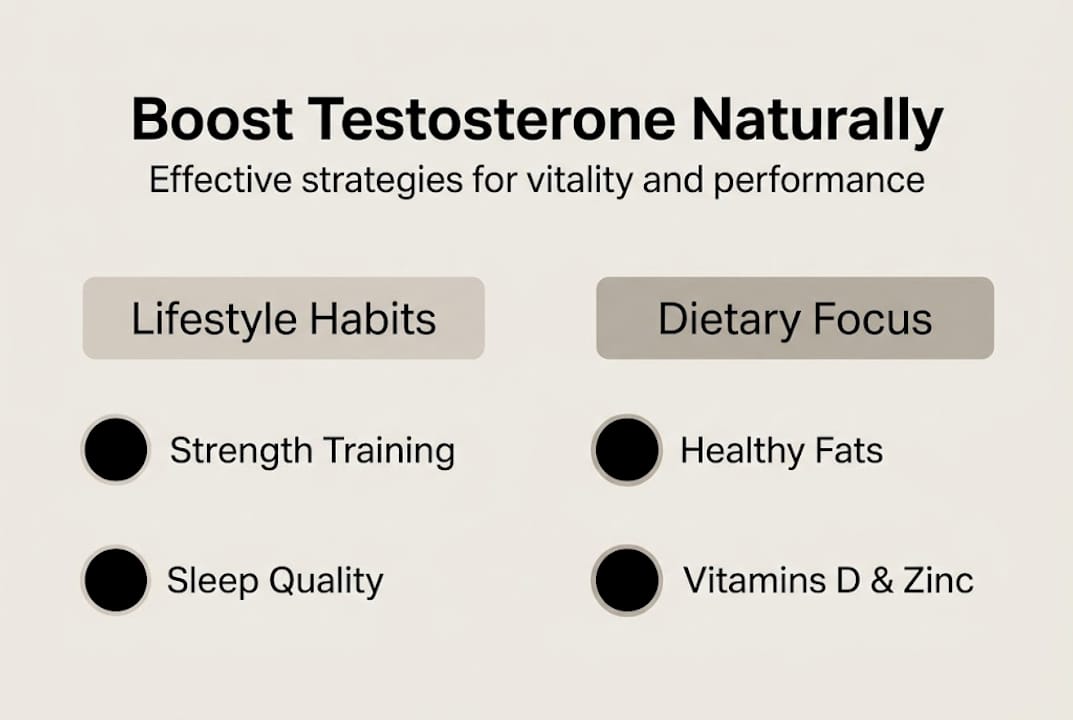
Weight loss, resistance training, 7 to 9 hours of sleep, and stress management can boost T by 10 to 15%. For a man sitting at 350 ng/dL, that is a meaningful improvement that may resolve symptoms without any medical intervention.
Here are the highest-impact lifestyle upgrades:
- Resistance training: Compound movements (squats, deadlifts, presses) 3 to 4 times per week produce the strongest T response
- Sleep optimization: Below seven hours suppresses T significantly. Prioritize sleep architecture, not just duration
- Body composition: Reducing visceral fat directly raises free testosterone by lowering aromatase activity (the enzyme that converts T to estrogen)
- Stress reduction: Chronic cortisol elevation is one of the most potent suppressors of testosterone production
- Alcohol reduction: Even moderate regular consumption measurably lowers T levels over time
- Zinc and vitamin D: Both are directly involved in testosterone synthesis. Deficiencies are common in high-stress professionals
For broader support, longevity strategies and understanding key vitamins for vitality can reinforce the lifestyle foundation before any clinical intervention is considered.
When lifestyle optimization is not enough and diagnosis confirms low T with persistent symptoms, TRT becomes a legitimate conversation. TRT improves sexual function, muscle mass, bone density, and mood, but it carries potential risks including elevated red blood cell count, reduced sperm production, and cardiovascular considerations that require close monitoring.
TRT delivery methods include injections (most cost-effective, requires biweekly administration), topical gels (daily application, risk of transfer to others), and pellets (subcutaneous implants lasting 3 to 6 months). Each has tradeoffs in convenience, cost, and hormonal stability.
Pro Tip: If you start TRT, schedule labs every 3 months for the first year. Total testosterone, free testosterone, estradiol, hematocrit, and PSA should all be tracked. Executives often underestimate how much their stress load and travel schedule affect hormonal response to therapy. Regular reassessment keeps the protocol calibrated to your actual demands, not a static baseline.
Why testosterone health matters for leaders: Beyond the numbers
Here is the uncomfortable reality most testosterone content avoids: the men most likely to dismiss hormonal decline are often the ones most affected by it. High-performing executives have spent decades attributing every physical and mental shift to external pressure. That narrative is useful for pushing through hard periods. It becomes a liability when it prevents you from addressing something biological and fixable.
Executives should test if symptomatic, optimize lifestyle, and consider TRT only if levels are low and symptoms are present. That framework sounds simple, but it runs counter to two common failure modes: ignoring the issue entirely, or jumping to therapy before exhausting lifestyle interventions.
The leaders who manage this well treat testosterone health the same way they treat performance longevity insights: as a system to monitor, optimize, and adjust over time. They are not chasing numbers. They are protecting function. That distinction matters because it keeps the focus on what actually drives results, which is how you feel, decide, and perform under sustained pressure, not what your lab report says on any given Tuesday.
Personalized, measured, and consistent. That is the approach that holds up over a decade.
Next steps: Maximize your vitality and performance
Understanding your testosterone health is a starting point, not a destination. The real work is building a system around it: tracking symptoms, optimizing lifestyle inputs, working with the right medical partners, and reassessing regularly as your demands evolve.

At VIRIDOS, we have built the Performance Journal specifically for executives who want structured, evidence-informed tools to track and improve their vitality over time. From hormone health to recovery protocols, the resources at VIRIDOS are designed for men who take their performance as seriously as their business. If you are ready to move from awareness to action, this is where precision meets practice.
Frequently asked questions
What exactly does testosterone health mean for men over 40?
Testosterone health supports key male functions including muscle, energy, metabolism, and vitality as levels naturally decline with age. Maintaining optimal levels means protecting your physical and cognitive performance over the long term.
What are the earliest warning signs of low testosterone?
Early signs include fatigue, low sex drive, mood changes, poor focus, and reduced strength. Symptoms of low T often appear gradually and are frequently misattributed to stress or overwork before a diagnosis is considered.
Is testosterone therapy safe for high-performing executives?
TRT can be safe when properly diagnosed, prescribed, and monitored. TRT must be carefully individualized with regular lab work to track risks and ensure the protocol remains appropriate for your health profile.
How much can lifestyle improve low testosterone?
Lifestyle upgrades can boost T by significant margins before considering medication. Losing weight, lifting weights, improving sleep, and reducing stress can increase testosterone by 10 to 15%, which is often enough to resolve symptoms at borderline levels.