Plant-derived androgens can interact with human androgen pathways, but the evidence base is mechanistic rather than clinical. Biochemical plausibility is real; demonstrated human efficacy is not yet established.
- Mechanistic plausibility: Multiple plant taxa contain DHEA, testosterone, and DHT, and Eucommia ulmoides extracts show androgen-receptor transactivation via a "tripartite synergism" of plant steroids, lipids, and non-hormonal compounds.
- Evidence strength: Plant detection and in vitro receptor work are well-documented; animal models show functional signals; robust human clinical trials remain scarce, with limited pharmacokinetic data in men.
- Practical next step: Establish baseline labs (total testosterone, free testosterone, SHBG, PSA) and discuss any supplement trial with a clinician before starting.
Key Takeaways
Phytoandrogens show mechanistic plausibility across multiple evidence tiers, but human clinical data remain limited, making clinician-supervised, quality-controlled use the only defensible approach for performance-focused men.
| Point | Details |
|---|---|
| Evidence is mechanistic, not clinical | Plant steroids and AR transactivation are documented; large human RCTs do not yet exist. |
| Tripartite synergism matters | Whole-extract formulations with intact lipid fractions show greater receptor activity than isolated steroids. |
| Pair with resistance training | Preclinical data show amplified functional gains when phytoandrogens are combined with structured training. |
| Baseline labs are non-negotiable | Measure total testosterone, free testosterone, SHBG, and PSA before and after any trial. |
| Viridos offers a monitored path | Small-batch Swedish production, sublingual delivery, and controlled membership access support a quality-first trial. |
Table of Contents
- What are phytoandrogens and what effects do they produce?
- How phytoandrogens might act in the body
- What does the evidence actually show?
- Safety, interactions, and U.S. regulatory context
- Why formulation and delivery route matter
- A practical plan before you start a phytoandrogen trial
- When phytoandrogens are a reasonable option and when they are not
- How phytoandrogens compare to pharmaceutical androgen therapies
- Traditional and ethnobotanical roots of phytoandrogen use
- Legal status and international regulations for phytoandrogen supplements
- The Viridos approach to phytoandrogenic precision
- Viridos membership: a monitored, premium option
- Sources
What are phytoandrogens and what effects do they produce?
Phytoandrogens are plant-derived compounds that structurally resemble mammalian androgens or interact with androgen-signaling pathways. The term "fytoandrogener effekt" refers specifically to the downstream physiological response these compounds may trigger in human tissue, whether through direct receptor binding, precursor conversion, or enzyme modulation.
Survey and analytical work confirm that DHEA, testosterone, and 5α-dihydrotestosterone (DHT) are among the most abundant mammalian-like steroids detected across plant samples, with enzymatic D5-to-D4 steroid conversions observed in plant cultures. Commonly reported plant steroids and precursors include:
- DHEA (dehydroepiandrosterone): a testosterone precursor found in pine pollen and other taxa
- Androstenedione: a direct testosterone precursor detected in multiple plant species
- Testosterone: identified in trace quantities in pine pollen and Eucommia
- DHT (5α-dihydrotestosterone): the most potent natural androgen; detected in plant tissue
- Progestogens: progesterone-related compounds with partial androgenic or anti-androgenic activity depending on receptor context
The pathway from plant presence to human effect runs: ingestion → absorption (route-dependent) → systemic circulation → potential receptor interaction or enzymatic conversion. Each step carries attrition, which is why delivery method matters as much as botanical source.
How phytoandrogens might act in the body
The most credible mechanistic framework for phytoandrogen effects is tripartite synergism: plant steroids do not act alone. Research on Eucommia ulmoides shows that short-chain plant lipids and triterpenoids potentiate androgen-receptor (AR) transactivation alongside the steroid ligands themselves. Isolating a single steroid from the extract reduces activity; the whole-extract matrix amplifies it.
Three enzymes appear in plant steroidogenesis research and parallel human steroidogenesis:
- CYP17A1-like activity: catalyzes conversion of pregnenolone to DHEA in animal tissue; analogous enzymatic activity has been observed in some plant species
- HSD17B3 (17β-hydroxysteroid dehydrogenase 3): converts androstenedione to testosterone; plant cultures show comparable 17β-HSD conversions
- SRD5A1 (5α-reductase type 1): converts testosterone to the more potent DHT; flavonoids such as quercetin and EGCG can inhibit this enzyme, which cuts both ways depending on your goal
Flavonoids, lignans, and polyphenols add a second layer: mechanistic reviews document that genistein, quercetin, and EGCG modulate androgen metabolism through 5-alpha reductase inhibition and AR modulation, plus oxidative-stress protection in testicular tissue.
Pro Tip: Mechanistic plausibility in vitro or in plant models does not translate automatically to a measurable hormonal shift in a healthy adult male. Treat these pathways as a scientific rationale for further investigation, not a confirmed clinical outcome.
What does the evidence actually show?
| Evidence tier | What it shows | Key limitation |
|---|---|---|
| Plant detection | DHEA, testosterone, DHT present across many taxa | Presence ≠ bioavailability in humans |
| In vitro AR binding | AR transactivation confirmed for Eucommia extracts | Cell-culture conditions differ from human physiology |
| Animal models | Functional gains (strength, locomotion) amplified with resistance training | Species differences; dose extrapolation uncertain |
| Human trials | Sparse; mostly surrogate or subjective endpoints | No large RCTs; pharmacokinetics poorly characterized |
Plant physiology studies demonstrate dose-dependent effects: low concentrations stimulate growth and antioxidant activity, while high concentrations become inhibitory. That dose-response curve matters for supplement formulation because "more" is not a reliable proxy for "better."
Preclinical data show that phytoandrogenic extracts produce larger functional gains in animal models when paired with resistance training than when used alone. The signal suggests a modulator of training adaptation rather than a standalone anabolic agent.
The human evidence gap is the central limitation. Consumer health guidance and phytotherapy reviews consistently note that pine pollen and related botanicals lack rigorous randomized controlled trial data in men, with pharmacokinetic parameters largely uncharacterized.
Safety, interactions, and U.S. regulatory context
This section is general information, not medical advice. Consult a qualified clinician before starting any supplement with androgenic activity.
Under the Dietary Supplement Health and Education Act (DSHEA), U.S. supplement manufacturers are not required to prove efficacy before sale, only to avoid explicit disease claims. A product labeled "supports healthy testosterone levels" is legal; one claiming to "treat hypogonadism" is not. That regulatory gap means quality and dosing vary widely across brands.
Known or plausible interactions and red flags to discuss with your clinician:
- 5-alpha reductase inhibitors (finasteride, dutasteride): combining with phytoandrogens that affect the same enzyme creates unpredictable androgenic balance
- Prescription testosterone therapy: adding phytoandrogens on top of TRT may amplify androgenic load without proportional benefit
- Anticoagulants (warfarin, apixaban): some botanical extracts affect CYP450 metabolism, altering drug clearance
- Thyroid medications: polyphenol-rich extracts can interfere with thyroid hormone absorption timing
- Red flags to monitor: gynecomastia, rapid mood shifts, urinary symptoms (stream changes, frequency), elevated PSA
Finasteride is FDA-indicated for men only. Women who are or may become pregnant must not handle crushed or broken finasteride tablets, due to the risk of harm to a male fetus. It can also cause sexual side effects (reduced libido, erectile dysfunction) in a minority of men, which usually resolve after stopping treatment. Discuss these risks with a physician before starting.
Chronic stress and hormonal dysregulation can compound androgenic imbalance, making baseline mental and physiological health assessment relevant before any hormonal supplement trial.
Pro Tip: Before starting, ask your clinician to run total testosterone, free testosterone, SHBG, and PSA. Retest at 8–12 weeks. Objective data separates genuine response from placebo effect.
Why formulation and delivery route matter
Bioavailability is where most phytoandrogen products fail. Oral capsules expose plant steroids to first-pass hepatic metabolism, which can substantially reduce the fraction reaching systemic circulation. Delivery method is a primary determinant of whether any measurable phytoandrogen effect occurs.
- Capsules/pills: convenient, but subject to full first-pass metabolism; standardization varies widely
- Tinctures: faster absorption than capsules; alcohol-based extraction can preserve lipid fractions, but concentration control is inconsistent
- Sublingual spray: bypasses first-pass metabolism via oral mucosal absorption; onset is faster and the dose reaching circulation is more predictable
When evaluating any product, look for: batch-specific certificates of analysis (CoA), solvent-free or ethanol-based extraction documentation, standardized lipid fractions (relevant to tripartite synergism), and third-party testing for heavy metals and contaminants. The Science Behind Viridos page documents the brand's extraction methodology and delivery rationale for readers who want to inspect those specifics directly.
A practical plan before you start a phytoandrogen trial
- Establish baseline labs: total testosterone, free testosterone, SHBG, PSA, and a basic metabolic panel. Do this before any supplement, not after.
- Consult your clinician: share what you plan to take, your current medications, and your goals. Get explicit sign-off.
- Source a quality-controlled product: verify CoA availability, extraction method, and third-party testing. Generic products with no documentation carry unknown risk.
- Pair with resistance training: preclinical evidence and a broader self-optimization framework both support combining supplementation with structured training for amplified adaptation.
- Run a defined trial period: 8–12 weeks minimum for any meaningful signal. Track objective markers (lab values, strength metrics) alongside subjective ones (energy, focus, sleep quality).
- Set a stop criterion: if red flags appear (see Safety section) or labs shift unfavorably, stop and consult your clinician before continuing.
Pro Tip: Small subjective gains in the first two weeks are often placebo. Meaningful signal shows up in objective markers at 8+ weeks. If you feel dramatically different in week one, that warrants scrutiny, not celebration.
When phytoandrogens are a reasonable option and when they are not
Phytoandrogens occupy a specific, narrow lane. They are a reasonable, evidence-aware option for men with mild, non-clinical vitality concerns who want a monitored, conservative approach before committing to pharmaceutical intervention. They are not a substitute for diagnosed hypogonadism treatment.
- Reasonable candidates: men aged 30–55 with subjective vitality decline, normal-to-low-normal testosterone, no contraindicated medications, and clinician oversight
- Not appropriate: men with diagnosed hypogonadism requiring TRT, active prostate concerns, or those on medications with known CYP450 interactions
- Bottom line: the evidence supports biological plausibility and modest modulation of androgenic signaling; it does not support expecting pharmaceutical-grade hormonal shifts from botanical sources
How phytoandrogens compare to pharmaceutical androgen therapies
Pharmaceutical testosterone replacement therapy (TRT) delivers a known, measurable dose of bioidentical testosterone with well-characterized pharmacokinetics and decades of clinical trial data. Phytoandrogens offer none of that precision. The trade-off runs in both directions.
TRT carries documented risks: erythrocytosis, testicular atrophy, fertility suppression, and cardiovascular considerations that require ongoing monitoring. Phytoandrogens, used at conservative doses with quality-controlled formulations, carry a substantially lower risk profile, though their effect ceiling is also lower. For men with clinically confirmed hypogonadism (total testosterone below 300 ng/dL by standard U.S. clinical thresholds), TRT remains the evidence-supported standard of care. For men operating in the gray zone of age-related vitality decline with testosterone in the low-normal range, a monitored phytoandrogen trial represents a proportionate first step. The testosterone health overview on the Viridos blog covers the physiology of this distinction in more detail.
Traditional and ethnobotanical roots of phytoandrogen use
Long before biochemical assays confirmed plant steroid content, traditional medicine systems across Asia, Africa, and the Americas used specific botanicals to support male vitality. Eucommia ulmoides has been used in Traditional Chinese Medicine for over two millennia, primarily for kidney and liver support, categories that in TCM overlap substantially with male reproductive and physical vigor. Pine pollen was consumed in parts of East Asia as a tonic food, with practitioners noting effects on stamina and libido.

Ayurvedic traditions employed ashwagandha (Withania somnifera) and shilajit for male vitality, both of which have since attracted modern mechanistic research. West African ethnobotany includes Fadogia agrestis and Pausinystalia yohimbe for similar purposes. The consistency of these independent traditions across cultures points to empirical observation of real, if modest, physiological effects. Modern phytochemistry has begun to explain the mechanisms behind those observations, though it has not yet validated them in large controlled human trials.
Legal status and international regulations for phytoandrogen supplements
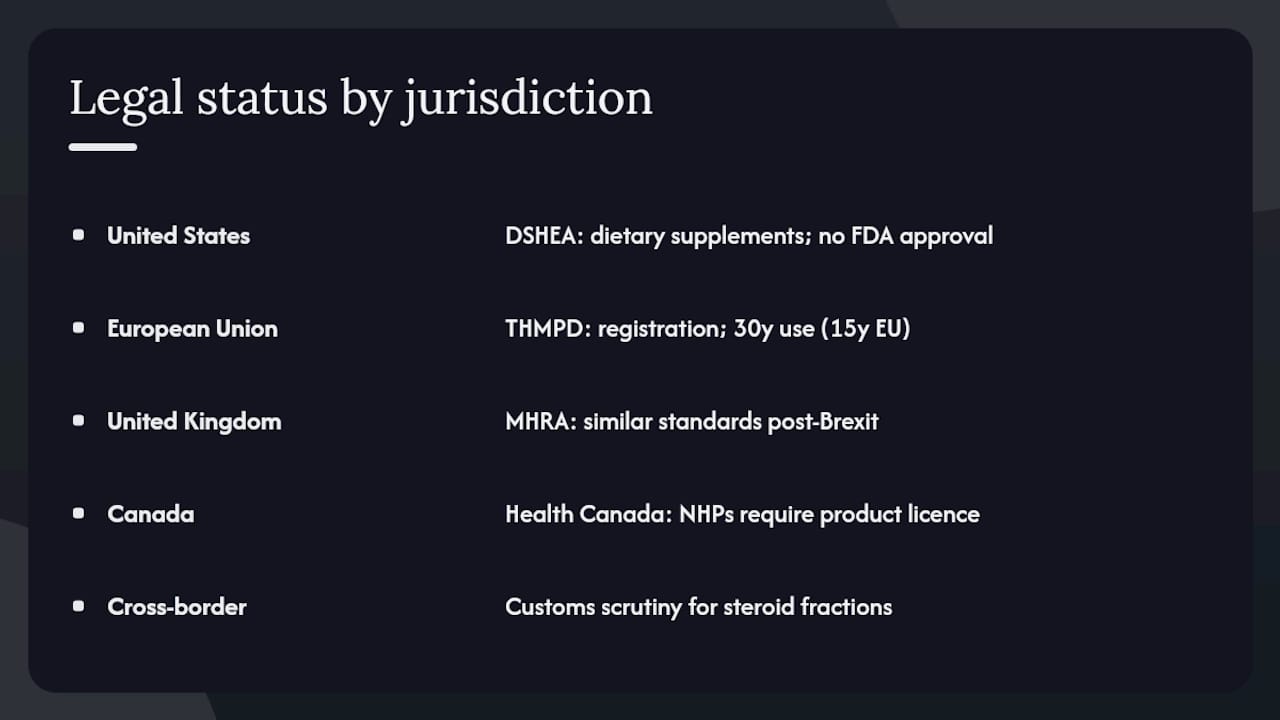
In the United States, phytoandrogen supplements are regulated as dietary supplements under DSHEA. They do not require pre-market approval from the FDA, but manufacturers must not claim to diagnose, treat, cure, or prevent any disease. Structure/function claims ("supports healthy testosterone levels") are permitted with a mandatory disclaimer.
The regulatory picture differs significantly outside the U.S. In the European Union, botanical supplements are governed by the Traditional Herbal Medicinal Products Directive (THMPD), which requires registration and documented traditional use for at least 30 years (15 of which within the EU). Several phytoandrogen-relevant botanicals, including Eucommia ulmoides, are not registered under THMPD and therefore cannot be legally sold as medicinal products in the EU. In the United Kingdom post-Brexit, the MHRA applies similar standards. Canada classifies many botanical supplements as Natural Health Products under Health Canada, requiring a product license before sale.
Import and export of phytoandrogen supplements across borders can trigger customs scrutiny, particularly for products containing concentrated plant steroid fractions. Travelers and online buyers should verify the legal status of specific botanicals in their destination country before purchasing internationally. This is general regulatory information; confirm current rules with the relevant national authority or a qualified regulatory professional.
The Viridos approach to phytoandrogenic precision
What separates a credible phytoandrogen product from a generic capsule is the decision-making behind formulation. At Viridos, that means starting with extraction. We use a solvent-free process designed to preserve the lipidic fractions that tripartite synergism research identifies as critical for receptor potentiation. Standardizing only the steroid fraction while discarding the lipid matrix would undermine the very mechanism the science supports.
Small-batch production in Sweden allows us to maintain batch-specific certificates of analysis and third-party testing for every production run. That is not a marketing claim; it is a quality-control requirement we built into the model from the start. The membership structure exists for the same reason: controlled distribution means we can stand behind every unit that leaves our facility. We do not sell through mass retail channels because volume and quality control are in tension at scale.
Viridos membership: a monitored, premium option
For men who have done the baseline work, consulted a clinician, and want a precision-formulated option rather than a generic supplement, Viridos offers a controlled-access membership built around its sublingual phytoandrogen spray.

The product is not a drug. Individual results vary, and Viridos does not make medical claims. It is a premium botanical formulation designed for men who take their performance seriously and want a quality-controlled, clinician-compatible option. The membership page details the application process, production standards, and what controlled access means in practice. If you are ready to move from research to a structured, monitored trial, that is the place to start.