
TL;DR:
- Supplements are used to correct specific deficiencies and support vital biological functions. Targeted micronutrient supplements only work when a deficiency is measured and addressed through testing. Proper supplementation relies on lifestyle foundation and quality formulations, with retesting to ensure effectiveness over time.
Supplements are defined as concentrated nutrients or bioactive compounds taken to address specific physiological gaps that diet alone fails to fill. The role of supplements for vitality is not to replace food or lifestyle discipline. It is to correct documented deficiencies and support the biological systems, including energy metabolism, immune function, and muscle maintenance, that determine how well you perform over time. Over 1 billion people worldwide have vitamin D deficiency, and an estimated 1.62 billion suffer from iron deficiency anemia. Those numbers tell you that nutrient gaps are not rare edge cases. They are the norm, and they carry a direct cost to your output and resilience.
What supplements have evidence-based roles in vitality?
The standard industry term for this category is targeted micronutrient supplementation. Not every supplement earns that label. The ones that do share one trait: they correct a specific, measurable deficiency and produce a measurable result.
B-complex vitamins and cellular energy
B vitamins are the most cited supplements for energy, and the most misunderstood. B vitamins only increase energy in people who are functionally deficient. A well-nourished man with normal B12 and folate levels will not feel sharper after adding a B-complex. The benefit is real, but it is conditional. Men over 50 absorb B12 less efficiently due to reduced stomach acid, making this one of the few cases where supplementation is broadly warranted without waiting for symptoms.
Vitamin D and immune resilience
Vitamin D functions as a hormone, not just a bone nutrient. It regulates immune response, modulates inflammation, and supports testosterone synthesis. Most men working indoors in northern latitudes are deficient by october and remain so through march. A blood test measuring 25-hydroxyvitamin D is the only way to know your actual status. Correcting a deficiency here produces real gains in energy, mood stability, and resistance to illness.
Iron and oxygen transport
Iron is the mineral most directly tied to fatigue. It is the core component of hemoglobin, which carries oxygen to every working muscle and organ. Iron deficiency anemia affects 1.62 billion people globally. That scale of impact means fatigue attributed to stress or aging is often, in fact, a correctable iron problem. Testing serum ferritin, not just hemoglobin, gives a more accurate picture of iron stores.
Protein, collagen, and muscle preservation
Protein and collagen supplementation combined with resistance training consistently improve muscle mass and physical function in aging adults. Muscle mass is the single strongest predictor of metabolic health and physical independence past 50. Collagen peptides, specifically hydrolyzed forms, show particular benefit for joint integrity and connective tissue repair. This matters for men who train hard and want to stay in the game long term.
NAD+ precursors and mitochondrial function
Nicotinamide riboside (NR) is one of the more credible emerging compounds in this space. NR increased NAD+ levels and improved mitochondrial and cardiovascular markers in older adults. NAD+ is the coenzyme that powers cellular energy production. Its decline with age is well documented. Supplementing with NR or its precursor NMN represents a targeted intervention at the mitochondrial level, not a vague "energy boost."
- Vitamin D: Correct deficiency to support immune function, mood, and testosterone regulation
- B12 and methylated B-complex: Address absorption decline in men over 50
- Iron (as ferritin): Rule out deficiency before attributing fatigue to lifestyle factors
- Protein and collagen peptides: Support muscle mass and joint integrity with resistance training
- NAD+ precursors (NR/NMN): Target mitochondrial decline in men over 45
Pro Tip: Get a full micronutrient panel, including serum ferritin, 25-hydroxyvitamin D, and B12, before spending money on any supplement. You cannot correct what you have not measured.
How do supplements interact with lifestyle to amplify results?
Supplements function as multipliers. They amplify the return on habits you have already built. Without those habits, most supplements produce negligible benefit. Supplements complement but do not replace foundational lifestyle habits for vitality. That sentence should be the first thing you read on any supplement label.
The interaction between lifestyle and supplementation follows a clear logic:
- Resistance training activates protein synthesis. Protein and collagen supplements then provide the raw material that training demands. Without the training stimulus, the extra protein is simply metabolized for energy.
- Sleep drives mitochondrial repair. NAD+ precursors support mitochondrial function, but that function is rebuilt during deep sleep. Supplementing without prioritizing sleep is like fueling a car with a broken engine.
- A whole-food diet sets the baseline. Supplements fill gaps. If your diet is already rich in leafy greens, fatty fish, and quality animal protein, your gap list is short. If it is not, your supplement list will be long and still insufficient.
- Stress management determines cortisol. Chronically elevated cortisol depletes magnesium, disrupts B vitamin metabolism, and suppresses testosterone. No supplement corrects a stress load that lifestyle has not addressed.
The risk of ignoring this hierarchy is real. Excess fat-soluble vitamins or minerals can cause toxicity or block absorption of other nutrients. Vitamin A toxicity, for example, is not theoretical. It occurs in men who stack multiple supplements without tracking cumulative intake.
Pro Tip: Before adding any supplement, audit your nutrition and performance habits first. The return on fixing sleep and diet almost always exceeds the return on adding another capsule.
What are the limitations and misconceptions about supplements?
The supplement industry generates significant revenue by conflating energy marketing with nutritional science. Marketing often conflates energy boosts with genuine nutritional correction. The distinction matters because a supplement that does nothing for a replete individual is not harmless. It costs money, creates false confidence, and may displace attention from actual deficiencies.
The most common misconceptions worth correcting:
- "More is better." Fat-soluble vitamins (A, D, E, K) accumulate in tissue. Excess vitamin D raises calcium levels and can impair kidney function. Excess zinc blocks copper absorption. Dose matters as much as choice.
- Multivitamins prevent disease. Regular multivitamin use does not reduce risk for heart disease or cognitive decline. It is associated with a modest reduction in some cancer risks, but it is not a substitute for targeted correction of specific deficiencies.
- "Natural" means safe. Herbal supplements for wellbeing, including ashwagandha, rhodiola, and ginseng, interact with medications and carry dose-dependent risks. Natural origin does not equal unrestricted use.
- All supplements are equivalent. Formulation quality varies widely. A cheap magnesium oxide supplement delivers a fraction of the elemental magnesium of magnesium glycinate at the same dose. Bioavailability is the metric that matters, not milligrams on the label.
- Vitality is a supplement outcome. Vitality is a multifactorial concept involving mitochondrial efficiency, inflammation control, and muscle resilience. No single supplement produces it. A protocol does.
The men most at risk from these misconceptions are not uninformed. They are high-functioning professionals who apply the same "more input, more output" logic to supplementation that works in business. Biology does not respond to that model.
How to approach supplementation strategically for long-term vitality?
A systematic clinical protocol involves four steps: identify goals, test biomarkers, implement targeted supplementation, and monitor outcomes. That sequence is not optional. It is the difference between spending money on precision health and spending money on expensive urine.
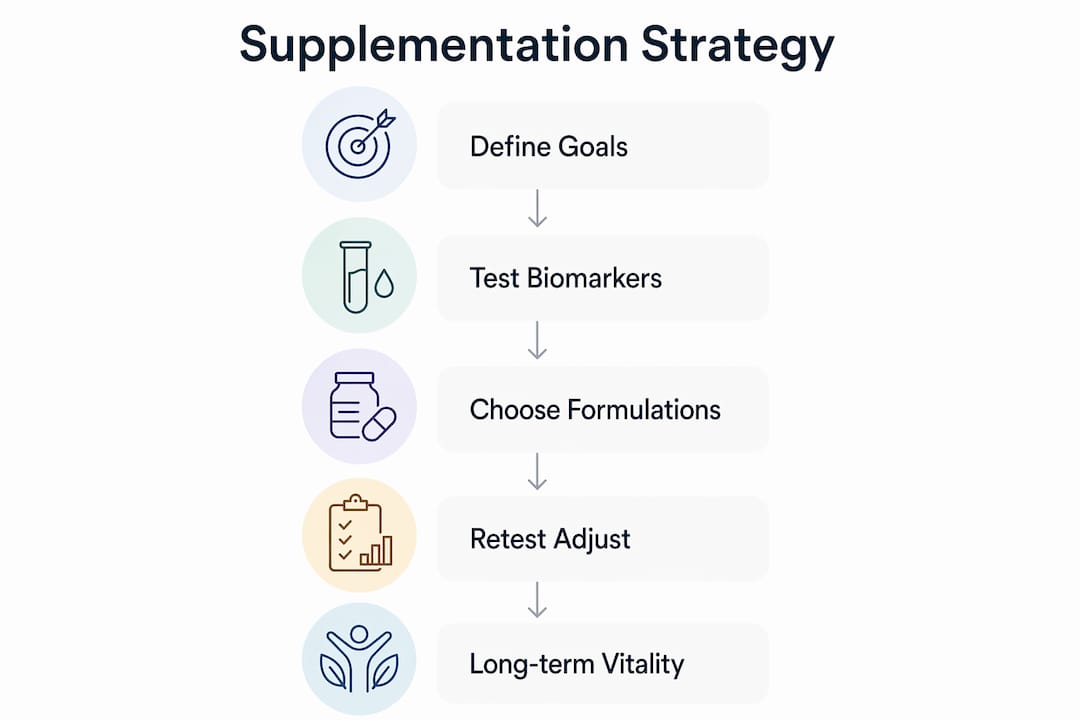
Step 1: Define your goals
Are you addressing fatigue, supporting muscle preservation, improving sleep quality, or maintaining cognitive sharpness? Each goal maps to a different set of biomarkers and a different supplement protocol. Clarity here prevents the scatter-shot approach that most men default to.
Step 2: Test before you supplement
A baseline panel should include serum ferritin, 25-hydroxyvitamin D, B12, homocysteine, testosterone, and a complete metabolic panel. This is not excessive. It is the minimum needed to make an informed decision. Bioavailability and supplement form significantly affect efficacy, and older adults in particular may require methylated B12 or peptide proteins for optimal absorption.
Step 3: Choose clinical-grade formulations

Not all products meet the same standard. When identifying a sophisticated supplement brand, look for third-party testing, transparent ingredient sourcing, and bioavailable forms of key nutrients. Sublingual delivery, which bypasses first-pass liver metabolism, offers superior absorption for compounds like B12 and certain hormonal precursors.
Step 4: Retest and adjust
Supplementation is not a set-and-forget decision. Retest the same biomarkers at 90–120 days. Adjust dose or form based on results. This is what separates a disciplined protocol from a habit built on hope.
| Scenario | Supplement priority |
|---|---|
| Vitamin D below 30 ng/mL | Vitamin D3 with K2, 2,000–5,000 IU daily |
| Fatigue with low serum ferritin | Iron bisglycinate with vitamin C |
| Vegetarian or vegan diet | Methylated B12 and algae-sourced omega-3 |
| Men over 45 with low energy | NAD+ precursor (NR or NMN) |
| Active men with joint stress | Hydrolyzed collagen peptides with vitamin C |
Key Takeaways
Targeted supplementation corrects specific deficiencies and amplifies lifestyle habits; without testing and a disciplined foundation, most supplements produce no meaningful benefit.
| Point | Details |
|---|---|
| Test before supplementing | A baseline biomarker panel prevents wasted spend and avoids toxicity risk. |
| Supplements multiply habits | Diet, resistance training, and sleep must be in place for supplements to work. |
| Formulation quality matters | Choose bioavailable forms like methylated B12 and hydrolyzed collagen for real absorption. |
| Multivitamins have limits | They do not reduce heart disease or cognitive decline risk in healthy adults. |
| Retest at 90–120 days | Adjust dose and form based on results, not on how you feel. |
What I have learned from watching men supplement wrong
by Joakim
The men I respect most in this space share one trait: they treat supplements the way they treat financial decisions. They gather data first, then act. The men who struggle are the ones who buy based on marketing language and stack products without a baseline.
The uncomfortable truth is that most of the supplement industry profits from the gap between what people hope a product will do and what it actually does in the absence of a deficiency. I have seen executives spend thousands annually on premium stacks while their vitamin D sits at 18 ng/mL and their ferritin is borderline. Fix those two things and the fatigue they attributed to stress often resolves within eight weeks.
What I find genuinely compelling about the vitality strategies for men 40–65 that actually work is their simplicity. A short, tested, high-quality protocol outperforms a long, untested, marketing-driven one every time. Swedish small-batch production and sublingual delivery are not marketing language to me. They are the difference between a product that reaches the bloodstream and one that does not.
The discipline required to supplement well is the same discipline that makes a man effective in any other domain. Define the problem. Measure it. Apply the right tool. Check the result.
— Joakim
Viridos: built for men who supplement with precision
Men who perform at a high level for decades do not leave their health inputs to chance. Viridos is a Swedish performance brand built on that same logic: small-batch production, clinical-grade formulations, and sublingual delivery that maximizes absorption where it counts.

The Viridos Performance Journal gives you a structured way to track biomarker baselines, supplement protocols, and results over time. It is the tool that turns supplementation from a habit into a measurable practice. Viridos products are produced in Sweden under strict quality controls, and the formulations reflect the same precision that disciplined men apply to every other area of their performance. If you want to understand what that production standard means in practice, the Swedish production process is worth reviewing.
FAQ
What is the primary role of supplements for vitality?
Supplements correct specific nutrient deficiencies that impair energy metabolism, immune function, and muscle maintenance. They do not replace diet or lifestyle but amplify the return on those foundations when deficiencies are present.
Which vitamins are most important for energy and stamina?
Vitamin D, B12, and iron are the three nutrients most directly linked to fatigue and low stamina. B vitamins only improve energy in people who are functionally deficient, so testing before supplementing is the correct first step.
Do multivitamins improve vitality in healthy adults?
Regular multivitamin use does not reduce risk for heart disease or cognitive decline in healthy adults. Targeted supplementation based on confirmed deficiencies produces better outcomes than a broad-spectrum multivitamin.
How do I know which supplements I actually need?
A baseline blood panel measuring serum ferritin, 25-hydroxyvitamin D, B12, homocysteine, and testosterone identifies your actual gaps. Supplementing without this data is guesswork that carries real toxicity risk.
How long does it take for supplements to improve vitality?
Most targeted interventions show measurable results within 90–120 days when the correct deficiency is addressed. Retesting biomarkers at that interval confirms whether the dose and form are working.