A reliable hormone lab delivers clinically accurate panels, clear reference ranges, and nationwide access to blood draws — without requiring you to navigate a physician referral first. For most performance-focused men, three practical routes cover the full spectrum of need:
- Direct-to-consumer platforms (Labcorp OnDemand, WalkInLab, Accesa Labs) that partner with national draw networks and return digital results in days
- Physician-ordered testing through national labs (Quest Diagnostics, Labcorp) when insurance billing or clinical oversight is the priority
- Specialty endocrine reference labs for complex cases requiring LC-MS/MS mass spectrometry and expert interpretation
For a man in his 40s or 50s running a baseline performance check, a direct-access platform using a national draw network is the fastest, most cost-effective starting point. If results are ambiguous or low-level steroid measurements are needed, escalate to a specialty endocrine lab that explicitly lists mass-spectrometry methods.
Table of Contents
- Which hormone lab options are worth comparing?
- What does a standard hormone panel actually measure?
- What sample type and timing give you accurate results?
- What does hormone testing cost, and how long does it take?
- How to read your results and what to do next
- Why assay methodology determines whether your results are trustworthy
- Key Takeaways
- The case for measuring before you optimize
- Viridos membership as a complement to lab-based monitoring
- Useful sources
Which hormone lab options are worth comparing?
The three providers the market consistently surfaces — Labcorp OnDemand, Quest consumer options, and WalkInLab — each represent a distinct service model. The table below maps them by the criteria that matter most for an executive making a quick, informed decision.
| Feature | Large national lab (direct-access) | National lab (physician/telehealth) | DTC aggregator |
|---|---|---|---|
| Representative provider | Labcorp OnDemand | Quest Diagnostics | WalkInLab |
| Sample types | Venous blood draw | Venous blood draw | Venous blood draw |
| Panel breadth | Broad; sex hormones, thyroid, adrenal, reproductive | Extensive; specialty assays available | Curated consumer panels |
| Price shape | Mid | Mid–high (insurance may apply) | Low–mid |
| Turnaround | 3–5 business days | 3–5 business days; longer for specialty | 3–5 business days |
| Physician order required | No | Often yes; telehealth consults available | No |
| Draw-site access | Nationwide network | Nationwide network | Partners with national networks |
| Interpretation support | Basic digital report | Clinician-linked; annotated for complex cases | Basic; optional consult |
Labcorp OnDemand lets you order online and draw at thousands of patient service centers across the country. The hormone testing menu covers sex hormones, thyroid function, adrenal markers, and reproductive panels — a solid breadth for a first workup. The limitation: standard consumer reports are functional but lean on self-interpretation.
Quest Diagnostics operates one of the most extensive endocrine test menus in the U.S., with mass-spectrometry methods available for diagnostically complex cases. Physician or telehealth ordering is typically required, which adds a step but also adds clinical oversight and potential insurance billing.
WalkInLab publishes transparent consumer hormone panels with listed analytes and ordering FAQs — useful for men who want to know exactly what they are buying before they commit. Pricing tends to be competitive, and the ordering process is straightforward.
What does a standard hormone panel actually measure?
A well-constructed panel covers four interconnected axes: sex hormones, thyroid function, adrenal output, and reproductive signaling. Labcorp's hormone testing documentation reflects this structure, grouping markers by clinical question rather than alphabetically.
Core markers in most standard panels:
- TSH, free T4, free T3 — the thyroid axis; TSH alone misses conversion issues
Specialty and add-on assays worth knowing: pregnenolone (upstream adrenal precursor), 17-OH progesterone (adrenal steroidogenesis pathway), insulin and HbA1c (metabolic context), and luteal-phase progesterone timing for women.
For male performance optimization, the markers that carry the most signal are testosterone and its downstream effects — specifically free testosterone, SHBG, estradiol, and cortisol. These four together tell a more complete story than total testosterone alone.
What sample type and timing give you accurate results?
Specimen type and collection timing affect result validity as much as the lab's equipment does. Getting this wrong produces numbers that look abnormal when the biology is fine.
Specimen types and their appropriate uses:
- Venous blood draw (serum): — The clinical gold standard for sex hormones, thyroid markers, and most endocrine panels. Requires a draw site or phlebotomist.
Timing rules that protect result accuracy:
| Test | Recommended timing | Key prep notes |
|---|---|---|
| Total/free testosterone | Morning (7–10 AM) | Fasting preferred; avoid intense exercise the prior day |
| Cortisol (serum) | Morning draw | No corticosteroid use shortly before |
| TSH/thyroid panel | Morning | Consistent time if tracking trends |
| Estradiol/progesterone (women) | Cycle day 3 (follicular) or mid-luteal phase | Confirm with ordering clinician |
| FSH/LH | Cycle day 2–4 for women | Stable timing for men |
| DHEA-S | Morning | Minimal variation; fasting not required |
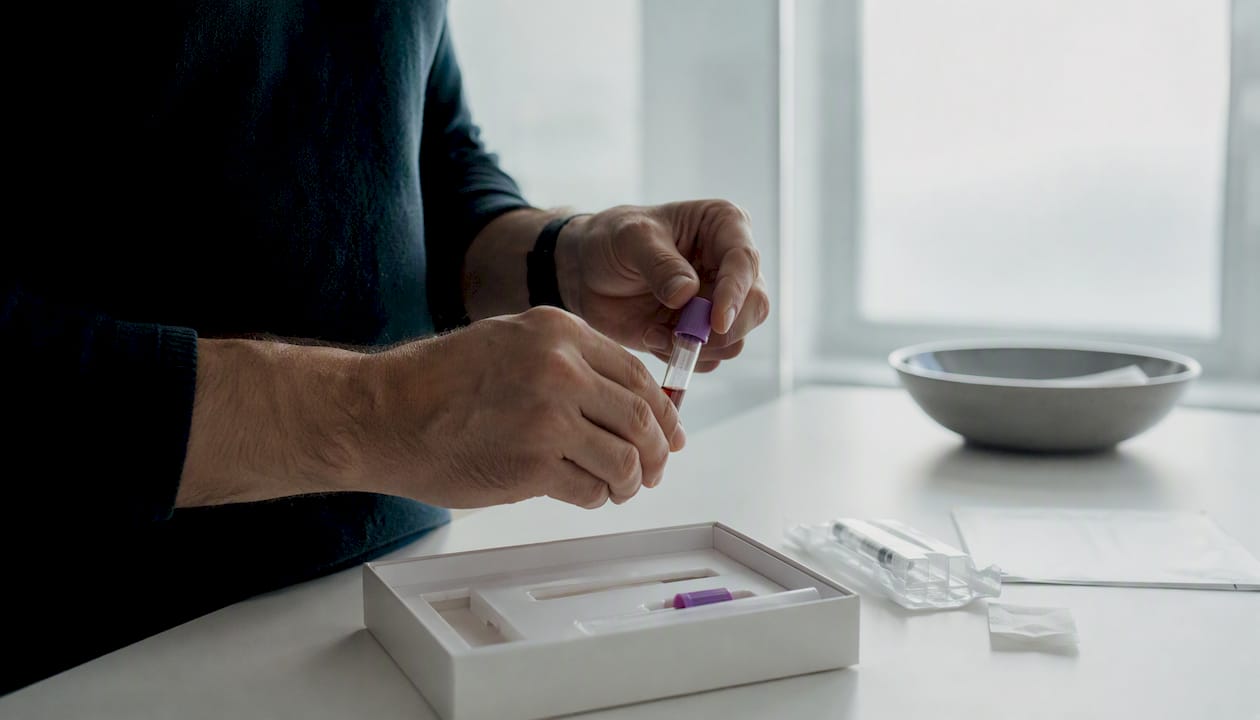
Testosterone follows a diurnal rhythm, peaking in the early morning and declining through the afternoon. Afternoon draws can read substantially lower than morning draws in the same individual — which is why morning timing is important for a valid baseline.
Most national lab networks (Labcorp, Quest) operate patient service centers with early morning hours. Direct-access platforms like Accesa Labs partner with these networks, so the draw logistics are the same regardless of which consumer platform you order through.
What does hormone testing cost, and how long does it take?
Direct-to-consumer hormone panels start at a competitive price for a basic baseline evaluation, with results typically returned within a few business days. More comprehensive or specialty assays — particularly those using mass spectrometry — run higher and may extend turnaround time.
Practical cost and access breakdown:
- Basic DTC panel (testosterone, TSH, basic sex hormones): Starting around $99 out-of-pocket; no physician order needed
- Comprehensive performance panel (full sex hormone axis, thyroid, adrenal, metabolic markers): Typically $200–$400 depending on the platform and add-ons
- Specialty mass-spec assays or advanced endocrine workup: Higher cost; often requires physician or telehealth order; turnaround may extend to 7–10 business days for confirmatory tests
- Physician-ordered through insurance: Cost varies by plan; deductibles and co-pays apply; may require a diagnosis code
Cost callout: A performance-focused initial panel covering testosterone (total and free), SHBG, estradiol, TSH, cortisol, and DHEA-S typically falls in the $150–$300 range on direct-access platforms. An advanced endocrine workup adding FSH, LH, free T3/T4, and specialty metabolites will sit higher. Neither figure includes clinician consult fees if added separately.
Access models:
- Order online, draw at a national patient service center (most DTC platforms)
- Telehealth consult that orders labs and interprets results (adds clinical oversight)
- Physician-ordered through your primary care provider or endocrinologist (insurance-eligible)
- Home-collection kits for saliva or dried urine panels (specialty labs only)
Insurance rarely covers DTC-ordered tests. Physician-ordered panels for documented symptoms or diagnoses are more likely to qualify for coverage, though prior authorization requirements vary by plan.
How to read your results and what to do next
A lab report delivers numeric values alongside reference ranges. Understanding what those numbers mean in context requires more than comparing your result to the printed range.
- Review medications and supplements — Biotin supplementation, corticosteroids, thyroid medications, and several other compounds interfere with immunoassay results. Note anything you took in the 48 hours before the draw.
- Flag out-of-range values for clinician review. A single out-of-range result is not a diagnosis. Mayo Clinic Laboratories emphasizes panel-based interpretation — viewing interrelated markers together — rather than acting on isolated numbers.
- Establish a retesting cadence. A single snapshot has limited value. Baseline, post-intervention, and seasonal checks (see the self-optimization guide) build the longitudinal data that actually drives informed decisions.
High-quality labs — including Labcorp's specialty endocrinology division — provide annotated reports and clinician consult options precisely because raw numbers without context produce more anxiety than insight.
Why assay methodology determines whether your results are trustworthy
Not all hormone measurements are created equal. The method a lab uses to quantify testosterone or estradiol directly affects whether a low or borderline result reflects your biology or a limitation of the assay.
LC-MS/MS vs. immunoassay — the practical difference:
The CDC Hormones Reference Laboratory uses LC-MS/MS reference measurement procedures for total testosterone and estradiol — these reference methods underpin the traceability and calibration standards that well-run clinical labs are expected to align with. Quest Diagnostics explicitly offers mass-spectrometry methods for diagnostically complex endocrine cases, and Labcorp's specialty testing division uses LC-MS/MS for steroid hormone panels requiring high specificity.
When each method is appropriate:
- Immunoassay: — Sufficient for initial screening, general monitoring at mid-range values, and thyroid panels (TSH, free T4)
One practical advantage of specialty labs: some store serum specimens for up to 60 days, allowing add-on testing from the original draw. That means if your initial panel raises a question about adrenal steroidogenesis, a follow-up assay can often be run without a second blood draw.
Key Takeaways
Choosing the right hormone evaluation laboratory comes down to accreditation, assay methodology, and whether the reporting model supports clinical interpretation — not just the lowest price.
| Point | Details |
|---|---|
| Prioritize CLIA/CAP accreditation | Only use labs that publicly list CLIA certification and CAP accreditation as a baseline quality standard. |
| Match assay method to your need | Use LC-MS/MS for low-level or borderline steroid results; immunoassay is sufficient for general screening. |
| Time your draw correctly | Testosterone must be drawn between 7–10 AM; afternoon draws can read 20–30% lower in the same individual. |
| Start with a DTC panel | Direct-access platforms starting around $99 provide a fast, accessible baseline without a physician referral. |
| Viridos membership complements testing | Viridos pairs a measurement-driven cadence with a precision plant-derived performance supplement for men who act on their data. |
The case for measuring before you optimize
Most men in demanding roles reach their mid-40s running on pattern recognition — they know something has shifted, but they are working from intuition rather than data. That gap between felt experience and measured reality is where poor decisions accumulate.
Hormone testing is not a destination. A single panel tells you where you stand on one morning in one season of your life. What it cannot tell you is trajectory. The men who extract the most value from endocrine testing are the ones who treat it as a recurring input — baseline, post-intervention, seasonal check — and who resist the temptation to act on a single data point without clinical context.
There is also a tendency in performance circles to fixate on total testosterone as the primary signal. It is not. Free testosterone, SHBG, estradiol, and cortisol together describe the hormonal environment your tissues actually operate in. A man with total testosterone at 650 ng/dL and SHBG at 70 nmol/L has far less biologically available androgen than his total number suggests. That distinction matters when you are deciding whether a behavioral intervention, a clinical consult, or a supplementation protocol is the appropriate next step.
The discipline is in the measurement cadence and the willingness to act on what the data shows — not in chasing a number.
Viridos membership as a complement to lab-based monitoring
Lab testing tells you where your hormones stand. What you do with that information determines whether the data produces results or just sits in a portal.

Viridos is built for men who measure and then act. The membership pairs a precision plant-derived performance supplement — formulated in small batches in Sweden using proprietary phytoandrogen extraction — with a structured approach to performance monitoring. Where lab results identify a gap in drive, clarity, or metabolic resilience, Viridos provides a disciplined, clinically restrained protocol to support sustained output. No hype, no mass-market formulation, no generic advice.
For men pairing lab-based hormone monitoring with a performance-support program, the Viridos membership offers a controlled-access framework that complements the measurement cadence described throughout this article and how peptides support athlete recovery and joint health. Applications are reviewed individually; cohort sizes are limited by design.
If your baseline panel has raised questions about vitality, drive, or long-term performance longevity, review the Viridos membership criteria and apply.
Useful sources
- Hormones | Accesa Labs
- Hormone Testing | Labcorp OnDemand
- Hormone Check Blood Test Panel | Walk-In Lab
- Hormones Reference Laboratory | CDC
- Endocrinology | Mayo Clinic Laboratories
- Endocrine disorders | Quest Diagnostics
- Endocrinology | Specialty Testing | Laboratory Corporation of America