
TL;DR:
- Effective energy management relies on deliberate nutrition timing, regular movement, and personal energy tracking to optimize productivity. Building system-level habits, such as protecting peak work windows and reviewing medications, sustains high performance over time. Passive breaks like social media increase cognitive load, while real restorative activities enhance emotional and mental resilience.
Energy level management is the practice of deliberately regulating physical, mental, emotional, and spiritual resources to sustain high output across demanding workdays without relying on stimulants or willpower alone. For executives, founders, and high-responsibility professionals, this discipline separates consistent performers from those who cycle through bursts of productivity followed by exhaustion. Johns Hopkins Medicine, the Mayo Clinic, and Dr. Amy Shah at NPR have each published evidence-based frameworks that point to the same conclusion: stable, lasting energy comes from system-level habits, not from caffeine or shortcuts.
How to manage energy levels through nutrition
The most direct lever for daily energy is what you eat and when you eat it. Blood sugar spikes followed by rapid drops trigger cortisol surges and inflammation, producing the mid-afternoon crash that derails focus and decision-making. High-protein meals paired with healthy fats stabilize output far better than high-carbohydrate or sugary options. This is not a diet philosophy. It is basic metabolic physics.
Johns Hopkins recommends that raw fruits and vegetables make up at least 50% of each meal to support energy through hydration and nutrient density. Animal proteins take longer to digest and divert blood flow to the gut, which reduces cognitive sharpness for hours after a heavy meal. Nutrient-dense, high-fiber foods like avocados, walnuts, leafy greens, and legumes support gut health and provide slow-release fuel. Dr. Amy Shah specifically links gut-circadian alignment to sustained energy, arguing that syncing gut health with your body clock outperforms any stimulant strategy.
Eating windows matter as much as food choices. Stopping food intake three hours before bed and maintaining a 12-hour fasting window aligned with circadian rhythm improves energy metabolism and reduces the energetic burden of constant calorie processing. A 16:8 fasting schedule supports mitochondrial health, though it should be personalized with medical clearance. Two nutrients that executives frequently overlook are vitamin D and B12. Both are overlooked causes of chronic low energy, and deficiencies are common in men over 40 who spend most daylight hours indoors.
Key dietary habits that support stable energy throughout the day:
- Prioritize protein and fat at breakfast to prevent a mid-morning blood sugar drop
- Avoid processed meats, refined carbohydrates, and sugary drinks before high-focus work blocks
- Test vitamin D and B12 levels annually and supplement where deficient
- Stop eating at least three hours before sleep to protect sleep quality and morning energy
- Limit caffeine to the first half of the day to avoid disrupting sleep architecture
Pro Tip: If you experience a consistent energy dip between 2 and 4 p.m., audit your lunch composition before blaming your schedule. A high-carb midday meal is almost always the cause.
Does movement actually improve energy levels?
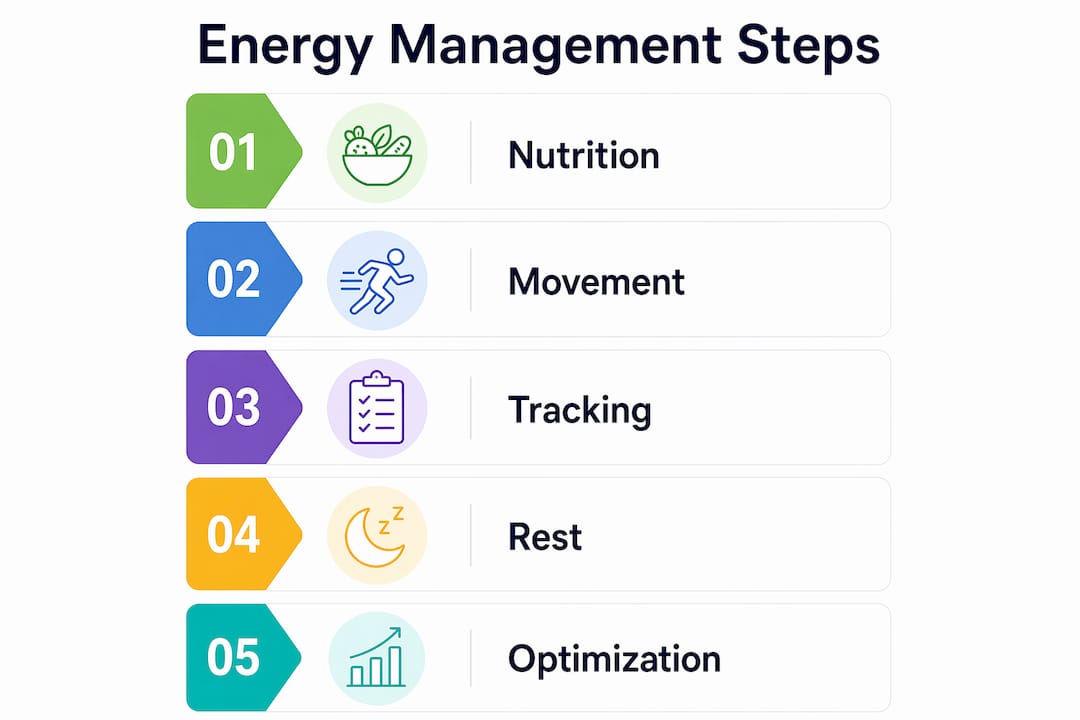
Movement is one of the most underutilized energy tools available to professionals, and the mechanism is straightforward. Brief, frequent movement breaks, such as five-minute walks every 90 minutes, prevent the energy dips that accumulate from prolonged sitting. They also regulate blood flow to the brain, which directly supports sustained concentration. The compounding effect of four or five short walks across a workday is measurably greater than a single 30-minute gym session in terms of cognitive energy maintenance.

Early morning sunlight is equally important. Morning sunlight exposure resets the circadian clock, suppresses residual melatonin, and elevates cortisol at the biologically correct time, which is early morning rather than mid-afternoon. Ten to fifteen minutes of outdoor light before 9 a.m. produces a measurable shift in alertness that no supplement fully replicates. This is one of the simplest, zero-cost ways to boost energy naturally, yet most executives skip it entirely.
Hydration is the third pillar of physical energy that professionals consistently underestimate. Mild dehydration causes fatigue, and the Mayo Clinic notes that thirst is not a reliable early indicator, particularly in men over 40. By the time you feel thirsty, cognitive performance has already declined. A practical framework for staying ahead of dehydration:
- Drink 500ml of water within 30 minutes of waking, before coffee
- Keep a 1-liter bottle visible on your desk and finish it before lunch
- Drink a second liter across the afternoon, finishing by 6 p.m. to protect sleep
- Add electrolytes if you exercise, travel frequently, or work in air-conditioned environments
Pro Tip: For professionals with joint discomfort who find walking difficult, a rebounder (mini trampoline) provides low-impact lymphatic stimulation and circulation benefits in under five minutes. It is a legitimate alternative, not a gimmick.
What drains mental and emotional energy at work?
Physical energy is the foundation, but mental and emotional energy determine whether you perform at your ceiling or well below it. Managing energy requires balancing physical, emotional, mental, and spiritual dimensions, each with its own investment and recovery cycle. Executives who treat energy as purely physical miss the primary source of their fatigue.
Decision fatigue is one of the most significant and least discussed drains on cognitive energy. Every choice, regardless of its importance, draws from the same finite pool of mental resources. Minimizing low-stakes decisions through routines, templates, and delegation preserves that capacity for work that actually requires judgment. Information overload compounds this: constant notifications, unstructured meetings, and reactive email habits fragment attention and accelerate mental depletion faster than almost any physical demand.
Emotional energy follows a different pattern. Positive social interactions and recreational hobbies replenish emotional reserves and build resilience against fatigue. Journaling, time in nature, and genuine connection with people you respect are not soft productivity habits. They are recovery mechanisms with measurable effects on nervous system regulation and sustained output. Spiritual energy, meaning alignment between your daily work and your deeper purpose, determines whether effort feels generative or depleting. When the work you do reflects what you actually value, the same hours produce far less fatigue.
The distinction between real and fake breaks deserves direct attention:
- Real breaks: Walking outside, brief conversations with people you enjoy, five minutes of focused breathing, or a short creative task unrelated to work
- Fake breaks: Scrolling social media, checking news feeds, or passively watching short-form video content
Passive social media use increases energy depletion compared to active restorative breaks. The comparison and decision overload embedded in social feeds adds cognitive load rather than removing it. This is one of the most counterintuitive findings in energy research, and it has direct implications for how you structure your downtime.
"Energy, not time, is the fundamental currency of high performance." This principle, drawn from the work behind the LifeHack energy management framework, reframes the entire productivity conversation for executives who have already optimized their calendars but still feel depleted.
How to track and optimize your personal energy patterns
Generic advice about sleep and nutrition only takes you so far. The most effective approach to energy level management is building a personal map of when your energy peaks, when it drops, and what causes each. A 3-day energy tracking experiment, rating physical, mental, emotional, and spiritual energy every two hours, reveals individual cycles that no generalized framework can predict.
The process is straightforward. Set a recurring reminder every two hours across three representative workdays. Rate each energy dimension on a scale of one to ten and note what you were doing in the preceding period. After three days, patterns emerge clearly: your peak cognitive window, your reliable low-energy trough, and the specific activities or interactions that drain you most.
Use those findings to build an energy ROI matrix:
| Task type | Energy demand | Optimal timing |
|---|---|---|
| Strategic decisions and creative work | High mental | Peak window (typically 9 a.m. to noon) |
| Meetings and collaborative work | High emotional | Mid-morning or early afternoon |
| Administrative and routine tasks | Low cognitive | Post-lunch trough |
| Learning and reading | Moderate mental | Late afternoon recovery window |
Once you know your personal pattern, protect peak windows aggressively. Block them in your calendar before others fill them with meetings. Schedule demanding work there and administrative tasks in your low-energy periods. This single structural change produces more output than most productivity systems.
One additional optimization that professionals rarely consider: review medications every three to six months with your primary care physician. Medications for blood pressure, diabetes, depression, and allergies can sap energy as a side effect. Adjusting timing, dosage, or formulation sometimes resolves chronic fatigue that no lifestyle change has been able to address. For professionals over 40 managing multiple prescriptions, this review is not optional. It is part of the system.
Pro Tip: After completing your 3-day energy audit, share the results with your assistant or chief of staff. Protecting your peak windows only works if the people scheduling your time understand which hours are non-negotiable.
Key takeaways
Sustained energy for high-performing professionals depends on managing nutrition, movement, circadian alignment, mental load, and personal energy patterns as an integrated system rather than isolated habits.
| Point | Details |
|---|---|
| Nutrition timing matters | Stop eating three hours before bed and maintain a 12-hour fasting window to stabilize energy metabolism. |
| Movement breaks compound | Five-minute walks every 90 minutes prevent cognitive energy dips more effectively than a single long workout. |
| Fake breaks deplete energy | Passive social media use adds cognitive load. Real breaks involve movement, nature, or genuine social connection. |
| Track before you optimize | A 3-day energy audit across four dimensions reveals personal peak windows that no generic schedule can predict. |
| Medications are a hidden drain | Review prescriptions every three to six months to identify and address energy-depleting side effects. |
Energy management is a system, not a supplement
I have worked with and around high-performing men long enough to know that most energy problems are not deficiency problems. They are system problems. The executive who drinks four coffees a day and still crashes at 3 p.m. does not need a fifth coffee. He needs to look at what he ate at noon, how many decisions he made before 10 a.m., and whether his last three "breaks" were actually recovery or just a different form of screen time.
The shift that changes everything is moving from time management to energy management. You can have a perfectly structured calendar and still perform at 60% if your energy is misaligned with your schedule. I have seen founders with extraordinary discipline in their work habits completely neglect the physical and emotional inputs that determine whether that discipline produces results or just activity.
What I have found consistently is that the men who sustain high performance into their 50s and 60s are not the ones with the most willpower. They are the ones who have built systems that make recovery automatic. They protect their mornings, they eat with intention, they move briefly but frequently, and they have learned to recognize the difference between being busy and being effective. That recognition comes from tracking, not from guessing.
For professionals over 40, the strategies that sustain high energy daily are not complicated. They are just consistently applied. The gap between knowing and doing is where most men lose ground. Build the system first. The discipline follows.
— Joakim
Track your energy with precision
The 3-day energy audit described in this article is far more effective when you have a structured format to capture it. Viridos designed the Performance Journal specifically for executives and founders who want to track energy, protect peak performance windows, and build the kind of reflective practice that compounds over months and years. It is not a generic planner. It is a precision tool for men who take their output seriously.
Small-batch produced in Sweden, the Performance Journal integrates energy tracking, daily intention setting, and weekly review into a single premium format. If you are serious about executive energy management, this is where structured practice begins.
FAQ
What is the most effective way to manage energy levels daily?
The most effective approach combines nutrition timing, brief movement breaks, and personal energy tracking across physical, mental, emotional, and spiritual dimensions. Identifying your peak cognitive window through a 3-day audit and scheduling demanding work there produces more consistent output than any single habit change.
Why do I feel tired even after a full night of sleep?
Chronic fatigue despite adequate sleep often points to blood sugar instability, vitamin D or B12 deficiency, or medication side effects. Johns Hopkins recommends reviewing prescriptions every three to six months and testing key nutrient levels annually to identify hidden energy drains.
How does diet affect energy levels throughout the day?
High-carbohydrate and sugary meals cause blood sugar spikes followed by crashes, triggering cortisol surges that deplete focus and motivation. Meals built around protein, healthy fats, and fiber-rich vegetables stabilize energy output across the full workday.
Are short walks really enough to boost energy at work?
Five-minute walks every 90 minutes prevent the energy dips that accumulate from prolonged sitting and maintain blood flow to the brain. Johns Hopkins cites this pattern of brief, frequent movement as more effective for sustained cognitive energy than a single longer exercise session.
What counts as a real break for energy recovery?
Real breaks involve movement, time in nature, or genuine social connection. Passive activities like scrolling social media increase cognitive load and worsen energy depletion, making them counterproductive as recovery tools during a demanding workday.