
TL;DR:
- Most professionals treat energy as a fixed resource, often relying on caffeine and schedule tweaks instead of biological alignment. Aligning work to circadian and ultradian rhythms, maintaining balanced nutrition, and establishing sleep consistency can significantly boost sustained energy levels. Practicing micro-breaks, managing emotional drain, and tracking personal patterns are essential strategies for long-lasting performance and vitality.
Most professionals treat energy like a fixed resource. When it runs low, they reach for another coffee. When the 2 PM slump hits, they push through or blame their schedule. But sustained energy is not a willpower problem, and it is not solved by caffeine timing alone. It is the product of coordinating your biology: circadian rhythms, nutrition, recovery, and the emotional systems that quietly drain you before noon. This guide cuts through the noise to give you the science-backed framework that high-performing professionals aged 30 to 55 actually need to build long-lasting energy that holds through demanding days.
Table of Contents
- Key takeaways
- Sustained energy starts with your biology
- Nutrition and hydration for sustained performance energy
- Sleep and recovery as a strategic asset
- Daily practices that extend your performance window
- Understanding energy depletion traps
- My take on sustained energy in high-demand roles
- How Viridos supports your energy for the long term
- FAQ
Key takeaways
| Point | Details |
|---|---|
| Energy rhythms are biological | Aligning work to your ultradian and circadian cycles can increase output by 30 to 50%. |
| Nutrition stabilizes performance | Balanced macronutrients and consistent hydration prevent crashes more reliably than stimulants. |
| Sleep consistency beats sleep quantity | Keeping sleep and wake times within 15 to 30 minutes matters more than logging extra hours. |
| Micro-breaks compound over time | Short movement breaks every 45 to 60 minutes measurably protect focus and creative output. |
| Energy drains require active management | Identifying and delegating depleting tasks preserves the cognitive fuel that matters most. |
Sustained energy starts with your biology
Most executives manage time obsessively and ignore energy almost entirely. That is a fundamental error. Your brain and body do not operate on a flat performance curve. They operate on predictable biological waves, and fighting those waves is one of the fastest ways to accelerate burnout.
The circadian rhythm governs your 24-hour cycle of alertness, hormonal output, body temperature, and cognitive readiness. Peak alertness for most people falls between 9 AM and noon, with a secondary window in the late afternoon around 4 to 6 PM. Scheduling work by energy peaks can boost output by 30 to 50%, not because you are working longer, but because you are matching cognitive demands to biological readiness.
Nested inside the circadian rhythm are ultradian cycles, approximately 90 to 120 minutes of high-focus capacity followed by a natural dip. These are not signs of weakness. They are your brain signaling that it needs a brief recovery period before the next cycle begins. Ignoring those signals by forcing through with stimulants trains your system into a state of chronic low-grade exhaustion.
Here is how to start mapping your personal energy cycles:
- Track your alertness, focus quality, and mood every two hours for 7 to 14 days
- Note which tasks felt effortless and which required disproportionate effort
- Identify your two or three daily peak windows and your predictable troughs
- Restructure your calendar so that complex decisions, creative work, and high-stakes calls land in peak windows
Pro Tip: Reserve your 2 to 3 PM circadian trough for email, administrative work, and low-stakes tasks. Most professionals mistake the afternoon dip for personal weakness. It is not. It is biology, and working with it rather than against it is one of the most underused productivity moves available to you.
Nutrition and hydration for sustained performance energy
What you eat and when you eat it determines whether your energy holds or collapses between your peak windows. This is not about dieting. It is about fueling a system that runs at high load daily.
The foundation is macronutrient balance at every meal. Protein, healthy fats, fiber, and complex carbohydrates together produce a slow and steady glucose release that keeps blood sugar stable for hours. High-protein balanced meals within one hour of waking stabilize blood sugar and improve morning cognitive performance. A breakfast of eggs, avocado, and steel-cut oats will outperform a high-sugar smoothie every time, not just for physical energy but for sustained mental clarity.

The energy boosting foods most professionals overlook are not exotic. Oily fish, legumes, nuts, sweet potatoes, and dark leafy greens provide the micronutrients that support mitochondrial function, the actual mechanism of cellular energy production. These are your sustained energy sources at the molecular level.
Hydration deserves equal respect. At just a 2% loss in body mass from fluid deficit, cognitive function and endurance drop by 10 to 15%, often before you feel thirsty. Many professionals are running at partial cognitive capacity by mid-morning simply because they skipped their first liter of water.
Common fueling mistakes to eliminate immediately:
- Skipping breakfast or eating a carbohydrate-only meal that causes a mid-morning crash
- Eating a large, heavy lunch that pulls blood flow toward digestion and tanks afternoon focus
- Relying on coffee as a meal replacement in the early hours
- Going more than four to five hours without eating any protein or fat
Statistic: For endurance-focused activities, recommended carbohydrate intake ranges from 30 to 90g per hour depending on duration. The same principle applies to cognitive endurance. Your brain needs steady fuel, not feast-and-famine cycles.
Sleep and recovery as a strategic asset
Executives who optimize everything except sleep are building on a compromised foundation. Sleep is where energy systems reset, hormones balance, and the cognitive processing of the day gets consolidated.
The most important and least appreciated principle here is consistency over quantity. Keeping your sleep and wake times within 15 to 30 minutes across the week matters more than getting an extra hour on Sunday. Variability in sleep timing disrupts circadian alignment and compounds sleep debt faster than most people realize.
Circadian alignment itself depends on light exposure. Morning sunlight within 30 minutes of waking, ideally ten minutes outdoors, anchors your cortisol and melatonin rhythms for the entire day. Temperature also matters. A cooler sleep environment, between 65 and 68 degrees Fahrenheit, supports the drop in core body temperature that triggers deep sleep entry. Aerobic exercise increases slow-wave sleep by 10 to 15% and shortens the time it takes to fall asleep, making it one of the highest-return investments for daytime energy.
Caffeine timing is where most people quietly sabotage their sleep architecture. Consuming coffee within the first 60 minutes of waking suppresses the natural cortisol surge that should provide your morning alertness. Delaying your first cup by 90 to 120 minutes after waking produces smoother, more sustained alertness without the mid-morning crash. Cutting caffeine intake by 2 PM protects the adenosine clearance your brain needs for quality sleep.
Pro Tip: Track your sleep variance for two weeks using a simple spreadsheet. Most executives discover their weekday versus weekend timing drift exceeds 90 minutes, which is enough to measurably impair energy and cognition throughout the following week.
Daily practices that extend your performance window
Once your rhythms, nutrition, and sleep are structured, the next layer is within-day tactics that protect and extend your energy rather than spending it down.
-
Work in 90-minute focus blocks. Set a clear start and end time. When the block closes, stop and take a real break, not a scroll. Physical movement, a short walk, or even lying down for five minutes allows your prefrontal cortex to recover before the next cycle.
-
Move every 45 to 60 minutes. Movement micro-breaks increase focus and creativity by up to 60%. This is not gym time. It is standing, stretching, walking to the window, or doing a set of bodyweight movements. The metabolic reset is fast and measurable.
-
Use breathwork for state changes. Box breathing and the Wim Hof method can shift your physiological state from depleted to alert within two to five minutes. Four counts in, four counts hold, four counts out, four counts hold. Do this before a critical meeting or when you feel your focus slipping.
-
Consider targeted supplementation carefully. Magnesium glycinate supports sleep depth and nervous system recovery. Adaptogens like ashwagandha and rhodiola have credible evidence for reducing cortisol and supporting energy for endurance under chronic stress. A combination of low-dose caffeine and L-theanine provides cleaner focus than caffeine alone, without the jitteriness. None of these replace the fundamentals, but for professionals running demanding systems daily, they can sharpen what an already strong base produces.
Pro Tip: The L-theanine and caffeine combination at roughly a 2:1 ratio has strong evidence for improved attention without overstimulation. It is the cleaner alternative to a second or third espresso.
Understanding energy depletion traps
There is a concept in sports science called Relative Energy Deficiency. It describes what happens when caloric intake chronically fails to match energy expenditure. Most people associate it with endurance athletes. It applies equally to executives running at maximum cognitive load on undersized caloric intake. RED-S affects busy professionals, not just athletes, leading to fatigue, impaired recovery, and eventually motivation loss.
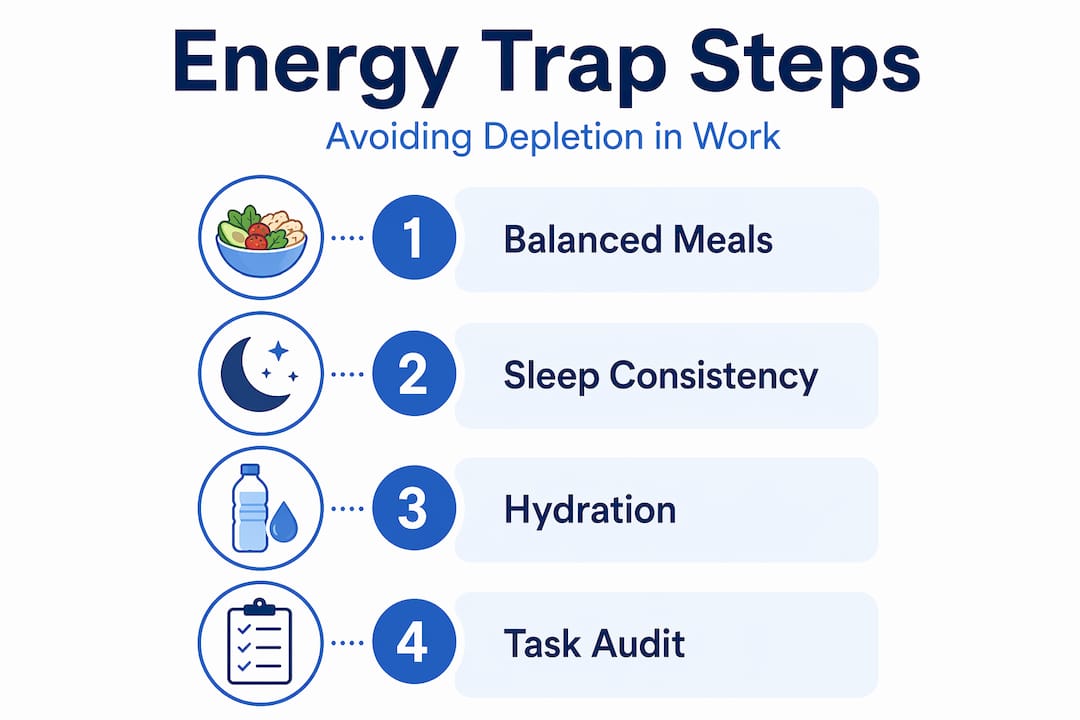
The challenge is that the signs are gradual. You do not collapse. You simply perform slightly worse each week while telling yourself you are just tired.
| Warning sign | Likely cause |
|---|---|
| Persistent fatigue despite adequate sleep | Caloric deficit or poor macronutrient balance |
| Declining motivation and initiative | Emotional energy drain or cortisol dysregulation |
| Slower recovery after workouts | Underfueling or inadequate protein intake |
| Increased irritability and decision fatigue | Sleep inconsistency or sustained cognitive overload |
| Frequent illness or low immune resilience | Chronic stress combined with nutritional gaps |
Emotional energy is as real as physical energy, and it gets ignored almost universally in executive wellness conversations. Psychological safety, the quality of your relationships at work and at home, and your sense of autonomy over your time all draw from the same reservoir as cognitive performance. True energy management coordinates metabolic, hormonal, and emotional systems rather than addressing nutrition and sleep in isolation.
The practical move is an audit. List every recurring task or interaction that consistently leaves you drained. Not tired in a productive way. Drained. Then ask which of those you can eliminate, delegate, or restructure. For professionals over 40, this is often the most impactful single intervention available. You can find more strategies specifically calibrated for this age group in this guide for professionals over 40.
My take on sustained energy in high-demand roles
I have spent years watching highly capable professionals run optimization programs on their schedules, their tools, and their teams while completely neglecting the biological system that makes all of it possible. In my experience, the moment someone shifts from time management to energy management, their entire relationship with productivity changes.
What I have found is that circadian and ultradian alignment is not a biohacker's experiment. It is the most reliable and underused advantage available to any serious executive. Knowing that your best thinking happens between 9 AM and 11 AM and protecting that window ruthlessly is worth more than any productivity app.
On supplementation: I am pragmatic. The fundamentals, sleep consistency, macronutrient balance, hydration, and movement, do 80% of the work. Supplements sharpen a strong base. They do not rescue a neglected one. If you are relying on adaptogens to compensate for five hours of sleep and a skipped lunch, you are solving the wrong problem.
What I keep coming back to is self-tracking. Not obsessive biometric monitoring, but simple, consistent attention to your own patterns. Two weeks of energy journaling will tell you more about how to maintain energy than most articles can. Discipline here is not restriction. It is clarity about where your edge actually comes from.
— Joakim
How Viridos supports your energy for the long term

Building sustained performance energy is not a one-time optimization. It is a system you refine over months and years. Viridos was designed specifically for disciplined men in demanding roles who understand that vitality requires the same precision they apply to everything else.
The Viridos Performance Journal gives you a structured framework to track energy rhythms, sleep consistency, nutrition timing, and daily output in one place. It is the self-tracking tool built for executives, not fitness enthusiasts.
For those who want access to Viridos premium vitality formulations developed through small-batch Swedish production, the Viridos Membership provides controlled access to executive-grade formulations that support sustained energy, recovery, and cognitive resilience. The science behind Viridos extraction and sublingual delivery is built to maximize bioavailability, because a formulation that does not reach your system at effective concentrations is not a formulation worth taking.
FAQ
What is the most effective way to maintain energy throughout the day?
Align your highest cognitive work to your circadian peak windows, typically morning, and work in 90-minute ultradian cycles with real recovery breaks between them. Combine this with balanced macronutrient meals and consistent hydration to prevent blood sugar dips.
How does sleep consistency affect sustained energy?
Keeping your sleep and wake times within 15 to 30 minutes each day stabilizes your circadian rhythm more effectively than sleeping longer on weekends. Variability compounds sleep debt and impairs daytime energy even when total hours look adequate.
What are the best energy boosting foods for professionals?
Protein, healthy fats, fiber, and complex carbohydrates at each meal form the foundation. Specific examples include eggs, oily fish, legumes, nuts, sweet potatoes, and dark leafy greens. These provide steady glucose release and the micronutrients that support cellular energy production.
Can supplements replace foundational energy habits?
No. Supplements like magnesium, adaptogens, and the caffeine plus L-theanine combination can sharpen an already strong base, but they do not compensate for sleep deficits, poor nutrition, or sedentary behavior. Address the fundamentals first.
What is Relative Energy Deficiency and does it affect executives?
Relative Energy Deficiency occurs when caloric intake consistently falls short of energy expenditure. It affects professionals running at high cognitive load, not just athletes, producing fatigue, poor recovery, and gradual motivation loss over time.