
TL;DR:
- True energy depends on balancing biological load and recovery, not motivation or hacks.
- Improving sleep quality and tracking HRV enhances cognitive performance and resilience.
- Focus on measurable variables like exercise intensity, sleep architecture, and recovery for lasting performance.
You push through 12-hour days, field back-to-back decisions, and still expect to perform at your peak by Friday afternoon. Yet the energy strategies most professionals rely on, productivity hacks, motivational reframes, and caffeine cycling, are built on the wrong foundation entirely. Real, sustained energy is a biological problem, not a mindset problem. The executives who stay sharp through their 40s, 50s, and beyond aren't just working smarter. They're managing the physiological systems that make performance possible in the first place.
Table of Contents
- Rethinking energy: Beyond motivation and productivity hacks
- Scientific foundations: Why sleep and recovery are non-negotiable
- Exercise and energy: The double-edged sword for busy executives
- Integrating energy mechanisms: Daily routines for sustainable performance
- What most energy guides get wrong about executive vitality
- Take your energy and performance to the next level
- Frequently asked questions
Key Takeaways
| Point | Details |
|---|---|
| Mechanism over motivation | Lasting professional energy relies on optimizing sleep, recovery, and load management—not just motivational tactics. |
| Quality outperforms quantity | Targeted sleep improvement and proper exercise intensity have greater impact on energy than raw hours or frequency. |
| Measure to sustain | Tracking HRV and recovery metrics allows executives to refine routines for peak mental and physical performance. |
| Daily routines matter | Integrating structured sleep, exercise, and recovery habits is essential for professionals to achieve and sustain high energy. |
Rethinking energy: Beyond motivation and productivity hacks
Most productivity advice treats your energy like a mental resource you can top up with the right playlist or morning routine. That's not just incomplete, it's misleading. The professionals who sustain genuine output over years are managing something far more specific: the balance between physiological load and recovery.
Load includes every demand placed on your biological systems, work stress, travel, intense exercise, poor sleep, even prolonged decision-making. Recovery is the counterweight, quality sleep, parasympathetic nervous system activity, deliberate rest, and nutritional replenishment. When load chronically outpaces recovery, you don't just feel tired. Your autonomic nervous system becomes dysregulated, your cognitive performance declines measurably, and your resilience erodes.
"Credible approaches emphasize mechanisms such as sleep and autonomic recovery, as well as load vs. recovery balance and decision processes, rather than motivational slogans alone."
The model is simple but profound: Input (load) → Output (recovery) → State (energy). Fix the mechanism, and the output takes care of itself. Ignore the mechanism, and no amount of inspiration will keep you performing.
Here's why this matters practically for you:
- Surface-level motivation wears off because it doesn't address depleted autonomic reserves or cognitive fatigue
- Time-management tricks optimize your schedule, not your biological capacity to execute within that schedule
- Generic energy advice ignores individuality, specifically the interaction between your sleep patterns, exercise habits, and stress load
- Measurement is the missing layer in most energy strategies, you cannot manage what you don't track
Understanding personal energy for executives starts with acknowledging that your body runs on systems, not willpower. This reframe changes everything about how you approach performance. The energy management tips that actually produce lasting results are grounded in physiology, not inspiration. Even elite endurance athletes understand this, applying hydration and energy strategies built on measurable biology rather than gut feeling.
Scientific foundations: Why sleep and recovery are non-negotiable
Here's something most executives don't fully absorb: improving sleep quality can produce significant gains in cognitive performance and autonomic recovery even when total sleep duration doesn't increase. This finding fundamentally changes the conversation.
A study on elite esports athletes found that structured sleep counseling improved HRV and reaction time meaningfully, even though sleep duration didn't change significantly. That's a critical distinction. You may not be able to manufacture an extra 90 minutes of sleep per night. But you can dramatically improve what happens during the sleep you already get.
HRV (heart rate variability) is a direct marker of your autonomic nervous system's balance between sympathetic activation (fight or flight) and parasympathetic recovery (rest and digest). High HRV signals resilience. Low HRV signals accumulated stress and poor recovery, often before you consciously feel it.
| Metric | Sleep counseling group | No intervention group |
|---|---|---|
| HRV improvement | Significant increase | Minimal change |
| Cognitive reaction time | Measurably faster | No significant improvement |
| Sleep duration change | Minimal increase | No change |
| Reported readiness | Higher | Baseline |
The table above captures the core finding: it's the quality of sleep architecture, not just the clock hours, that drives the autonomic and cognitive gains that executives need.
This connects directly to performance longevity. The professionals who sustain high performance into their 60s typically aren't the ones who sleep most. They're the ones who protect sleep quality aggressively and track meaningful recovery metrics. Applying proven executive performance optimization means treating sleep as a performance input, not a luxury. Research on mental health and recovery consistently reinforces that recovery quality is the lever that separates resilient performers from those who plateau or burn out.
Pro Tip: Don't track only your total sleep hours. Use an HRV monitor to measure autonomic recovery each morning. A declining HRV trend over several days is an early warning sign, long before your performance visibly drops.
Exercise and energy: The double-edged sword for busy executives
Exercise is almost universally presented as a net positive for energy. And it can be. But there's a critical nuance that most executives miss entirely, one that may explain why your workout routine isn't delivering the energy returns you expect.
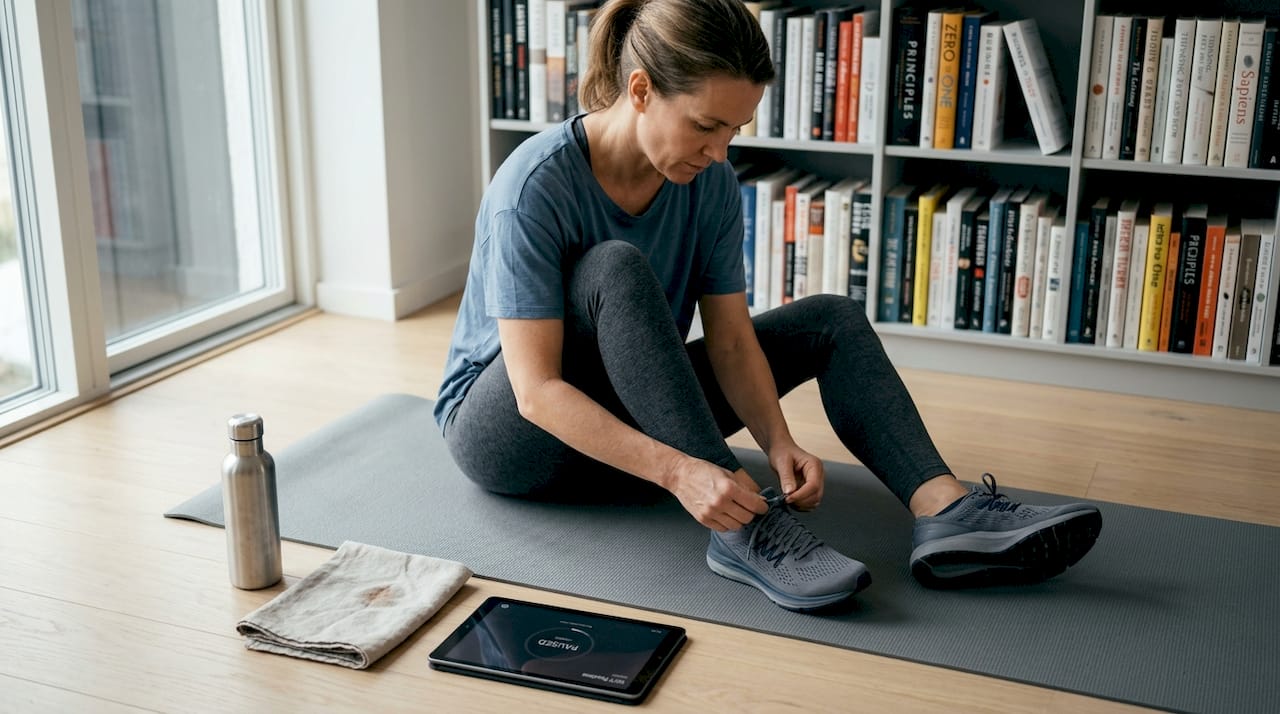
Research from the Midlife in the United States Biomarker study found that among short sleepers (those averaging less than seven hours per night), inadequate vigorous or moderate physical activity was strongly associated with lower HRV. In other words, if you're not sleeping enough and you're not exercising at sufficient intensity, your autonomic recovery is compromised more than if you weren't exercising at all. This matters enormously for time-pressed executives who squeeze in low-intensity or sporadic workouts and assume they're covered.
The interaction between sleep and exercise on autonomic recovery is more complex than a simple "more is better" equation.
| Exercise profile | Sleep adequate | Sleep short (under 7 hrs) |
|---|---|---|
| Vigorous, consistent intensity | Strong HRV, high recovery | Moderate HRV, maintained |
| Moderate, consistent intensity | Good HRV | Noticeable HRV decline |
| Low or inconsistent intensity | Mild HRV impact | Significant HRV decline |
| Sedentary | Negative HRV trend | Severe HRV compromise |
The pattern is clear: if you're a short sleeper (and most executives are), exercise intensity isn't optional, it's the primary compensating lever. Sporadic, low-effort sessions actively work against your autonomic recovery.
How to identify and optimize your own energy zone for exercise:
- Establish your baseline by tracking HRV for two weeks without changing your routine. Note which days you exercise and at what intensity.
- Identify your short sleep nights (under seven hours) and cross-reference them with your HRV scores the following morning.
- Test a structured increase in exercise intensity (not frequency) for three weeks, maintaining your current sleep schedule.
- Compare HRV trends before and after the intensity change. Look for direction, not just single-day scores.
- Adjust load and recovery based on what the data shows, not what you assume is working.
Many executives overestimate the impact of their current workout routines because they feel accomplished after each session. Without measurement, you're navigating blind. Building executive fitness strategies around measured outcomes changes that. The research on building endurance makes the same point: perceived effort is a poor proxy for actual physiological benefit without objective markers.
Pro Tip: If you sleep less than seven hours regularly, prioritize exercise intensity over frequency. Two high-intensity sessions per week will do more for your HRV and energy than five low-intensity ones.
Adopting holistic vitality frameworks means connecting these variables into one coherent system rather than treating sleep, exercise, and stress management as separate concerns.
Integrating energy mechanisms: Daily routines for sustainable performance
Understanding these mechanisms is only half the work. The other half is building a daily structure that reinforces them consistently, even during travel weeks, board season, or high-stakes deal cycles.
Research confirms that inadequate physical activity worsens HRV in short sleepers, which means your daily habits need to compensate for the structural reality of executive life, not pretend it doesn't exist. The goal is a repeatable system that maintains autonomic recovery even when conditions aren't ideal.
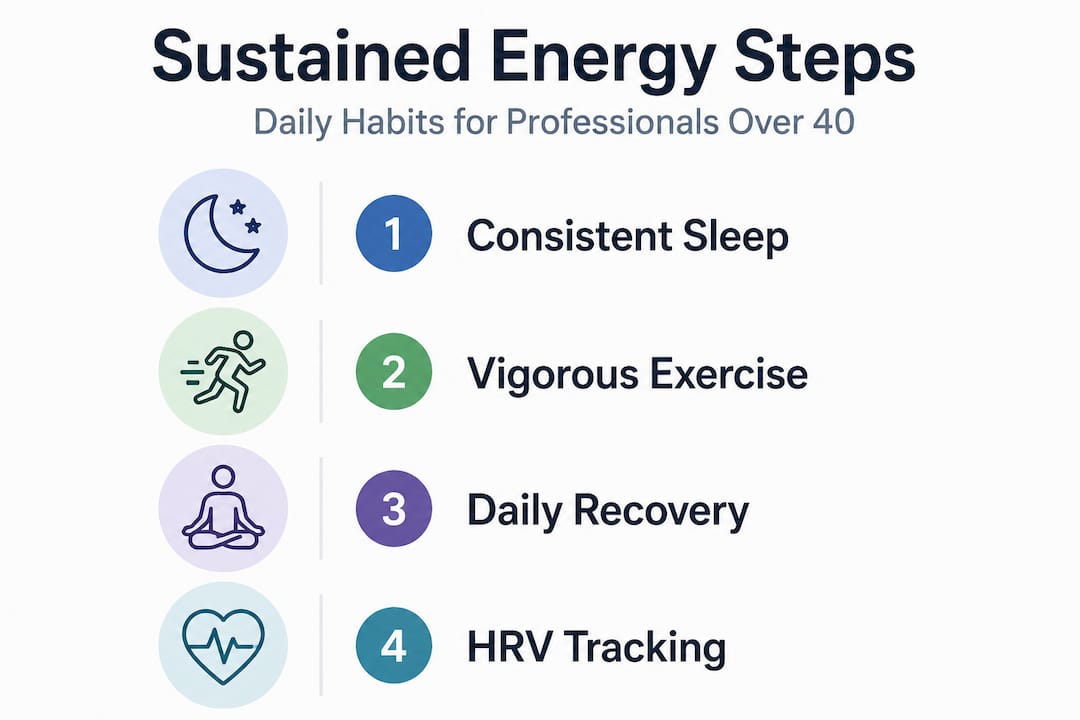
Your core daily energy template should address three domains without exception:
Domain 1: Sleep quality (not just duration)
- Maintain a consistent sleep and wake time, even on weekends
- Keep your room temperature between 65 and 68 degrees Fahrenheit
- Eliminate screen exposure 45 minutes before bed; use a deliberate wind-down protocol
- Avoid alcohol within three hours of sleep; it fragments sleep architecture significantly
Domain 2: Exercise with sufficient intensity
- Block exercise as a non-negotiable appointment, not a task to complete when time allows
- Include at least two vigorous sessions per week (where conversation becomes difficult)
- If a week is compressed, reduce duration rather than intensity; a 20-minute vigorous session beats 45 minutes at low effort
- Track the session in relation to your HRV the following morning to build your personal database
Domain 3: Intentional recovery practices
- Schedule one deliberate recovery block per day, even five minutes of controlled breathing or a short walk
- Use your HRV score to modulate your day's demands; don't ignore a low reading and push through blindly
- Nutritional timing matters: prioritize protein and complex carbohydrates in the morning; avoid large meals close to sleep
- Consider carb loading for sustained energy principles on high-demand days, front-loading fuel rather than relying on mid-afternoon rescue eating
The best executive wellness optimization frameworks share one feature: they're built on feedback loops, not assumptions. Executives who sustain energy over decades don't wing it. They track, adjust, and systematize. Building self-optimization for resilience means creating a system you can run in any context, not one that only works when conditions are perfect.
Stat callout: Among the cohort of midlife professionals studied, those who combined adequate vigorous exercise with consistent sleep habits showed markedly better HRV outcomes than those relying on either factor alone. The compounding effect is real and measurable.
Pro Tip: Pick one non-negotiable action in each of the three domains and protect it no matter what. Quality sleep anchor, one intense exercise session, five minutes of intentional recovery. Build consistency before you build complexity.
What most energy guides get wrong about executive vitality
Most energy guides have a fundamental design flaw: they're built to be read, not implemented. They give you a list of things that work in aggregate for a general population and call it a prescription. That's not a system. That's a catalog of suggestions with no feedback mechanism.
What actually works, especially in high-performance professional environments, is designing your own feedback loop. This is the insight that separates elite sports science from generic wellness content. In competitive environments, coaches don't hand athletes a motivation booklet. They build measurement systems, track individual responses, and adjust load based on real data. Executives deserve the same precision.
The uncomfortable reality is that many professionals carry persistent HRV deficits they've normalized. They assume that feeling functional means they're recovered. But functional and optimal are very different states. You can make decisions in a depleted state. You just make worse ones, slower ones, and you're less likely to spot it happening in real time.
True vitality at the executive level requires three things most guides ignore entirely. First, autonomy over your own data. You need to own your HRV trends, sleep quality scores, and performance metrics rather than relying on a once-a-year physical. Second, load clarity. You need to explicitly acknowledge and account for the full load you're carrying, work stress, personal demands, travel, and social obligations all compound biologically. Third, a recovery protocol you actually follow under pressure, not just when life is easy.
This is exactly what health coaching for executives grounded in performance science addresses. The goal is not to add another wellness habit to an already full schedule. The goal is to build a lean, adaptive system that keeps your biological engine performing at the level your ambitions require.
The executives who get this right stop asking "how do I get more energy?" and start asking "what is my current load to recovery ratio, and what's one adjustment I can make today?" That question produces results. The other one produces supplement purchases.
Take your energy and performance to the next level
You've now seen the science that most energy conversations skip entirely. Sleep quality over duration, exercise intensity as an autonomic lever, and the load-to-recovery ratio as the operating system underneath every high-performance career. The next move is building a personal tracking and optimization system around these principles.

VIRIDOS is built for exactly this. Our Performance Journal is designed to help you track HRV trends, sleep quality, and exercise intensity in one structured daily format, creating the feedback loop that actually drives improvement. Behind every product is science-driven performance methodology developed for demanding men who measure results, not intentions. Through VIRIDOS Membership, you access exclusive protocols, expert insights, and a community of high-agency professionals who treat personal performance with the same rigor they apply to business decisions.
Frequently asked questions
Can sleep quality improve energy even if I can't sleep longer?
Yes. HRV and reaction time improve with targeted sleep quality interventions even when total sleep duration stays the same, meaning better sleep architecture is the primary target for most time-constrained executives.
Why does exercise intensity matter more than frequency for my energy?
For short sleepers, inadequate exercise intensity is directly associated with lower HRV and compromised autonomic recovery, regardless of how many days per week you train. Frequency without sufficient intensity doesn't compensate for poor sleep.
Is there a simple routine professionals can use for more sustained energy?
The most effective starting point is combining one sleep quality anchor (consistent wake time), one vigorous exercise block (minimum twice weekly), and one daily recovery practice. Build consistency in all three before adding any complexity.
Does tracking HRV really help executive performance?
Absolutely. HRV improvements correlate directly with better cognitive performance and recovery markers, giving you an objective daily signal to guide decisions about training load, rest, and workday intensity.
Recommended
- Top performance optimization tips for executives over 40
- Longevity strategies: Why professionals thrive on healthspan
- Why optimize personal energy for executive performance
- Vitality optimization guide for high-performing men 40–65
- 5 voordelen van krachttraining na je 30e voor meer energie
- Top energy supplements for professionals: sharpen focus without the cr – IQ Pouch