
Yes, you can combine supplements safely, but only within three firm boundaries: staying under the tolerable upper intake level for every nutrient you stack, spacing competing minerals and medications by hours rather than minutes, and buying only from brands that document batch quality. Livsmedelsverket confirms most supplements are safe at recommended doses, but overdose, interaction, and contamination risks are real. Get the sequencing wrong, and a stack meant to sharpen performance quietly works against it.
TL;DR:
- Combining supplements safely requires keeping nutrient intakes below upper limits, spacing competing minerals by hours, and choosing brands with verified batch quality.
- Fat-soluble vitamins (A, D, E, K) can accumulate silently and cause toxicity, making dose regulation and product quality critical.
- Risky combinations include iron with calcium, zinc with copper, multiple stimulants, and blood thinners with blood-thinning supplements, which all demand careful timing or medical consultation.
- Timing supplements properly—such as taking fat-soluble vitamins with meals and spacing minerals by hours—reduces interaction risks without unnecessary elimination.
- Regular review and a thorough audit of ingredients help prevent overdose, especially for those with health conditions, medication, or high doses, and should include batch verification.
Table of Contents
- Risks and Key Rules for Combining Supplements Safely
- Which Supplement Combinations Are Genuinely Risky
- How to Time and Dose Your Supplements Correctly
- Supplement Interactions with Prescription Medications
- Who Needs Extra Caution and What Overdose Looks Like
- Building a Safe Supplement Stack Step by Step
- Verifying Supplement Quality: What Executives Should Check
- An Executive's Take on Supplement Discipline
- The Viridos Approach to Verified, Single-Source Performance Support
- Sources
Risks and Key Rules for Combining Supplements Safely
The single most dangerous assumption in supplementation is that more input equals more output. It does not. Every vitamin and mineral carries a tolerable upper intake level, the ceiling above which a nutrient stops helping and starts causing measurable harm. Livsmedelsverket is direct about this: most supplements sold in Sweden are safe when used at recommended doses, but a subset carries genuine risk from overdosing, drug interactions, or contamination. That distinction, recommended dose versus accumulated dose across multiple products, is where most self-designed stacks go wrong.
Fat-soluble vitamins deserve particular respect. Vitamin A, D, E, and K store in liver and fatty tissue rather than clearing through urine, so they accumulate silently across weeks of layered dosing. Water-soluble vitamins like C and the B-complex typically flush out through the kidneys, but even they cause measurable side effects (nausea, nerve symptoms, digestive upset) at extreme intakes, according to Ohio State University Wexner Medical Center.
Quality is the second variable most men overlook entirely. A product with an unreliable label can put you over a safe threshold before you've even started stacking.
- Fat-soluble vitamins (A, D, E, K) accumulate in tissue and carry real toxicity risk over time.
- Water-soluble vitamins (C, B-complex) are generally excreted but still cause side effects at extreme doses.
- Mislabeled potency and undisclosed fillers are common enough that batch testing and a certificate of analysis (COA) matter as much as the ingredient list.
- If your diet already covers baseline needs, a single well-formulated multivitamin often outperforms five separate bottles.
National health authorities consistently push back against the "more is better" instinct, and the guidance is unambiguous: safe stacking is a function of measured dosing and timing, not volume, per Livsmedelsverket.
Pro Tip: Before adding a third or fourth product to your routine, total up every ingredient across all your current supplements. Overlap is the most common way men accidentally exceed a safe upper limit without ever taking an obviously "high" dose of anything.

Which Supplement Combinations Are Genuinely Risky
Some pairings are risky by mechanism, not just by dose. Knowing which ones matters more than knowing every nutrient's individual profile.
- Iron and calcium. Calcium competes directly with iron for absorption in the gut. Take them at least two hours apart, and skip the high-calcium glass of milk with your iron dose.
- Zinc and copper. Chronic high-dose zinc, sustained high-dose zinc intake can suppress copper absorption enough to cause clinical deficiency over months, according to research on mineral interactions. This is not a same-day interaction; it is a slow, cumulative one that rarely shows up on a label warning.
- Stacked stimulants. Caffeine, yohimbine, synephrine, and similar compounds each raise heart rate and blood pressure independently. Combine two or three sources across different products, and the cumulative cardiovascular load can exceed what any single label anticipated.
- Bleeding-risk supplements alongside anticoagulants. Vitamin E, high-dose fish oil, and ginkgo all thin the blood modestly on their own. Paired with a prescribed anticoagulant, the combined effect warrants a conversation with your prescriber before you start.
Not every combination cuts against you. The classic pairing of vitamin C with iron is a genuine synergy: Michigan State University Extension notes that vitamin C measurably improves iron absorption, which is exactly why many iron formulations already include it.
- Beneficial: vitamin C paired with iron, taken together on an empty stomach when tolerated.
- Risky: iron paired with calcium or high-calcium meals, taken at the same time.
- Risky: sustained high-dose zinc without periodic copper monitoring.
- Consult first: any bleeding-risk supplement layered on top of a prescribed blood thinner.
How to Time and Dose Your Supplements Correctly
Timing resolves more supplement conflicts than elimination does. Most of the pairings flagged above are not "never combine these" situations. They're "separate these by a few hours" situations, and that single adjustment removes most of the risk.
- Take fat-soluble vitamins (A, D, E, K) with a meal that contains some fat. Absorption improves, and the dose lands more predictably.
- Take iron on an empty stomach when your gut tolerates it. Food, especially dairy, slows absorption.
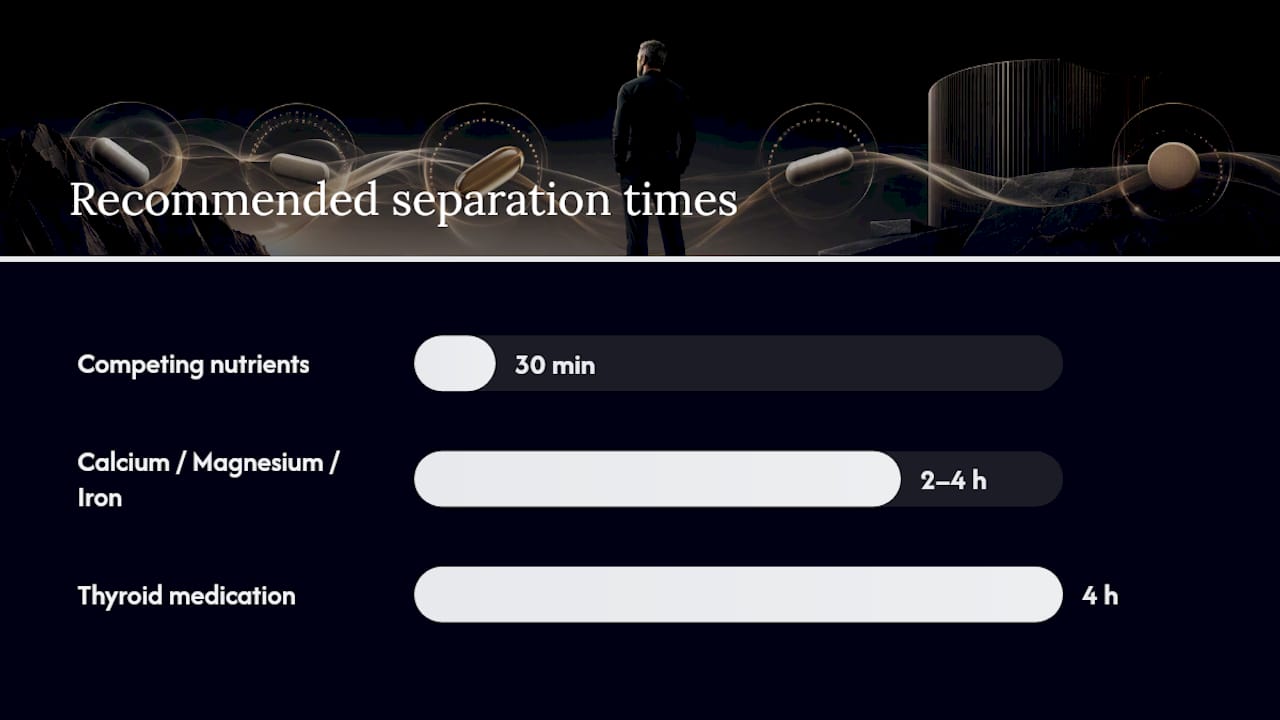
- Space calcium, magnesium, and iron from each other by two to four hours if you're taking meaningful doses of more than one.
- Separate thyroid medication from calcium, iron, and magnesium supplements by at least four hours, per guidance from VeryWell Health.
A workable template: fat-soluble vitamins and any performance formulation with breakfast, iron (if prescribed or recommended) mid-morning away from other minerals, magnesium in the evening to support recovery, and thyroid medication first thing on an empty stomach, well ahead of anything else. The exact order matters less than the discipline of never bunching competing nutrients into the same thirty-minute window.
Pro Tip: Keep a simple log, product, dose, and time taken, for two weeks. It takes five minutes a day and turns a vague "I take a few things" into a document your physician can actually review.
Supplement Interactions with Prescription Medications
The FDA is blunt on this point: supplements can change how a medication is absorbed, metabolized, or cleared, and the effects are sometimes dangerous rather than mild. This is the category where self-directed stacking carries the most real consequence, because the interaction often shows up as reduced drug efficacy rather than an obvious symptom.
Four interactions deserve specific attention:
- Warfarin and vitamin K. Warfarin's effect depends on stable vitamin K intake. Wild swings, not moderate consistent intake, are what cause dangerous clotting shifts.
- St. John's wort and nearly everything. It's a potent inducer of liver enzymes that metabolize a wide range of prescription drugs, from antidepressants to immunosuppressants. Do not add it without explicit clinician sign-off.
- Thyroid medication and minerals. Calcium, iron, and magnesium all interfere with absorption if taken too close to a thyroid dose, a timing rule confirmed by VeryWell Health.
- Antidepressants and botanicals. Certain herbal extracts interact with serotonergic medications in ways that aren't intuitive from the label alone.
The practical fix is not complicated: bring your full supplement list, brand names, doses, and timing, to your next pharmacist or physician visit. Apotek Hjärtat treats this kind of pharmacist review as routine, and it resolves more uncertainty in ten minutes than an hour of forum research.
Who Needs Extra Caution and What Overdose Looks Like
Some men need a lower margin for error than others. Age, kidney and liver function, pregnancy status, and the number of concurrent prescriptions all change how much room you have for stacking.
- Pregnant or breastfeeding individuals, older adults, and anyone managing multiple prescriptions should treat every new addition as a decision to review with a clinician first, not after.
- Severe vitamin D toxicity can present as nausea, vomiting, confusion, and in extreme cases, cardiac arrhythmia.
- Acute iron overdose, particularly relevant with pediatric exposure, causes vomiting and abdominal pain that escalates quickly and requires emergency evaluation.
- Persistent fatigue, unusual bruising, or digestive changes after starting a new stack are signals to stop and get tested, not push through.
If symptoms are severe, sudden, or involve confusion, chest pain, or irregular heartbeat, that's an emergency department situation, not a wait-and-see one. For anything short of that, a call to your prescriber is the right first move. Before starting a high-dose regimen of any single nutrient, ask for a baseline blood test. It's the only way to know your actual starting point rather than guessing from symptoms.
Building a Safe Supplement Stack Step by Step
A disciplined stack follows a sequence, not a shopping list. Five steps, done in order, cover nearly every risk raised above.
- Assess the goal. Define what you're actually trying to improve, energy, recovery, focus, and confirm the need with a blood test where relevant rather than assuming a deficiency.
- Audit what you already take. List every product, then total the overlapping nutrients across them. This is where hidden excess usually surfaces.
- Eliminate duplicates and set timing rules. Cut redundant products, then assign each remaining one a specific time of day based on the spacing rules above.
- Verify quality. Choose products with a documented certificate of analysis and third-party batch testing, and record batch numbers as you would with any regulated intake.
- Schedule a review. Revisit the stack with a healthcare professional every few months, not just at the start.
Pro Tip: Treat step two, the audit, as non-negotiable. Most overdose risk isn't from one reckless product. It's from three reasonable products that quietly share the same ingredient.
Verifying Supplement Quality: What Executives Should Check
Every rule above assumes the product on your shelf actually contains what the label claims. That assumption fails often enough to matter, which is why quality verification isn't a bonus step. It's the foundation the rest of the stack depends on.
- Confirm a certificate of analysis (COA) exists for the specific batch you're holding, not a generic product-line document.
- Look for third-party testing, an independent lab confirming potency and purity, rather than in-house claims alone.
- Prioritize small-batch production, which typically allows tighter traceability from raw material to finished dose.
- Cross-check any botanical ingredient against a recognized safety compendium, such as EFSA's compendium of botanicals, before adding it to a stack.
Viridos applies this same discipline internally, and the five-step COA verification process outlines exactly what to demand from any brand before you trust its label. Pair that verification habit with the nutrition timing guidance covered earlier, and the quality question stops being a leap of faith.
An Executive's Take on Supplement Discipline
Most men over-engineer their stack before they've earned the right to. The instinct is to add another compound the moment progress stalls, when the more useful move is almost always to audit what's already there and fix the timing. Evidence-backed consistency beats aggressive stacking every time I've seen the two compared side by side.
The men who get this right treat their supplement routine the way they treat their calendar: reviewed, logged, and adjusted deliberately rather than reactively. Professional oversight isn't a sign of caution getting in the way. It's what separates a serious long-term regimen from a hobby.
Start this week with one action: pull every bottle you currently take and total the overlapping ingredients. You'll likely find more redundancy than you expect.
— Joakim
The Viridos Approach to Verified, Single-Source Performance Support
Every rule in this guide points toward the same conclusion: safe stacking depends on knowing exactly what you're taking and trusting the source behind it. That's precisely the problem Viridos was built to remove. Instead of layering five separately sourced products and hoping the doses don't collide, Viridos delivers a single, small-batch formulation from Sweden, produced in limited cohorts with batch-level traceability built in from the start.

Membership access means every shipment traces back to a verified batch, adhering to standard documentation this guide recommends demanding from any supplement brand. For a reader managing a demanding schedule, that consolidation matters: one verified source instead of a shelf of products to audit individually. If the checklist above left you wanting fewer variables to manage rather than more, explore Viridos membership and see whether the controlled-access model fits how you already think about performance discipline.
This article is general information, not a substitute for advice from a qualified doctor. Consult a qualified healthcare professional about your own circumstances before acting on anything here.
Sources
- Risker med kosttillskott | Livsmedelsverket
- Supplements You Should Avoid Mixing | VeryWell Health
- Mixing medications and dietary supplements can endanger your health | FDA
- PubMed article on mineral interactions and clinical effects