
TL;DR:
- A strong sense of purpose is linked to lower mortality risk by promoting healthier behaviors and physiological regulation. Purpose is dynamic and modifiable, with changes over time significantly predicting overall health and aging. Cultivating clarity through contribution, reflection, and purposeful engagement enhances longevity and sustained performance.
A strong sense of life purpose is defined in psychology as a stable orientation toward meaningful goals that gives direction to daily behavior and long-term decision-making. The role of purpose in longevity is now supported by a substantial body of research: individuals with high purpose scores face significantly lower mortality risk than their low-purpose counterparts, with some studies reporting up to a 46% reduction in all-cause mortality. The Health and Retirement Study and Maastricht University's 12-year longitudinal analysis are among the most rigorous investigations confirming this link. For men between 35 and 65 navigating high-stakes careers and demanding responsibilities, understanding this relationship is not abstract philosophy. It is a concrete performance variable.
How purpose influences longevity: evidence from major studies
The connection between purpose and longevity is not a single finding from a single lab. It is a pattern replicated across large longitudinal cohorts, meta-analyses, and cross-cultural samples.
The most cited mechanism is mortality risk reduction. Research consistently shows that low purpose predicts earlier death, though the magnitude of this effect depends heavily on how baseline health is measured. The Health and Retirement Study found that hazard ratios for mortality among low-purpose individuals dropped from 2.59 to 1.77 and then to 1.20 after researchers applied progressively more rigorous baseline health controls. This is a critical finding. It means prior studies that used coarse health measures likely overstated the direct causal effect of purpose on lifespan.
A large Spanish cohort study added another dimension by examining chronic disease risk. Researchers found a clear dose-response pattern linking lower purpose scores to higher estimated type 2 diabetes risk across three validated risk instruments, independent of lifestyle factors. This graded relationship strengthens the argument that purpose operates through real physiological pathways, not just behavioral ones.
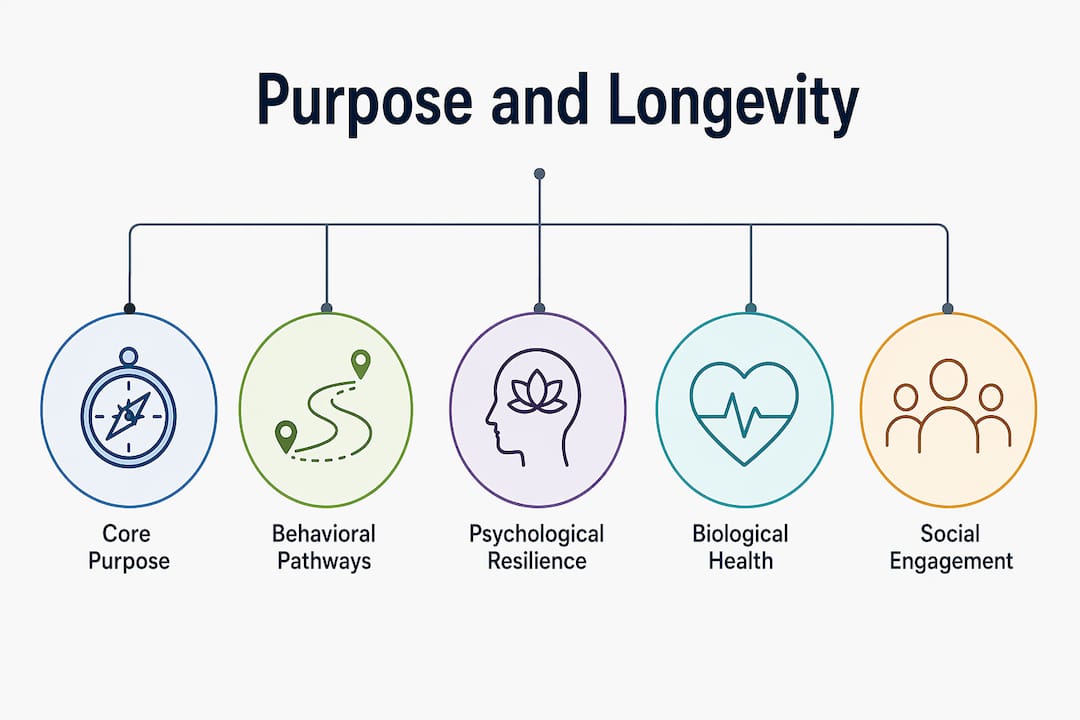
The mechanisms researchers have identified fall into two categories:
- Behavioral pathways: Higher purpose associates with greater physical activity, better dietary adherence, and lower rates of tobacco use. These behaviors partially explain the lower mortality and disease risk observed in purposeful individuals.
- Biological pathways: Purpose correlates with faster cortisol recovery after stressors, reduced stress reactivity, and lower levels of systemic inflammation. These are measurable physiological differences, not self-reported perceptions.
"Purpose-based health benefits involve multiple mechanisms including stress reduction, healthier coping, and behavioral engagement rather than a single causal pathway." — PLOS ONE research synthesis
The practical implication is that purpose does not work through one lever. It works through several simultaneously, which makes it a high-leverage variable for anyone serious about performance longevity.
Is the purpose-longevity relationship truly bidirectional?
The Maastricht University 12-year study introduced a finding that most popular coverage has ignored. Purpose and health do not operate in a one-way direction. They influence each other over time, though the relationship is asymmetric.
Within-person changes in purpose predicted subsequent changes in five distinct health markers, while only two health markers predicted later changes in purpose. This asymmetry matters. Purpose is the stronger driver in this bidirectional exchange, which means cultivating it is not just a philosophical exercise. It is a health intervention with measurable downstream effects.
The nuances worth understanding include:
- Age moderation: The strength of the purpose-health association varies by age group. Effects detected in adults aged 50 and above may not apply uniformly to those in their late 30s or early 40s, according to meta-analytic findings.
- Measurement scale effects: Different purpose scales capture distinct psychological components. The Ryff Purpose in Life subscale, the Life Engagement Test, and the Meaning in Life Questionnaire each measure slightly different constructs, and scale type influences detected effects on health outcomes.
- Residual confounding: Even after robust adjustment, some residual confounding from unmeasured health variables likely remains. This cautions against claiming that purpose alone extends life.
The honest read of this evidence is that purpose is a meaningful and modifiable contributor to health trajectories, not a magic variable that overrides biology. For executives and founders who demand precision in their decision-making, that distinction matters.
Psychological and behavioral mechanisms linking purpose to healthier aging
Understanding why purpose affects health requires looking at what purposeful people actually do differently under pressure.

PLOS ONE research on purpose and coping found that individuals with higher purpose scores consistently used more active and support-seeking coping strategies when facing stress, while relying less on disengaged strategies like avoidance or rumination. Disengaged coping is directly associated with worse health outcomes over time, including elevated inflammatory markers and poorer cardiovascular function. This behavioral difference is one of the clearest pathways from purpose to longevity.
The physiological evidence is equally specific. Purposeful individuals show faster cortisol recovery after acute stressors and report fewer physical symptoms during high-stress periods. Cortisol dysregulation is a known contributor to metabolic disease, immune suppression, and accelerated cellular aging. A man who recovers faster from stress is not just feeling better. He is aging more slowly at a biological level.
Here is a practical framework for understanding the mechanism chain:
- Purpose creates direction. When goals are clear and meaningful, daily decisions align with long-term outcomes rather than short-term relief.
- Direction reduces reactive stress. Men with a defined mission are less destabilized by setbacks because individual failures do not threaten the larger structure of meaning.
- Reduced reactivity lowers cortisol load. Less chronic cortisol exposure means better metabolic function, lower inflammation, and more consistent sleep quality.
- Better physiology supports sustained behavior. Sleep, recovery, and energy levels feed back into the capacity to exercise, eat well, and maintain social connection.
Pro Tip: If you want to assess your own coping patterns honestly, track how you respond to the three most stressful recurring situations in your week. Are you engaging with them directly, seeking input, or avoiding them? The pattern reveals more about your purpose alignment than any questionnaire.
For men managing stress at the executive level, this mechanism chain is not abstract. It describes the difference between leaders who sustain performance across decades and those who burn out or decline in their 50s.
How to cultivate purpose for longevity in midlife and beyond
Purpose is not a fixed trait you either have or lack. Maastricht University's longitudinal data confirms that purpose changes over time and that within-person changes in purpose are more predictive of health shifts than baseline purpose scores. This makes purpose a genuinely modifiable target, not just a personality characteristic.
For men in midlife, the challenge is often not a lack of purpose but a misalignment between current roles and the sources of meaning that once drove them. Career transitions, organizational changes, and shifting family structures can erode purpose without the individual recognizing it until health markers begin to shift.
Practical approaches that research and clinical experience support:
- Redefine contribution, not just achievement. Purpose tied exclusively to status or financial outcomes is fragile. Purpose anchored in contribution to others, craft mastery, or institutional legacy is more durable and more strongly associated with the health benefits described in the literature.
- Set process goals alongside outcome goals. A 16-source framework from cross-cultural research found that sources of purpose associated with meaning, happiness, and psychological richness were consistent across four cultures. Process engagement, not just achievement, is a universal driver.
- Build social contribution into your schedule. Mentoring, advisory roles, and community leadership are not soft activities. They are purpose-maintenance practices with documented health effects.
- Use structured reflection to track purpose alignment. A weekly review of whether your primary activities align with your stated values takes less than 15 minutes and creates the feedback loop that sustains directional clarity.
Pro Tip: Purpose interventions that combine behavioral components, such as exercise and social engagement, with reflective practices produce stronger health outcomes than motivational exercises alone. Build the behavior first; the meaning often follows.
For men building a longevity strategy for the long term, purpose cultivation belongs alongside sleep optimization, nutrition, and physical training. It is not a supplement to those practices. It is the organizing principle that makes them sustainable.
Key takeaways
Purpose is the most underutilized variable in executive longevity because it operates through behavioral, psychological, and physiological pathways simultaneously, making it more powerful than any single lifestyle intervention.
| Point | Details |
|---|---|
| Purpose reduces mortality risk | Low purpose predicts higher mortality, though baseline health mediates the effect size substantially. |
| The relationship is bidirectional | Purpose changes predict health changes more strongly than health changes predict purpose shifts. |
| Stress regulation is a key mechanism | Purposeful individuals show faster cortisol recovery and use more adaptive coping strategies under pressure. |
| Purpose is modifiable, not fixed | Within-person changes in purpose over time are the most actionable target for health interventions. |
| Behavioral and biological pathways both matter | Exercise adherence, diet, and cortisol regulation each partially explain the purpose-longevity connection. |
Purpose as a performance variable, not a philosophy
I have spent years reading the longevity literature and working with men who perform at the highest levels. The honest observation is this: most of them do not lack purpose. They lack clarity about whether their current purpose still fits who they are at 50 versus who they were at 35.
The Maastricht data resonates with what I see in practice. Purpose is not static. It erodes quietly when roles change, when organizations shift around you, or when the goals that once drove you get achieved and nothing replaces them. The men who age best are not the ones who had the most purpose at 40. They are the ones who actively updated it.
What I find most credible in the recent research is the baseline health confounding story. The hazard ratio dropping from 2.59 to 1.20 after proper adjustment does not undermine the case for purpose. It refines it. Purpose matters, and it matters most when your health is already reasonably solid. That is the profile of most men reading this. Which means the return on investing in purpose clarity is real and measurable, not aspirational.
The Swedish approach to quality applies here. Small-batch, deliberate, no shortcuts. Purpose built on genuine values and honest self-assessment outlasts purpose built on external validation. The men I respect most in demanding roles treat their sense of mission with the same rigor they apply to their balance sheets. That discipline is what separates sustained performance from a decade of impressive output followed by a steep decline.
— Joakim
Build your performance foundation with Viridos

Viridos is built for men who take their long-term performance as seriously as their professional output. The Viridos Membership gives you controlled access to executive performance formulation developed through small-batch Swedish production, designed to support the physiological foundations that purpose-driven living demands. For men who want to track and strengthen the connection between their goals, their vitality, and their health markers, the Performance Journal provides the structured framework to do it with precision. Purpose without a system is intention. Purpose with a system is performance.
FAQ
What is the role of purpose in longevity?
Purpose in life reduces mortality risk through behavioral pathways like exercise and diet adherence, and biological pathways including cortisol regulation and reduced inflammation. Research shows the effect is real but partially mediated by baseline health status.
Does purpose directly cause a longer life?
The relationship is significant but not purely direct. Hazard ratios for mortality among low-purpose individuals fall substantially after adjusting for baseline health, indicating that health status both confounds and mediates the purpose-longevity association.
Can you increase your sense of purpose in midlife?
Yes. Longitudinal data from Maastricht University confirms that purpose changes over time and that within-person increases in purpose predict improvements across multiple health markers, making it a modifiable target for men in their 40s and 50s.
How does purpose affect stress and aging?
Purposeful individuals show faster cortisol recovery after acute stressors and rely more on active coping strategies rather than avoidance. This reduces chronic cortisol exposure, which is directly linked to metabolic disease and accelerated biological aging.
What activities build sustainable purpose?
Cross-cultural research identifies contribution to others, craft mastery, and process engagement as the most durable sources of purpose. Combining these with structured reflection and behavioral routines produces stronger health outcomes than motivational practices alone.