
91% of healthy aging is within your personal control, yet most executives are unknowingly accelerating their own decline. Chronic stress, poor recovery habits, and a fixation on short-term output quietly erode the biological foundation that sustains peak performance. Longevity is not about living to 100. It is about staying sharp, energized, and effective through the decades that matter most to your career and legacy. This article breaks down why healthspan is the real metric to track, how stress silently ages you, and which frameworks give you a measurable edge right now.
Table of Contents
- The strategic value of longevity for professionals
- Healthspan versus lifespan: The foundation of professional longevity
- Stress, aging, and vitality: The hidden risks for high-performers
- Beyond biomarkers: Purpose, fulfillment, and legacy in longevity
- Actionable frameworks: Benchmarks and practical longevity tools
- Enhance your longevity with evidence-based solutions
- Frequently asked questions
Key Takeaways
| Point | Details |
|---|---|
| Strategic continuity | Longevity strengthens organizational leadership continuity and cultural legacy. |
| Healthspan pillars | Movement, nutrition, and mindfulness drive sustained executive performance. |
| Stress risks | Managing chronic stress reduces accelerated aging and preserves vitality. |
| Fulfillment matters | Longevity only delivers value when linked to purpose, fulfillment, and legacy. |
| Practical frameworks | Benchmarks and actionable tools empower professionals to optimize their longevity. |
The strategic value of longevity for professionals
Longevity is not just a personal health goal. For executives and founders, it is a strategic asset that directly shapes organizational outcomes. When a senior leader stays sharp and engaged over a longer arc, the organization benefits from continuity, preserved institutional knowledge, and a culture that compounds over time.
Strategic continuity, lower turnover risk, and a stronger cultural legacy are direct outputs of executive longevity. Replacing a senior leader costs far more than retaining one who performs at a high level for an extended period. The knowledge, relationships, and judgment that accumulate over decades cannot be replicated quickly.
The demographic shift makes this even more urgent. The UN projects that 25% or more of the population in key regions will be 65 or older by 2050. Organizations that invest in optimizing performance longevity now will have a structural advantage as the talent pool ages.
Here is what longevity delivers at the organizational level:
- Continuity of vision across multi-year strategic cycles
- Reduced leadership turnover and the costs that come with it
- Preserved institutional knowledge that newer hires cannot replicate
- Stronger cultural values embedded by long-tenured leaders
- Legacy building that extends beyond any single role or company
"Longevity is not a personal luxury. It is a professional obligation for anyone who leads at scale."
For a deeper look at longevity tactics for leaders, the case for investing in your own healthspan becomes even clearer when you map it against organizational risk.
Healthspan versus lifespan: The foundation of professional longevity
Lifespan counts the years. Healthspan counts the years you actually perform at a high level. That distinction matters enormously for executives who need sustained cognitive sharpness, physical energy, and emotional resilience, not just a longer calendar.
The longevity blueprint for executives rests on three pillars that produce exponential impact on energy and cognition: movement, nutrition, and mindfulness. Each one reinforces the others. Neglect one and the system weakens.

| Factor | Lifespan focus | Healthspan focus |
|---|---|---|
| Goal | Live longer | Perform longer |
| Metric | Age at death | Years of high function |
| Strategy | Disease prevention | Energy and cognition optimization |
| Daily habit | Annual checkup | Daily recovery and tracking |
| Outcome | More years | More productive, fulfilling years |
Understanding the importance of healthspan shifts your entire approach to wellness. Instead of reacting to illness, you build systems that sustain output. Instead of waiting for a diagnosis, you track leading indicators like sleep quality, resting heart rate, and cognitive load.
The three pillars in practice:
- Movement: Zone 2 cardio and strength training preserve metabolic health and cognitive function well into your 60s
- Nutrition: Protein prioritization, reduced ultra-processed food, and targeted vitality vitamins for executives support hormonal balance and recovery
- Mindfulness: Structured recovery, breathwork, and deliberate downtime reduce cortisol and sharpen decision-making
Pro Tip: Do not wait for your annual physical to assess your health. Track three simple daily metrics: sleep duration, energy level at 2 PM, and workout consistency. Trends in these three indicators will tell you more than most lab panels.
Stress, aging, and vitality: The hidden risks for high-performers
Chronic stress is the most underestimated performance killer in executive life. It does not announce itself. It accumulates quietly, accelerating biological aging, suppressing testosterone, impairing sleep architecture, and degrading the prefrontal cortex function you rely on for judgment and strategy.
Executives face accelerated aging from chronic stress, yet the same research confirms that 91% of healthy aging remains within personal control through lifestyle. That is not a small margin. That is almost everything.
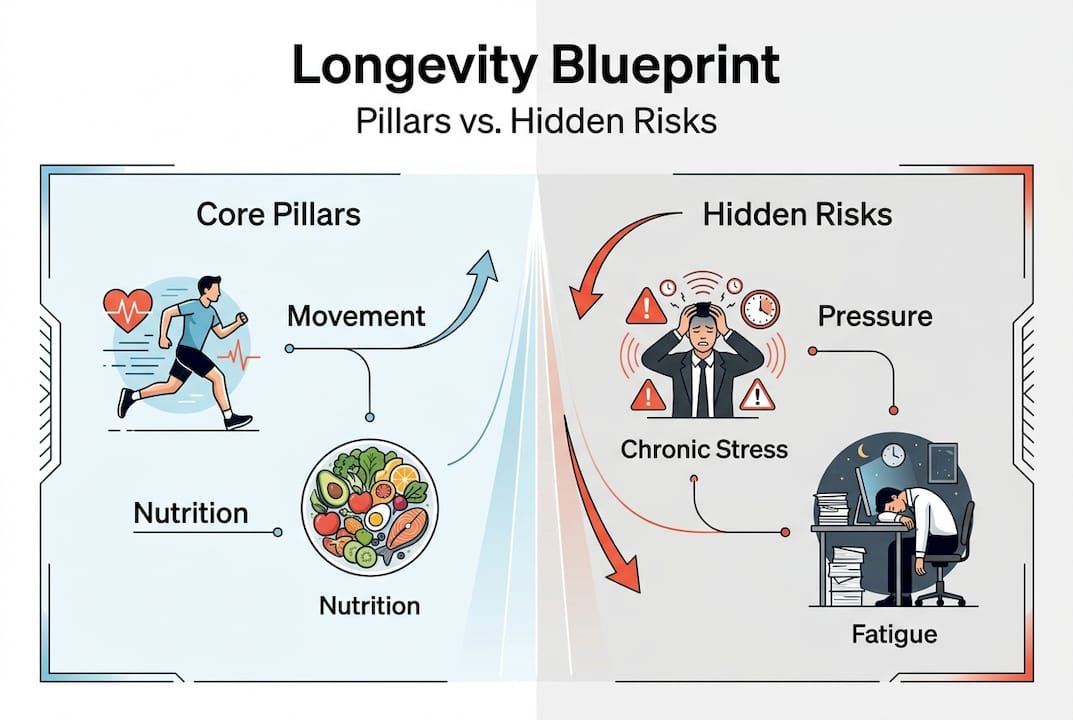
One of the most dangerous patterns among high-performers is what researchers call quiet cracking. Men aged 40 to 65 are particularly vulnerable. They hide decline behind productivity, mask fatigue with caffeine and adrenaline, and interpret warning signs as temporary stress rather than systemic breakdown. Metabolic dysfunction, hormonal imbalance, and cognitive fog often go unaddressed for years.
Here is a practical framework for catching decline early:
- Audit your recovery stack. Are you getting 7 to 8 hours of quality sleep consistently? If not, this is your first intervention.
- Track your energy curve. Note when your focus drops during the day. Consistent afternoon crashes signal metabolic or hormonal issues worth investigating.
- Assess your stress load honestly. Use a simple 1 to 10 daily stress rating over 30 days. Patterns reveal more than single data points.
- Schedule quarterly self-assessments. Review your executive wellness strategies against objective markers, not just how you feel.
- Use a structured vitality checklist for men to identify gaps in movement, nutrition, sleep, and recovery.
| Warning sign | What it signals | First action |
|---|---|---|
| Afternoon energy crash | Blood sugar instability | Adjust meal timing and composition |
| Poor sleep quality | Elevated cortisol | Implement wind-down protocol |
| Reduced motivation | Hormonal decline | Assess testosterone and thyroid |
| Increased irritability | Nervous system overload | Add structured recovery days |
Building healthy lifestyle routines is not about perfection. It is about consistency in the habits that buffer against the biological cost of high-pressure roles.
Pro Tip: Set a recurring 15-minute monthly review to assess your energy, mood, and output trends. Catching a 10% decline early is far easier to reverse than addressing a 40% decline after two years of ignoring the signals.
Beyond biomarkers: Purpose, fulfillment, and legacy in longevity
Biomarkers matter. But they are not the whole picture. A man can have optimal testosterone, perfect sleep scores, and a resting heart rate of 48, and still feel like he is running on empty if his work lacks meaning.
Longevity without fulfillment leads to existing longer rather than living with purpose. That distinction separates the executives who thrive in their 50s and 60s from those who simply survive them. The goal is not to optimize your biology in isolation. It is to build a life worth sustaining.
The fulfillment trifecta that anchors meaningful longevity includes three dimensions:
- Self: Physical vitality, mental clarity, and emotional regulation that allow you to show up fully
- Others: Deep relationships, mentorship, and contribution to people who matter to you
- Legacy: Work and impact that outlast your active career and reflect your values
The longevity paradox insights highlight a critical tension between extreme optimization approaches and sustainable ones. Some executives chase biomarker perfection at the cost of enjoyment, relationships, and spontaneity. That is not longevity. That is a different kind of deprivation.
"The most resilient executives are not the ones with the best lab results. They are the ones who know why they are still in the game."
A high-performance living guide that integrates purpose alongside physical optimization produces far more durable results than a purely biological approach. And sustaining elite performance over decades requires that your ambition is anchored to something larger than quarterly results.
Actionable frameworks: Benchmarks and practical longevity tools
Knowing that longevity matters is not enough. You need tools that translate intention into measurable progress. The following frameworks give you a structured starting point.
Step-by-step self-assessment process:
- Calculate your Healthspan Life Index (HLI). This personalized benchmark maps your biological age against your chronological age and identifies your highest-leverage intervention areas.
- Run Peter Attia's physical tests. These physical aging benchmarks include grip strength, VO2 max, and balance assessments that predict functional capacity a decade out.
- Define your peakspan. Peakspan is the window of your most productive, high-impact years. Identify what you need to sustain it and work backward to build the habits that protect it.
- Set 90-day health sprints. Choose one pillar (movement, nutrition, or mindfulness) and optimize it intensively before moving to the next.
- Review and recalibrate quarterly. Use your long-term health tips framework to assess progress and adjust based on real data, not assumptions.
| Tool | What it measures | Why it matters |
|---|---|---|
| Healthspan Life Index | Biological vs. chronological age | Identifies your real aging rate |
| VO2 max test | Cardiovascular fitness | Predicts 10-year mortality risk |
| Grip strength test | Functional muscle strength | Correlates with cognitive longevity |
| Sleep tracking | Recovery quality | Reveals cortisol and hormonal patterns |
| Peakspan mapping | Productive lifespan window | Aligns habits with career goals |
These tools are not about vanity metrics. They are about giving you an honest picture of where you stand and what to prioritize. The executives who use structured benchmarks consistently outperform those who rely on intuition alone.
Enhance your longevity with evidence-based solutions
You now have the frameworks. The next step is putting them into practice with tools built specifically for men who operate at your level.
VIRIDOS is designed for exactly this. The performance journal gives you a structured daily system to track the habits that drive healthspan, not just productivity. The evidence-based science behind every VIRIDOS product reflects the same rigor you apply to your business decisions. And the longevity methodology translates the latest research into practical protocols for men in demanding roles. If you are serious about sustaining your edge through your 50s and beyond, VIRIDOS gives you the precision tools to do it.
Frequently asked questions
What is healthspan and why is it more important than lifespan for executives?
Healthspan is the period of life spent in good health and high function, which determines your ability to sustain peak performance. Healthspan over lifespan produces exponential benefits for professional performance, making it the metric that actually matters for executives.
How much control do professionals really have over aging?
More than most realize. 91% of healthy aging is controllable via lifestyle changes including movement, nutrition, and stress management, which means genetics play a far smaller role than behavior.
Can focusing on longevity actually boost workplace performance?
Yes. Longevity strategies improve energy, resilience, and cognitive output. Strategic continuity and stronger leadership legacies are direct organizational benefits of executives who invest in their own healthspan.
What frameworks help executives measure and enhance their longevity?
The Healthspan Life Index and physical tests for aging such as VO2 max and grip strength assessments are recommended starting points for personalized risk assessment and targeted improvement.