
TL;DR:
- Consistent lifestyle habits across sleep, movement, nutrition, stress, relationships, and purpose are key for longevity.
- Building and maintaining simple, repeatable systems with feedback loops enhances long-term vitality.
- Flexibility and adherence during travel and stress are crucial; habits and purpose drive sustainable performance.
Longevity Lifestyle: Achieve Peak Performance and Vitality
Most high-achieving executives spend enormous energy chasing quick fixes: another supplement stack, a cold plunge subscription, or the latest sleep tracker. Yet the biggest competitive edge in the room rarely belongs to the guy with the most gadgets. It belongs to the one who has quietly built consistent, evidence-based lifestyle habits that compound over years. Blue Zones research suggests the core mechanisms behind exceptional longevity are far more accessible than any clinic can sell you. This guide walks you through exactly what a longevity lifestyle means, what science actually supports, and how to implement it around an unforgiving executive schedule.
Table of Contents
- What defines a longevity lifestyle for executives?
- The science behind proven longevity habits
- From checklist to protocol: Executing for real-world results
- Real-world implementation: Adapting longevity for executives' lives
- Why popular longevity frameworks miss what executives need most
- Next steps: Precision tools for your longevity journey
- Frequently asked questions
Key Takeaways
| Point | Details |
|---|---|
| Consistency trumps shortcuts | Long-term success comes from daily, repeatable behaviors not quick fixes or extreme interventions. |
| Science-backed pillars | The core drivers of longevity are sleep, movement, nutrition, stress handling, and social connection. |
| Protocols over fads | Structured, personalized habit systems outperform the latest hacks in delivering sustainable results. |
| Adaptation is critical | Tailor routines to your travel and career demands for lasting adherence and high performance. |
| Purpose drives longevity | Clarity of purpose and aligned motivation enhances both healthspan and leadership impact. |
What defines a longevity lifestyle for executives?
The term "longevity lifestyle" gets thrown around loosely, so let's sharpen it. For executives, it means building and maintaining a set of repeatable habits across six core pillars: sleep quality, daily movement, nutrition, stress regulation, meaningful relationships, and sense of purpose. These pillars are not aspirational wellness talking points. They are interconnected systems that directly influence your cognitive sharpness, emotional regulation, and physical resilience, all of which determine your ceiling in a demanding career.
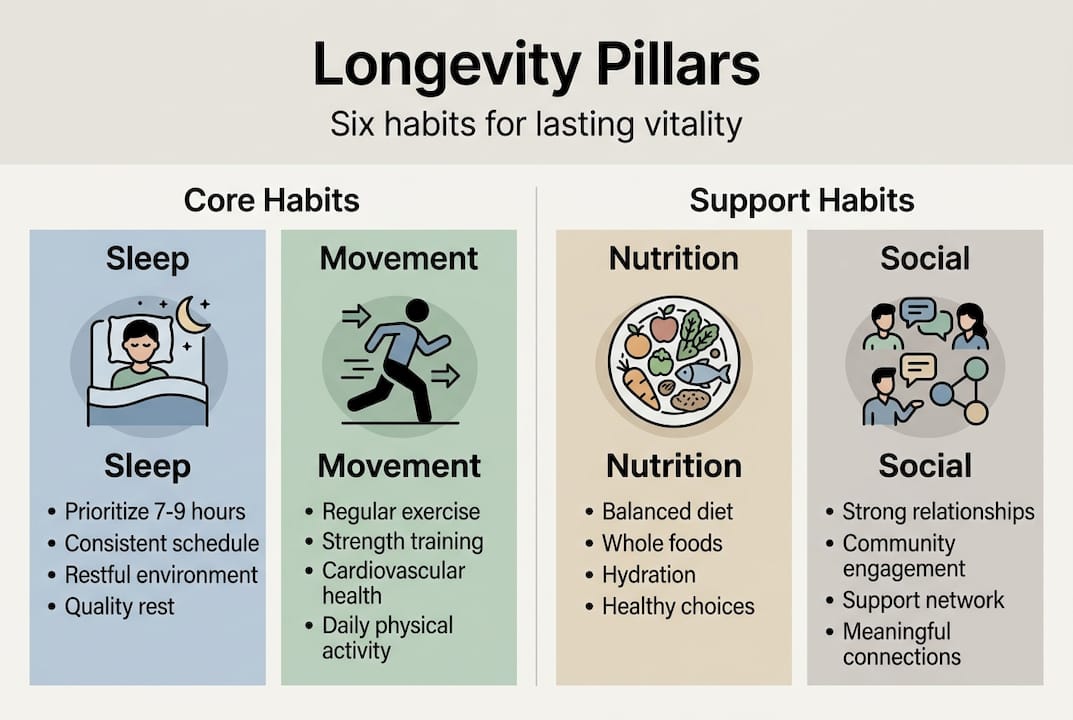
Here's what separates high performers who sustain their edge into their 50s and 60s from those who flame out early: not IQ, not even work ethic alone, but the consistency of foundational habits over time. Executives are uniquely prone to overwork. The culture rewards it. But chronic overwork without recovery is the equivalent of drawing down a savings account without ever making a deposit. Eventually, the account is empty.
The Blue Zones framework provides a useful real-world template. Its "Power 9" principles span natural movement, calorie awareness, plant-heavy diets, belonging, stress relief rituals, and community. Harvard Health notes the approach offers instructive patterns but cautions against treating Blue Zone data as "strong science" in a strict clinical sense. Smart executives take the same critical approach they'd apply to a business strategy: use it as a framework, pressure-test its claims, and adapt it to your specific context.
Common myths that derail executive longevity efforts:
- Supplements replace fundamentals. No nootropic or longevity compound compensates for chronic sleep debt or a sedentary schedule. Supplements work at the margins, not at the foundation.
- Biohacking equals longevity. Tracking 40 biomarkers without consistent sleep or exercise is like optimizing a poorly built engine. The data becomes noise without the fundamentals in place.
- More discipline equals more output. Relentless discipline without recovery produces diminishing returns. Longevity is about sustainable output, not maximum short-term throughput.
- Social connection is soft. Research consistently shows that robust social bonds are as protective for longevity as diet and exercise. For driven men, this is often the most neglected pillar.
"The most durable performance edge isn't found in a lab or a supplement bottle. It's built in daily rituals, repeated over years, that reinforce your physical and mental foundation."
Pro Tip: Audit your six pillars once a quarter the same way you review a business quarter. Score each from 1 to 10. The lowest scores reveal your biggest leverage opportunities, not your supplement gaps.
For a structured overview of the fundamentals, explore these 8 strategies for men's longevity and understand why healthspan and executive performance are inseparable for sustained career success.
The science behind proven longevity habits
Once you accept that lifestyle consistency is the engine, the next question is: which habits actually move the needle, and what does credible research say versus what is still speculative?
The Blue Zones "Power 9" aligns closely with mainstream longevity mechanisms. These include natural daily movement integrated into routines rather than isolated gym sessions, plant-predominant nutrition with moderate calorie intake, active stress-relief practices, strong social connectivity, and a clear sense of purpose. These aren't fads. They map directly onto well-established physiological pathways including reduced systemic inflammation, improved metabolic health, stronger immune function, and better cognitive maintenance over decades.
The key mechanisms worth understanding at an executive level:
- Inflammation regulation. Chronic low-grade inflammation accelerates biological aging, impairs decision-making, and erodes energy reserves. Diet quality, sleep duration, and stress management are the three most powerful modulators.
- Metabolic health. Insulin sensitivity, blood glucose stability, and mitochondrial efficiency drive sustained cognitive and physical energy. These are directly shaped by movement frequency, meal composition, and sleep.
- Cognitive function maintenance. Executive function, working memory, and emotional regulation all decline with poor sleep, chronic stress, and low social engagement. Conversely, they are preserved and even enhanced through targeted lifestyle habits.
- Cardiovascular resilience. Zone 2 aerobic training, meaning moderate intensity sustained effort, builds the cardiac and mitochondrial base that underlies both physical stamina and brain perfusion.
| Habit | Evidence strength | Universally recommended | Still debated |
|---|---|---|---|
| 7-9 hours sleep | Very strong | Yes | Optimal timing varies |
| Daily movement | Very strong | Yes | Type/intensity optimization |
| Plant-rich diet | Strong | Yes | Precise macros |
| Stress management | Strong | Yes | Best method varies |
| Social connectivity | Strong | Yes | Digital vs. in-person |
| Fasting protocols | Moderate | Partial | Ideal window and frequency |
| Targeted supplements | Weak to moderate | No | Most are unproven |
| Cold/heat therapy | Early | No | Mechanisms still emerging |
For healthy longevity routines, the evidence consistently points to the same core behaviors regardless of the framework you use. Optimizing longevity and performance requires building on this evidence base, not bypassing it for faster-sounding solutions.

A critical insight often missed: consistency compounds. A 70% adherent habit practiced daily for three years outperforms a 100% adherent habit practiced for three months, then abandoned. This mirrors the logic of compound interest, an analogy every executive immediately grasps. The payoff is not linear. It accelerates over time as the body adapts and systems strengthen. For performance nutrition essentials, the same principle holds: sustained quality intake beats periodic perfect eating.
From checklist to protocol: Executing for real-world results
Understanding the science is step one. The gap that separates the executives who actually transform their vitality from those who accumulate insight without change is execution infrastructure. A protocol mindset means turning healthy habits from good intentions into repeatable systems with built-in feedback loops.
Bryan Johnson's longevity approach is instructive here. His model demonstrates what it looks like to treat your biology with the same rigor you would apply to a business operation: strict sleep schedules, structured meals, biomarker-driven iteration, and detailed tracking. Some elements of his regimen are experimental and not appropriate for most people to replicate wholesale. But the mindset, the protocol mindset, is transferable and powerful.
Here's how to build your own execution system in four steps:
- Anchor your non-negotiables. Choose three to five daily habits that are mandatory regardless of schedule: a consistent wake time, 20 to 30 minutes of movement, and a defined eating window. These become the scaffolding everything else hangs on.
- Systematize your environment. Lay out workout clothes the night before. Keep pre-planned meals or quality meal options ready. Block sleep time in your calendar before anyone else books it. Remove friction from the right behaviors.
- Implement a simple tracking loop. You don't need 40 biomarkers to start. Track sleep duration, daily steps, and one dietary metric. Review weekly. Simple data creates surprising insights and accountability.
- Iterate based on feedback, not trends. When metrics dip, investigate the cause before adding another supplement or protocol. Most disruptions trace back to a core habit slipping, not a missing intervention.
| Tracking metric | Why it matters | Minimum viable tracking method |
|---|---|---|
| Sleep duration | Cognitive and recovery foundation | Wearable or manual log |
| Daily steps | Movement adequacy signal | Phone or wearable |
| Resting heart rate | Recovery and stress indicator | Wearable |
| Meal timing | Metabolic and energy regulation | Simple diary or app |
| Mood/energy rating | Subjective performance signal | 1-10 daily score |
Pro Tip: Treat your weekly habit review like a board meeting for your body. Spend 10 minutes every Sunday reviewing your metrics, identifying the one thing that slipped most, and planning how you address it the following week.
The pitfall that wastes the most time and money for high-performing men is chasing the next supplement or protocol before the basics are dialed in. A protocol mindset for resilience is not about adding complexity. It's about executing the fundamentals with precision and discipline. For a complete framework, explore building a longevity strategy and understand what it takes to be thriving with healthspan over the long arc of a career.
Real-world implementation: Adapting longevity for executives' lives
Here's where theory meets the hardest test: your actual calendar. Board meetings, international flights, client dinners, and quarterly crunches don't care about your sleep protocol. Building a longevity lifestyle that survives real-world executive demands requires adaptive systems, not perfect conditions.
The key insight is that consistency beats intensity and context-specific adaptation beats rigid adherence. Habit adherence over perfection is the real driver of longevity gains. Missing one night of great sleep because of a flight doesn't erase months of good habits. But consistently compromising sleep for two weeks of travel without a recovery strategy absolutely will.
Practical strategies for sustaining the core three, sleep, movement, and nutrition, under executive pressure:
- Sleep on the road. Book hotels with blackout curtains or bring a sleep mask. Keep your wake time consistent even across time zones when possible. Avoid alcohol on flights, which fragments sleep architecture significantly.
- Movement without a gym. A 20-minute bodyweight circuit in a hotel room, a brisk 30-minute walk between meetings, or a single set of resistance exercises before a shower all maintain baseline fitness. Micro-workouts aren't a compromise. They're a strategy.
- Nutrition defaults. Pre-identify two or three reliable healthy meal choices in the cities you visit regularly. Carry portable, high-quality snacks to avoid decision fatigue when hungry and time-pressed. Meal prep on Sunday for Monday through Wednesday, and rely on your fallback options the rest of the week.
- Technology as scaffolding. Use calendar blocking for movement and sleep, wearable devices for passive tracking, and brief daily check-in apps to maintain accountability without adding cognitive load.
- Social reinforcement. Share your longevity goals with one or two trusted peers, a business partner, a spouse, or an executive coach. Accountability from people who understand your world dramatically improves follow-through during high-stress stretches.
Pro Tip: Identify your three highest-risk travel scenarios, such as back-to-back flights, late client dinners, and early morning calls, and write a one-sentence protocol for each. Knowing in advance exactly what you will do removes the need to decide under pressure.
For executives in the 40 to 65 range, the vitality guide for men 40-65 provides targeted strategies for this specific life stage. Pair those with practical executive fitness tips that fit around a demanding schedule rather than competing with it.
Quick wins that take less than five minutes and deliver compounding returns: a two-minute breathing exercise before a high-stakes meeting to lower cortisol, a 10-minute walk after lunch to blunt the post-meal glucose spike, five minutes of journaling before bed to offload mental load and improve sleep onset. None of these require a spa or a dedicated wellness day. They require only decision and repetition.
Why popular longevity frameworks miss what executives need most
Most longevity content falls into two traps. Either it romanticizes the Blue Zones as a lifestyle template to copy wholesale, or it obsesses over precision protocols that require the schedule of a full-time athlete. Both miss the actual lever for sustained executive performance.
The real value of frameworks like Blue Zones, as Harvard Health notes, lies in behavioral alignment with diet, movement, stress management, and social bonds, not in geographic imitation or metric obsession. You don't need to move to Sardinia. You need to identify what drives you to protect your health consistently, because your habits will erode the moment your motivation is purely external or trend-driven.
The most underrated longevity levers for executives are authenticity of purpose and quality of your immediate environment. Why do you want to live and perform well into your 60s and 70s? For founders and executives, that answer is rarely abstract. It's tied to legacy, to the people depending on you, to projects that matter. Anchoring your health habits to that specific "why" creates a motivational immune system that survives travel, stress, and setbacks.
The uncomfortable truth: many executives who optimize obsessively are actually using biohacking as a substitute for addressing real gaps in their lives, poor relationships, work they no longer find meaningful, or a pace they have never consciously chosen. The tactics for leaders' longevity that actually compound over decades are the ones integrated into who you are, not bolted on top of a life that's running on fumes.
Sustainability wins over extremity, always, in both health and career vitality.
Next steps: Precision tools for your longevity journey
Building a longevity lifestyle is not a one-time project. It's an ongoing practice that benefits enormously from the right guidance, tools, and community.
VIRIDOS exists specifically for men who understand that sustained peak performance requires more than motivation. It requires a system. Our methodology draws on evidence-based frameworks, precision formulations developed in Sweden, and a membership model built for demanding professionals who value consistency over convenience. Whether you're refining your existing habits or building a performance foundation from scratch, VIRIDOS provides the structured support for executives who refuse to leave their vitality to chance. Explore our resources, protocols, and performance guides tailored to the real demands of your role.
Frequently asked questions
How quickly can I expect results from adopting a longevity lifestyle?
Most executives notice meaningful improvements in energy, focus, and stress resilience within 2 to 4 weeks of consistent lifestyle changes, with compounding gains building over months.
Do I need extreme protocols or expensive therapies for longevity?
No. Major gains come from consistent core behaviors like quality sleep, smart nutrition, daily movement, and active social engagement, not costly or extreme interventions.
How does social connection impact executive longevity?
Strong social bonds and belonging are directly linked to longer lifespan, better immune function, and greater resilience during high-stress periods, making them a non-negotiable pillar.
What is the biggest pitfall executives face with longevity routines?
Inconsistency during travel or peak stress periods is the primary killer of longevity gains. As behavioral consistency research shows, daily practice matters far more than occasional perfection.
Where can I find proven frameworks and protocols for executive longevity?
Evidence-based longevity guides built for high-performing professionals are available through trusted platforms like VIRIDOS, which specializes in precision performance strategies for ambitious men.