
TL;DR:
- Energy management is a structured process that monitors and optimizes energy use to lower costs and improve efficiency. Implementing an EnMS based on ISO 50001 creates a continuous improvement cycle, ensuring sustained gains through leadership and accountability. Effective programs yield significant long-term savings, operational benefits, and enhanced strategic resilience.
Energy management is defined as the systematic process of monitoring, controlling, and optimizing an organization's energy consumption to reduce costs, improve operational efficiency, and meet sustainability goals. The recognized industry standard for this practice is the Energy Management System, or EnMS, formalized through frameworks like ISO 50001. For executives running complex operations, understanding energy management is not a facilities concern. It is a governance responsibility with direct impact on margins, risk exposure, and long-term competitiveness.
What is an energy management system and how does it work?
An Energy Management System is a set of practices designed to foster continual energy performance improvement using quantitative tools and structured processes. The U.S. Department of Energy defines it precisely this way, and the distinction matters: an EnMS is not a one-time audit or a capital project. It is an ongoing operational framework.
The backbone of any EnMS is the ISO 50001 standard, which applies the Plan-Do-Check-Act (PDCA) cycle to energy use. This cycle works as follows:
- Plan: Establish an energy policy, conduct an energy review, identify significant energy uses, and set measurable objectives.
- Do: Implement action plans, train personnel, and deploy operational controls across target systems.
- Check: Monitor and measure energy performance indicators (EnPIs), conduct internal audits, and compare results against baselines.
- Act: Review findings at the management level, identify deviations, and apply corrective actions to close performance gaps.
ISO 50001 makes energy improvement systematic and repeatable rather than ad hoc. That distinction separates organizations that sustain gains from those that see one-year improvements followed by regression.
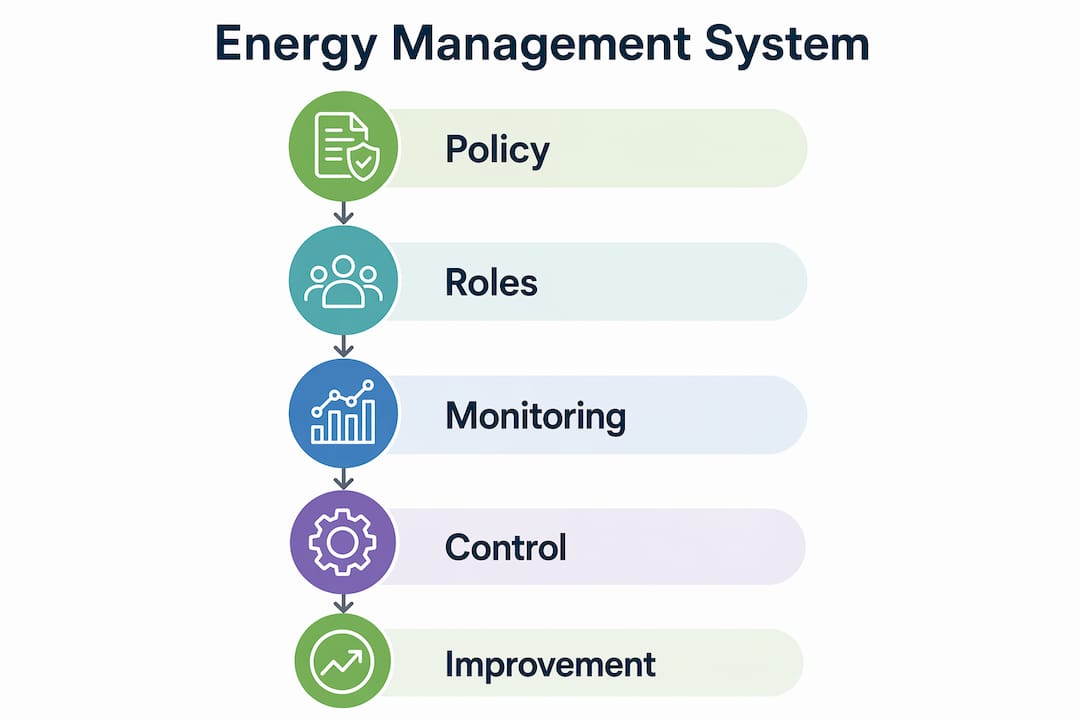
The key components of a functioning EnMS include an energy policy endorsed by top management, defined roles and responsibilities, a measurement and verification plan, and a formal management review process. These elements work together to create what practitioners call a control loop. Baselines are set, metrics are tracked, results are reviewed, and corrective actions are triggered when performance drifts.

Pro Tip: Assign a dedicated energy manager or cross-functional energy team before deploying any EnMS software. Technology without accountable ownership produces data, not results.
Why is energy management important for your organization?
The importance of energy management is most visible on the cost side, but the operational and strategic benefits run deeper. Participating sites typically achieve about 4% annual energy savings sustained over a decade. Compounded across a large facility portfolio, that figure represents a material reduction in operating expenditure.
The benefits extend well beyond the utility bill:
- Cost reduction: Systematic monitoring eliminates waste from equipment running outside optimal parameters, idle systems, and unscheduled demand spikes.
- Equipment longevity: Smart controls extend operational lifespan of equipment by preventing overuse and triggering scheduled maintenance before failures occur.
- Regulatory compliance: Governments and institutional investors increasingly require documented energy performance data. An EnMS provides the audit trail.
- Energy security: Organizations with active demand-side management programs are less exposed to price volatility and supply disruptions.
- Sustainability credentials: Verified energy reductions directly support Scope 2 emissions reporting under frameworks like GHG Protocol and CDP.
"The most critical aspect of energy management is creating a culture of continual improvement supported by quantitative tracking and decision-making." — U.S. Department of Energy
The risk dimension is underappreciated. Organizations without structured energy tracking often discover their largest inefficiencies only during a crisis, a price spike, a regulatory audit, or an equipment failure. A functioning EnMS surfaces those vulnerabilities before they become expensive.
What are the most effective energy management strategies?
Strategic energy management connects operational energy actions with governance and broader efficiency programs. The most effective organizations treat it as both a technical discipline and a management practice.
The table below compares the primary strategy categories by focus, tools, and organizational impact:
| Strategy | Primary Focus | Common Tools | Impact Level |
|---|---|---|---|
| Monitoring and metering | Real-time data collection | Smart meters, building automation systems | High |
| Automation and controls | System-level optimization | HVAC controls, lighting automation, BMS | High |
| Energy audits | Baseline and gap identification | ISO 50001 audits, ASHRAE Level I–III audits | Medium |
| Employee engagement | Behavioral and cultural change | Training programs, energy champions | Medium |
| Software platforms | Data management and reporting | EnMS software, 50001 Ready Navigator | High |
Energy management in commercial buildings focuses on monitoring and optimizing major systems like HVAC and lighting to reduce waste and costs. These systems account for the majority of energy consumption in most facilities, making them the highest-leverage targets for any efficiency program.
Automation is where most organizations see the fastest returns. Building management systems can adjust HVAC setpoints, lighting levels, and equipment schedules based on occupancy data and real-time conditions. The result is continuous optimization without requiring manual intervention.
Energy audits establish the baseline that makes everything else measurable. Without a verified baseline, you cannot calculate savings, set credible targets, or demonstrate progress to stakeholders. The ASHRAE audit framework provides three levels of rigor, from a simple walkthrough to a detailed investment-grade analysis.
Pro Tip: Start with a Level I ASHRAE audit to identify low-cost, no-cost opportunities before committing capital to major retrofits. Most organizations find 10–20% savings potential at this stage alone.
Employee engagement is the strategy most executives underinvest in. Behavioral changes, such as shutdown procedures, reporting anomalies, and following energy protocols, can deliver meaningful reductions at near-zero cost. The organizations that sustain long-term gains are those where energy awareness is embedded in daily operations, not confined to the facilities team.
How can executives lead successful energy management initiatives?
Leadership is the single variable that determines whether an energy management program sustains or stalls. Corporate energy management practices are often fragmented and inconsistent, lacking standard measurement and allocation frameworks. That fragmentation traces directly to insufficient executive engagement.
Effective executive leadership in energy management requires the following:
- Top-management commitment: Endorse the energy policy formally, allocate budget, and make energy performance a standing agenda item in operational reviews.
- Cross-functional team authority: Form an energy team with representatives from operations, finance, facilities, and procurement. Give them decision-making authority, not just advisory roles.
- Defined roles and responsibilities: Every significant energy use must have an owner. Ambiguity in accountability produces drift.
- Standardized measurement: Require consistent EnPIs across business units. Without standardized metrics, you cannot compare performance, identify outliers, or aggregate results.
- Alignment with business objectives: Frame energy targets in financial terms. A 4% annual reduction in energy costs is a margin improvement, not an environmental initiative.
- Continual improvement mindset: Treat energy performance the same way you treat quality or safety. Set targets, review results, and raise the bar each cycle.
Successful strategic energy management in industrial sectors depends heavily on top-management commitment and the formation of empowered, cross-functional energy teams. Organizations that delegate energy management entirely to facilities staff without executive sponsorship consistently underperform against those where leadership is visibly engaged.
The governance structure matters as much as the technology. An EnMS with strong executive backing and clear accountability will outperform a more sophisticated technical deployment that lacks organizational authority. For executives looking at practical approaches to energy leadership, the governance layer is where the real work begins.
Key takeaways
Effective energy management requires a structured EnMS, executive ownership, standardized metrics, and a culture of continual improvement to deliver sustained operational and financial results.
| Point | Details |
|---|---|
| EnMS is a control loop | Baselines, metrics, and corrective actions must cycle continuously, not run as one-off projects. |
| ISO 50001 drives repeatability | The PDCA framework makes energy gains systematic and measurable across leadership transitions. |
| Executive ownership is non-negotiable | Fragmented programs without top-management commitment consistently underperform structured ones. |
| 4% annual savings compounds | Sites using formal EnMS programs sustain roughly 4% annual energy savings over a decade. |
| Audits establish the baseline | Without a verified baseline, savings cannot be calculated or credibly reported to stakeholders. |
Why most energy programs fail before they start
I have reviewed enough organizational energy programs to recognize a consistent pattern. The technical infrastructure is usually adequate. The problem is almost always governance.
Companies invest in metering systems, building automation upgrades, and ISO 50001 consulting, then watch the program lose momentum within 18 months. The reason is predictable: no executive owns the outcome. Energy gets delegated to a facilities manager who lacks the authority to change procurement contracts, override operational schedules, or hold business unit leaders accountable for consumption data.
There remains a critical gap in many companies concerning leadership engagement and consistent frameworks to manage energy costs effectively. That gap is not a technical problem. It is a leadership problem.
The organizations I find most credible on this topic are those where the CFO can quote the company's energy intensity ratio in the same breath as gross margin. That level of integration does not happen by accident. It requires deliberate framing of energy as a financial metric, not an environmental one.
The other failure mode is treating the annual energy audit as the program itself. An audit produces a report. A report produces recommendations. Recommendations without a control loop produce nothing. The shift from audit-based thinking to EnMS-based thinking is the single most valuable conceptual move an executive can make on this topic.
For high-responsibility professionals, the parallel to personal performance is direct. Sustained output requires the same elements: a baseline, measurable indicators, regular review, and corrective action when performance drifts. Energy management at the organizational level is discipline applied to infrastructure.
— Joakim
How Viridos supports executives who demand sustained performance
The same discipline that drives effective organizational energy management applies to the executive running it. Sustained output at the leadership level requires the same systematic approach: baseline awareness, consistent tracking, and deliberate recovery.

Viridos is built for disciplined men in demanding roles who treat personal performance with the same rigor they apply to operational decisions. The Viridos Performance Journal offers structured resources for executives who want to maintain the mental clarity, physical resilience, and sustained drive that long-term leadership demands. If you manage energy at the organizational level, you already understand the value of systems. Apply the same logic to yourself.
FAQ
What is energy management in simple terms?
Energy management is the process of monitoring, controlling, and optimizing how an organization uses energy to reduce costs and waste. It involves setting targets, measuring performance, and taking corrective action when consumption exceeds baselines.
What is the role of energy management in a business?
The role of energy management is to reduce operational costs, extend equipment lifespan, meet regulatory requirements, and support sustainability goals. It functions as a governance practice that connects energy consumption data to financial and strategic decision-making.
What is the difference between energy management and energy efficiency?
Energy efficiency refers to using less energy to perform the same task, such as replacing equipment with lower-consumption models. Energy management is the broader system of practices that identifies where efficiency improvements are needed, tracks their impact, and sustains gains over time.
How does ISO 50001 relate to energy management systems?
ISO 50001 is the international standard that defines the requirements for an EnMS. It provides the Plan-Do-Check-Act framework that makes energy performance improvements systematic and repeatable rather than dependent on individual effort or one-time projects.
What are the measurable benefits of energy management programs?
Organizations using formal EnMS programs typically achieve about 4% annual energy savings sustained over a decade. Additional benefits include reduced equipment failure rates, improved regulatory compliance, and stronger sustainability reporting credentials.