
TL;DR:
- Male vitality encompasses physical, mental, and emotional health that supports sustained performance and longevity. It is improved through consistent exercise, quality nutrition, adequate sleep, stress management, and targeted supplements when appropriate. Prioritizing these habits over time builds resilience, cognitive clarity, and emotional stability essential for long-term well-being.
Male vitality is defined as the integrated state of physical strength, mental clarity, and emotional resilience that determines a man's capacity for sustained performance, health, and longevity. The term is widely used in men's health and wellness contexts, though the recognized clinical framework is physiological and psychological vitality, which encompasses energy and well-being beyond the simple absence of disease. For men aged 30 to 55 operating in demanding professional roles, this distinction matters. Vitality is not a fixed trait. It is a dynamic output of how you live, recover, and invest in yourself over time.
What is male vitality, and what are its core components?
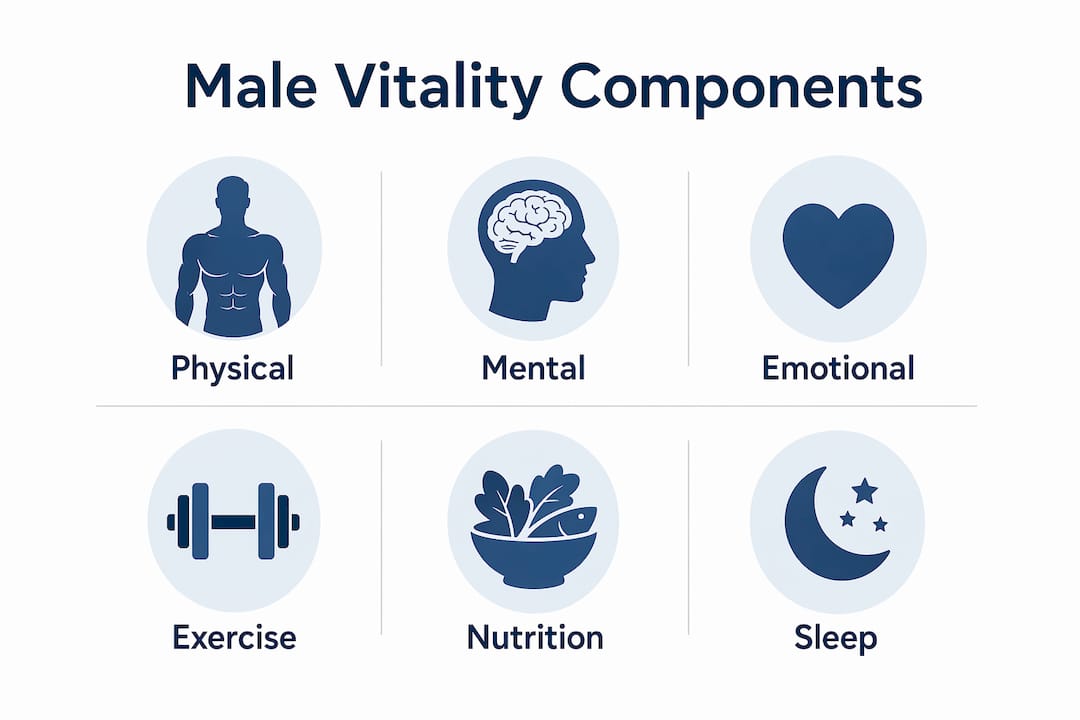
Male vitality is a holistic integration of physical health, mental clarity, and emotional resilience that influences both performance and quality of life. Reducing it to sexual function or muscle size misses the full picture. The concept spans three interconnected domains, each of which reinforces the others.

Physical vitality covers the fundamentals most men recognize: energy levels, muscular strength, cardiovascular endurance, and recovery capacity. A man with strong physical vitality moves through demanding days without accumulating a deficit. He recovers from exertion, illness, or stress without prolonged downtime.
Mental vitality is the capacity for sustained cognitive clarity, focused decision-making, and resistance to mental fatigue. For executives and founders, this is often the most operationally critical dimension. Cognitive fog, decision fatigue, and reduced working memory are not personality flaws. They are measurable signs that mental vitality is under strain.
Emotional vitality includes mood stability, motivation, and the psychological resilience to absorb pressure without losing initiative. Men with strong emotional vitality maintain consistent drive across weeks and months, not just during peak periods.
- Physical vitality: stamina, strength, recovery speed, cardiovascular function
- Mental vitality: focus, cognitive endurance, resistance to fatigue
- Emotional vitality: mood regulation, motivation, stress resilience
These three domains are not independent. Exercise significantly promotes mental vitality by reducing depression and anxiety while improving cognitive function and confidence. A man who neglects physical training will eventually pay for it in mental and emotional output.
Pro Tip: Track all three dimensions, not just the physical. A weekly self-assessment of energy, focus, and mood gives you a more accurate vitality baseline than any single biomarker.
How can men recognize signs of their current vitality level?
Identifying where you stand requires honest observation across multiple dimensions. The signs of low vitality are often dismissed as normal aging, which is one of the most costly mistakes a high-performing man can make.
Low vitality can manifest as chronic fatigue, decreased stamina, mental fog, and mood fluctuations. Persistent low energy should be evaluated as a possible medical signal, not normalized. The distinction between aging-related change and a correctable underlying factor is critical and often requires a physician's assessment.
Signs of declining vitality to monitor:
- Chronic fatigue that sleep does not resolve. Waking unrefreshed despite adequate hours is a primary indicator that recovery systems are compromised.
- Reduced stamina during physical or cognitive tasks. If you are hitting walls earlier in workouts or workdays than you did 12 months ago, that trajectory matters.
- Mental fog and slower decision-making. Difficulty concentrating, forgetting details, or feeling mentally sluggish mid-afternoon are measurable drops in cognitive vitality.
- Mood instability or loss of motivation. Irritability, reduced drive, or a flattened sense of purpose are emotional vitality signals that warrant attention.
- Slower physical recovery. Muscle soreness lasting more than 72 hours, or frequent minor illness, indicates compromised physiological resilience.
Signs of strong vitality are equally specific: sustained energy through a full workday, sharp focus during complex tasks, positive and stable mood, and the ability to recover from physical exertion within expected timeframes. These are not aspirational states. They are the functional baseline that disciplined living produces.
Pro Tip: Schedule a full blood panel annually, including testosterone, vitamin D, thyroid function, and inflammatory markers. Objective data removes guesswork from vitality assessment.
What lifestyle habits and practices enhance male vitality effectively?
Male vitality is best framed as an outcome of integrated lifestyle foundations including exercise, nutrition quality, recovery, and mental health. No single habit produces it. The combination and consistency do.
Exercise is the highest-leverage input. Men should engage in at least 150 minutes of moderate aerobic activity weekly, plus two days of muscle-strengthening exercises. This is not a suggestion calibrated for general population health. For men in demanding roles, it is the minimum threshold for maintaining physical and mental vitality simultaneously. Structured programs from coaches at REP Philosophy align training to these evidence-based parameters with individual precision.
Nutrition is the second pillar. A diet rich in protein, healthy fats, and micronutrients supports male vitality by enhancing energy and reducing chronic disease risk. For executive men, the practical application means prioritizing whole food sources, managing caloric quality rather than just quantity, and treating nutrition as a performance input rather than a social activity. The High Performance Nutrition Guide for Executives outlines how diet quality maps directly to energy levels and cognitive output.
Sleep and recovery are non-negotiable. Seven to nine hours of quality sleep is the period during which testosterone is synthesized, tissue is repaired, and memory is consolidated. Cutting sleep to gain working hours is a net negative trade for any man prioritizing sustained performance.
- Prioritize compound resistance training: squats, deadlifts, rows, and presses
- Eat 1.6 to 2.2 grams of protein per kilogram of body weight daily
- Limit alcohol to no more than two drinks per day, as alcohol directly suppresses testosterone production and sleep quality
- Practice deliberate stress management: structured breathing, meditation, or scheduled decompression time
- Maintain social connection, which research consistently links to reduced cortisol and improved mood stability
Pro Tip: Treat your sleep schedule with the same discipline as a board meeting. Consistent sleep and wake times, even on weekends, produce measurably better hormonal and cognitive outcomes than variable schedules.
How do supplements fit into male vitality optimization?
Supplements occupy a specific and limited role in male vitality optimization. They are not a substitute for lifestyle foundations. They are a targeted addition for men who have already built those foundations and want to address specific gaps.
The most studied options include Asian Ginseng, Maca, and vitamin D. Each has a distinct evidence profile. Vitamin D deficiency is linked to erectile dysfunction and broader hormonal disruption, making it one of the most clinically relevant supplements for men in northern latitudes or office-heavy lifestyles. Asian Ginseng has demonstrated modest benefits for energy and cognitive function in controlled trials. Maca shows some evidence for libido and mood, though the effect sizes are modest.
The safety landscape requires attention. The FDA has warned that products marketed for vitality may contain undisclosed pharmacological agents such as sildenafil or tadalafil. This is not a fringe concern. It is a documented pattern in the supplement industry that makes sourcing and transparency non-negotiable criteria.
| Supplement | Primary evidence | Key consideration |
|---|---|---|
| Vitamin D | Hormonal support, erectile function | Deficiency is common; test before supplementing |
| Asian Ginseng | Energy, cognitive function | Modest effect sizes; quality sourcing matters |
| Maca | Libido, mood | Limited large-scale trials; generally well tolerated |
| Multi-ingredient blends | Variable | High risk of undisclosed ingredients; scrutinize sourcing |
The right approach treats supplements as precision tools, not daily insurance. For an overview of vitamins with the strongest evidence base for executive men, the top vitamins for male executives guide provides a structured starting point.
Pro Tip: Consult a physician before starting any supplement protocol. Request a blood panel first. Supplementing without knowing your baseline is guesswork, not optimization.
What role does sustained vitality play in long-term health and performance?
Male vitality predicts functional independence and resilience across the aging process, correlating with reduced risk of chronic disease and prolonged active engagement in life. This is the long-term argument for treating vitality as a strategic priority rather than a wellness trend. The man who maintains disciplined lifestyle habits at 40 is building the physiological and psychological capital he will draw on at 60 and 70.
The connection between sustained vitality and mental and emotional well-being compounds over time. Men who maintain physical activity, quality nutrition, and recovery discipline into their fifties report higher life satisfaction, stronger professional performance, and greater emotional stability than those who do not. The vitality optimization guide for men 40 to 65 maps this trajectory with specific frameworks for each decade.
Vitality longevity is not about extreme measures. It is about consistency applied to the right inputs. The men who age with the most functional capacity are not those who trained hardest in their thirties. They are those who trained most consistently across decades, managed stress deliberately, and treated recovery as a performance variable rather than an afterthought.
Pro Tip: Think of vitality as a compound investment. The returns are not dramatic in any single month, but the gap between disciplined and undisciplined men becomes significant and visible by the mid-fifties.
Key takeaways
Male vitality is the integrated output of physical, mental, and emotional health, and it is built through consistent, evidence-based lifestyle choices rather than any single intervention.
| Point | Details |
|---|---|
| Vitality is multi-dimensional | Physical strength, mental clarity, and emotional resilience all contribute equally to male vitality. |
| Low vitality signals require assessment | Chronic fatigue and mental fog are medical indicators, not inevitable aging, and warrant a physician's evaluation. |
| Exercise is the highest-leverage habit | 150 minutes of aerobic activity weekly plus strength training forms the non-negotiable foundation. |
| Supplements fill gaps, not foundations | Vitamin D, Asian Ginseng, and Maca have evidence, but sourcing quality and medical guidance are critical. |
| Consistency compounds over decades | Men who sustain disciplined habits into their fifties build measurably greater functional capacity and longevity. |
Vitality is not a destination, it is a discipline
I have worked with and observed enough high-performing men to say this plainly: the ones who struggle most with vitality in their fifties are almost always the ones who treated it as something to address later. They were productive, disciplined in their professional lives, and completely undisciplined about recovery, nutrition, and stress management. The career absorbed everything.
What I find most instructive is that the vitality gap between disciplined and undisciplined men is not obvious at 35. It becomes stark at 50. The man who has maintained consistent training, managed his sleep, and treated nutrition as a performance input does not just look different. He thinks differently, leads differently, and sustains initiative in ways that his peers cannot match.
The mistake I see most often is treating vitality as a binary: either you are sick or you are fine. The more useful frame is a performance spectrum. You are either building capacity or drawing it down. Every week of poor sleep, sedentary behavior, or nutritional neglect is a withdrawal. Every week of disciplined training, quality food, and deliberate recovery is a deposit.
For men in demanding roles, the healthy lifestyle routines for lasting vitality are not about aesthetics or longevity in the abstract. They are about maintaining the cognitive sharpness, emotional stability, and physical energy that high-responsibility roles demand. That is the real importance of male vitality for this audience.
— Joakim
How Viridos supports sustained male vitality
Viridos is built for men who take performance seriously and want formulations that match that standard.

Viridos produces small-batch, sublingual performance formulations in Sweden, designed for bioavailability and precision rather than mass-market convenience. The Performance Journal gives you a structured framework to track vitality inputs and outputs across weeks and months, turning subjective experience into actionable data. For men who want ongoing access to premium formulations and expert guidance, the Viridos Membership provides controlled access to executive-grade vitality support. Every product and resource reflects the same principle: sustained performance requires sustained investment in the right inputs.
FAQ
What is male vitality in simple terms?
Male vitality is the integrated state of physical energy, mental clarity, and emotional resilience that enables a man to perform, recover, and sustain well-being over time. It extends well beyond sexual health or physical strength to include cognitive function and mood stability.
What are the most reliable signs of male vitality?
Strong vitality presents as sustained energy through demanding days, sharp focus, stable mood, and fast recovery from physical exertion. Declining vitality shows up as chronic fatigue, mental fog, mood instability, and slower physical recovery.
What enhances male vitality most effectively?
The most effective approach combines regular aerobic and strength training, a diet rich in protein and micronutrients, seven to nine hours of quality sleep, and deliberate stress management. No single supplement replaces these foundations.
Are male vitality supplements safe?
Some supplements like vitamin D and Asian Ginseng have credible evidence and good safety profiles when sourced from reputable manufacturers. The FDA has documented cases of vitality products containing undisclosed drugs like sildenafil, making sourcing transparency and medical consultation non-negotiable.
How does male vitality affect long-term health?
Sustained vitality correlates with reduced chronic disease risk, greater functional independence as men age, and stronger mental and emotional well-being over time. Men who maintain disciplined lifestyle habits consistently report higher quality of life and performance capacity into their sixties.