
TL;DR:
- Baseline assessment of testosterone, VO2 max, and waist circumference guides effective vitality improvement.
- Sleep, body fat reduction, and consistent habits form the foundation for lasting hormonal health.
- Targeted resistance training, proper nutrition, and strategic supplements optimize vitality when basics are in place.
You've built the career, the discipline, and the reputation. Yet somewhere between board meetings and late-night decisions, your energy stopped keeping pace. For men in their 40s, 50s, and 60s who operate at the top of demanding fields, declining vitality isn't just inconvenient—it directly erodes decision quality, emotional resilience, and competitive edge. This guide delivers a stepwise, evidence-backed protocol to reclaim that edge: from identifying where you actually stand, to building the habits, training, and targeted inputs that produce measurable, lasting results.
Table of Contents
- Assess your baseline: Metrics, symptoms, and self-audit
- Establish your foundation: Sleep, body composition, and core habits
- Upgrade inputs: Nutrition, training, and essential supplements
- Monitor results, avoid backslides: Tracking progress and troubleshooting stagnation
- Why the basics beat shortcuts: Our take on lasting vitality
- Take your vitality further with VIRIDOS
- Frequently asked questions
Key Takeaways
| Point | Details |
|---|---|
| Baseline metrics matter | Clear tracking of hormones, VO2 max, and waistline set up targeted strategies for success. |
| Sleep and body composition | Optimizing sleep and reducing central fat dramatically elevate energy and testosterone levels. |
| Evidence-based training works | Heavy resistance training and strategic nutrition show measurable boosts in vitality and executive performance. |
| Troubleshoot, don’t guess | Verify progress regularly and adjust habits at early signs of stagnation or regression. |
| Consistency beats shortcuts | Sustained application of core habits delivers enduring results over quick fixes or excessive supplements. |
Assess your baseline: Metrics, symptoms, and self-audit
To optimize anything, you must start with clear, actionable metrics. Vague goals produce vague results. Before adjusting a single habit, you need a precise starting line—both objective numbers and honest self-observation.
The most critical biomarkers for midlife male vitality are total testosterone, free testosterone, SHBG (sex hormone-binding globulin, which determines how much testosterone is biologically active), VO2 max (your cardiovascular fitness ceiling), and waist circumference. According to current research, free T above 15 pg/mL and total testosterone in the 600 to 800 ng/dL range represent strong functional targets, with elite VO2 max benchmarks of 52 ml/kg/min achievable even into advanced age.
| Marker | Optimal range | Acceptable range | Red flag |
|---|---|---|---|
| Total testosterone | 600–800 ng/dL | 400–600 ng/dL | Below 400 ng/dL |
| Free testosterone | >15 pg/mL | 10–15 pg/mL | Below 10 pg/mL |
| SHBG | 20–40 nmol/L | 40–60 nmol/L | Above 60 nmol/L |
| VO2 max | >50 ml/kg/min | 40–50 ml/kg/min | Below 40 ml/kg/min |
| Waist circumference | <35 inches | 35–40 inches | Above 40 inches |
Symptoms often surface before lab values shift. Watch for: waking unrefreshed despite 7+ hours of sleep, reduced ability to concentrate through long meetings, slower recovery from physical effort, irritability or emotional flatness, and diminished drive to initiate. These aren't signs of aging gracefully—they're signals worth acting on.
Here's a practical home self-audit to run before your next lab appointment:
- Measure your waist at the navel, relaxed, first thing in the morning.
- Score your symptoms on a 1 to 10 scale across: energy, focus, sleep quality, mood, and libido.
- Track your sleep for one week using a wearable or a simple log—note total hours and how rested you feel.
- Schedule bloodwork including total T, free T, SHBG, vitamin D, and a basic metabolic panel.
- Benchmark your fitness with a 12-minute run or a resting heart rate check.
For a structured starting point, the executive vitality assessment at VIRIDOS provides a curated framework. You can also apply the self-optimization framework to build your personal tracking system from day one.
Pro Tip: Track both subjective scores and objective markers monthly. Numbers alone miss the lived experience; symptoms alone miss what's actually happening hormonally. You need both columns.
Establish your foundation: Sleep, body composition, and core habits
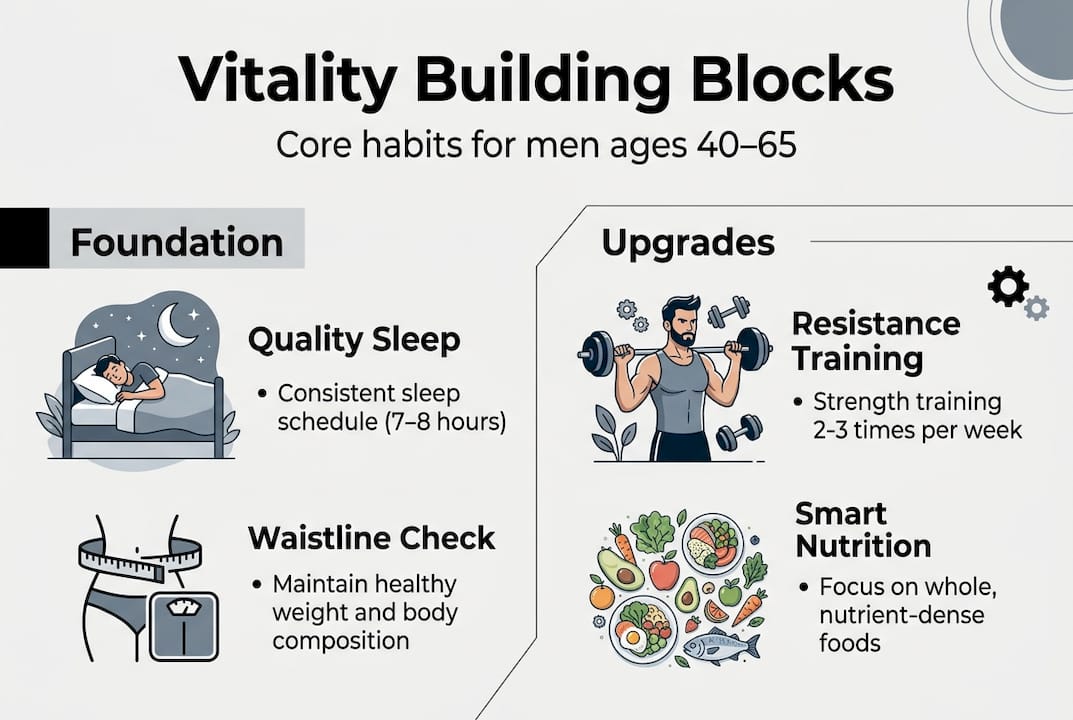
Once you know your baseline, it's time to secure the fundamentals. No biohack, supplement stack, or advanced protocol will compensate for poor sleep or excess abdominal fat. These two factors alone account for more vitality loss in men over 40 than almost anything else.
Waist circumference above 40 inches is a direct driver of hormonal decline. Excess visceral fat increases aromatase enzyme activity, which converts testosterone into estrogen. Body fat reduction below 40 inches can produce a 10 to 15 percent increase in free testosterone by lowering aromatase activity alone—no prescription required.
Sleep is equally non-negotiable. Roughly 70% of daily testosterone is released during slow-wave sleep (SWS), the deepest phase. Cutting sleep to six hours or less doesn't just make you tired—it systematically suppresses your hormonal output night after night. Mental clarity, emotional regulation, and physical recovery all follow the same curve downward.

| Approach | Impact on vitality | Timeline |
|---|---|---|
| Consistent 7–9h sleep | High: hormonal, cognitive, recovery | 2–4 weeks |
| Waist below 40 inches | High: testosterone, metabolic health | 8–16 weeks |
| Morning sunlight exposure | Moderate: cortisol rhythm, mood | 1–2 weeks |
| Advanced biohacks (saunas, ice baths) | Low to moderate without foundation | Variable |
| Supplement stacks without basics | Minimal | Negligible |
The Huberman protocol essentials reinforce this hierarchy clearly: foundation first, optimization second.
Your non-negotiables:
- Consistent bedtime and wake time, even on weekends—circadian rhythm is not optional
- Morning sunlight within 30 minutes of waking to anchor cortisol and melatonin cycles
- Eliminate alcohol and processed food during the active optimization phase
- Resistance training at least twice per week as a baseline
- Protein intake of at least 0.7 grams per pound of bodyweight daily
These core lifestyle routines are what separate men who sustain results from those who cycle through trends. For a longer view, the long-term health tips designed for executives lay out how to maintain these habits under real-world pressure.
Pro Tip: If you're tempted to add a new supplement or protocol before your sleep and waist are dialed in, stop. Fix the foundation first. The return on basics is five times higher than any advanced intervention.
Upgrade inputs: Nutrition, training, and essential supplements
When your foundation is solid, targeted training, smart food choices, and strategic supplements deliver measurable upgrades. This is where precision pays off—not before.
Resistance training is the single most powerful lifestyle lever for testosterone in midlife men. Training at 70 to 85% of 1RM, three sessions per week over 12 weeks, produced a 17.7% increase in free testosterone and an 11.4% reduction in SHBG in men aged 40 to 60. That's a meaningful hormonal shift without a single prescription. Compound movements—squats, deadlifts, rows, presses—drive the greatest hormonal response.
Nutrition for performance in this age group centers on three priorities: adequate protein to preserve lean mass, healthy fats to support steroid hormone synthesis, and micronutrient density over caloric restriction. Crash dieting suppresses testosterone faster than almost anything else. Eat to perform, then let the training create the deficit.
For supplementation, the Huberman protocol offers a research-informed stack: Tongkat Ali and Fadogia Agrestis cycled (not taken indefinitely), Zinc and Boron to support testosterone metabolism, and Vitamin D3 especially for men with limited sun exposure. These are adjuncts, not replacements for the foundation.
Here's how to integrate this into a demanding schedule:
- Block three 45-minute resistance sessions per week as non-negotiable calendar commitments.
- Hit protein targets first at every meal before worrying about anything else.
- Add Vitamin D3 and Zinc daily if bloodwork shows deficiency—common in executives with indoor-heavy schedules.
- Cycle Tongkat Ali and Fadogia for 8 weeks on, 4 weeks off, only after sleep and training are consistent.
- Track your lifts and energy weekly to confirm the protocol is working.
For performance longevity strategies and holistic performance frameworks, VIRIDOS has curated resources built specifically for this phase of optimization. Research comparing lifestyle versus pharmaceutical approaches consistently shows lifestyle interventions as the durable, lower-risk first line.
Common pitfalls to avoid:
- Overtraining by adding volume before recovery is established
- Chasing trending supplements before mastering protein and sleep
- Skipping deload weeks or rest days under the belief that more is always better
- Ignoring micronutrient deficiencies while spending on expensive stacks
Monitor results, avoid backslides: Tracking progress and troubleshooting stagnation
Progress isn't linear—success depends on ongoing feedback and rapid course correction. The men who sustain results long-term are not the ones who work hardest in week one. They're the ones who build a feedback loop and actually use it.
Schedule routine check-ins every four to six weeks: review your lab markers, sleep data, waist measurement, and a simple performance log covering energy, focus, and training output. If all four are trending positively, stay the course. If one stalls, that's your signal.
"Overtraining elevates cortisol, which directly suppresses testosterone. Chronic caloric restriction does the same. The body reads both as threats, and it responds by protecting fat stores and downregulating anabolic hormones. More is not always more." Monitoring free T above 15 pg/mL and total T in the 600 to 800 ng/dL range gives you an objective anchor point throughout.
Red flags that signal a need to adjust:
- Stalled or declining lifts despite consistent training
- Mood swings or increased irritability without obvious external cause
- Sleep duration shortening or waking at 3 to 4 AM regularly
- Chronic fatigue that doesn't resolve after a rest day
- Libido dropping after an initial improvement period
When you hit a plateau, the troubleshooting sequence matters. First, reduce training volume by 20% for two weeks and prioritize sleep. Second, audit your nutrition for hidden caloric restriction or protein shortfalls. Third, check whether your supplement cycling schedule is on track. Fourth, retest bloodwork before adding anything new.
The vitality strategies checklist at VIRIDOS offers a structured review process for exactly these moments.
Pro Tip: Cycle your interventions deliberately. Run a focused 12-week block, take a two-week deload, reassess, then build the next block. This prevents adaptation plateaus and keeps your system responsive to the inputs that matter.
Why the basics beat shortcuts: Our take on lasting vitality
Here's the uncomfortable truth most performance content won't say directly: the men who plateau fastest are usually the ones who optimized soonest. They found a protocol, layered on supplements, bought the devices, and skipped the part where they fixed their sleep and dropped the waist. The results came fast and then stopped.
The evidence comparing lifestyle to pharmaceutical approaches is consistent—foundational habits outperform shortcuts in durability and safety. TRT and aggressive supplementation have their place, but they're not where you start, and they're not what sustains you.
"The fundamentals are boring because they work. Shortcuts are exciting because they don't have to."
At VIRIDOS, we've seen this pattern repeatedly. The men who commit to the basics—sleep, training, body composition, and honest tracking—build results that compound. The men chasing the next protocol get a spike, then a slide. High-performance living is not about doing more. It's about doing the right things consistently, with precision and patience.
Take your vitality further with VIRIDOS
If this guide has clarified where to start, VIRIDOS is built to take you further. Our membership gives you access to curated protocols, executive-grade tracking tools, and science-driven frameworks designed specifically for high-performing men in demanding roles.

The VIRIDOS Membership connects you to structured programs that integrate training, nutrition, and recovery into a single, manageable system. Use the Performance Journal to track your metrics with precision and identify patterns before they become problems. If you want to understand the research driving every recommendation, the science behind VIRIDOS is fully transparent and evidence-grounded. This is not a supplement company. It's a performance system built for men who take results seriously.
Frequently asked questions
How quickly can I see results from this vitality optimization protocol?
Most men notice meaningful improvements in energy and focus within 8 to 16 weeks of consistent adherence, with full hormonal and cardiovascular effects typically emerging over 16 to 24 weeks of sustained effort.
Do I need supplements, or can I achieve results through lifestyle alone?
For most men, lifestyle interventions outperform supplements and pharmaceutical approaches when foundational habits are consistent—supplements are useful adjuncts, not prerequisites for progress.
What are the most accurate ways to track my progress?
Periodic bloodwork for free T and SHBG, combined with weekly sleep tracking and monthly waist measurements, gives you the clearest and most actionable picture of where you stand.
Can overtraining or extreme dieting harm my hormone levels?
Yes—overtraining raises cortisol and chronic caloric restriction suppresses testosterone directly, which is why recovery and adequate nutrition are non-negotiable parts of any effective protocol.