
The most reliable path to correcting androgen deficiency naturally combines three elements: a lifestyle-first program built around resistance training, sleep, and weight management; a short list of nutrients and botanicals with genuine evidence behind them; and laboratory monitoring that confirms whether any of it is working. This is not a supplement question. It's a systems question, and men who treat it that way see better outcomes than men chasing a single ingredient.
Most men who pursue androgenbrist naturligt stöd or natural support for androgen deficiency want to know what actually moves the needle before they consider prescription therapy. The honest answer is that a handful of interventions carry real evidence, and the rest is marketing. Within eight to twelve weeks of disciplined execution, many men report improved energy, sharper recovery between training sessions, and for some, a measurable return of libido. But nothing on this list replaces a diagnosis.
Before adjusting anything, know the benchmark clinicians use: a total testosterone reading under 300 ng/dL, confirmed on two separate early-morning draws, is the threshold most guidelines recognize for low testosterone. Symptoms alone don't diagnose it.
Two starting priorities matter more than any supplement stack:
- Get tested properly. Two early-morning total testosterone draws, not one afternoon lab visit.
- Start with resistance training, sleep, and weight management before anything else enters the plan.
Key Takeaways
Correcting androgen deficiency naturally works best as a sequenced plan: confirm the diagnosis with labs, prioritize training and sleep, then layer in evidence-backed nutrients and monitor with repeat testing.
| Point | Details |
|---|---|
| Confirm before you act | Two early-morning total testosterone draws under 300 ng/dL, not symptoms alone, define genuine deficiency. |
| Lifestyle changes come first | Resistance training three to four times weekly, seven to nine hours of sleep, and weight loss outperform most supplements. |
| Correct real deficiencies | Vitamin D and zinc supplementation only shows benefit when a true deficiency exists. |
| Retest at twelve weeks | Safety labs and repeat morning testosterone draws confirm whether the plan is working. |
| Viridos fits as an adjunct | A small-batch Swedish sublingual spray designed to support, not replace, a lifestyle-first plan and medical monitoring. |
Table of Contents
- What Androgenbrist Naturligt Stöd Really Requires: Why Testing Comes First
- The Lifestyle Steps With the Strongest Evidence
- Supplements With Real Evidence, and Where the Evidence Runs Thin
- How to Run a Safe, Measured Trial
- When Lifestyle Isn't Enough: Medical Options Worth Discussing
- What Discipline Actually Buys You Here
- A Precision Option Within a Disciplined Plan
- Sources
What Androgenbrist Naturligt Stöd Really Requires: Why Testing Comes First
A single blood draw taken at 3 p.m. tells you almost nothing reliable about your androgen status. Testosterone follows a circadian rhythm, peaking in the early morning and declining through the day, which is why the American Academy of Family Physicians recommends confirming a low reading with two separate early-morning draws before treating anything.
Illness, poor sleep the night before, recent heavy alcohol use, and even certain medications can suppress a single reading enough to produce a false positive. A man who skipped sleep for a client deadline and gets tested the next morning may see a number that doesn't reflect his baseline at all. This is precisely why repeat testing, not a one-off panel, anchors a credible diagnosis.
Beyond the testosterone number itself, a competent evaluation includes baseline hematocrit, PSA, and a metabolic panel. These aren't bureaucratic add-ons. Hematocrit tracks blood thickness, which matters enormously if testosterone therapy becomes part of your plan later. PSA screens prostate risk. The metabolic panel catches insulin resistance, which independently suppresses androgen production and often travels alongside low testosterone in men carrying excess visceral fat.
Clinical guidance is consistent on sequencing: lifestyle changes come before medication in most cases, and lifestyle changes are evaluated using the same objective labs used to confirm deficiency in the first place. Symptom improvement without corresponding lab changes is a weaker signal than most men assume.
| Diagnostic element | What it confirms | Why it matters |
|---|---|---|
| Two early-morning total testosterone draws | Confirms genuine deficiency vs. daily variation | Single tests produce false positives and negatives |
| Hematocrit | Blood thickness, cardiovascular risk | Rises with testosterone therapy and needs monitoring |
| PSA | Prostate baseline | Required before and during hormonal treatment |
| Metabolic panel | Insulin resistance, metabolic health | Poor metabolic health independently suppresses androgens |
A hormone lab built for men in demanding roles removes much of the friction here, since scheduling two early-morning draws around a packed calendar is often the hardest part of the process.
The Lifestyle Steps With the Strongest Evidence
Nothing you take by mouth outperforms what your body does when you train, sleep, and eat with discipline. Harvard Health lists weight management, resistance training, sleep quality, and stress control as the primary levers for slowing age-related testosterone decline, and the order matters. Here is the sequence with the best-supported returns:
- Lose excess weight if you're carrying it. Visceral fat converts testosterone to estrogen through aromatase activity. Weight loss in overweight men produces some of the most consistent testosterone improvements seen in the research.
- Train with resistance three to four times weekly. Compound lifts (squats, deadlifts, presses) recruit the most muscle mass and produce the strongest acute hormonal response. A resistance protocol of three to four sessions weekly is a reasonable baseline for most men.
- Protect seven to nine hours of sleep. Sleep deprivation drops testosterone measurably within a week. If you snore heavily or wake exhausted, screen for sleep apnea, since untreated apnea suppresses androgen production independent of sleep duration.
- Build in daily stress reduction. Chronic cortisol elevation competes with androgen production at a hormonal level. Ten minutes of deliberate decompression, whether that's breathwork, a walk without a phone, or a fixed shutdown time, counts more than an occasional weekend reset.
- Eat to supply the raw materials. Zinc-rich foods (oysters, beef, pumpkin seeds), healthy fats (olive oil, fatty fish, egg yolks), and adequate protein (roughly 0.7 to 1 gram per pound of bodyweight) give your endocrine system what it needs to manufacture hormones in the first place.
Pro Tip: Stack your resistance training and stress reduction into the same window. A 45 minute lifting session before your first meeting does double duty: it's the single most time-efficient intervention on this list for a man who can't add hours to his day.
Most men who commit fully to these five actions see measurable change within eight to twelve weeks. Weight loss and sleep correction tend to show up fastest; training adaptations and stress-related improvements build more gradually. For a broader view of how these pieces fit into a longer performance arc, this longevity checklist is worth reading alongside your training plan.
Supplements With Real Evidence, and Where the Evidence Runs Thin
Supplement evidence for androgen support splits into three honest categories: well-supported correction of a genuine deficiency, modest support with mixed trial results, and marketing claims with little behind them. Knowing which bucket an ingredient falls into changes how much confidence you should place in it.
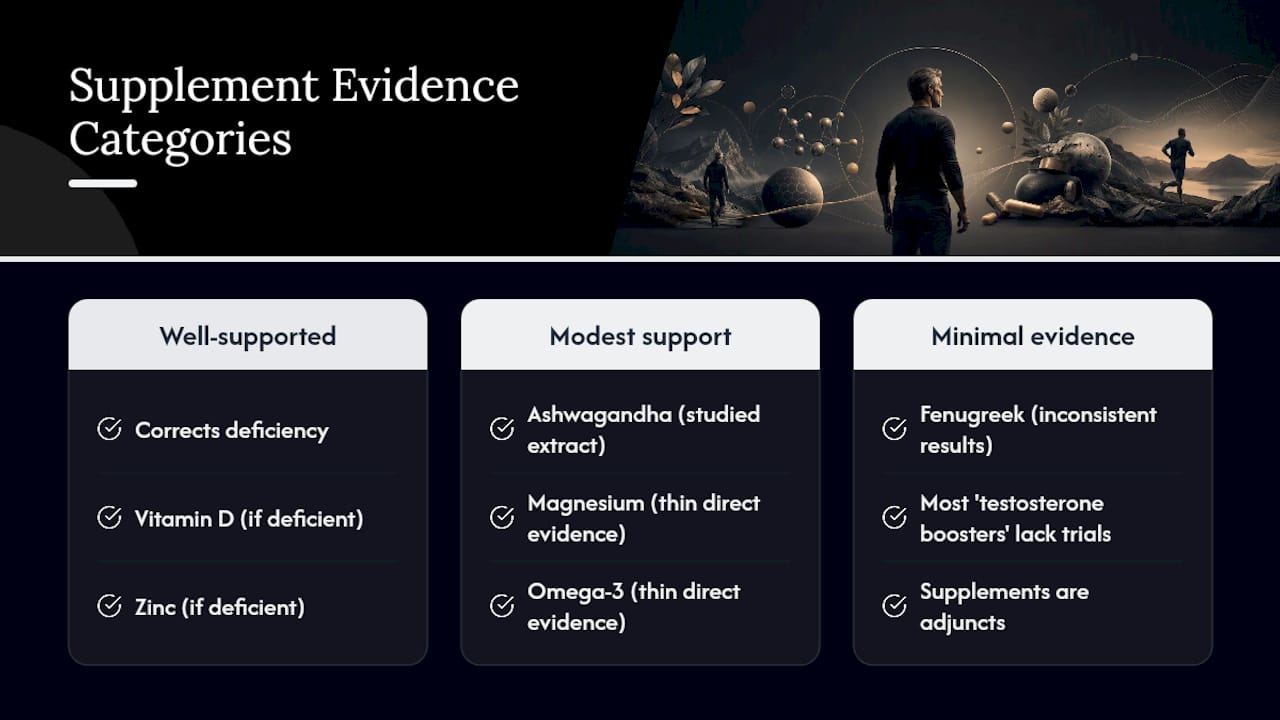
Vitamin D belongs in the first category, but only for men who are actually deficient. Correcting a vitamin D deficiency has shown testosterone improvements in trial data; supplementing when your levels are already adequate does not.
Zinc works the same way. Zinc deficiency directly impairs testosterone production, and correcting it restores levels. Men with normal zinc status see little additional benefit from megadosing.
Ashwagandha is the standout among botanicals. Specific extracts have produced modest testosterone increases in clinical trials, making it one of the few herbal ingredients with a credible track record. Not every ashwagandha product uses the studied extract, however, so formulation matters as much as the ingredient name.
Magnesium and fish oil (omega-3) support the physiological environment testosterone production depends on, magnesium through enzymatic pathways involved in hormone synthesis, omega-3s through reduced inflammation and improved cell membrane function, though the direct evidence for either raising testosterone independently is thinner than for zinc or vitamin D.
Fenugreek shows inconsistent results across studies. Some trials report modest improvements in libido and subjective vitality; others show no measurable hormonal change. Treat it as unproven rather than dismissed outright.
The evidence is clear on one point: most products marketed as "testosterone boosters" lack robust clinical backing and belong in a supporting role, not as the centerpiece of a plan.
Supplements are adjuncts. They correct deficiencies and support a system already doing the harder work through training, sleep, and weight management. A men considering a broader botanical or plant-derived strategy can find more detail in Viridos's guide to serum testosterone support, and an independent overview of the category is available from RankOfSupplements for readers who want a second perspective before choosing what to add.
How to Run a Safe, Measured Trial
Treat this like any other executive decision: define your baseline, set a timeline, and measure results against a fixed standard rather than how you feel on a given Tuesday.
Baseline checklist, before you change anything:
- Two early-morning total testosterone draws
- Hematocrit, PSA, and a metabolic panel
- Vitamin D level
- Zinc level, if clinically indicated
A practical twelve-week sequence:
- Start resistance training and sleep correction immediately. These carry no downside and the fastest measurable returns.
- Add stress reduction and dietary adjustments in week one alongside training.
- Introduce any indicated supplement (vitamin D or zinc if deficient, ashwagandha if desired) by week two, one at a time, so you can identify what's actually contributing.
- Retest safety labs (hematocrit, PSA) at the eight to twelve week mark, particularly if you've made significant changes.
- Retest total testosterone with two early-morning draws at twelve weeks to assess whether lifestyle and supplementation moved the number.
Watch for a few signals along the way: rising hematocrit, new cardiovascular symptoms, unexplained mood shifts, or fertility concerns if you're planning children. Any of these warrants a call to your physician before continuing, not after your next scheduled check-in.
Pro Tip: If your calendar makes two early-morning lab visits genuinely difficult, look for remote or mobile hormone-lab services that draw blood before your first meeting. The logistics shouldn't be the reason you skip proper testing.
When Lifestyle Isn't Enough: Medical Options Worth Discussing
Three months of disciplined lifestyle change with no improvement in symptoms or lab values is the point to escalate. So is a confirmed low testosterone reading on repeat morning tests, an abnormal safety lab, or an active fertility goal that changes which medical options make sense.
- Persistent fatigue, low libido, or reduced strength despite twelve weeks of consistent training, sleep, and dietary discipline.
- Total testosterone confirmed under 300 ng/dL on two separate early-morning draws.
- Abnormal hematocrit, PSA, or metabolic markers that require clinical management regardless of testosterone status.
- Active plans to conceive, which changes the calculus around several medical options.
A clinician may discuss a few categories of prescription support at that point. Testosterone replacement therapy (TRT) comes in several delivery forms and requires ongoing hematocrit and PSA monitoring, since it can affect blood viscosity and prostate markers over time. Clomiphene citrate, a selective estrogen receptor modulator, stimulates the body's own testosterone production rather than replacing it directly, which makes it relevant for men who want to preserve fertility. hCG works through a similar fertility-preserving mechanism and is sometimes used alongside or instead of TRT for that reason.
Clinical reviews of non-testosterone alternatives describe SERMs and hCG as effective options under medical supervision, particularly for men prioritizing fertility, while noting that shared decision-making and ongoing lab monitoring remain essential regardless of which path a patient chooses.
None of these decisions belong outside a clinical relationship. The trade-offs around fertility, bone density, and cardiovascular monitoring differ enough between options that self-directed experimentation carries real risk. For readers curious about how delivery method affects one of these paths, this overview of testosterone patches covers the practical mechanics without recommending a specific course of treatment.
What Discipline Actually Buys You Here
Most men researching androgenbrist naturligt stöd want a shortcut. There isn't one, and pretending otherwise does a disservice to men who are genuinely trying to solve this correctly. What the evidence actually supports is unglamorous: lift weights, sleep enough, lose the extra weight if you're carrying it, correct real deficiencies, and measure everything with labs instead of guesswork.
Where I think the conventional wellness narrative gets this wrong is in treating supplementation as the intervention rather than the accessory. Ashwagandha and zinc earn their place on a well-run plan. They do not replace the plan. Men in high-responsibility roles tend to gravitate toward the supplement because it's the fastest thing to add to a routine, and the training and sleep changes get deferred indefinitely. That ordering produces the weakest results of anyone I've seen approach this seriously.
A precision plant-derived option, taken with the same discipline you'd apply to training or sleep, can be a reasonable adjunct within that structure for men who have already done the harder work. It is not a substitute for it, and any brand suggesting otherwise is selling you a shortcut that the evidence doesn't support.
A Precision Option Within a Disciplined Plan
Viridos was built for exactly the man described throughout this article: someone unwilling to accept decline as inevitable, but also unwilling to gamble on unverified ingredient claims. Where most "testosterone boosters" rely on generic capsule formulations with unclear absorption, Viridos uses a sublingual spray designed for more direct delivery, produced in small batches in Sweden under controlled, verified formulation standards.

This is not a replacement for the lifestyle work covered above, and it is not positioned as one. It is a precision-formulated, plant-derived adjunct intended for men who have already prioritized training, sleep, and lab-confirmed deficiency correction, and who want a premium option built with the same rigor they apply elsewhere in their lives. Product quality and verified ingredient sourcing matter more than most men realize, since inconsistent dosing and contamination risk are real concerns in an unregulated supplement category. If you're combining this or any supplement with prescription hormonal therapy, talk to your physician first. To see how Viridos formulates and produces its spray in Sweden, review the production and membership details and apply for the current cohort.
Sources
- Low testosterone (male hypogonadism) — Cleveland Clinic
- Testosterone replacement therapy: male hypogonadism — American Academy of Family Physicians (AAFP)
- Lifestyle strategies to help prevent natural age-related decline in testosterone — Harvard Health
- Clinical review on alternatives to testosterone therapy (peer-reviewed review) — PMC