
Testosterone patches are largely unavailable in the United States today. Androderm, the primary U.S. transdermal testosterone product, was discontinued, leaving limited to no supply in the domestic market. That doesn't end the conversation on transdermal testosterone delivery, but it does change it. If you're investigating this option, here is what matters:
- What patches do: They deliver testosterone steadily through the skin over 24 hours, maintaining more stable serum levels than injections and avoiding the daily variability some men experience with gels.
- Who they're for: Men with clinically confirmed hypogonadism, diagnosed by symptoms plus low morning serum testosterone on at least two separate tests.
- Current U.S. reality: MedlinePlus confirms the discontinuation and recommends speaking with your prescriber about alternatives.
- Your next step: Request a full hormone panel from your clinician, confirm your diagnosis, and discuss which currently available delivery method fits your physiology, lifestyle, and monitoring capacity.
The rest of this guide covers how transdermal delivery works, who qualifies, how to apply and manage a patch correctly, side effects, alternatives, and what a realistic monitoring schedule looks like.
Key Takeaways
Testosterone patches are clinically discontinued in the U.S., making gels and injections the practical alternatives for men with confirmed hypogonadism who require transdermal or systemic testosterone delivery.
| Point | Details |
|---|---|
| U.S. availability | Androderm has been discontinued; limited to no supply remains in the U.S. market as of current ASHP reporting. |
| Clinical indication | TRT is for men with confirmed pathologic hypogonadism, not general aging or lifestyle-related fatigue. |
| Monitoring obligation | Expect bloodwork every 3–6 months initially, covering testosterone levels, hematocrit, PSA, and metabolic markers. |
| Onset of effects | Sexual interest may improve within approximately 3 weeks; erectile function improvements can take up to 6 months. |
| Viridos approach | For men below the clinical threshold, Viridos's plant-derived performance spray supports vitality as a nonpharmacological adjunct to disciplined living. |
Table of Contents
- How a testosterone patch works and what it delivers
- Who should use a testosterone patch and who should not
- How to apply a testosterone patch correctly
- Side effects and risks you need to understand before starting
- U.S. availability and practical alternatives to the patch
- What your monitoring schedule should look like on testosterone therapy
- How long it takes for testosterone therapy to work
- A performance-focused perspective on where patches fit
- Viridos offers a nonpharmacological path for performance-focused men
- Sources
How a testosterone patch works and what it delivers
A testosterone patch is a small adhesive system applied to the skin that releases testosterone continuously across a 24-hour period. Historically, formulations came in two strengths: 2 mg/24 h and 4 mg/24 h, with the dose titrated based on serum response. The patch sits on the skin's surface, and testosterone diffuses through the dermis into the capillary bed beneath, bypassing first-pass hepatic metabolism entirely.
That pharmacokinetic profile is the core clinical argument for transdermal delivery. Unlike intramuscular injections, which produce a sharp peak followed by a trough, a patch maintains relatively flat serum testosterone levels throughout the day. For men sensitive to mood swings, libido fluctuations, or energy crashes tied to hormonal peaks and troughs, that stability has real clinical relevance.

Practical notes on wear time and application windows
Cleveland Clinic guidance and MedlinePlus both recommend applying the patch in the evening, typically between 8 PM and midnight, and wearing it for a full 24 hours. That timing aligns testosterone delivery with the body's natural diurnal rhythm, which peaks in the early morning hours.
Site rotation is non-negotiable. Applying to the same location repeatedly causes cumulative skin trauma and increases contact dermatitis risk. Wait at least seven days before reusing any application site. Approved sites include the back, abdomen, upper arms, and thighs. Avoid the scrotum, bony prominences, and any area with active irritation.
- Apply only to clean, dry, intact skin
- Avoid areas with visible hair, cuts, or rashes
- Do not apply lotions, oils, or creams to the site before or immediately after patch placement
- Press firmly for at least 10 seconds to seat the adhesive fully
Pro Tip: If adhesion is a recurring problem, try applying the patch 30 minutes after a cool shower when skin is fully dry and pores are less dilated. Avoid the patch site during workouts by choosing the back or upper arm rather than the abdomen, where waistbands and sweat concentrate.
Who should use a testosterone patch and who should not
Testosterone replacement therapy, in any delivery form, is indicated for men with pathologic hypogonadism: a clinical syndrome defined by symptoms of androgen deficiency combined with consistently low morning serum testosterone confirmed on at least two separate measurements. Mayo Clinic is explicit that TRT is not appropriate for men experiencing normal age-related hormonal decline without a confirmed diagnosis, and that resistance training and weight management are first-line interventions for men without a clear pathological deficiency.
Appropriate candidates:
- Men with confirmed primary or secondary hypogonadism
- Men whose symptoms (low libido, fatigue, loss of muscle mass, mood changes) correlate with documented low testosterone on morning labs
- Men who have discussed fertility implications and accept the risk of reduced sperm production during therapy
Absolute and relative contraindications:
- Active or suspected prostate cancer or breast cancer
- Polycythemia or a history of erythrocytosis
- Untreated severe obstructive sleep apnea
- Pregnancy risk in household contacts (secondary exposure risk)
- Men with significant cardiovascular disease require individualized risk assessment before initiating therapy
Men over 65 warrant particular caution. The benefit-to-risk calculation shifts with age, and individualized assessment with a clinician experienced in men's health endocrinology is the appropriate path.
On fertility: Exogenous testosterone suppresses the hypothalamic-pituitary-gonadal axis, reducing luteinizing hormone (LH) and follicle-stimulating hormone (FSH) output. Sperm production drops significantly during therapy. Men who want to preserve fertility should discuss this with a reproductive endocrinologist before starting testosterone replacement therapy.
Drug interactions worth flagging with your prescriber:
- Anticoagulants (warfarin): testosterone can potentiate anticoagulant effects, requiring INR monitoring
- Insulin and oral hypoglycemics: androgen therapy may alter insulin sensitivity
- Corticosteroids: concurrent use may increase fluid retention risk
- Oxyphenbutazone: elevated plasma levels reported with concurrent testosterone use
How to apply a testosterone patch correctly
Correct application technique determines both efficacy and tolerability. These steps reflect MedlinePlus and Cleveland Clinic guidance:
- Wash and dry the application site thoroughly. No soap residue, no moisturizer, no sweat.
- Check the foil pouch for integrity before opening. A compromised seal may indicate degraded product.
- Open the pouch carefully and remove the patch without touching the adhesive surface.
- Peel the protective liner from the adhesive side.
- Apply to the chosen site (back, abdomen, upper arm, or thigh) and press firmly for 10 seconds.
- Wear for 24 hours, then remove and replace with a new patch at the same time of day.
- Rotate sites systematically, waiting at least seven days before returning to any previously used location.
If a patch falls off or you miss a dose:
Do not apply two patches simultaneously to compensate. Doubling up can cause unpredictable, supra-physiological hormone spikes. If the patch falls off and less than 12 hours remain in the wear cycle, apply a new patch and remove it at your next scheduled time. If more than 12 hours remain, apply a replacement and continue on your normal schedule from that point.
Storage and disposal:
Per DailyMed label guidance, store patches at room temperature, away from heat and direct light. Fold used patches adhesive-side together before disposal to prevent accidental skin contact by children or pets. Do not flush patches unless the label explicitly permits it; use a medication take-back program when available.
Secondary exposure precautions: Cover the application site with clothing when in close skin-to-skin contact with a partner or child. Wash the site with soap and water before prolonged contact. Testosterone exposure in women and children can cause virilization and developmental disruption.
Statistic callout: Skin reactions at the application site are among the most commonly reported adverse effects with transdermal patches, and they are a primary reason StatPearls notes that gels are often preferred over patches for convenience and lower local skin-reaction rates.
Pro Tip: During travel or high-sweat training blocks, apply the patch to the upper back rather than the abdomen. The back is less exposed to friction from clothing waistbands and accumulates less sweat during most forms of exercise. Check adhesion after any activity that causes heavy perspiration.
Side effects and risks you need to understand before starting
Side effects with transdermal testosterone fall into two categories: local reactions at the application site and systemic effects from elevated androgen levels.
Local reactions (most common):
- Contact dermatitis, erythema, and pruritus at the patch site
- Blistering or vesicle formation with repeated placement on the same location
- Chronic skin thickening if site rotation is neglected
Most local reactions are manageable with strict rotation and proper skin preparation. Persistent or severe reactions may require switching to a gel or injectable formulation.
Systemic risks:
- Erythrocytosis (polycythemia): Testosterone stimulates red blood cell production. Elevated hematocrit increases blood viscosity and thrombotic risk. Hematocrit monitoring is mandatory.
- Prostate concerns: Testosterone can stimulate prostate tissue. PSA monitoring is required at baseline and throughout therapy. Men with benign prostatic hyperplasia may experience symptom worsening.
- Sleep apnea: Testosterone therapy can worsen existing obstructive sleep apnea. Screen for symptoms and refer for sleep study if indicated.
- Mood and behavioral changes: Some men report increased irritability or mood instability, particularly during dose titration.
- Cardiovascular signals: The relationship between TRT and cardiovascular risk remains an active area of clinical research. Men with pre-existing cardiovascular disease require individualized risk-benefit assessment.
- Fertility suppression: Sperm count reduction is expected during therapy and may persist for months after discontinuation.
Red flags requiring immediate medical attention:
- Chest pain, shortness of breath, or jaw pain
- Sudden weakness, slurred speech, or facial drooping
- Leg swelling, warmth, or redness suggesting deep vein thrombosis
- Sudden vision changes
Statistic callout: A clinical review published on PMC reports that changes in sexual interest can appear within approximately 3 weeks of initiating testosterone therapy, with a plateau around 6 weeks. Improvements in erectile function may take considerably longer, with some men requiring up to 6 months to see meaningful change.
U.S. availability and practical alternatives to the patch
The practical reality for U.S. men in 2026 is straightforward: ASHP has documented the discontinuation of Androderm, the primary transdermal testosterone patch product in the U.S. market. New prescriptions are not being filled, and existing supply is limited to absent. If you were previously prescribed a patch, your clinician needs to transition you to an available alternative.
Working through a shortage means requesting a formal prior authorization review with your insurer for an alternative formulation, documenting your clinical history, and asking your prescriber to specify medical necessity for the substitute. Compounding pharmacies can sometimes produce transdermal testosterone preparations, though these are not FDA-approved and carry their own quality-assurance considerations.
Comparing testosterone replacement delivery methods
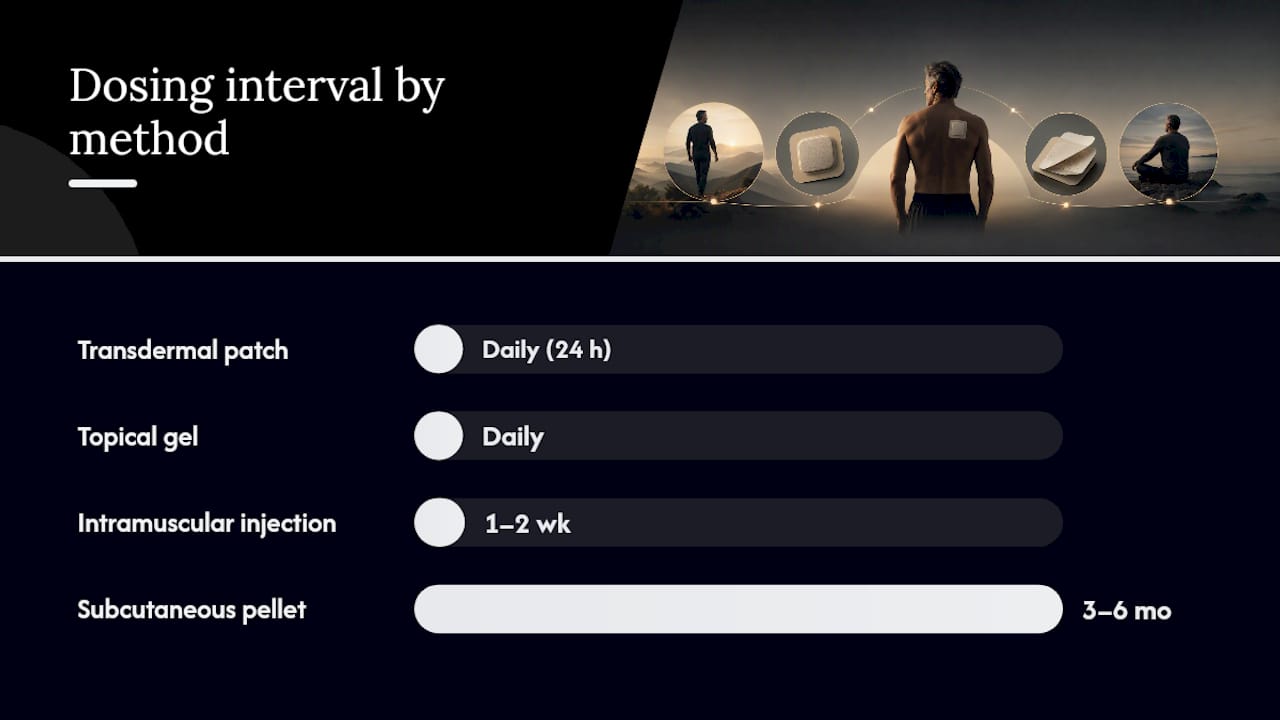
| Delivery Method | Dosing Frequency | Side-Effect Profile | Monitoring Needs | Availability / Cost |
|---|---|---|---|---|
| Transdermal patch | Daily (every 24 h) | Higher local skin-reaction rate; steady serum levels | Standard TRT labs; skin assessment | Discontinued (Androderm); limited U.S. supply |
| Topical gel | Daily | Lower skin-reaction risk; secondary transfer risk to contacts | Standard TRT labs; transfer precautions | Widely available; variable insurance coverage |
| Intramuscular injection | Every 1–2 weeks (cypionate/enanthate) | Serum peaks and troughs; injection-site reactions | Standard TRT labs; may need more frequent checks during titration | Widely available; often lower cost; good insurance coverage |
| Subcutaneous pellet | Every 3–6 months | Surgical insertion; extrusion risk; less flexible dosing | Standard TRT labs; pellet-specific follow-up | Available via specialist clinics; higher out-of-pocket cost |
Key trade-offs in plain terms:
- Gels offer daily convenience and lower skin-reaction rates than patches, but secondary transfer to partners and children is a real risk requiring careful hygiene protocols. StatPearls confirms gels are generally favored for convenience and lower local skin-reaction rates.
- Injections are cost-effective and widely covered by insurance, but the peak-trough cycle can produce noticeable energy and mood fluctuations between doses. Subcutaneous self-injection with a shorter-acting ester can smooth this curve.
- Pellets minimize daily adherence burden but require a minor surgical procedure every few months, and dose adjustment after insertion is not possible until the next implantation cycle.
For men who valued the steady-release pharmacokinetics of a patch, a daily gel applied with strict transfer precautions is the closest practical substitute currently available in the U.S.
What your monitoring schedule should look like on testosterone therapy
Testosterone therapy is not a set-and-forget intervention. Cleveland Clinic's TRT guidance is explicit: bloodwork every 3–6 months initially, then annual assessments once stable, with specific triggers for earlier testing.
Baseline labs before starting any TRT:
- Morning total testosterone (two separate measurements on different days)
- Free testosterone (if total is borderline or symptoms are disproportionate)
- PSA (prostate-specific antigen)
- Hematocrit and hemoglobin
- Liver function panel
- Fasting lipid panel
- Luteinizing hormone (LH) and follicle-stimulating hormone (FSH) to classify hypogonadism type
- Metabolic panel including fasting glucose
Understanding the difference between free and total testosterone is clinically meaningful, particularly for men whose symptoms don't align with total testosterone numbers alone.
Follow-up monitoring cadence:
| Timepoint | Tests Required | Action Triggers |
|---|---|---|
| 3 months post-initiation | Total T, hematocrit, PSA, symptoms review | Dose adjustment if T out of range; pause if hematocrit elevated |
| 6 months | Total T, hematocrit, PSA, lipids, metabolic panel | Evaluate cardiovascular markers; reassess sleep apnea symptoms |
| 12 months | Full baseline panel repeat | Annual benchmark; reassess therapy continuation |
| Ongoing (annual) | Total T, hematocrit, PSA, lipids | Trigger early testing on symptom change or dose modification |
When to pause or stop therapy pending evaluation:
- Hematocrit rises above 54%
- New or worsening lower urinary tract symptoms
- PSA increase of more than 1.4 ng/mL within any 12-month period
- New cardiovascular event or diagnosis
- Confirmed or suspected prostate malignancy
For guidance on selecting a lab and interpreting your results, the Hormone Lab for Men 40–65 guide covers the practical steps in detail.
How long it takes for testosterone therapy to work
Realistic expectations matter. Men who expect immediate transformation often discontinue therapy before reaching the window where meaningful physiological change occurs.
A clinical review published on PMC provides the clearest timeline data available:
- Sexual interest: Changes can appear within approximately 3 weeks, with a plateau around 6 weeks
- Erectile function and ejaculatory changes: May require up to 6 months for meaningful improvement
- Hematocrit: Rises within weeks of initiating therapy; requires early monitoring
- PSA changes: Typically detectable within the first 3–6 months
Expected response windows by symptom domain:
Individual variation is significant. Baseline health, body composition, concurrent medications, and lifestyle factors all modify the response curve. Men who combine testosterone therapy with structured resistance training and body-composition work tend to see faster and more pronounced improvements in lean mass and strength than those who rely on hormone therapy alone.
Lifestyle inputs are not optional adjuncts. They are part of the clinical picture. The self-optimization guide for resilience and performance covers the non-hormonal levers that compound with any medical intervention.
A performance-focused perspective on where patches fit
The patch's clinical appeal was always its pharmacokinetic profile: steady delivery, no injection burden, no daily gel-transfer anxiety. For a man running a demanding schedule, that simplicity had real value. The discontinuation of Androderm removes that option from the practical toolkit for most U.S. men, and the honest response is to evaluate what the alternatives actually deliver rather than mourn a product that's no longer available.
What I find underappreciated in most TRT discussions is the monitoring burden. Therapy doesn't end at the prescription. It requires quarterly bloodwork, PSA surveillance, hematocrit tracking, and ongoing clinical engagement. For a high-agency professional, that's a manageable commitment, but it needs to be planned for deliberately, not treated as an afterthought. Men who enter TRT without a structured monitoring protocol are taking a risk that has nothing to do with the hormone itself.
The other underappreciated variable is the threshold question. Many men in their 40s and 50s who present with fatigue, reduced drive, and declining performance do not have pathologic hypogonadism. They have suboptimal lifestyle inputs: poor sleep architecture, insufficient resistance training, excess visceral adiposity, and chronic stress. Mayo Clinic's guidance is clear that these men are not TRT candidates; they are candidates for disciplined lifestyle intervention. That distinction matters clinically and practically, because the men who pursue TRT without a confirmed diagnosis often don't get the results they expected, while the men who address the lifestyle variables first frequently find their hormonal picture improves substantially without pharmacological intervention.
For men who are not yet at the clinical threshold, or who want to support their hormonal environment while working through the diagnostic process, plant-derived approaches targeting androgen signaling pathways represent a legitimate area of interest. Viridos's serum testosterone support guide covers the evidence base for phytoandrogen-related compounds in this context.
Viridos offers a nonpharmacological path for performance-focused men

For men who don't yet meet the clinical threshold for TRT, or who want to support their vitality while navigating the diagnostic process, Viridos offers a different route. The Viridos performance spray is a plant-derived, precision-formulated oral spray designed to support drive, clarity, and executive performance through phytoandrogen-related compounds, produced in small batches in Sweden and available through a controlled membership model.
This is not a medical treatment, and it is not a substitute for clinical evaluation. If your symptoms suggest hypogonadism, get the labs done and work with a qualified clinician. Viridos is designed for the man who takes his hormonal health seriously, wants a premium, evidence-minded adjunct to disciplined living, and understands that performance longevity is built on multiple inputs, not a single intervention. Apply for membership and see whether you qualify.
Sources
The sources below are primary clinical references. Bring relevant pages to your clinician appointment, particularly the monitoring guidance and the delivery-method comparison, to support a productive conversation about your options.
- Testosterone Transdermal Patch: MedlinePlus Drug Information
- Androgen Replacement - StatPearls - NCBI Bookshelf
- Onset of effects of testosterone treatment and time span until benefit — PMC
- Drug Shortage Detail: Testosterone Transdermal System - ASHP
- DailyMed drug label for testosterone transdermal systems
This article provides general information only and is not a substitute for professional medical advice. Confirm current prescribing guidelines and your individual clinical status with a qualified healthcare provider before initiating or modifying any hormone therapy.