
TL;DR:
- Effective productivity relies on managing energy through structured systems like time blocking, task batching, and focused deep work during peak cognitive periods. Limiting deep work to two 90-minute blocks, optimizing physical and digital environments, and replacing unnecessary meetings with async communication significantly enhance output quality and consistency. Building disciplined routines and fostering a culture of focus and recovery enable sustained high performance over time.
Productivity enhancement is the disciplined practice of managing your energy, attention, and work structure to produce more output of higher quality in less time. The professionals who consistently outperform their peers do not work more hours. They work within systems: time blocking, task batching, deep work protocols, and async communication frameworks that protect cognitive capacity. Tools like Asana, methods like Getting Things Done (GTD), and research from institutions like the Mayo Clinic confirm that environment, focus architecture, and team culture are as consequential as individual effort. This guide delivers the frameworks that actually move the needle.
How to enhance productivity with a daily energy management system
The foundational error most executives make is treating productivity as a time management problem. It is an energy management problem. Physical, mental, emotional, and cognitive energy all fluctuate across the day, and your schedule must reflect that reality rather than fight it.

The most effective daily system starts the night before. A 10-minute nightly planning session where you identify your top three priorities and pre-schedule them into tomorrow's calendar eliminates the morning decision tax. A two-minute morning review then adjusts for anything that shifted overnight. This sequence takes less than fifteen minutes total and removes the single biggest productivity drain: starting the day without a clear plan.
Deep work belongs in your peak energy window, which for most people falls two to four hours after waking. Schedule your most cognitively demanding work there without exception. Meetings, email, and administrative tasks belong in the afternoon when executive function naturally declines. This is not preference. It is physiology.
Pro Tip: Never schedule more than two deep work blocks in a single day. Two protected 90-minute blocks with genuine screen-free recovery between them consistently outperform four fragmented sessions. Overloading your schedule with focus blocks is the fastest way to produce shallow work while feeling busy.
The table below shows why time blocking outperforms a conventional to-do list for professionals managing complex, high-stakes work.
| Dimension | Time blocking | Simple to-do list |
|---|---|---|
| Cognitive load | Low. Decisions made in advance. | High. Constant reprioritization required. |
| Deep work protection | Built in by design. | Absent. Reactive by default. |
| Energy alignment | Schedules tasks to match energy peaks. | Ignores energy fluctuation entirely. |
| Accountability | Calendar creates a commitment. | List creates an intention. |
| Flexibility | Blocks can be moved. Structure remains. | No structure to preserve or adjust. |
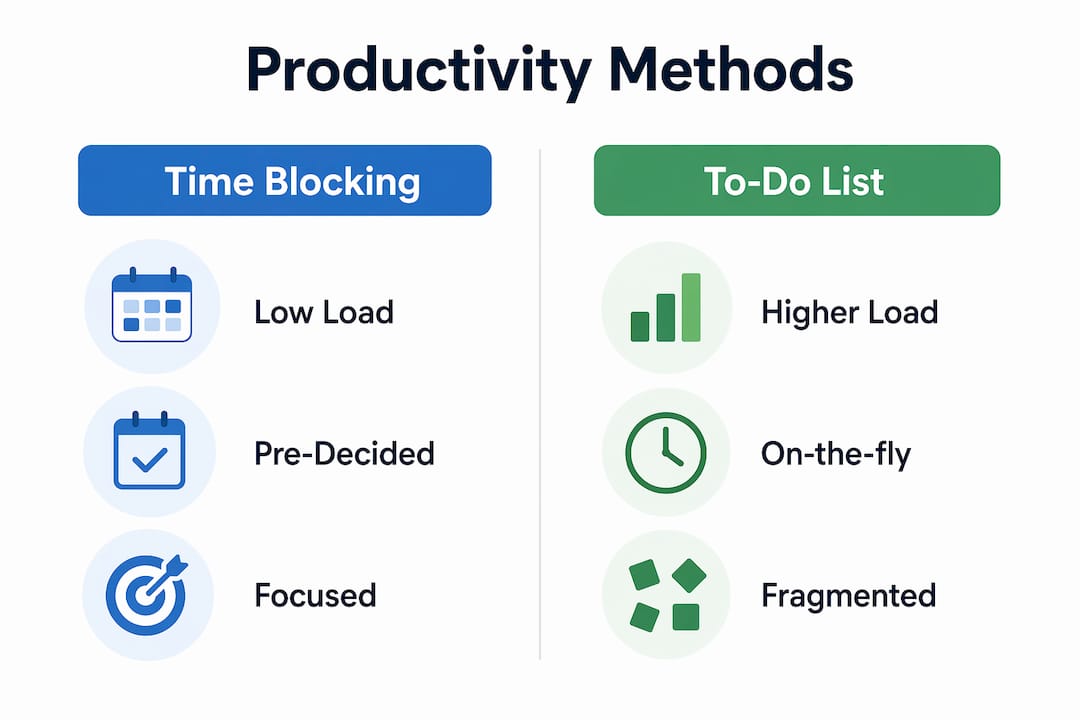
Notification batching completes the system. Set two or three fixed windows per day for checking messages and email. Outside those windows, notifications are off. This single habit protects the cognitive flow that deep work requires and reduces the hidden cost of constant interruption.
What focus and execution techniques best enhance productivity in knowledge work?
The standard advice to "focus more" is useless without a method. Two techniques dominate the research for knowledge workers: task batching and structured deep work blocks. They are complementary but distinct, and mixing them improperly can fragment your protected time rather than extend it.
Task batching groups similar tasks into a single time block. Instead of answering emails as they arrive, you process all email in one 30-minute window. Instead of switching between writing, reviewing, and planning throughout the day, each activity occupies its own block. The cognitive benefit is significant. Every time you switch task types, your brain incurs a switching cost, sometimes called attention residue, where part of your attention remains on the previous task for up to 20 minutes. Batching eliminates most of that residue by keeping you in one cognitive mode at a time.
The Pomodoro Technique structures work into 25-minute focused intervals followed by five-minute breaks, with a longer break after four cycles. It works well for tasks with clear completion criteria: writing, coding, financial modeling. The 90-minute deep work block, drawn from Cal Newport's framework, suits problems requiring sustained synthesis: strategy development, complex analysis, high-stakes writing. Neither method is universally superior. The right choice depends on task type.
| Dimension | Pomodoro Technique | 90-minute deep work block |
|---|---|---|
| Session length | 25 minutes on, 5 minutes off | 90 minutes uninterrupted |
| Best for | Defined, repeatable tasks | Complex synthesis and creative work |
| Interruption tolerance | Low but structured | Zero |
| Daily volume | 8 to 12 cycles possible | Maximum two blocks recommended |
| Recovery requirement | Short breaks built in | 15 to 20 minutes screen-free after each block |
Specificity in task targets reduces cognitive load further. "Work on the Q3 report" is not a task. "Write the executive summary section of the Q3 report, 400 words" is a task. The more precisely you define the output before you begin, the less mental energy you spend mid-session deciding what you are actually doing.
Pro Tip: Treat communication windows as explicit interfaces with defined start and end times, not open channels. Tell your team: "I respond to messages at 9 AM and 3 PM." This single structural change reduces context switching more than any app or tool.
How to optimize your environment to sustain focus and reduce fatigue
Your physical and digital environment either supports or degrades your cognitive performance. Most professionals underinvest in both.
On the physical side, access to natural daylight is one of the most evidence-backed levers available. A controlled crossover study published through the Mayo Clinic found that daylight access in offices improves working memory, inhibition, and satisfaction while reducing eyestrain compared to blackout conditions. Modern motorized mesh shades and dynamic tint systems preserve daylight benefits while controlling glare. If you work from a fixed office, position your desk to receive indirect natural light and eliminate direct screen glare. This is not an aesthetic preference. It is a cognitive performance decision.
Noise is the second major physical variable. Open-plan offices with unpredictable ambient noise consistently reduce deep work quality. Noise-canceling headphones, acoustic panels, or a dedicated closed-door space during focus blocks are not luxuries. They are infrastructure. For a structured recovery and focus routine that complements your physical setup, the principles of disciplined recovery apply equally to your workspace design.
The digital environment deserves equal attention. The following practices form the minimum viable setup for sustained focus:
- Remove all social media apps from your primary work device.
- Use a browser extension like Freedom or Cold Turkey to block distracting sites during deep work blocks.
- Keep no more than five browser tabs open at any time during focused sessions.
- Turn off all non-essential push notifications at the operating system level, not just within individual apps.
- Use a single task management system. Asana, Notion, or a physical notebook all work. Splitting tasks across multiple systems creates invisible cognitive overhead.
- Set your phone to Do Not Disturb with exceptions only for specific contacts during work blocks.
The goal is a workspace where the path of least resistance leads to the work that matters most.
How to improve team productivity through fewer meetings and better async communication
High meeting loads are one of the most reliable predictors of low team output. Every synchronous meeting fragments the calendars of every attendee, making it structurally impossible for knowledge workers to protect the deep work blocks their best work requires.
The first step is a meeting audit. Review every recurring meeting on your team's calendar and ask one question: does this meeting produce a decision or outcome that cannot be achieved asynchronously? If the answer is no, cancel it. Teams that schedule less and invest in written communication infrastructure consistently ship faster and make clearer decisions than teams that default to synchronous discussion.
Async communication done well requires more than fewer meetings. It requires explicit ownership structures, written decision logs, and proposal documents that contain enough context for readers to act without a follow-up call. When these artifacts exist, async infrastructure reduces execution lag and creates institutional memory that survives personnel changes.
Practical steps for improving team productivity through communication reform:
- Designate two or three meeting-free days per week for the entire team.
- Replace status update meetings with a shared written log updated daily by each team member.
- Require every meeting request to include a written agenda and a defined decision or outcome.
- Assign explicit ownership to every project and decision. Ambiguity in ownership is the primary cause of dropped tasks.
- Use AI automation tools to handle repetitive administrative tasks. Office workers spend over 600 hours annually on administrative work. Automating even a fraction of that reclaims meaningful time for high-value output.
Pro Tip: After reducing meetings, measure output rather than activity. Track decisions made, documents shipped, and milestones hit. Teams that shift to async communication often feel less busy initially, which is the point. Busyness is not a proxy for performance.
Key takeaways
Sustained productivity gains come from managing energy and protecting focus through structured systems, not from working more hours or adopting more tools.
| Point | Details |
|---|---|
| Energy management over time management | Schedule deep work during peak cognitive windows, not based on calendar availability. |
| Two focus blocks maximum | Limit daily deep work to two 90-minute sessions with genuine screen-free recovery between them. |
| Task batching reduces switching costs | Group similar tasks into fixed windows to eliminate attention residue and maintain cognitive flow. |
| Environment is infrastructure | Daylight access, noise control, and digital minimalism directly improve working memory and output quality. |
| Async communication scales team output | Fewer meetings combined with written ownership structures accelerate execution and reduce coordination drag. |
Why energy is the variable most executives ignore
I have worked with and observed enough high-performing men to say this with confidence: the ones who plateau are almost always managing their calendar, not their energy. They fill every hour with something productive and wonder why their output feels thin.
The research on discretionary effort is instructive here. Employees who report ease of cooperation are dramatically more likely to go beyond what is required. That finding applies to individuals too. When your energy is managed well, you bring more to the work without forcing it.
What I have found actually works is ruthless simplicity. One system for capturing tasks. Two deep work blocks. Three communication windows. The temptation is always to add another technique, another app, another framework. That temptation is itself a productivity problem. Every tool you add requires maintenance, and maintenance is cognitive overhead. The executive daily routine that compounds over years is the one simple enough to execute on your worst days, not just your best.
Recovery is the part most men in demanding roles refuse to take seriously until something breaks. Two 90-minute focus blocks with real recovery between them outperform six fragmented hours of half-attention. That is not a soft claim. It is what the data on deep work consistently shows. Building recovery into your schedule is not a concession to weakness. It is the mechanism by which sustained performance becomes possible.
Culture amplifies or destroys everything else. You can have the best individual system in the room and still underperform if the team around you defaults to constant interruption, performative busyness, and meeting-heavy coordination. Productivity at the executive level is partly a personal discipline problem and partly a culture design problem. Both require your attention.
— Joakim
Viridos and the performance edge that compounds over time
Disciplined systems produce results only when the man running them has the physical and cognitive capacity to execute consistently. That is where Viridos enters.
Viridos is a premium Swedish performance brand built for founders, executives, and high-agency professionals who demand sustained edge without shortcuts. Formulated in small batches with sublingual delivery for precision absorption, Viridos products are designed to support the cognitive energy, motivation, and resilience that your productivity system depends on. When your focus blocks require genuine mental sharpness and your recovery windows need to actually restore you, the quality of what you put in your body matters. Explore the Viridos performance range and see how precision formulation supports the long game.
FAQ
What is the most effective method to enhance productivity?
The most effective approach combines energy management with time blocking and task batching. Schedule deep work during your peak cognitive window, limit focus sessions to two 90-minute blocks per day, and batch communications into fixed windows.
How many deep work blocks should I schedule per day?
Two well-protected 90-minute blocks with genuine screen-free recovery between them consistently outperform more fragmented schedules. Adding more blocks typically produces diminishing returns and increases the risk of shallow, low-quality output.
How does task batching boost work efficiency?
Task batching groups similar activities into a single time block, eliminating the attention residue caused by switching between different task types. This reduces cognitive switching costs and preserves the sustained focus that complex work requires.
What environmental changes most improve focus?
Access to natural daylight is one of the strongest evidence-backed changes available, with Mayo Clinic research showing improvements in working memory and reduced eyestrain. Noise control and digital minimalism, including limiting browser tabs and disabling push notifications, complete the setup.
How can teams increase daily productivity without more meetings?
Teams improve output by replacing recurring status meetings with written daily logs, assigning explicit ownership to every decision, and creating meeting-free blocks for deep work. Cutting meetings without building async documentation infrastructure slows execution rather than accelerating it.