
TL;DR:
- After 40, focus on recovery, resilience, and tracking key biomarkers rather than just output.
- Sleep, stress management, and personalized nutrition are critical for sustaining elite performance.
- Data and renewal practices are essential; balance metrics with holistic identity and purpose for longevity.
High-performing executives aged 40 to 65 work an average of 53 hours per week, log five travel days monthly, and report stress levels of 6.3 out of 10. That load is relentless. And after 40, the strategies that kept you sharp in your 30s start losing their edge. Your body's recovery curve lengthens, hormonal shifts change how you process stress, and the margin for error on sleep and nutrition narrows. This article lays out the criteria, tactics, and frameworks that help executives sustain elite performance well into their 60s, backed by research and built for the demands of real leadership.
Table of Contents
- Criteria for optimizing performance after 40
- Sleep, stress management, and cognitive resilience
- Nutrition and fueling strategies for high-performance longevity
- Leveraging data, biomarkers, and advanced tracking for executive advantage
- Staying motivated and engaged: avoiding the midlife downshift
- Why 'optimization' is about renewal, not just metrics
- Take your performance further with VIRIDOS
- Frequently asked questions
Key Takeaways
| Point | Details |
|---|---|
| Start with fundamentals | Prioritizing sleep, nutrition, and stress basics produces the most reliable performance gains. |
| Personalize using data | Executives get better results by tracking health metrics and customizing approaches. |
| Rethink success | Lasting performance is rooted in renewal, purpose, and avoiding burnout, not just harder work. |
| Adopt long-term habits | Simple, consistent routines beat quick fixes for sustainable executive energy. |
Criteria for optimizing performance after 40
Before you add another supplement or wearable to your stack, you need a clear framework for what actually moves the needle. The shift after 40 is fundamental: it's no longer about squeezing more output from your system. It's about recovery capacity, resilience under sustained pressure, and tracking the right biomarkers so you know what's working.
The metrics that matter most include:
- Sleep duration and quality (7 or more hours, consistently)
- Heart rate variability (HRV) as a proxy for stress recovery
- VO2 max, your aerobic capacity and one of the strongest predictors of longevity
- Testosterone and key hormones, which shift meaningfully after 40
- Continuous glucose monitoring (CGM) for real-time metabolic feedback
- Advanced annual screenings covering inflammation markers, lipid panels, and organ function
Dr. Tracy Gapin recommends tracking blood sugar via CGM, body composition, hormones, and addressing stress through 7 or more hours of sleep, nutrition, and exercise before reaching for biohacks. That sequencing matters. Personalization beats generic advice every time, and wearables give you the real data to make that call.
The goal is to build a longevity strategy grounded in your actual biology, not a template borrowed from a 28-year-old athlete. Understanding why healthspan matters for executives is the first step toward making smarter optimization decisions.
Pro Tip: Before spending on advanced technology or supplements, get your foundational health metrics dialed in. Blood work, sleep tracking, and honest stress assessment come first.
Sleep, stress management, and cognitive resilience
Sleep is where most executives bleed performance without realizing it. Quality sleep powers memory consolidation, emotional regulation, and the kind of restraint under pressure that separates good leaders from great ones. Cut it short consistently and your decision-making degrades in ways you won't notice until the damage is done.
The data is striking. 48% of executives feel overwhelmed, 41% report chronic sleep issues, yet most self-report good mental health. That disconnect is dangerous.
"81% of executives identify sleep as the single most underused performance tool available to them."
Stress compounds the problem. Chronic stress narrows long-term thinking, accelerates decision fatigue, and elevates cortisol in ways that directly undermine testosterone and HRV. Research on burnout scores among leaders shows that fulfillment and burnout exist on a spectrum that most executives ignore until they hit a wall.
Here's a practical action sequence:
- Set a fixed sleep and wake time, even on weekends
- Eliminate screens 60 minutes before bed
- Use HRV data to identify your highest-stress days and schedule recovery accordingly
- Build at least one non-negotiable stress outlet into your weekly routine (training, meditation, or deliberate downtime)
- Track your mental health score quarterly, not just your physical metrics
For deeper frameworks, explore stress management for executives and executive wellness optimization strategies that go beyond surface-level advice.
Pro Tip: Fix sleep before you fix caffeine intake. Caffeine masks fatigue; it doesn't resolve it. The executive who sleeps well needs less of everything else.
Nutrition and fueling strategies for high-performance longevity
After 40, your metabolism shifts in ways that make the high-output, low-sleep, high-caffeine model unsustainable. The diet that worked in your 30s stops working because your body's insulin sensitivity, muscle protein synthesis rate, and hormonal environment have all changed.
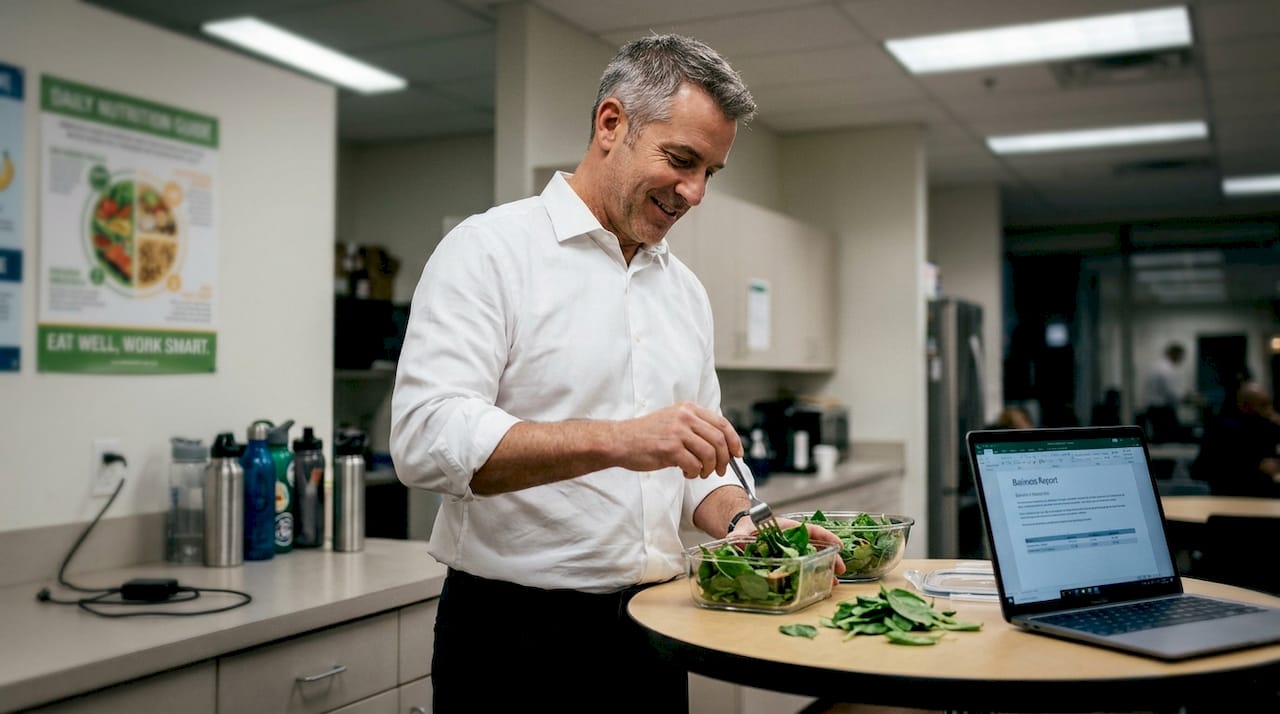
Nutrition shifts post-40 require prioritizing protein early in the day, stopping the habit of skipping meals, stabilizing blood sugar, and treating caffeine as a cognitive tool rather than a crutch. You eat for recovery and sustained focus, not just output.
| Goal | Strategy | Timing |
|---|---|---|
| Sustained energy | High-protein breakfast (30g+) | Within 60 min of waking |
| Cognitive focus | Complex carbs + healthy fats | Midday meal |
| Recovery | Leucine-rich protein | Within 2 hours post-exercise |
| Blood sugar stability | Avoid processed snacks | Throughout the day |
| Sleep quality | Light dinner, low sugar | 3 hours before bed |
Key fueling principles for executives over 40:
- Prioritize protein at every meal to preserve muscle mass and support hormonal health
- Stabilize blood sugar by spacing meals consistently and reducing refined carbohydrate spikes
- Use caffeine strategically, ideally before 1 p.m., to avoid disrupting sleep architecture
- Track your glucose response with a CGM to understand how your body reacts to specific foods
- Eat for recovery, not just performance, especially around travel and high-stress periods
For a detailed breakdown, the nutrition optimization guide for men 40 to 65 and the longevity nutrition checklist are worth your time.
Pro Tip: Use caffeine as a precision tool. Time it to your cognitive peak windows and never use it to compensate for a short night.
Leveraging data, biomarkers, and advanced tracking for executive advantage
Foundational habits create the floor. Data creates the ceiling. Once sleep, stress, and nutrition are structured, the next performance gain comes from tracking what's actually happening inside your body and acting on it.
Preventive metrics for executives worth monitoring include VO2 max above 35, HRV trends, testosterone levels, A1C, cholesterol ratios, and inflammation markers like CRP and homocysteine. Annual advanced screenings catch what routine checkups miss.
| Biomarker | Optimal range (men 40 to 65) | Why it matters |
|---|---|---|
| VO2 max | Above 35 ml/kg/min | Longevity and cardiovascular resilience |
| HRV | Trending upward over time | Stress recovery and nervous system health |
| Testosterone (total) | 500 to 900 ng/dL | Energy, cognition, body composition |
| Fasting glucose | 70 to 99 mg/dL | Metabolic health and focus |
| CRP (inflammation) | Below 1.0 mg/L | Systemic inflammation and disease risk |
Data-driven personalization via wearables and CGM consistently outperforms generic health advice. The stepwise approach: choose your tracking tools, establish your baseline, review monthly, and act on trends rather than single data points.
To understand the financial and strategic case, read why you should invest in executive health and explore long-term executive health tips that integrate tracking into a sustainable system.
Pro Tip: Use your data to measure progress, not to chase perfection. Update your baseline annually and compare trends, not daily fluctuations.
Staying motivated and engaged: avoiding the midlife downshift
Performance longevity isn't only physical. Motivation, identity, and a sense of purpose are just as critical to sustained output as VO2 max or testosterone levels. And the data suggests this is where many executives quietly lose ground.
"45% of male knowledge workers aged 40 to 65 are actively considering reducing their working hours, with 1 in 4 already having downshifted due to burnout or identity shifts."
This isn't weakness. It's a signal that performance strategy needs to evolve beyond metrics. Fulfillment, engagement, and a clear sense of what you're building toward are performance variables, not soft extras.
Tactics that sustain motivation and meaning at this stage:
- Redefine success beyond revenue or title. What does a great decade look like for you?
- Build mentoring or teaching into your weekly schedule. Contribution fuels identity and engagement.
- Pursue deliberate learning in areas adjacent to your expertise to stay curious and mentally sharp.
- Audit your commitments annually and cut what no longer aligns with your highest priorities.
- Create rituals of renewal, whether that's physical training, creative projects, or time in nature.
Equating performance with metrics alone is a trap. The executives who sustain elite output into their 60s tend to be those who have built holistic performance frameworks that include identity and purpose alongside physical data. Explore how to boost executive fitness in ways that support both body and drive.
Pro Tip: Schedule renewal the same way you schedule board meetings. Mentoring, learning, and rest are not rewards for performance. They are part of the performance system.
Why 'optimization' is about renewal, not just metrics
Here's where we push back on conventional wisdom: the executive performance world has become obsessed with quantification. Steps, glucose curves, sleep scores, HRV readings. These tools are genuinely useful. But they can also create a new kind of performance anxiety, one where you're optimizing numbers instead of living a life that actually sustains you.
The executives we see sustain real edge into their 60s aren't the ones with the best wearable data. They're the ones who have learned to adapt. They rest without guilt. They stay curious. They let their identity evolve as their role and priorities shift. Renewal practices, not just recovery protocols, are what separate those who maintain momentum from those who quietly plateau.
The most meaningful performance gains after 40 often come from rethinking what you're performing for, not from tightening your tracking. Future-readiness means embedding self-renewal alongside your data stack. That's the edge most optimization frameworks miss entirely. Learn how executive fitness and vitality can be reframed around renewal as much as output.
Take your performance further with VIRIDOS
If you're ready to move from insight to action, VIRIDOS is built specifically for men like you. The VIRIDOS platform gives high-performing executives the tools to log habits, track key health data, and build the kind of consistent routines that compound over years, not just weeks.
The Performance Journal helps you capture what's working and where your energy is actually going, so you stop guessing and start optimizing with precision. The VIRIDOS Methodology draws on the science behind executive performance longevity and translates it into a practical, premium system designed for demanding schedules. This is not a generic wellness app. It's a performance infrastructure built for the long game.
Frequently asked questions
What is the single most important metric for executive performance after 40?
Consistently getting over 7 hours of quality sleep is the most impactful and underused tool for executives. 81% of executives identify it as their top untapped performance lever.
How do wearables help in optimizing executive performance?
Wearables provide real-time data on sleep, activity, and recovery, enabling personalized adjustments that outperform generic advice. Data-driven personalization via wearables and CGM consistently delivers better outcomes than one-size-fits-all protocols.
How common is burnout or downshifting among midlife male executives?
It's more common than most admit. 45% of male knowledge workers aged 40 to 65 are considering reducing hours or changing pace due to burnout or shifting identity.
Should executives try advanced supplements or focus on basics first?
Always build the foundation first. Prioritize fundamentals like sleep, nutrition, and exercise before experimenting with advanced supplements or biohacking protocols.