
Sustained reductions in low-grade inflammation come from four levers pulled together: a whole-food dietary pattern, regular structured activity, meaningful weight loss when excess visceral fat is present, and disciplined sleep and stress control. No single food or supplement moves the needle on its own. The lab marker to track is high-sensitivity CRP (hs-CRP), and a baseline test before you change anything gives you a number to measure against.
Expect a two-speed timeline. Subjective improvements, sharper mornings, steadier energy, better recovery, often show up within a few weeks. The objective marker moves slower.
- Baseline hs-CRP test before starting
- Retest at three and six months, not two weeks
- Track the trend, not a single reading
A measurable hs-CRP reduction typically requires three to six months of consistent, combined changes to diet, activity, and weight, according to guidance from Puhti's clinical overview of low-grade inflammation.
Key Takeaways
Lowering low-grade inflammation requires sustained changes across diet, movement, weight, sleep, and stress, tracked with hs-CRP over a three to six month horizon.
| Point | Details |
|---|---|
| Track hs-CRP, not symptoms alone | Get a baseline test, then retest at three and six months to see real trend data. |
| Prioritize dietary pattern over single foods | Mediterranean, Nordic, or DASH-style eating outperforms any isolated "anti-inflammatory" ingredient. |
| Hit the exercise dose, not just activity | Aim for 150 minutes moderate aerobic weekly plus two resistance sessions. |
| Target modest weight loss if visceral fat is elevated | A 5 to 10% reduction often produces measurable biomarker improvement. |
| Quit smoking and cap alcohol first | These two changes often outweigh dietary tweaks in effect size. |
| Complement, don't replace, with Viridos | A small-batch Swedish sublingual formulation for men already disciplined about the fundamentals. |
Table of Contents
- What Is Low-Grade Inflammation, and Why Does It Matter?
- How Do You Know If You Have Low-Grade Inflammation?
- Which Foods Actually Lower Inflammation?
- How Much Exercise Actually Reduces Inflammatory Markers?
- Does Losing Weight Reduce Inflammation?
- How Do Sleep and Stress Affect Inflammation?
- A 12-Step Plan You Can Start This Week
- When Will You See Results?
- Why Trust This Guidance?
- What Role Does Gut Health Play in Inflammation?
- How Do Smoking and Alcohol Affect Chronic Inflammation?
- Which Supplements Have Real Evidence Behind Them?
- Can Your Environment or Job Contribute to Inflammation?
- How Does Inflammation Interact With Diabetes and Heart Disease?
- The Discipline Behind the Data
- Support Your Routine With Viridos
- Sources
What Is Low-Grade Inflammation, and Why Does It Matter?
Acute inflammation is your body's short, sharp response to injury or infection, useful and self-limiting. Low-grade chronic inflammation is different: a persistent, low-level immune activation that runs in the background for years, often without symptoms you'd notice day to day.
Left unchecked, it's linked to elevated cardiometabolic risk and associations with cognitive decline over time, according to NCBI's clinical review of anti-inflammatory diets. The drivers are almost entirely lifestyle-based:
- Excess visceral fat, which behaves like an active endocrine organ
- Diets heavy in ultra-processed foods and added sugar
- Physical inactivity
- Poor or insufficient sleep
- Chronic psychological stress
- Smoking and heavy alcohol use
How Do You Know If You Have Low-Grade Inflammation?
High-sensitivity CRP is the standard lab test for detecting inflammation in people without acute symptoms, and it's the marker referenced across Swedish clinical guidance on low-grade inflammation. Values in the low-grade elevation range sit modestly above normal, well below the levels seen in acute infection, and should always be read alongside your broader clinical picture rather than in isolation.
- Get a baseline reading before changing your routine
- Repeat testing around three months after sustained changes, not sooner
- Rule out active infection or injury before interpreting any single result
Persistent fatigue, joint stiffness, unexplained weight change, or recurring low-level illness are signals worth raising with a clinician regardless of what your CRP shows.
Which Foods Actually Lower Inflammation?
Forget the hunt for a single miracle ingredient. The evidence points consistently to patterns, not superfoods. Long-term adherence to Mediterranean, Nordic, or DASH-style eating reduces circulating inflammatory markers and lowers cardiovascular and type 2 diabetes risk, a finding borne out in primary-prevention trials cited by NCBI. UT MD Anderson's guidance points to the same pattern-based conclusion: whole grains, vegetables, legumes, nuts, and omega-3-rich fish, eaten consistently, do the work that no isolated compound can replicate.
Priority foods:
- Vegetables and fruit across a range of colors, not a single "hero" item
- Whole grains: oats, barley, whole rye
- Legumes: lentils, chickpeas, beans
- Nuts and seeds, particularly walnuts and flaxseed
- Fatty fish twice weekly (salmon, mackerel, herring) for omega-3s
- Extra-virgin olive oil or canola oil as primary fats
Foods to limit: ultra-processed snacks and ready meals, added sugar, refined white carbohydrates, processed and red meat, and industrial trans fats. None of these need to disappear entirely. The goal is a shift in ratio, not a purity test.
For a man running a demanding schedule, the practical swaps matter more than theory. Replace the mid-afternoon pastry with a handful of walnuts and an apple. Swap the desk-lunch sandwich on white bread for a grain bowl with lentils, olive oil, and grilled salmon. Trade the nightly glass of wine for sparkling water three nights a week. None of these require a kitchen overhaul.
Pro Tip: Batch-cook a base grain (barley or farro) and a legume (lentils) once a week. Building a bowl around them takes five minutes and removes the daily decision fatigue that leads to processed defaults.
On supplementation: fish oil has reasonable evidence behind it as a dietary complement to an already sound pattern, not a substitute for one. Any high-dose supplementation, fish oil or otherwise, deserves a conversation with your physician first, particularly if you take blood thinners or have existing cardiovascular conditions.
How Much Exercise Actually Reduces Inflammatory Markers?
The dose that moves inflammatory markers is well established: 150 minutes of moderate aerobic activity per week, or 75 minutes vigorous, plus resistance training twice weekly. National Geographic's synthesis of exercise research ties this dose to measurable improvements in inflammatory signaling, driven by fat loss, better insulin sensitivity, and the release of anti-inflammatory myokines during muscle contraction.
You don't need an hour at the gym to hit this target.
- Three 10-minute brisk walking blocks during the workday cover meaningful aerobic volume
- A 20 to 30 minute interval session (bike, rower, or hill repeats) twice weekly covers vigorous intensity efficiently
- Resistance micro-workouts of 15 minutes, focused on compound lifts, twice a week satisfy the strength component
- Walking meetings and stair use fill gaps without requiring a calendar block
Consistency across weeks outperforms occasional long sessions for marker improvement.
Does Losing Weight Reduce Inflammation?
Visceral fat, the kind that surrounds abdominal organs, functions almost like an active inflammatory organ, releasing signaling proteins that keep your immune system on low simmer. This is why waist circumference tracks inflammation more closely than total body weight.
The encouraging finding: a 5 to 10% reduction in body weight often produces measurable biomarker improvement. Sustainable routes include a pattern-based diet, protein-forward meals that support satiety, resistance training to preserve lean mass, and a modest, sustained caloric deficit rather than aggressive restriction. Pharmacological options or procedural interventions are legitimate tools for some men, but they're medical decisions that belong in a conversation with a physician, not a self-directed plan.
How Do Sleep and Stress Affect Inflammation?
Sleep and stress are not soft factors here. They're direct levers on inflammatory signaling.
- Target 7 to 9 hours nightly on a consistent schedule, including weekends
- Keep the bedroom cool, dark, and free of screens in the final 30 minutes before bed
- Build a short mindfulness or breathing practice into the day rather than treating it as an occasional indulgence; for guidance, explore the importance of breath awareness in your yoga practice.
- Brief nature exposure, even 15 minutes outdoors, shows associations with lower inflammatory markers in observational research
- Don't overlook oral hygiene and reduced exposure to household chemical irritants as secondary, low-effort contributors, a point Harvard Health's review of inflammation habits makes explicitly
Pro Tip: Anchor a five-minute breathing practice to something you already do daily, coffee brewing, the commute, the first Slack check, so it survives busy weeks without needing a calendar reminder. For a deeper protocol, see Viridos's stress management process for high-performing professionals.
A 12-Step Plan You Can Start This Week
Sequencing matters more than intensity. Front-load the changes with the best evidence and the lowest friction, then layer in harder habits once the easy wins are locked.
- Get a baseline hs-CRP test this week
- Swap one processed snack daily for a whole-food alternative (nuts, fruit)
- Add fatty fish to two meals this week
- Cut added sugar in coffee, soda, or snacks by half
- Walk three 10-minute blocks daily, five days a week
- Add two 20-minute resistance sessions weekly by week 3
- Set a fixed sleep and wake time, even on weekends, by week 4
- Introduce a five-minute daily breathing or mindfulness practice by week 5
- Reduce alcohol intake to two or fewer drinks weekly by week 6
- Reassess portion sizes and aim for a modest caloric deficit if weight loss is a goal, by week 8
- Add one outdoor, screen-free 15-minute block daily by week 10
- Retest hs-CRP at the three-month mark and adjust based on the trend
Pro Tip: Pick one accountability mechanism, a standing weekly check-in with a partner, a recurring calendar block for meal prep, or a simple spreadsheet log, and use it for all twelve steps rather than inventing a new system for each one.
Phasing this across twelve weeks beats attempting all twelve changes simultaneously. Willpower is a limited resource; sequencing protects it.
When Will You See Results?
Energy and sleep quality often improve within two to four weeks. Objective hs-CRP change generally takes three to six months of sustained adherence, per Puhti's clinical guidance. Test at baseline, three months, and six months, and rule out recent illness before interpreting any single reading. If markers or symptoms persist despite consistent changes, involve a clinician.
Why Trust This Guidance?
This article was written by Joakim for Viridos, a Swedish performance brand built on small-batch production and a membership model that rewards long-term discipline over quick fixes.
- Recommendations are grounded in NCBI, Harvard Health, and MD Anderson clinical literature
- Lifestyle steps are evidence-based; interpreting your own lab results still requires a clinician
- Viridos applies the same evidence standard to its own formulation and editorial content
What Role Does Gut Health Play in Inflammation?
Your gut microbiota, the trillions of bacteria lining your digestive tract, communicates constantly with your immune system. When that ecosystem loses diversity, a condition often driven by low-fiber, high-processed diets, the gut lining becomes more permeable. Bacterial fragments leak into circulation more easily, triggering the kind of persistent, low-level immune activation that defines chronic inflammation.
This is one reason dietary pattern outperforms any single "anti-inflammatory" ingredient. Fiber from vegetables, legumes, and whole grains feeds beneficial bacteria that produce short-chain fatty acids, compounds that help maintain the gut barrier and moderate immune signaling. A diet low in fiber and high in refined carbohydrates does the opposite: it starves beneficial bacteria and can shift the microbial balance toward species associated with higher inflammatory tone.
Practical steps to support gut health overlap almost entirely with the broader anti-inflammatory plan already outlined:
- Increase fiber diversity, aim for a wide range of plant foods weekly, not just volume
- Include fermented foods (yogurt, kefir, sauerkraut, kimchi) a few times a week if tolerated
- Limit artificial sweeteners and emulsifiers common in ultra-processed foods, which some research links to microbial disruption
- Avoid unnecessary antibiotic use, and discuss probiotic supplementation with a clinician if you've recently completed a course
There's no single "gut reset" that works in a week. Microbial diversity shifts gradually, in step with sustained dietary change, which is another reason the twelve-week phased plan outlined earlier serves you better than a short, aggressive intervention.
How Do Smoking and Alcohol Affect Chronic Inflammation?
Smoking is one of the most direct drivers of systemic inflammation available to modify. Tobacco smoke introduces oxidative compounds directly into the bloodstream, keeping immune cells in a persistent activated state. The inflammatory burden begins dropping within weeks of quitting, though full normalization takes longer and depends on smoking history.
Alcohol's relationship with inflammation is dose-dependent. Moderate intake affects markers less dramatically than smoking, but regular heavy drinking damages the gut lining in a way that mirrors the low-fiber diet problem described above, increasing intestinal permeability and driving low-grade immune activation. It also disrupts sleep architecture, which compounds the inflammatory effect through a second pathway entirely.
For men serious about lowering their inflammatory baseline, the practical guidance is straightforward even when the execution isn't:
- If you smoke, quitting produces the single largest inflammatory improvement available from any lifestyle change, greater than diet or exercise alone
- Nicotine replacement therapy or prescription cessation aids, discussed with a physician, meaningfully improve quit rates over unassisted attempts
- Cap alcohol at moderate levels; two or fewer drinks on drinking days is a reasonable target for most men
- Track drinking patterns for two weeks before deciding on a target. Most men underestimate their own average by a meaningful margin
- If quitting or cutting back triggers withdrawal symptoms beyond mild irritability, involve a clinician rather than managing it alone
Neither habit change is comfortable, but both belong at the top of the priority list precisely because their effect size is larger than most dietary tweaks.
Which Supplements Have Real Evidence Behind Them?
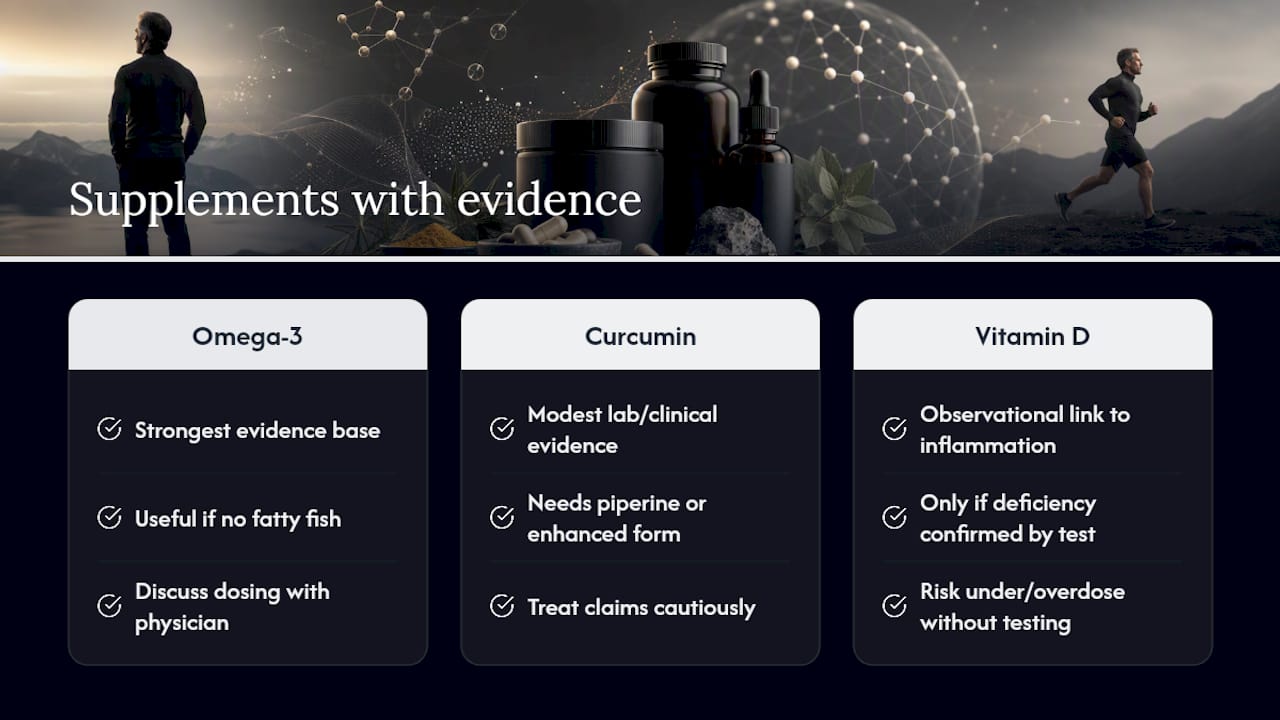
Three supplements show up consistently in the inflammation literature with genuine, if modest, supporting evidence: omega-3 fatty acids, curcumin, and vitamin D. None of them replace the core levers of diet, movement, and sleep. They're additions, not substitutes.
Omega-3 fatty acids (EPA and DHA, typically from fish oil) have the strongest evidence base of the three, largely because they're often studied as part of the broader dietary patterns already discussed rather than in isolation. If you don't eat fatty fish twice weekly, a fish oil supplement is a reasonable way to close that gap. Discuss dosing with a physician, especially if you take blood thinners, since higher doses can affect clotting.
Curcumin, the active compound in turmeric, shows anti-inflammatory activity in laboratory and small clinical studies, though its poor natural absorption limits real-world effect unless it's paired with piperine (black pepper extract) or a bioavailability-enhanced formulation. Treat claims about curcumin cautiously. It's a coherent but limited signal, not a proven intervention on the scale of dietary pattern change.
Vitamin D deficiency correlates with higher inflammatory markers in observational research, and correcting a genuine deficiency, confirmed by a blood test, is one of the more defensible supplement decisions available. Supplementing without testing risks both under and overdosing.
The universal caveat: consult a clinician before starting any of these at meaningful doses, particularly if you're on other medications or have existing kidney, liver, or cardiovascular conditions. Supplements interact with each other and with prescriptions in ways that aren't always intuitive.
Can Your Environment or Job Contribute to Inflammation?
Diet and exercise dominate the inflammation conversation, but environmental and occupational exposures deserve a place on the list, particularly for men in demanding roles that involve travel, irregular schedules, or physical environments outside their control.
Air pollution, from vehicle emissions, industrial exposure, or even wildfire smoke, has been linked to elevated systemic inflammatory markers in populations with high exposure. If your commute or work environment involves heavy traffic corridors or industrial zones, that's a background exposure worth acknowledging even if you can't eliminate it entirely.
Household and workplace chemical exposures, certain plastics, cleaning products, and industrial solvents, have documented associations with inflammatory signaling in some research, a point Harvard Health's inflammation review touches on when discussing overlooked contributors. Reducing use of plastic food storage, ventilating workspaces, and choosing fragrance-free cleaning products are low-effort adjustments.
Shift work and chronic sleep disruption, common among founders and executives managing global teams across time zones, independently elevate inflammatory markers through circadian misalignment, separate from simple sleep duration. If your role requires irregular hours, prioritizing sleep consistency on the days you control it matters more than it might for someone with a fixed schedule.

None of these factors override the core levers of diet, exercise, and sleep discussed earlier. They're modifiers, worth addressing once the fundamentals are in place, not before.
How Does Inflammation Interact With Diabetes and Heart Disease?
Low-grade inflammation isn't just a risk marker sitting alongside chronic disease. It's mechanistically involved in how conditions like type 2 diabetes and cardiovascular disease develop and progress.
In type 2 diabetes, inflammatory signaling interferes directly with insulin receptor function, contributing to insulin resistance in muscle and liver tissue. This creates a feedback loop: elevated blood sugar itself promotes further inflammatory activity, which worsens insulin resistance further. It's part of why the same lifestyle interventions, weight loss, exercise, dietary pattern change, that lower hs-CRP also improve glycemic control. They're addressing overlapping mechanisms, not two separate problems.
In cardiovascular disease, inflammation contributes directly to how arterial plaque forms and, more critically, how stable that plaque remains. Some plaque ruptures cause the heart attacks and strokes that make headlines; inflammatory activity within the arterial wall is a recognized factor in that instability, which is part of why the NCBI review of anti-inflammatory diets ties dietary pattern adherence directly to reduced cardiovascular event rates, not just improved lab numbers.
For men managing either condition, or with a family history that raises their risk, this interaction has a practical implication: lifestyle measures aren't a separate wellness track running parallel to medical management. They're part of the same management plan, and hs-CRP tracking alongside standard diabetes or cardiovascular monitoring gives your physician a fuller picture. This is a conversation for your clinician, not a substitute for one.
The Discipline Behind the Data
What separates men who actually lower their inflammatory markers from those who read about it and change nothing isn't intelligence or access to information. It's the willingness to treat these habits as non-negotiable infrastructure, not optional extras squeezed in when the schedule allows. Consistency compounds. A missed workout or a poor week of sleep isn't a failure; a pattern of them is. The men who sustain results treat the twelve-week plan the way they'd treat a critical business initiative: sequenced, measured, and revisited.
Support Your Routine With Viridos
Diet, movement, sleep, and stress control remain the foundation of lowering low-grade inflammation, and nothing replaces that groundwork. Viridos was built for the men doing that groundwork daily and looking for a disciplined complement to it, not a shortcut around it.

Formulated in small batches in Sweden and delivered through a precision sublingual spray, Viridos targets drive, clarity, and performance longevity for men already committed to the fundamentals covered in this guide. It isn't a substitute for the diet, exercise, and sleep changes outlined above. It's a membership built for men who've already decided consistency is the standard, and want a Swedish-made formulation that reflects the same discipline. Access is controlled and limited by cohort. If sustained performance and long-term resilience matter to how you operate, review the Viridos longevity performance strategy and apply to see whether your profile fits the current cohort.
Sources
- Anti-Inflammatory Diets - StatPearls - NCBI Bookshelf
- Easy ways to keep inflammation in check | Harvard Health
- Healthy habits for reducing chronic inflammation | UT MD Anderson
- How to reduce inflammation | National Geographic
- Låggradig inflammation – så dämpar du inflammationen med livsstilsval - Puhti