
TL;DR:
- Effective stress management involves identifying triggers, analyzing root causes, and applying targeted strategies. Long-term habits like regular exercise and gratitude practice build resilience, while quick techniques like box breathing provide immediate relief under pressure. Consistent review and disciplined practice are essential for sustaining performance and well-being.
The stress management process is a structured, repeatable system for identifying, analyzing, and reducing the physiological and psychological effects of stress on performance and health. For professionals in high-responsibility roles, unmanaged stress does not simply feel bad. It degrades decision-making, erodes physical health, and shortens career longevity. The CDC and Harvard Health both confirm that stress left unaddressed accumulates into chronic conditions that undermine the very performance executives work to protect. A disciplined approach to managing stress effectively treats stress as a signal worth reading, not a symptom to suppress. Viridos is built on exactly this premise: that sustained performance requires a structured relationship with stress, not an avoidance of it.
What are the essential steps in the stress management process?
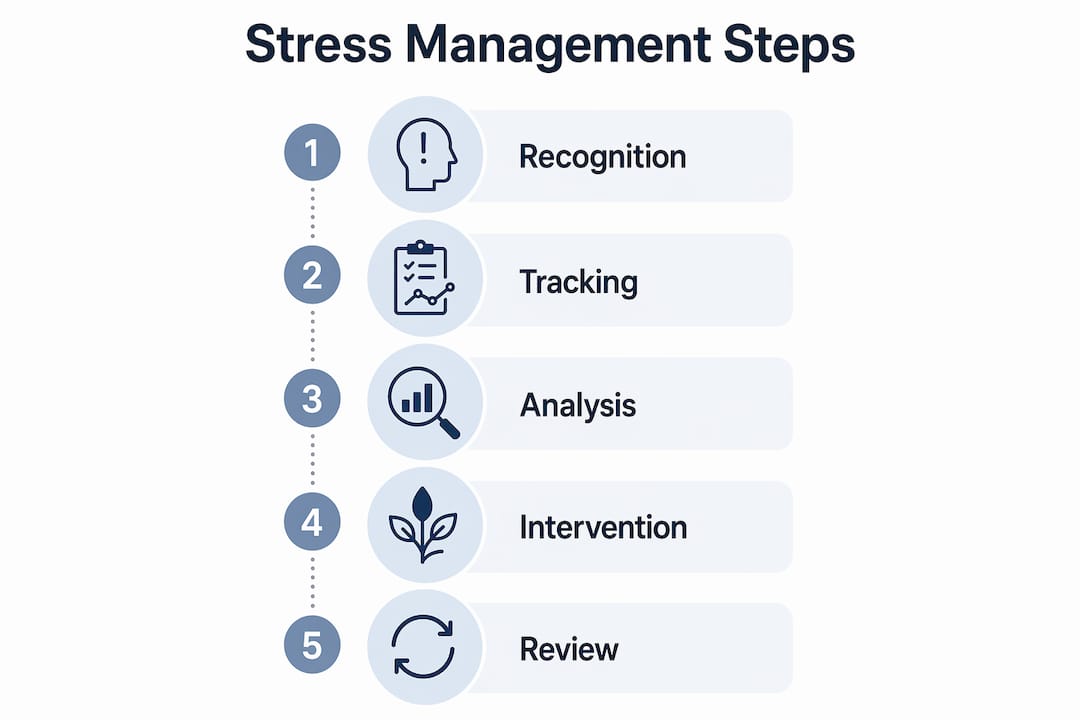
The stress management process begins with recognition, not reaction. Most professionals skip this step and go straight to coping, which is why their relief is temporary. The first step is identifying that stress is present and naming its physiological signs: elevated heart rate, disrupted sleep, shortened attention span, or persistent irritability.
The second step is systematic tracking. Keeping a stress diary for 2–4 weeks creates a clear picture of your triggers, patterns, and peak stress windows. This is not journaling for emotional release. It is data collection with a diagnostic purpose.
The third step is root cause analysis. Once you have 2–4 weeks of data, patterns emerge. A recurring trigger at 9:00 AM on Mondays is not random stress. It is a structural problem in your workflow or environment that can be addressed directly.
The fourth step is developing targeted coping strategies matched to specific stressors. A presentation anxiety requires a different tool than a chronic workload problem. Matching the technique to the trigger is what separates effective stress coping from generic advice.
- Recognize physiological and psychological stress signals early.
- Track triggers and patterns using a stress diary for 2–4 weeks.
- Analyze root causes behind recurring stressors.
- Match specific coping strategies to specific triggers.
- Review outcomes and adjust your approach every 4–6 weeks.
Pro Tip: Set a recurring 10-minute calendar block on Friday afternoons to review your stress diary entries from the week. Patterns that are invisible day-to-day become obvious across seven days of data.
Which immediate stress relief techniques work best under pressure?
Fast-acting stress reduction techniques work because they interrupt the physiological stress cycle before it compounds. The goal is not to eliminate stress but to restore enough composure to think clearly and act with intention.

Box breathing is the most reliable immediate tool available. The technique is simple: inhale for 4 counts, hold for 4 counts, exhale for 4 counts, hold for 4 counts. Repeat for 2–3 cycles. This activates the parasympathetic nervous system and reduces cortisol within minutes. Navy SEALs use it before high-stakes operations for exactly this reason.
Sensory grounding works by redirecting attention from abstract worry to immediate physical reality. Name five things you can see, four you can touch, three you can hear. This technique interrupts the cognitive loop that amplifies stress into anxiety.
Physical movement matters even in short bursts. The CDC recommends 20–30 minute activity blocks as the optimal unit for stress reduction. A brisk 10-minute walk between meetings delivers a measurable neurochemical reset.
Stanford Medicine research confirms that mastering physical stress responses signals agency and control to the brain. That signal directly reduces feelings of helplessness, which is the psychological core of chronic stress. Control the body first. The mind follows.
- Box breathing: 4-count inhale, hold, exhale, hold. Repeat 2–3 cycles.
- Sensory grounding: Name 5 things you see, 4 you can touch, 3 you hear.
- Short walks: 10–20 minutes between high-pressure blocks.
- Postural reset: Stand, roll shoulders back, and breathe deeply for 60 seconds.
- Cold water: Splash cold water on your face or wrists to trigger the dive reflex and slow heart rate.
Pro Tip: Box breathing works best when practiced daily, not just in crisis moments. Two minutes each morning builds the neural pathway so the technique activates faster when you actually need it.
How do long-term habits build stress resilience and well-being?
Short-term relief techniques manage the symptoms. Long-term habits change the baseline. This distinction is the most important structural insight in any serious approach to stress management.
The CDC recommends 150 minutes of physical activity weekly, structured as daily 20–30 minute sessions, to maintain mental health and reduce stress. That translates to five 30-minute sessions per week. Professionals who treat this as non-negotiable report consistently lower stress baselines than those who exercise only when they feel good.
Gratitude practice is not a soft skill. The American Medical Association frames daily gratitude as a rigorous cognitive behavioral strategy that actively reframes negative thought patterns and calms the nervous system. Writing three specific things you are grateful for each morning takes four minutes. The neurological effect accumulates over weeks.
Harvard Health research supports reframing stress as antifragile rather than purely damaging. Professionals who view stress as a signal that they are operating near their capacity, rather than evidence of failure, build resilience faster. This mindset shift does not require therapy. It requires a deliberate decision to interpret the data differently.
The table below separates short-term tools from long-term habits to clarify where each belongs in your practice.
| Approach | Purpose | Time to Effect |
|---|---|---|
| Box breathing | Immediate nervous system reset | 2–5 minutes |
| Sensory grounding | Interrupt anxiety loops | 3–5 minutes |
| Daily physical activity | Lower stress baseline | 4–8 weeks |
| Gratitude practice | Reframe negative cognition | 2–4 weeks |
| Sleep consistency | Restore cortisol regulation | 1–3 weeks |
Building executive resilience requires both columns working together. Fast tools without long-term habits produce diminishing returns. Long-term habits without fast tools leave you exposed in acute moments.
What mistakes undermine the stress management process?
The most common mistake is treating stress as something to avoid rather than something to read. High performers use stress diagnostically, auditing their environment and addressing stressors at the source. Avoidance delays the signal and allows the underlying problem to grow.
The second mistake is overreliance on fast-acting tools for chronic stress. Box breathing is not a substitute for fixing a broken workflow. Sensory grounding does not resolve a toxic team dynamic. Immediate techniques belong in the acute phase. Chronic stress requires structural change.
The third mistake is inconsistent tracking. Professionals who skip the stress diary step have no data to work with. They respond to stress reactively instead of proactively. Without a pattern, there is no root cause. Without a root cause, there is no durable solution.
The fourth mistake is passivity. Stress management research consistently shows that agency and control are the psychological mechanisms that reduce stress impact. Professionals who feel they have no influence over their stressors experience worse outcomes regardless of the techniques they apply.
Resilience is not a fixed trait. It is a skill built through deliberate practice, flexible focus, and rapid problem-solving. Elite operators like Navy SEALs do not avoid stress. They train their response to it until the response becomes automatic. The same principle applies to executive performance.
The fifth mistake is treating stress management as a one-time intervention rather than an ongoing practice. Stress patterns change as roles, responsibilities, and environments change. A system that worked at 40 may need recalibration at 50. Regular review is not optional. It is the mechanism that keeps the system functional.
How can professionals sustain an effective stress management practice?
Sustaining a stress management practice in a demanding career requires the same discipline applied to any other performance variable: scheduling, measurement, and periodic adjustment.
- Build your toolkit. Select two fast-acting techniques and two long-term habits. Start with box breathing and a 20-minute daily walk. Add gratitude journaling and a consistent sleep schedule. Four tools are enough to start.
- Schedule non-negotiably. Physical activity and gratitude practice belong on your calendar as fixed appointments, not aspirational intentions. Treat them with the same weight as a board meeting.
- Use social support deliberately. Peer accountability, a trusted mentor, or a professional counselor each serve different functions. Social connection is a documented stress buffer, not a luxury.
- Review every 4–6 weeks. Revisit your stress diary data. Identify which techniques are working and which stressors remain unresolved. Adjust your toolkit accordingly.
- Set measurable goals. "Reduce stress" is not a goal. "Complete five 30-minute walks per week for eight weeks" is a goal. Specificity creates accountability and makes progress visible.
Pro Tip: Pair your stress management review with an existing monthly ritual, such as a financial review or a quarterly planning session. Attaching a new habit to an established one dramatically increases follow-through.
The types of stress management available to executives are broader than most realize. Physical, cognitive, social, and environmental approaches each address different dimensions of the stress response. A complete practice draws from all four.
Stress inoculation training, a method used in high-pressure professional contexts, offers another layer for executives who want to build tolerance to acute stress before it occurs. Exposure-based training builds the neural pathways that make composed responses automatic under pressure.
Key Takeaways
A structured stress management process, combining systematic tracking, fast-acting techniques, and long-term physical and cognitive habits, is the most reliable path to sustained executive performance and well-being.
| Point | Details |
|---|---|
| Track before you act | Keep a stress diary for 2–4 weeks to identify triggers before selecting coping strategies. |
| Match tools to stressors | Use fast-acting techniques for acute stress and structural changes for chronic patterns. |
| Physical activity is non-negotiable | 150 minutes of weekly activity lowers your stress baseline over 4–8 weeks. |
| Gratitude is a cognitive tool | Daily gratitude practice actively reframes negative thought patterns and calms the nervous system. |
| Review and adjust regularly | Reassess your stress management toolkit every 4–6 weeks as your role and environment evolve. |
Stress management as a performance discipline
Most executives I observe treat stress management as something they will get to when things slow down. Things do not slow down. That is the nature of the roles they have chosen.
What I have found, both personally and in observing high-performing professionals over many years, is that the men who sustain their edge longest are not the ones who experience less stress. They are the ones who have built a structured relationship with it. They know their triggers. They have practiced their responses. They review and adjust with the same rigor they apply to their business metrics.
The shift from reactive coping to structured practice is not dramatic. It starts with a stress diary and a 20-minute walk. What makes it powerful is consistency. A technique practiced daily for 90 days becomes a reflex. A reflex does not require willpower in the moment. That is the difference between managing stress and being managed by it.
The psychological and physical dimensions of stress are inseparable. Executives who address only the mental side while neglecting physical activity, sleep, and nutrition are working with half the system. The body is not a vehicle for the brain. It is part of the same performance architecture.
My recommendation is simple: treat stress management as a professional discipline, not a wellness hobby. Build a toolkit. Schedule it. Measure it. Adjust it. The return on that investment compounds over decades.
— Joakim
Viridos and the disciplined pursuit of executive vitality
Sustained performance in demanding roles requires more than willpower and good intentions. It requires a system.
Viridos is a premium Swedish men's performance membership built for founders, executives, and high-agency professionals who take their vitality as seriously as their results. The membership combines science-backed formulations with structured guidance on physical and cognitive performance, delivered with the precision and restraint that disciplined men expect. For professionals who want a structured, premium approach to executive performance optimization, Viridos offers exactly that. Small-batch Swedish production. No hype. No shortcuts. Just consistent, evidence-aligned support for the long game.
FAQ
What is the stress management process?
The stress management process is a structured system for identifying stress triggers, analyzing their root causes, and applying targeted coping strategies to reduce their impact on health and performance. It combines immediate relief techniques with long-term habits to build durable resilience.
How long does it take to see results from stress management?
Fast-acting techniques like box breathing produce results within minutes. Long-term habits such as regular physical activity and gratitude practice typically show measurable effects on stress baseline within 4–8 weeks of consistent practice.
What is the most effective immediate stress relief technique?
Box breathing, a 4-count inhale, hold, exhale, and hold cycle repeated 2–3 times, is one of the most reliable fast-acting tools for calming the nervous system and restoring focus under pressure.
How much physical activity reduces stress?
The CDC recommends 150 minutes of physical activity per week, structured as daily 20–30 minute sessions, to maintain mental health and reduce stress over time.
Why do stress management efforts often fail?
The most common failure is treating stress as something to avoid rather than a diagnostic signal. Overreliance on fast-acting tools for chronic stress, inconsistent tracking, and lack of periodic review all undermine long-term effectiveness.