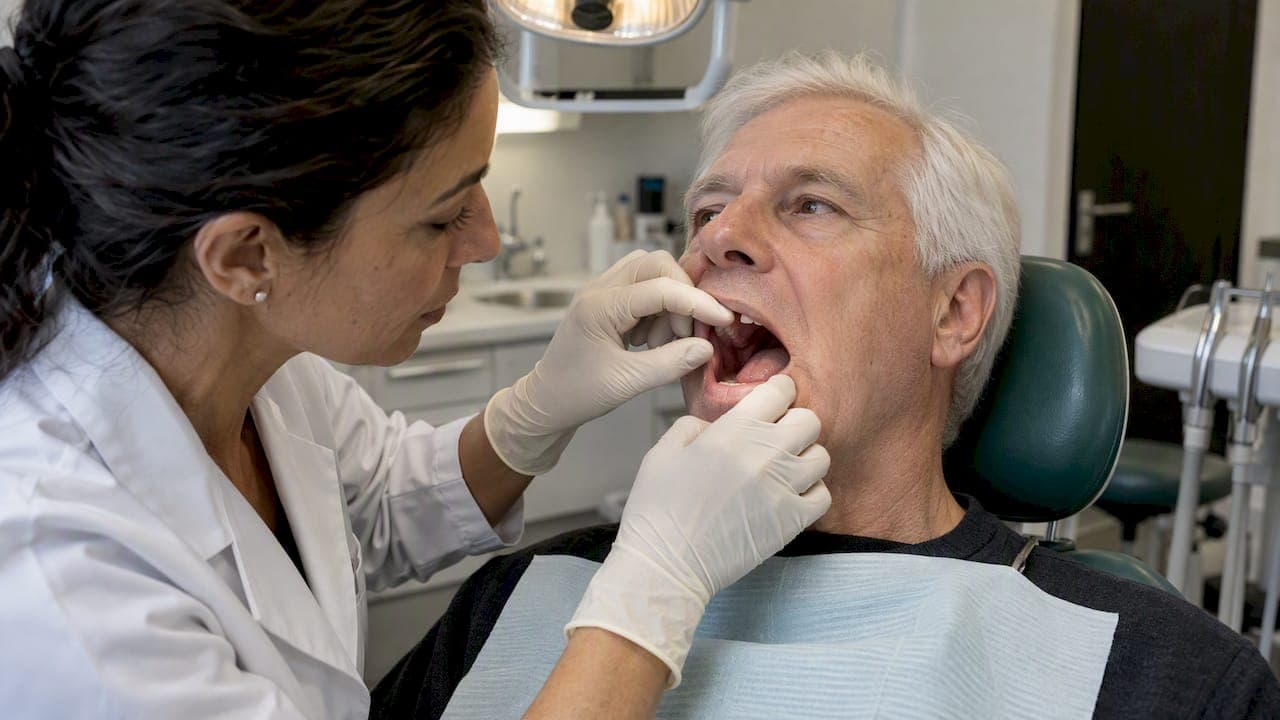
The lining of your mouth is not one uniform surface. The Swedish term munslemhinna covers several regions, and they differ in thickness, blood supply and permeability. The floor of the mouth under the tongue (the sublingual zone) is the most permeable of the commonly used areas. The inner cheek (the buccal zone) follows. The gums, the palate and the inner lips play smaller roles. This guide maps each zone, explains why they behave differently and describes what shapes uptake in practice.
TL;DR
- The oral mucosa includes the sublingual, buccal, gingival, palatal and labial regions. Each has its own tissue structure.
- Sublingual tissue is thinner and more vascularized than buccal tissue, which is why it is the reference zone for oral-mucosal delivery.
- Absorption depends on contact time, saliva, pH, enzyme activity and the condition of the tissue, not only on where a product lands.
- Substances taken up through the mouth lining enter systemic circulation directly rather than passing through the digestive tract first.
- Persistent sores, white or red patches or pain call for a dentist, not self-experimentation.
Table of Contents
- What the oral mucosa is, and which zones it includes
- The five zones compared
- Why the sublingual zone leads
- The barrier inside the barrier: lipids and saliva
- Why the route differs from swallowing
- What shapes uptake in practice
- Perspective: why zone discipline matters
- When to see a dentist
- A note on products and regulation in Sweden
- How this fits a longevity-minded routine
- Promo: membership built around precision
- FAQ
- Sources
What the oral mucosa is, and which zones it includes
The oral cavity contains the lips, cheeks, tongue, hard palate, soft palate and floor of the mouth, and all of it is lined by the oral mucosa. A review of orotransmucosal delivery systems describes the areas where substances can cross the tissue into the systemic circulation as the buccal (cheek), sublingual (under the tongue), gingival (gums), palatal and labial mucosae.

The mucosa is not a passive wall. It is a living barrier that protects against infection, contributes to taste and keeps the mouth moist. A 2025 review of bioavailability and formulation technologies puts cell turnover in this tissue at roughly 14 to 21 days, which is part of how the barrier maintains itself.
For a reader with a performance mindset, the useful point is simple. Placement is a variable you control. The mouth offers several surfaces, and they are not interchangeable.
The five zones compared
| Zone | Location | Tissue character | Role in uptake |
|---|---|---|---|
| Sublingual | Floor of the mouth, under the tongue | Non-keratinized, thin, highly vascularized | Most permeable of the commonly used zones |
| Buccal | Inner cheek | Non-keratinized, thicker than sublingual | Permeable, slower than sublingual |
| Gingival | Gums | Largely keratinized in places | Less commonly used for uptake |
| Palatal | Hard and soft palate | Hard palate is keratinized, soft palate is not | Limited role in practice |
| Labial | Inner lips | Non-keratinized, interacts with the salivary film | Minor role |
The first two rows are the ones that matter most. A 2023 review of oral mucosa models states that the sublingual mucosa is more permeable than the buccal mucosa because it is thinner and more vascularized, and that both are non-keratinized. The keratinization detail for the gingival and palatal rows reflects general oral histology; the rest of this article focuses on what the cited research establishes.
Why the sublingual zone leads
Three features explain its position.
- Thin tissue. A shorter diffusion distance between the surface and the capillaries below.
- Rich blood supply. The oral mucosa is highly vascularized, which the orotransmucosal review identifies as what allows direct systemic access while avoiding the gastrointestinal tract.
- Non-keratinized surface. Without a hardened outer layer, the barrier is less restrictive than skin or the hard palate.
Regional differences are real and measurable. Research on the permeability of oral mucosa indicates that regional differences, apparently reflecting differences in intercellular barrier lipids, can be used for both local and systemic delivery. For a deeper walk-through of the sublingual mechanism itself, see our guide to sublingual uptake.
The barrier inside the barrier: lipids and saliva
The oral mucosa resembles skin in one respect: lipids between the cells act as a permeability barrier. Philip W. Wertz's analysis of barrier lipids notes that removing these lipids from the buccal mucosa significantly increases permeability. The same work points to a difference from skin. Saliva is constantly present in the mouth, which removes the water gradient that skin depends on, so the oral barrier has its own physiological requirements.
This is why a formulation designed for the mouth is a different engineering problem from one designed for the skin or for swallowing. Solvent, concentration and particle behavior all interact with a wet, enzyme-containing environment.
Why the route differs from swallowing
When a substance is swallowed, it passes through the digestive tract and the liver before reaching general circulation. When it is absorbed across the oral mucosa, it enters the systemic circulation directly. The orotransmucosal review describes this as avoiding the gastrointestinal tract, and Farmakologi.nu's overview of sublingual administration adds that this route bypasses first-pass metabolism in the liver. It cites sublingual nitroglycerin as the classic example of rapid uptake.
That is pharmacology, and it describes the route, not any particular product. For the full mechanism, read First-Pass Effect and Sublingual Delivery: What Changes.
What shapes uptake in practice
The zone is only the starting variable. The 2025 bioavailability review lists fluid volume, pH, enzyme activity, penetration through the mucosal cell barrier and cell turnover as factors in absorption. A technical overview of sublingual tablets adds that uptake through the oral mucosa is generally passive, though some substances may use carrier-mediated transport.
Translated into habits, these factors suggest a disciplined routine:
- Placement. Deliver to the intended zone, not the tongue's top surface or the throat.
- Contact time. Hold still and avoid swallowing immediately. Contact time is a core variable in the formulation literature.
- Saliva. Excess saliva dilutes a product and washes it toward the throat. A dry mouth presents a different problem. Oral side effects of medication such as dry mouth (xerostomia) are common, according to a 2024 Läkartidningen review. If you take regular medication and notice dryness, discuss it with your dentist or physician. Background on mouth breathing and dry mouth also helps explain why some people have a drier mouth than others.
- Timing around food and drink. Eating, drinking and brushing change the mouth's surface conditions. Our guide to a fasted sublingual routine sets out a consistent 20 to 30 minute window.
- Tissue condition. Irritated or inflamed tissue behaves differently from healthy mucosa, which is a reason to get changes checked rather than work around them.
A simple placement routine
- Rinse with water and swallow, so the mouth is neither dry nor flooded with saliva.
- Lift the tongue and aim at the floor of the mouth, to one side of the midline.
- Dispense as directed on the product label, never more than the instructed amount.
- Keep the tongue still and refrain from swallowing for as long as the product directions suggest.
- Wait before eating or drinking, again as directed.
Consistency matters more than novelty. The same placement, at the same time, under the same conditions, makes your own observations meaningful. If you want to structure that, see the best time for a sublingual performance spray, by objective.
Perspective: why zone discipline matters
We build for men who measure things. When you measure, the variables you leave uncontrolled become the noise in your own data. The mouth is one of those variables.
Most conversation about performance products stops at the ingredient list. We start one step earlier: where the formulation meets the body, and how consistently. The sublingual zone is thin, richly supplied with blood and non-keratinized. That is why our spray is designed around sublingual delivery rather than the assumption that swallowing is the only option.
Our formulation is a plant-derived preparation of phytoandrogen-related compounds, produced in small batches in Sweden using proprietary extraction methods. We do not claim that delivery alone determines outcome. We claim something narrower and more honest: that a precise delivery route, used with a repeatable routine, gives you a cleaner signal to judge by. That is how disciplined men approach everything else in the arena, and it is how we approach this.
Read the reasoning behind our method on The Science Behind VIRIDOS.
Joakim
When to see a dentist
A guide to absorption zones should not become a guide to ignoring warning signs. Sores that persist, white or red patches, pain that does not settle or tissue that stays swollen are matters for a dentist or doctor. The top Swedish clinical pages on this subject, covering conditions from aphthous ulcers to lichenoid reactions, all make this point: changes in the mucosa need assessment, not guesswork.
If you cannot book a visit quickly, 1177 notes that for questions about a specific part of the mouth, including the mucosa, you can prepare a clear photo to upload during a digital meeting with a dentist, as described on the Digitala Folktandvården page. For toothache that does not go away, 1177 advises contacting a dental clinic.
If you notice an unusual change in the area where you place any product, stop using it there and have it examined before continuing.

A note on products and regulation in Sweden
In Sweden, a medicine must be approved on the basis of documented quality, safety and efficacy, and the applicant must show a positive benefit-risk balance, as Läkemedelsverket explains. That is a different framework from a food supplement. A supplement is not a medicine, and it should never be described or used as one. Read labels, follow the stated directions, and consult a physician if you take prescription medication or have a medical condition.
How this fits a longevity-minded routine
For men in demanding roles, performance longevity is built from boring, repeatable inputs: sleep, training, nutrition and a handful of well-chosen supplements used consistently. Understanding absorption zones belongs in that category. It is not a trick. It is a way to reduce variability in a routine you already keep.
If training is part of your week, our piece on what a mouth spray does and does not do before training keeps expectations realistic. For a broader frame, see our premium guide to sports nutritional supplements and the 4 to 8 week precision trial for structuring your own observations.
Promo: membership built around precision
VIRIDOS is a plant-derived performance spray designed for sublingual use, produced in small batches in Sweden. Access is by application, and approved members receive ongoing shipments. The Member plan is $99 per month and the Professional plan is $299 per month; you can compare them on the pricing page. You can also read how membership works and how we handle production in Sweden.

We design for men who still intend to perform in ten years. If that is you, apply and judge the routine on your own measurements.
FAQ
Which part of the mouth absorbs best?
The sublingual zone under the tongue is the most permeable of the commonly used areas. Research shows it is thinner and more vascularized than the buccal (cheek) mucosa, though both are non-keratinized. That combination is why sublingual delivery is the reference route for oral-mucosal uptake.
Is absorption through the mouth lining the same as swallowing?
No. Substances absorbed through the oral mucosa enter systemic circulation directly, rather than passing first through the digestive tract and the liver. The route changes how a substance reaches the bloodstream. It does not by itself determine what any given product does.
Does it matter if I swallow right after placing a spray?
Contact time is one of the main variables in oral-mucosal delivery. Swallowing early moves the product toward the throat and away from the mucosal surface. Follow the directions on your product label, and keep your routine identical from day to day.
Can dry mouth affect the routine?
Dry mouth is a common side effect of many medications, according to Swedish clinical literature. Saliva, pH and fluid volume all influence uptake, so persistent dryness is worth raising with your dentist or physician rather than adjusting your routine around it.
When should I stop and see a professional?
Stop using a product in the affected area and book an appointment if you have sores that persist, white or red patches, ongoing pain or swelling in the mouth. A dentist can assess the tissue. Do not wait for it to resolve on its own if it lasts.
Sources
- Orotransmucosal drug delivery systems: A review
- Oral Mucosa Models to Evaluate Drug Permeability (PMC)
- The permeability of oral mucosa (PubMed)
- Bioavailability Enhancement and Formulation Technologies (PMC, 2025)
- Roles of Lipids in the Permeability Barriers of Skin and Oral Mucosa (PMC)
- Sublingual administration, Farmakologi.nu
- Considerations in Developing Sublingual Tablets
- Läkemedelsbiverkningar som kan uppkomma i munhålan, Läkartidningen
- Så godkänns ett läkemedel, Läkemedelsverket
- Digitala Folktandvården, 1177
- Tandvärk, 1177
- Mouth breathing and dry mouth