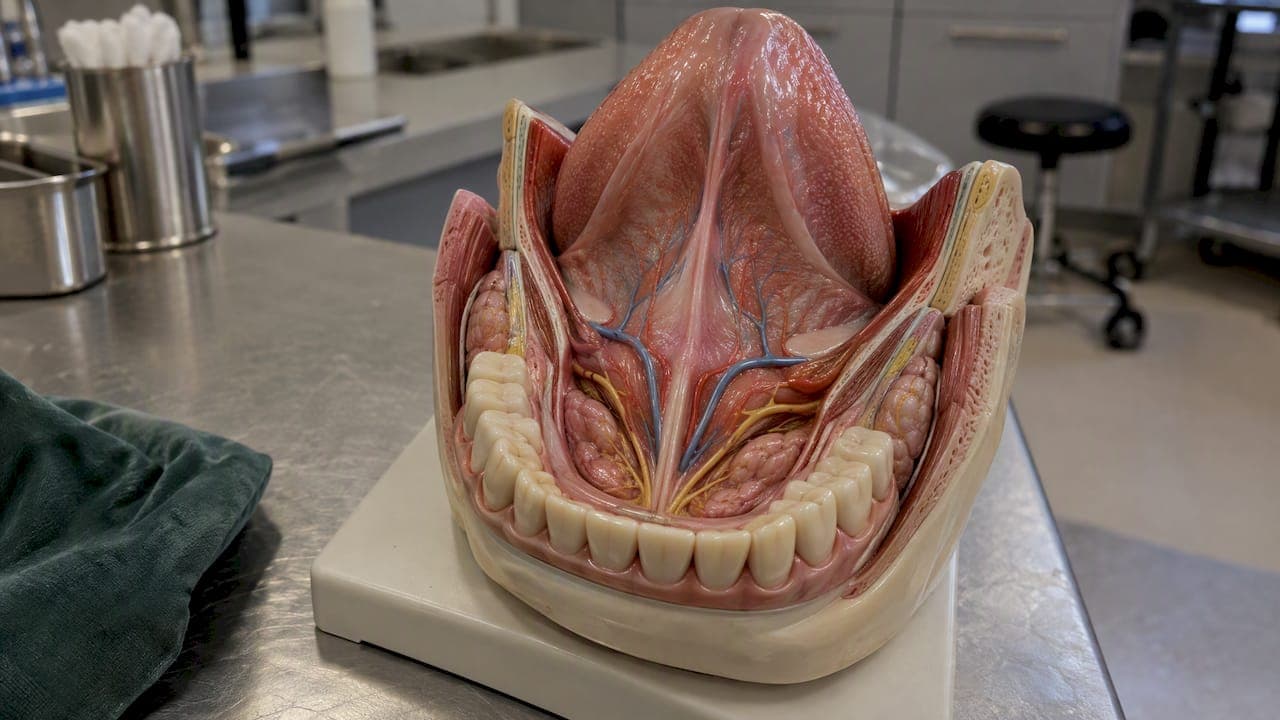
Sublingual uptake (sublingualt upptag in Swedish) is the absorption of a substance through the thin mucous membrane under the tongue, directly into the bloodstream. It skips the stomach and the first pass through the liver, which is why it can work faster than a swallowed capsule. It also has strict conditions: the compound has to suit the route, the formulation has to stay in contact with the tissue, and you have to behave in a way that lets it. This guide covers all three, in plain terms and with sources.
TL;DR
- Under the tongue, a compound enters the systemic circulation without passing through the digestive tract and the liver first, which can otherwise reduce bioavailability.
- The route is not a universal fast track. Only compounds with suitable chemistry and a well-built formulation absorb efficiently this way.
- Technique decides the outcome: swallowing saliva, eating, drinking, talking or smoking during the absorption window works against the route.
- Sublingual delivery is an acute, precise method, not sustained release. It complements foundations such as sleep, nutrition and training; it does not replace them.
- A routine you can repeat every day matters more than any single dose.
Table of Contents
- What sublingual uptake actually means
- Why the route differs from swallowing
- What limits sublingual absorption
- Technique: where most sublingual routines fail
- Swallowing a sublingual product changes what it does
- Sublingual versus swallowed: a quick comparison
- Our perspective: precision, not promises
- How to judge a sublingual product
- Building a routine around the route
- The VIRIDOS membership
- FAQ
- Sources
What sublingual uptake actually means
"Sublingual" means under the tongue. The floor of the mouth is lined with a thin, richly vascularized mucosa. A substance placed there can dissolve in saliva, cross the tissue and reach small veins that drain toward the heart. A review of sublingual delivery in PubMed describes it as one of the earliest routes for systemic delivery, one that avoids first-pass metabolism and gives quick entry into the circulation.
The term appears in several settings, which is why search results for it mix pharmacy glossaries, hormone tablets and vitamin B12 forum threads. The principle is the same in each: the active compound is absorbed through the oral mucosa instead of being swallowed. What differs is the compound, the dose form and the quality of the engineering behind it.
A few related terms are worth separating:
- Sublingual: absorption under the tongue.
- Buccal: absorption through the inner cheek.
- Oral (swallowed): absorption mainly in the intestine, followed by the liver's first pass.
- Oral spray: a liquid delivered as a measured mist, which can be directed at the sublingual or buccal tissue depending on design and instructions.
Why the route differs from swallowing
When you swallow a tablet, the compound has to survive stomach acid and digestive enzymes, cross the intestinal wall, and then travel through the portal vein to the liver. The liver can metabolize a large share before anything reaches the rest of the body. That is first-pass metabolism.
The sublingual route sidesteps much of this. According to the overview of sublingual delivery concepts and technologies, venous drainage from under the tongue runs through the facial and internal jugular veins to the superior vena cava. This allows rapid onset compared with oral tablets, and the same review notes that for some specific compounds sublingual absorption has been reported to be several times greater than the oral route. That figure depends heavily on the formulation and the compound's properties, so treat it as a ceiling seen in particular cases, not a promise for every product.

The same review also states the practical logic: this route can achieve high bioavailability by avoiding first-pass liver extraction and enzymatic degradation in the gastrointestinal tract, with a fast onset of effect.
The one condition that matters most
The benefit exists only if the compound stays under the tongue. The Frontiers in Pharmacology review on sublingual and buccal delivery points out that the area is small and saliva turns over quickly. If you swallow the compound with your saliva, it is redirected into the digestive tract, and the sublingual purpose is lost.
What limits sublingual absorption
It is tempting to treat "under the tongue" as a synonym for "better." The research is more disciplined than that.
Chemistry of the compound
A paper on sublingual drug delivery in the International Journal of Biological and Pharmaceutical Sciences describes how absorption depends on physicochemical properties. Lipophilicity matters: a compound needs a balance between fat-loving and water-loving behavior to dissolve in saliva and then cross the membrane. The pKa matters as well. Saliva sits at a mean pH around 6.0, and compounds that are too hydrophilic, or that must be heavily ionized at that pH, show poor systemic uptake. The paper gives an oil-water partition coefficient range of roughly 40 to 2,000 as favorable.
The practical reading: the route rewards compounds that are engineered for it. It does not rescue a compound that was never suited to it.
Formulation and the mucosal environment
Many compounds dissolve poorly in water. Formulators respond with strategies such as adjusting the microenvironment's pH so more of the compound stays in its unionized, absorbable form. A PMC review of microenvironmental pH modification in buccal and sublingual dosage forms describes this as a promising approach to improve oral mucosal absorption.
There is a trade-off. The oral mucosa is sensitive, and a formulation that absorbs well but irritates the tissue will not become a habit. For a daily protocol, tolerability is part of performance.
Speed is not duration
Sublingual delivery is built for rapid onset. It is not a sustained-release method. For a man who wants consistent all-day resilience, that means a sublingual product is best understood as a precise, well-timed tool. The foundations, which are sleep, protein and micronutrient intake, resistance training and recovery, still carry the load. If you want a wider look at what supplements can and cannot do, our guide to ergogenic aids and what the evidence says is a good companion.
Technique: where most sublingual routines fail
The most overlooked variable is the user. A well-made formulation can still underperform if the routine undermines it. The evidence points to a short list of behaviors to avoid during the absorption window:
- Swallowing saliva early. This pushes dissolved compound into the digestive tract.
- Eating or drinking. Both rinse the area and prompt swallowing.
- Talking. Movement and salivation shift the compound away from the tissue.
- Smoking or nicotine use. Smoking causes vasoconstriction in the oral mucosa, which directly reduces the vascular uptake the route depends on, as the Frontiers review notes.
A simple protocol
Follow the instructions on your specific product first. As a general pattern for any sublingual product:
- Rinse nothing and eat nothing in the minutes before. An empty mouth with normal saliva is the right starting point.
- Lift the tongue and place the dose under it, as the product directs.
- Close your mouth, keep the tongue relaxed and breathe through your nose.
- Let saliva pool naturally and avoid swallowing for as long as the instructions say.
- Wait before eating or drinking, again following the product's guidance.
- Repeat at the same time each day, so any change in how you feel can be judged against a stable routine.
Timing around meals is a separate question. We cover the practical side in the best time for a sublingual performance spray by objective and in a 20 to 30 minute fasted routine.
Swallowing a sublingual product changes what it does
Swedish regulators are explicit that dose forms are not interchangeable. The Swedish Medical Products Agency (Läkemedelsverket) explains in its guidance on dose form suitability for enteral administration that sublingual forms such as resoribletter are designed for local uptake in the oral mucosa and should not be given through a feeding tube. The agency's advice is to check each product's instructions, because oral dose forms are not all administered the same way.
A related point comes from its explanation of bioequivalence. The agency's Q&A on bioequivalent medicines describes it as showing that the amount of active substance reaching the bloodstream is equal for two products with the same active ingredient in the same amount. In other words, two products are only treated as equivalent when the blood profile matches. If you swallow something designed for the mucosa, you have changed its pathway, and you cannot assume the same result.

The gut is also not a constant. How quickly the stomach empties can shift with certain medications, and that affects how swallowed products behave. A short overview on delayed stomach emptying and why it matters illustrates why assuming that all oral forms act alike is risky. If you take prescription medication, ask your physician or pharmacist how any supplement fits with it before you start.
Sublingual versus swallowed: a quick comparison
| Criterion | Sublingual | Swallowed capsule or tablet |
|---|---|---|
| Path to circulation | Mucosa under the tongue, then veins draining toward the heart | Stomach, intestine, portal vein, liver |
| First-pass liver metabolism | Largely bypassed when absorption is successful | Applies |
| Onset | Typically rapid | Slower, varies with food and gastric emptying |
| Duration | Short, acute profile | Can be extended with release technology |
| Dependence on technique | High: saliva, talking, smoking and eating matter | Lower |
| Compound suitability | Narrow: needs suitable lipophilicity and ionization | Broad |
| Tolerability risk | Local mucosal irritation possible | Gastrointestinal discomfort possible |
Neither route wins in the abstract. The question is which fits the compound and the routine. For a deeper look at how spray formats compare on absorption, read our piece on mouth spray bioavailability for executives.
Our perspective: precision, not promises
We build VIRIDOS around a plain idea: if you choose a sublingual delivery philosophy, you accept its discipline. The route has a narrow window for success. It needs a compound suited to it, a formulation that holds up in saliva and does not irritate, and a user who follows a repeatable method.
That is why our product is a precision oral spray made in small batches in Sweden, and why we write about technique with the same seriousness as ingredients. A measured spray is easier to dose consistently than a loose powder or a tablet that dissolves unpredictably. Consistency is what makes a trial interpretable. If you change the dose, the timing and the method all at once, you learn nothing.
We also believe in restraint. A sublingual product is an acute tool. It does not substitute for sleep, training, nutrition or medical care, and we do not present it as such. Men in demanding roles already carry enough noise. What helps is a clear protocol, a stable routine and honest expectations. Our own approach to this is laid out in the 4 to 8 week precision trial for executives, and in the dose calculation guide for spray supplements.
If you want to judge any product, ours or another, ask four questions. What is the compound and why is it suited to mucosal uptake? How is the dose measured? What does the instruction say about swallowing, eating and timing? How does the maker handle evidence and uncertainty? A brand that cannot answer these clearly has not earned a place in your routine.
— Joakim
How to judge a sublingual product
Use this as a checklist before you commit to any sublingual supplement:
- Clear instructions. Placement, hold time and the wait before eating or drinking should be specified.
- Measured dosing. A metered spray or a defined unit beats a vague "a few drops."
- Formulation transparency. You should be able to see what carries the active compound and why.
- Tolerability. Recurring stinging, soreness or irritation is a reason to stop and speak with a clinician, not to push through.
- Realistic claims. Rapid onset is a property of the route. It is not evidence that a product delivers a particular outcome.
- Batch discipline. Small-batch production and traceable records make quality easier to hold constant.
- Fit with your health. If you take prescription medication, have a mouth or gum condition, or have a medical diagnosis, ask your physician or pharmacist before adding anything new.
For more on weighing alternatives by type, see our overview of sublingual spray alternatives, and for the wider picture, the role of nutrition in performance and our guide to sports nutritional supplements.
Building a routine around the route
A sublingual product earns its place when it fits a day you already run well. A workable structure for a high-responsibility schedule:
- Fix the anchor. Choose one daily moment you rarely miss, such as right after waking and before breakfast.
- Keep variables still for two weeks. Same time, same dose, same technique. Change one thing at a time afterward.
- Log briefly. Note sleep, training and stress alongside the dose. A few words a day is enough.
- Review at 4 and 8 weeks. Compare against your log, not your memory.
- Protect the foundations. Sleep, protein, resistance work and alcohol moderation will move your results more than any delivery method.
If you want the plant-based angle on hormonal health and what the evidence supports, our guide to serum testosterone support goes into it. It is general information, not medical advice. A man with symptoms that concern him should see a physician and have appropriate tests, not self-assess with a supplement.
The VIRIDOS membership
VIRIDOS is a precision sublingual spray offered through a controlled-access membership, with approved applicants receiving ongoing shipments from small-batch Swedish production. Two plans are published: Member at $99 per month and Professional at $299 per month. Details and the application path are on the pricing page, and you can read how the program works on the membership page. For longer reading on our approach to durability, see our longevity and performance strategy and the Performance Journal.
FAQ
How long should I hold something under my tongue?
Follow the instructions of your specific product, because hold time depends on the formulation. The principle is to keep the compound in contact with the mucosa and avoid swallowing saliva early, since swallowing redirects it to the digestive tract. If instructions are unclear, ask the manufacturer or your pharmacist.
Is sublingual absorption always better than swallowing?
No. It is superior only when the compound is suited to the route and the formulation is built for it. The research on physicochemical limits shows that compounds that are too water-loving or heavily ionized at salivary pH absorb poorly. For some compounds, swallowing remains the better choice.
Can I eat or drink right after a sublingual dose?
Wait for the period your product specifies. Eating and drinking rinse the area and prompt swallowing, which works against the route. Smoking is particularly counterproductive because it constricts blood vessels in the oral mucosa.
Is sublingual the same as a swallowed capsule if the active ingredient is the same?
Not necessarily. Regulators treat products as equivalent only when the blood concentration profile matches. Changing the route changes the pathway, so do not swap one form for another without checking the instructions.
Can a sublingual product irritate the mouth?
It can. The oral mucosa is sensitive, and formulations that adjust pH to aid absorption must balance that against tolerability, as the review on microenvironmental pH discusses. If you notice recurring soreness or stinging, stop and consult a dentist or physician.
Sources
- Overview and appraisal of the current concept and technologies for improvement of sublingual drug delivery, PubMed
- Sublingual drug delivery, PubMed
- Advances in Nanoparticulate Drug Delivery Approaches for Sublingual and Buccal Administration, Frontiers in Pharmacology
- Sublingual drug delivery paper, International Journal of Biological and Pharmaceutical Sciences
- Microenvironmental pH Modification in Buccal/Sublingual Dosage Forms, PMC
- Läkemedelsformers lämplighet, Läkemedelsverket
- Läkemedel som är bioekvivalenta, Läkemedelsverket