
Phytoandrogenic compounds are plant-derived phytochemicals that interact with androgen pathways, distinct from dietary phytoestrogens found in soy or flax. The evidence for their biological activity is real but preclinical and mechanistic rather than proven in large human trials. For executive men, the decisive variable isn't which plant you choose. It's whether the formulation and delivery route, particularly sublingual administration, can actually get the compound into circulation at a meaningful dose.
TL;DR:
- Sublingual delivery allows compounds to bypass digestion and liver metabolism, ensuring more reliable absorption at lower doses.
- Formulation quality, including mucoadhesive polymers and permeation enhancers, is crucial to maximize absorption and efficacy.
- Preclinical evidence shows Eucommia triterpenoids can activate androgen receptors, but human trials are limited and produce inconsistent results.
- It is essential to verify product dose transparency, third-party testing, and stability data before considering supplementation.
- Regular monitoring of labs and symptoms during a four to eight-week trial helps assess safety and effectiveness before long-term use.
Table of Contents
- What Are Phytoandrogens, and Which Plants Show Activity?
- Why Sublingual Delivery Matters for Precision Phytoandrogen Supplements
- What Does the Research Actually Show?
- Safety, Interactions, and Regulatory Considerations
- How to Evaluate or Trial a Phytoandrogen Sublingual Spray
- Viridos' Perspective: Precision Over Volume
- Ready to Evaluate Membership Access
- Selected Reading
- Sources
- FAQ
What Are Phytoandrogens, and Which Plants Show Activity?
Phytoandrogens are plant compounds that bind to or potentiate androgen receptor activity, distinct from phytoestrogens, which mimic estrogen and dominate most consumer confusion around "hormone foods." The distinction matters because the two classes work through opposite signaling pathways and produce different physiological effects entirely.
The research on plant-derived androgenic activity is narrow but specific. A handful of botanicals recur across the phytopharmacology literature:
- Eucommia ulmoides bark: contains triterpenoids that showed androgen receptor binding and potentiation in laboratory and animal studies, including augmented androgen-mediated tissue growth when combined with testosterone in rats.
- Pine pollen: proposed as an androgenic source in several reviews, though evidence remains preclinical and inconsistent across human contexts.
- Fenugreek extract: studied for steroidal saponin content with claimed androgen-supportive properties, though a recent review of phytoandrogen candidates notes mixed human trial outcomes and variable regulatory status across markets.
These compounds work through receptor binding, enzymatic modulation, or potentiation of existing androgen signaling rather than direct hormone replacement. None of them approach pharmaceutical potency, and none should be expected to. The honest framing, and the one Viridos builds around, treats phytoandrogens as modulatory tools that support endogenous sensitivity rather than substitutes for the body's own signaling.
Why Sublingual Delivery Matters for Precision Phytoandrogen Supplements
Swallow a compound and it faces stomach acid, enzymatic breakdown, and first-pass liver metabolism before a fraction ever reaches circulation. Sublingual administration bypasses that gauntlet entirely. Capillaries beneath the tongue absorb compounds directly into the bloodstream, which means faster onset and a formulation that isn't gambling most of its active ingredient on gut survival.
That advantage only materializes with the right formulation science behind it. Molecular weight and lipophilicity determine whether a compound can actually cross the oral mucosa, and research on sublingual formulation determinants makes clear that dose size and taste masking are persistent engineering challenges, not afterthoughts.
What separates a serious sublingual product from a diluted tincture:
- Mucoadhesive polymers that keep the formula in contact with oral tissue long enough for absorption
- Permeation enhancers calibrated to the specific molecule's chemistry
- Lipid or nanoparticle carriers for compounds that resist mucosal uptake on their own
- Validated stability data showing the active ingredient survives storage, not just the lab bench
Formulation reviews of buccal and sublingual delivery show these technologies are advancing quickly, but they are not interchangeable. A product built for melatonin's molecular profile will not automatically work for a triterpenoid.
Pro Tip: Ask any sublingual supplement brand for its dose-per-actuation data and third-party assay results before you ask about ingredients. A well-documented low dose beats an undocumented high one every time.
Done right, sublingual delivery lets a formulator use a lower, more predictable effective dose with less variability between men. Done poorly, it's an expensive way to swallow something anyway.
What Does the Research Actually Show?
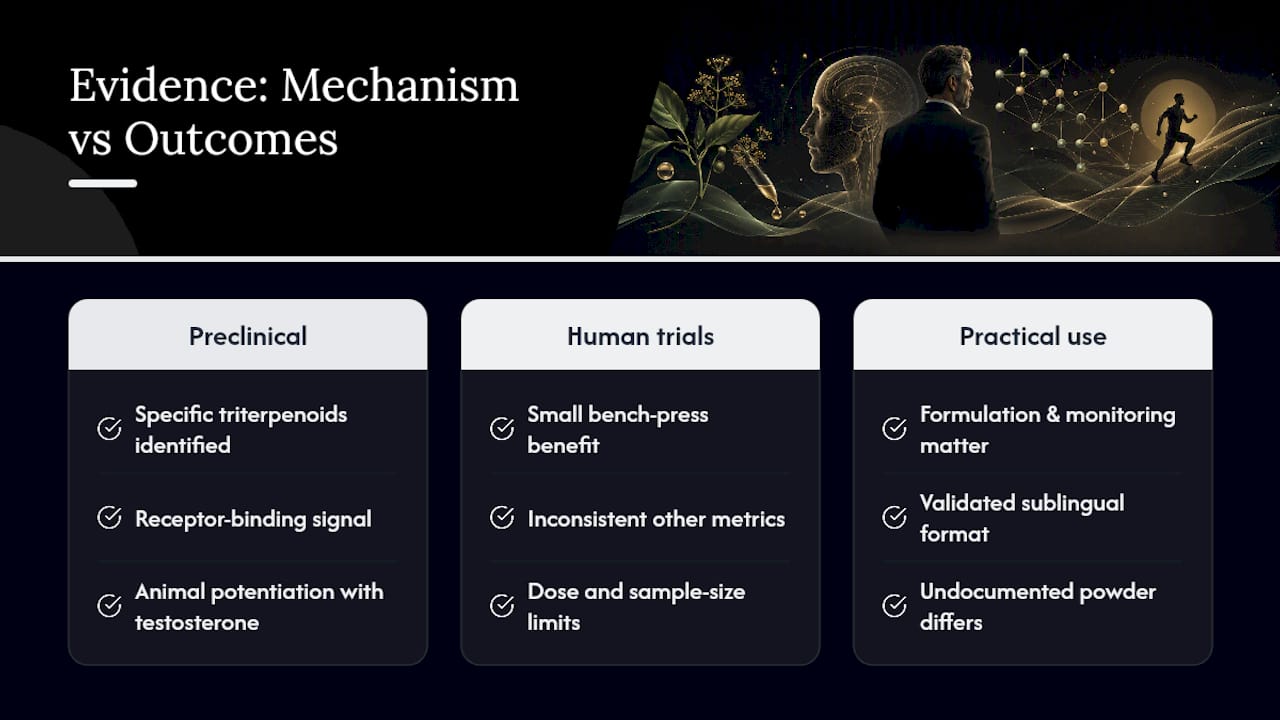
The preclinical case for compounds like Eucommia triterpenoids is genuinely interesting. Bioassay-guided fractionation identified specific triterpenoids driving androgen receptor activity, and when researchers combined the extract with testosterone in animal models, it potentiated androgen-mediated growth beyond testosterone alone. That's a real mechanistic signal, not marketing language.
Human evidence tells a more cautious story. A field trial of a multi-ingredient sublingual ergogenic spray found a small, statistically significant improvement in one strength measure, bench-press repetitions, but inconsistent results across other performance metrics, and the study's own limitations around dose standardization and sample size constrain how far you can generalize from it.
The pattern across this evidence base is consistent: mechanism is persuasive, human outcomes data is thin. Receptor binding studies and animal models build a credible case for biological plausibility. What's still missing is the large, well-controlled human trial that would let anyone claim a reliable, reproducible effect size in men.
That gap is exactly why Viridos treats formulation quality and monitored use as the load-bearing part of the equation, not the raw ingredient list. A compound with strong preclinical signal, delivered through a validated sublingual format and tracked against objective baselines, is a defensible bet. The same compound sold as an undocumented powder in a mass-market capsule is a different product entirely, even with an identical label.
Safety, Interactions, and Regulatory Considerations
Multi-ingredient "test booster" products are where most of the real risk concentrates. Systematic analysis of testosterone booster formulas has cataloged hundreds of distinct ingredients across the category, many with thin evidence and some carrying genuine endocrine risk when stacked without oversight. Regulatory bodies across the EU have flagged both novel-food classification issues and unsupported health claims in this space, and product transparency varies enormously between brands.
Before adding any phytoandrogen product to a regimen, a disciplined approach looks like this:
- Get baseline labs: total and free testosterone, SHBG, and liver function tests.
- Review current medications and supplements for interaction risk with a clinician.
- Confirm the product discloses exact dose per actuation, not just a proprietary blend list.
- Reassess labs after a defined trial period rather than continuing indefinitely without data.
None of this is diagnostic advice. It's the same due-diligence standard you'd apply to any capital allocation decision, applied to your own physiology.
How to Evaluate or Trial a Phytoandrogen Sublingual Spray
Treat this like you would any high-stakes decision: gather data before committing capital or time. A pre-purchase checklist worth applying to any sublingual phytoandrogen product:
- Full ingredient transparency, including exact dose per spray, not a blend percentage
- Third-party lab testing for active-compound verification
- Published stability data confirming potency holds through the shelf life
- Small-batch manufacturing with traceable quality control
For the trial itself, a conservative protocol works best: baseline labs, a four to eight week monitored period, and tracking that combines objective markers (strength output, recovery time) with subjective notes on clarity and drive. Set stop rules in advance, if you notice adverse symptoms, you halt and consult a clinician rather than pushing through.
Pro Tip: Take your sublingual dose at a consistent time relative to training and sleep. Variability in timing is one of the most common reasons men misjudge whether a supplement is doing anything at all.
If labs shift unexpectedly or symptoms emerge, that's the signal to escalate to clinician-guided care immediately, not to wait out the trial window.
Viridos' Perspective: Precision Over Volume
Viridos builds in small batches, in Sweden, because formulation precision doesn't scale carelessly. Every cohort receives product tied to documented dose and stability data, not a mass-market run. Controlled membership access exists for the same reason disciplined men limit their own commitments: quality control requires constraint, and constraint is what separates a serious performance tool from another bottle on a shelf.
— Joakim
Ready to Evaluate Membership Access
Viridos is the formulation-first alternative to undocumented "test booster" powders and mass-market sprays. Every cohort ships from small-batch Swedish production with dose-per-actuation data behind it, not a blend percentage on a label.

Membership grants access to a precision sublingual phytoandrogen spray built around the delivery science covered above, mucoadhesive formulation, validated stability, and transparent dosing, rather than a proprietary blend guessing game. Review the Viridos longevity and performance strategy for the current membership structure, and read the internal protocol notes in our evidence-first phytoandrogen protocol for executive men before applying. Get baseline labs done first, and talk to your physician about your current medications and health history. If the approach fits your standards, the next step is straightforward: apply for cohort access through the landing page above.
Selected Reading
- Eucommia ulmoides triterpenoids and androgen receptor activity
- Advances in buccal and sublingual delivery formulation
- Sublingual ergogenic spray human trial results
- Review of phytoandrogen candidates and evidence gaps
- Serum testosterone support: a plant-based guide
This article is general information, not a substitute for advice from a qualified doctor. Consult a qualified healthcare professional about your own circumstances before acting on anything here.
Sources
Eucommia ulmoides has the most specific preclinical data, showing androgen receptor binding and potentiation in animal models. Pine pollen and fenugreek appear frequently in reviews but with more mixed human evidence.
- PubMed: Eucommia ulmoides phytoandrogen study
- PMC review: Advances in buccal and sublingual delivery (2025)
- Assessment of the effectiveness of a sublingual, ergogenic spray on muscle strength and power (2009)
- Exploring phytoandrogens: A review (2025)
FAQ
What Is the Difference Between Phytoandrogens and Phytoestrogens?
Phytoandrogens are plant compounds that support androgen receptor activity, while phytoestrogens mimic estrogen. They work through opposite hormonal pathways and should never be confused as interchangeable "hormone foods."
Why Does Viridos Use Sublingual Delivery Instead of Capsules?
Sublingual delivery bypasses first-pass liver metabolism and stomach acid degradation, allowing faster onset and more predictable absorption when the formulation is engineered correctly. Viridos builds around this delivery philosophy specifically because raw ingredient choice matters less than whether the compound actually reaches circulation.
Are Phytoandrogen Supplements Regulated the Same Way in the EU?
No. Regulatory status varies by ingredient and jurisdiction, and some botanical extracts fall under novel-food review depending on their history of use and specific formulation. Always verify a product's current regulatory standing rather than assuming uniform rules.
How Long Should a Monitored Trial of a Phytoandrogen Spray Last?
A conservative approach uses a four to eight week trial period with baseline and follow-up labs, paired with objective performance tracking. Stop rules should be set before starting, not improvised mid-trial.